Chapter 8: Return to Heidelberg, Our Second Tour of Germany

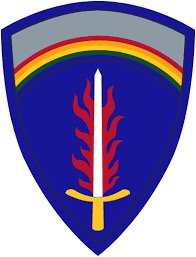
HQ US Army Europe (USAREUR) Patch. Autobiography of Dr. Anthony J. Carbone.

Believe Nothing You Hear, and Only Half of What You SeeA Memoir of Service, Shame, and the Search for Truth

Second Tour in Heidelberg, Germany

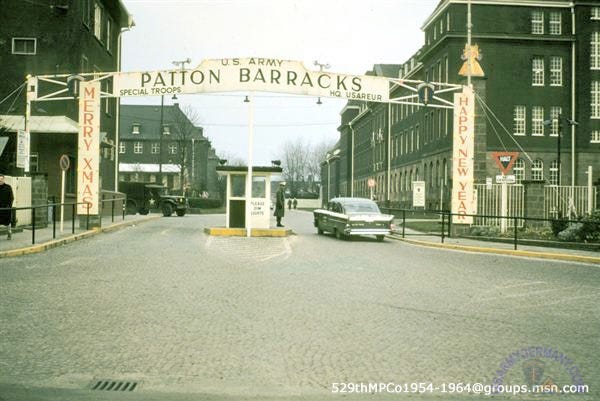
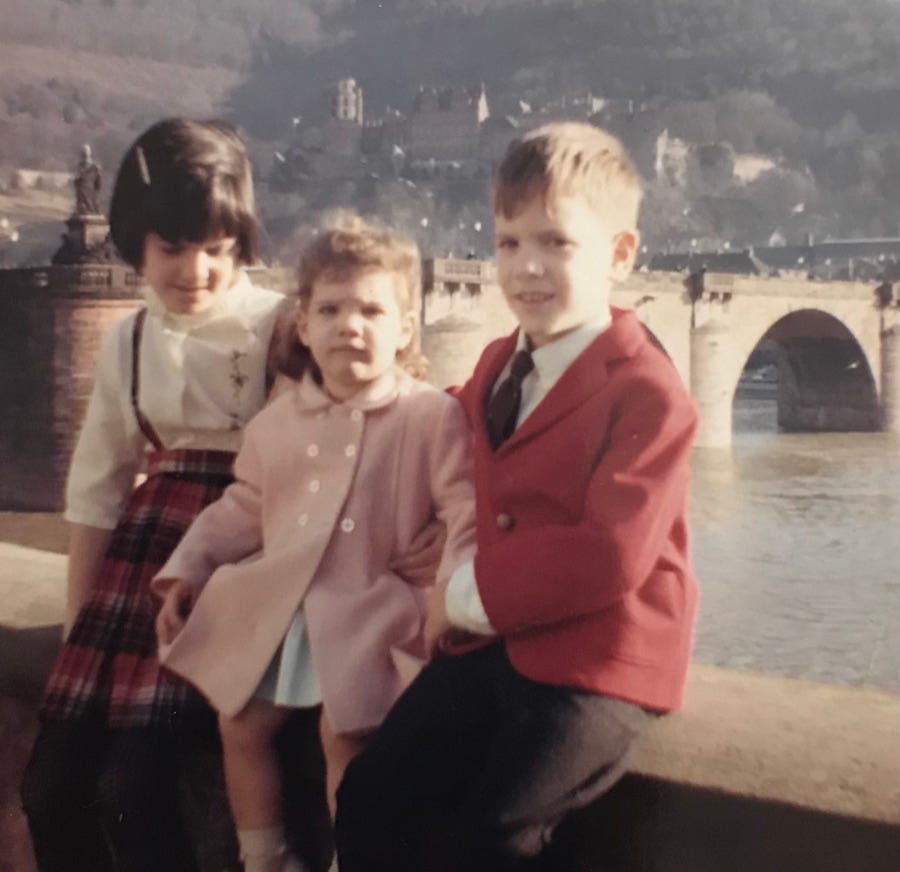
When I was ten years old, our family once again packed up our lives and headed overseas — this time for our second tour in Germany. My father had received orders assigning him to Headquarters, US Army Europe (USAREUR) and 7th Army, located at Campbell Barracks in Heidelberg. Unlike our earlier tour in the early 1960s, this one brought us back as seasoned travelers. I had already lived in multiple states and countries by then, and yet the thought of returning to Germany filled me with a deep sense of excitement and familiarity.
Shoulder patch of US Army Europe (USAREUR) Command that my father wore while assigned to Headquarters, USAEUR in Heidelberg, Germany.

Part of the autobiography of Dr. Anthony J. Carbone, Son in the Shadow of a Green Beret Hero
Headquarters US Army Europe (USAREUR) Shoulder Patch

Father works in the Mushroom

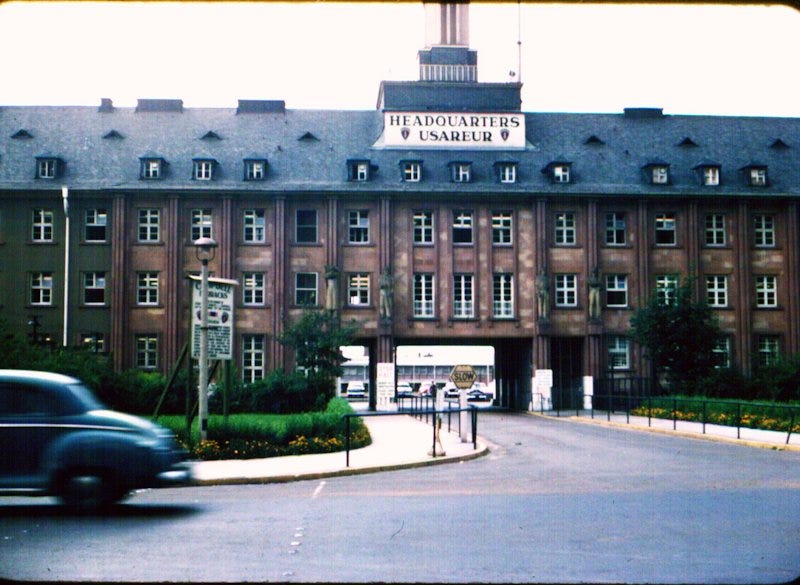
My father’s new assignment placed him in the Plans Department at Headquarters USAREUR, a position that carried immense responsibility. His Top Secret work took place deep in the lower levels of Campbell Barracks headquarters — in a windowless basement complex affectionately nicknamed “The Mushroom.” It was a fitting name for a place that seemed to operate in the dark, both literally and figuratively. There, my father and his fellow officers drafted highly classified contingency war plans in the event of a Soviet invasion through the Fulda Gap — the very terrain he had once patrolled with C Troop, 14th Armored Cavalry.
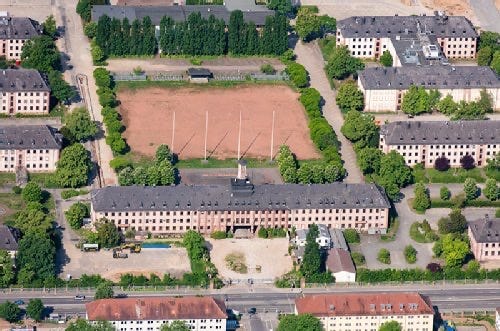
U.S. Army Campbell Barracks aeirial view in Heidelberg, Germany where my father worked in the War Plans Department in the deep basement called "The Mushroom".

Part of the autobiography of Dr. Anthony J. Carbone, Son in the Shadow of a Green Beret Hero
US Army Campbell Barracks in Heidelberg, Germany

We Live in Mark Twain Village (MTV) in Heidelberg

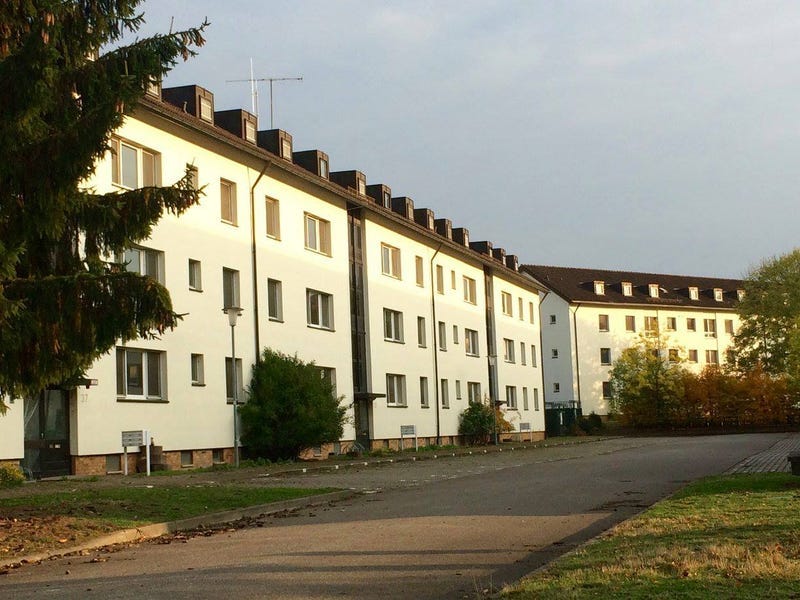
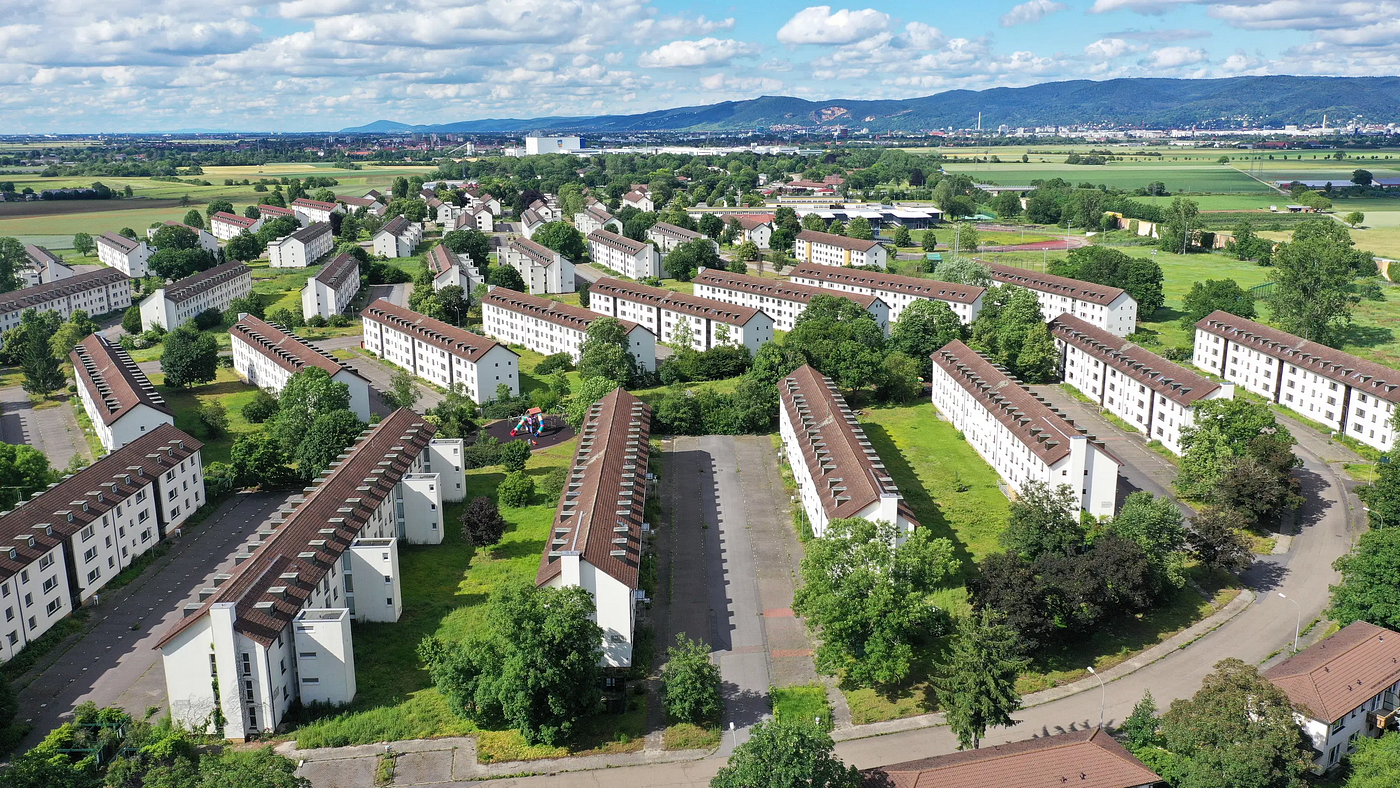
Although I didn’t fully understand the gravity of the Cold War at that age, I did understand that my father’s job was important. And we were lucky: his assignment came with stable, convenient housing and a chance to tour Europe. We lived in Mark Twain Village, a government residential community just steps from Campbell Barracks. Our second-floor apartment on Römerstrasse quickly became home.
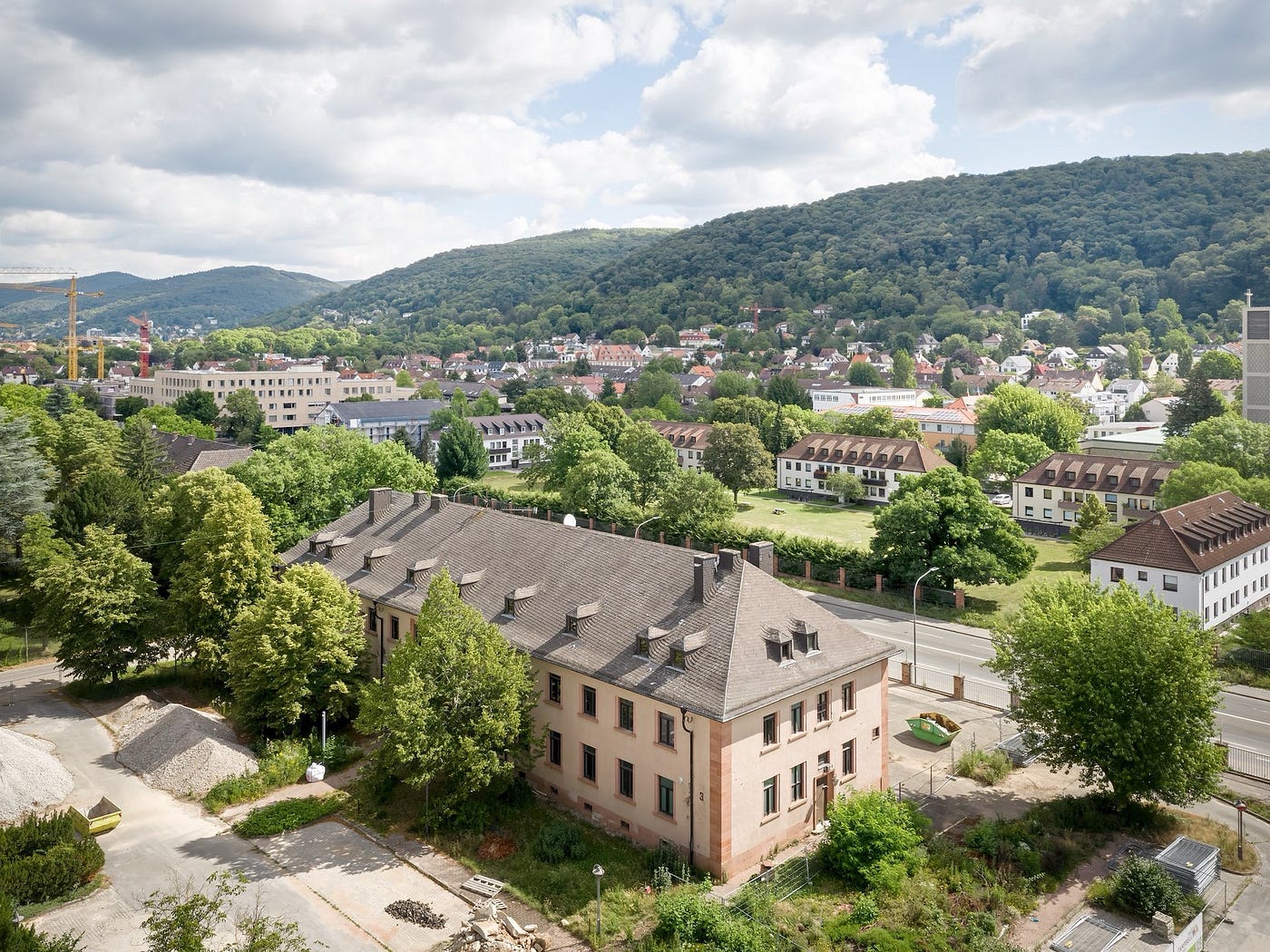
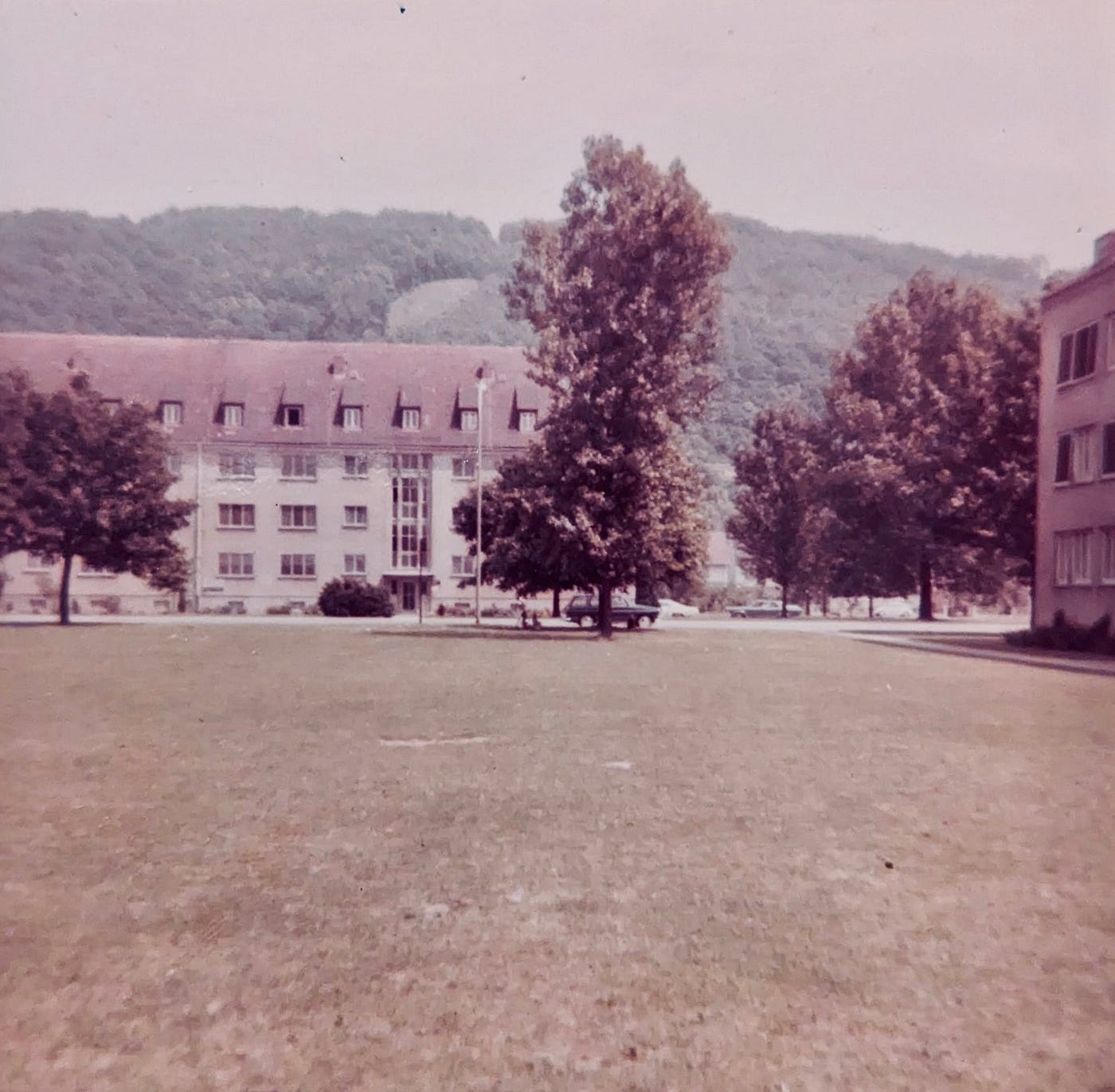
Mark Twain Village (MTV) Military Family Housing Area in Heidelberg, Germany near Campbell Barracks, home of Headquarters, USAREUR.

Part of the autobiography of Dr. Anthony J. Carbone, Son in the Shadow of a Green Beret Hero
Mark Twain Village in Heidelberg, Germany
Typical housing quad at Mark Twain Village (MTV), military family housing area of Heidelberg, Germany for military personnel working at Campbell Barracks.

Part of the autobiography of Dr. Anthony J. Carbone, Son in the Shadow of a Green Beret Hero
Mark Twain Village in Heidelberg, Germany

Apollo 11 Moon Landing (July 20, 196)

We had just settled into our new government quarters in Mark Twain Village in Heidelberg when the world seemed to stop for another historic moment. On July 20, 1969, we were glued to our little black-and-white television, watching the Armed Forces Radio & Television Network as the Apollo 11 mission unfolded. The Lunar Module touched down on the moon that evening (around 8PM German time), and I remember the suspense and awe in our household. We even woke up before dawn the next morning to see Neil Armstrong climb down the ladder and take that first step onto the lunar surface. His words — That’s one small step for man, one giant leap for mankind”— were broadcast across the globe, and even as a boy in Germany, I understood how extraordinary it was. The mission had launched from Florida on July 16, landed on the moon at 4:17 p.m. EDT on July 20, and Armstrong’s first step came at 10:56 p.m. EDT. By the time the astronauts returned safely to Earth on July 24, the entire world felt changed.
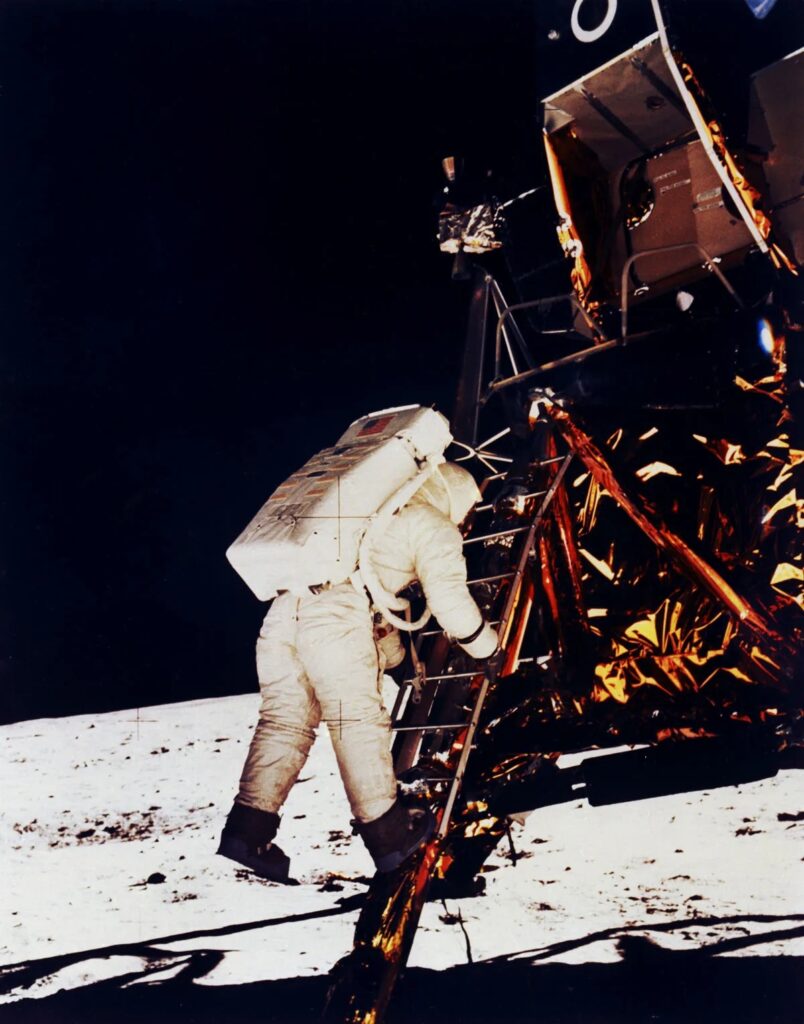
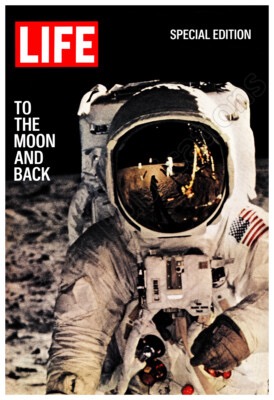
Watching Dad Walk Home from Campbell Barracks

From our living room window, my mother and I would sit together in the early evenings and watch the stream of officers walk home in their uniforms. Even though they all looked the same from a distance — identical green fatigues or Class A uniforms, same gait, same caps — I could always pick out my father by his walk. There was something distinctive and familiar in his stride and the way he tilted his head as though examining the terrain ahead of him, and spotting him from afar gave me a small sense of pride and comfort each day.

Parades at Campbell Barracks

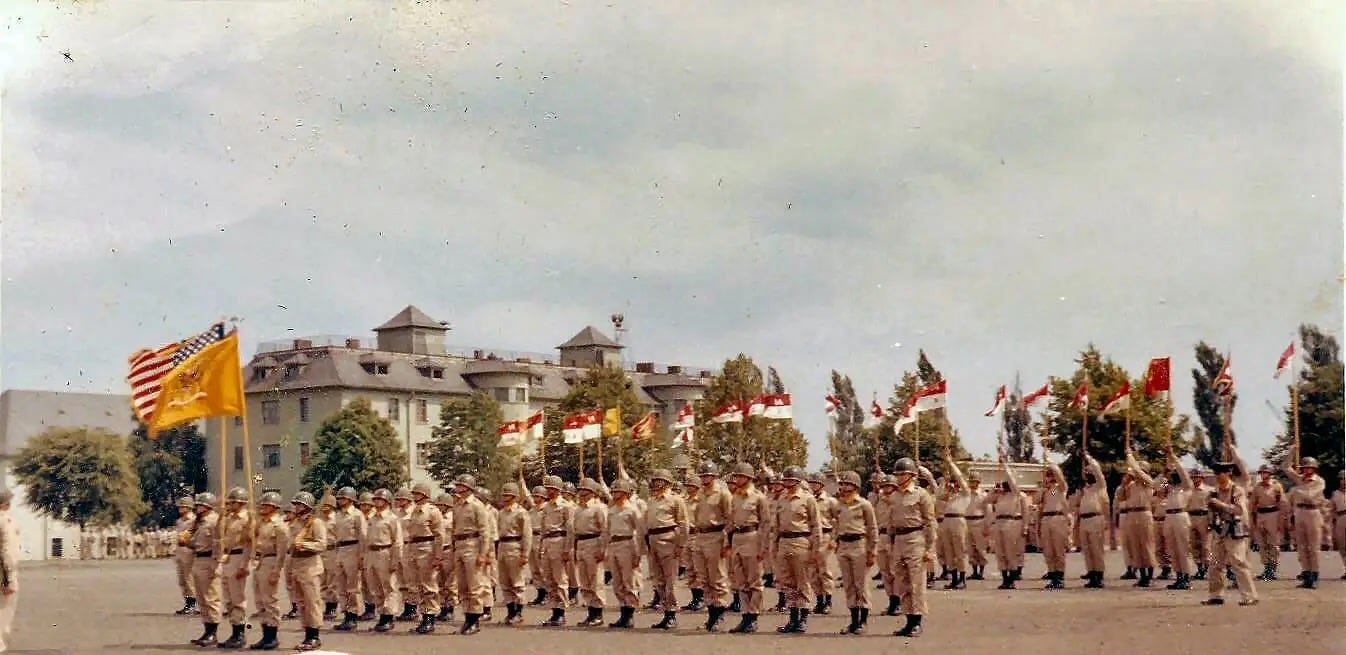
We were so close to Campbell Barracks that we didn’t just see Army life — we heard it. The bugle calls, the thunderous boom of cannon salutes, and the rousing music of the 7th Army Band became the background soundtrack of our lives. If I had a day off school and it was light outside, I’d run over to Campbell Barracks to watch the soldiers march “Pass In Review”. Their gleaming boots, synchronized steps, colors and guidons waiving, and perfectly timed salutes made a deep impression on me. It was patriotic, ceremonial, and somehow reassuring.
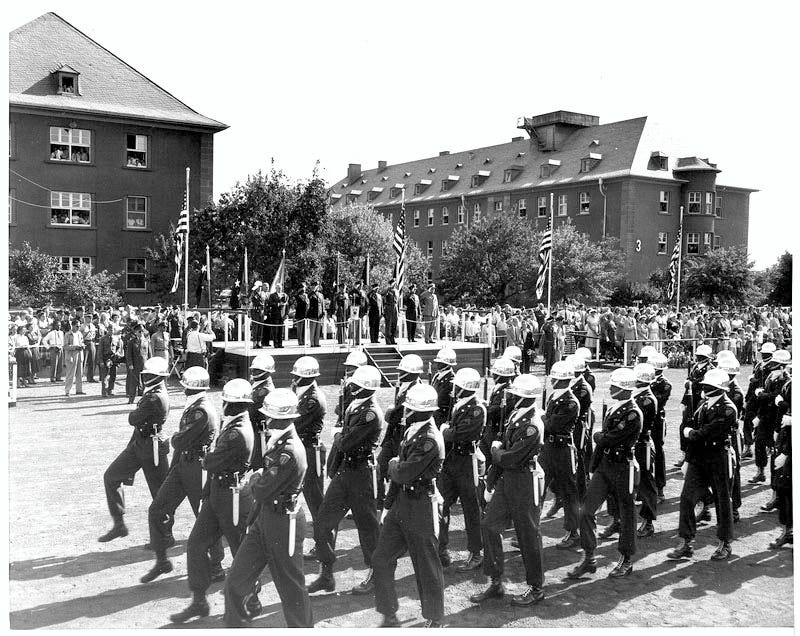
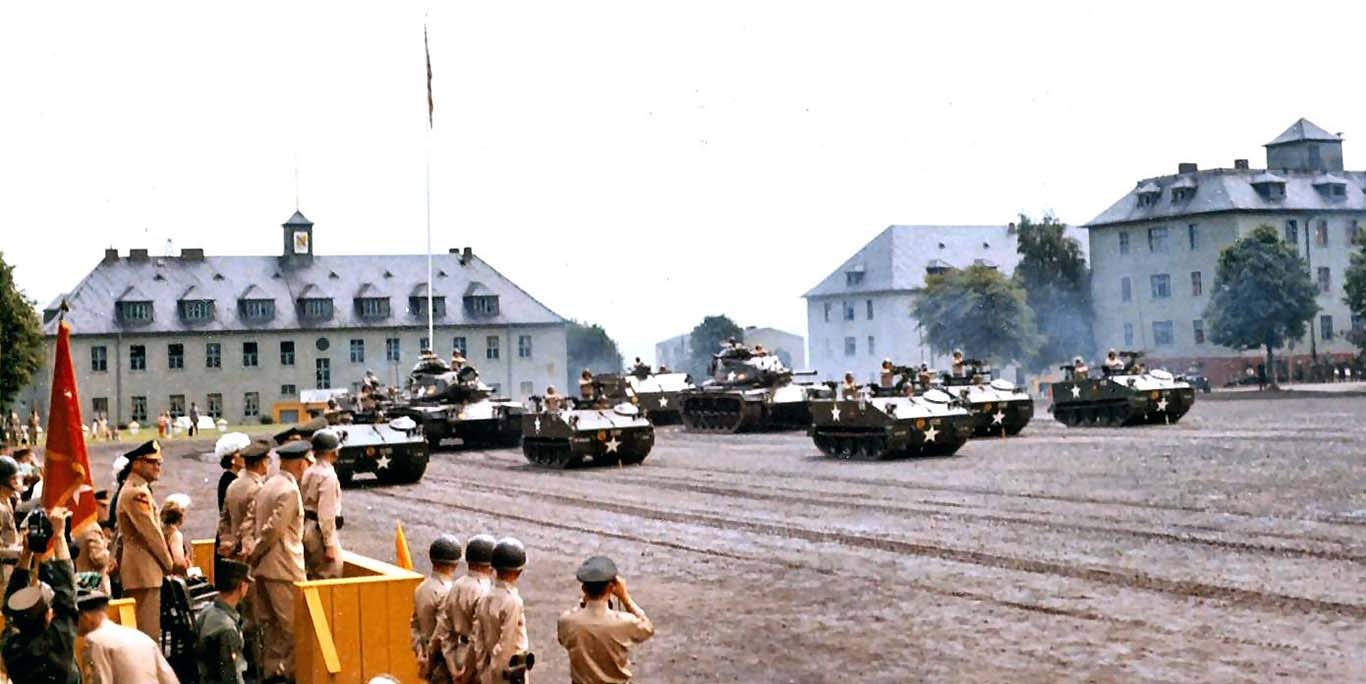
U.S. 7th Army Band and soldiers "Pass in Review" on the parade field of Campbell Barracks in Heidelberg, Germany--home of Headquarters, USAEURA.

Part of the autobiography of Dr. Anthony J. Carbone, Son in the Shadow of a Green Beret Hero
US 7th Army Soldiers Pass In Review at Campbell Barracks in Heidelberg

Life in Mark Twain Village (MTV)

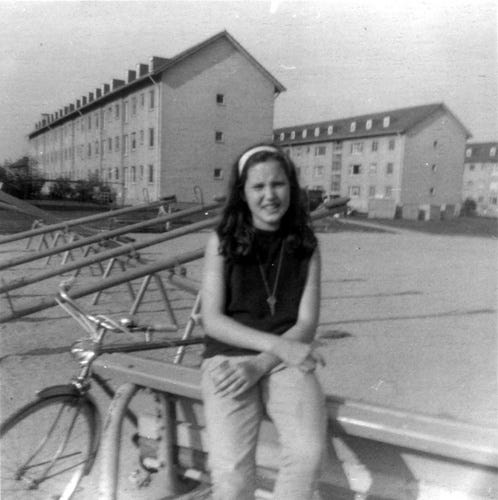
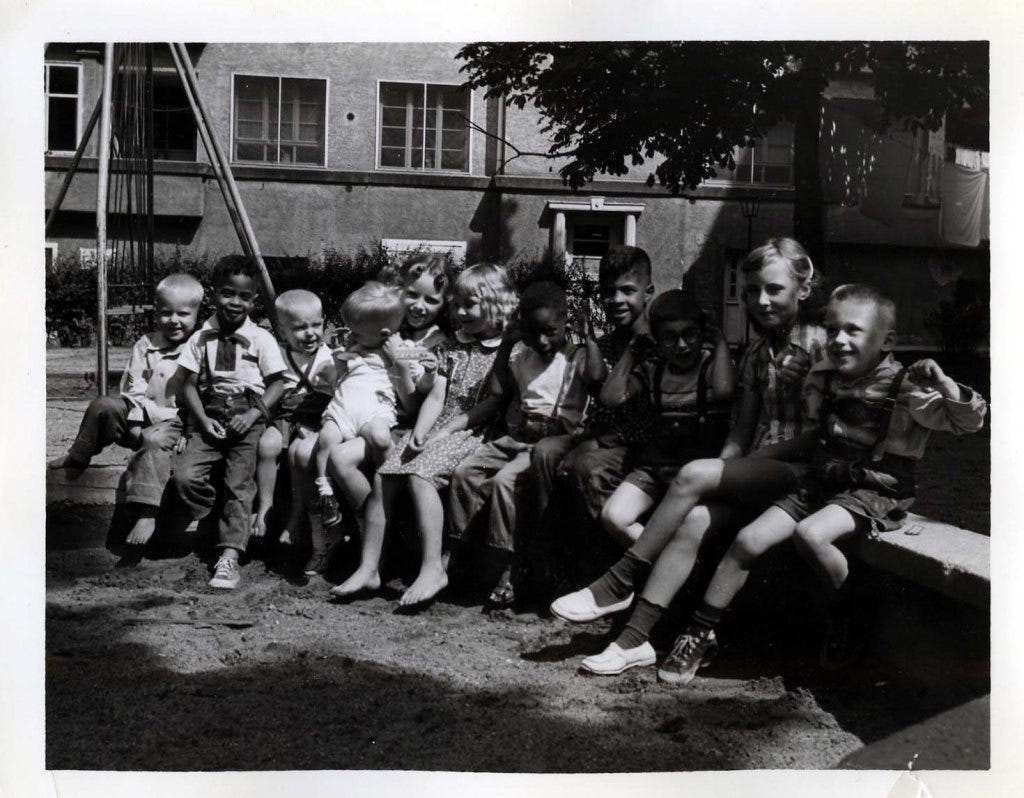
Mark Twain Village was filled with other Army families like ours. The kids played outside until dinner, rode bikes on the broad sidewalks, and gathered for games in the shared courtyards. We attended the American grade school nearby and shopped at the PX and commissary. Even though we were living in a foreign country, our daily life felt predictable and secure — until it didn’t.
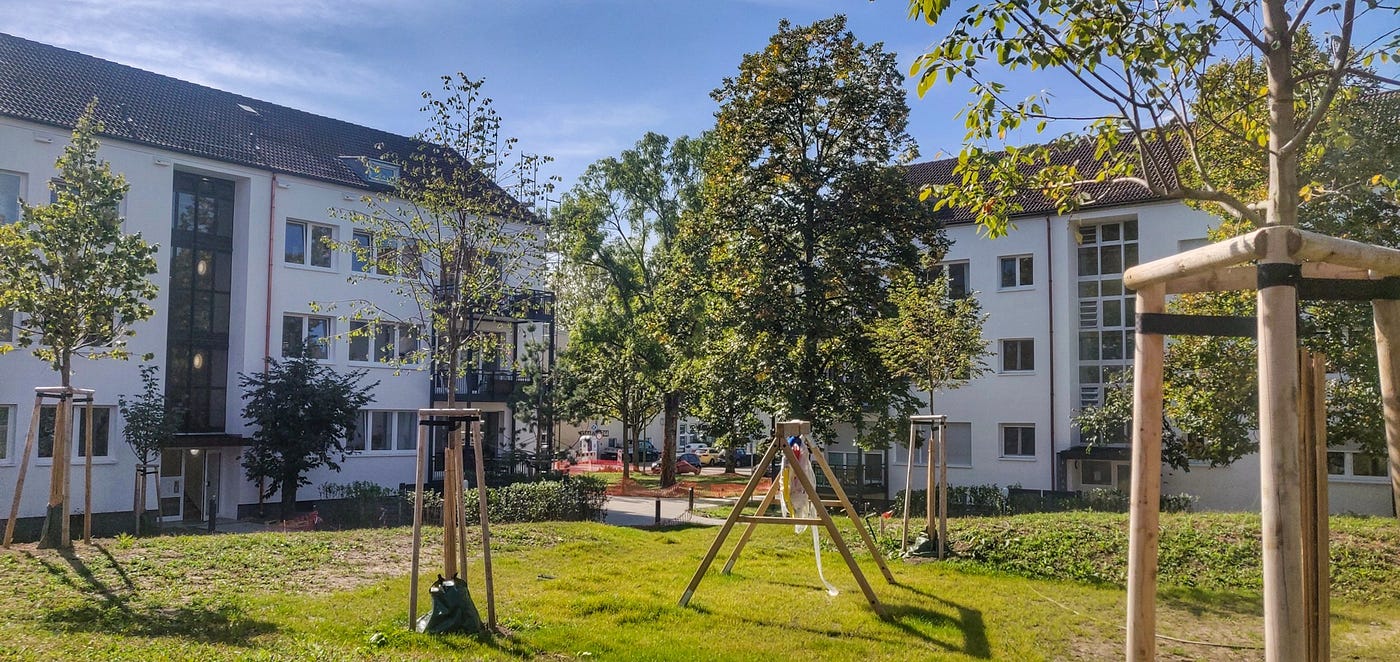
Typical playground in. the quad betwen the apartment buildings of Mark Twain Village (MTV), the family housing area for military personnel working at Campbell Barracks, Home of HQ USAEURA, Heidelberg, Germany.

Part of the autobiography of Dr. Anthony J. Carbone, Son in the Shadow of a Green Beret Hero
Mark Twain Village Playground

Our Car is Used in a Kidnapping

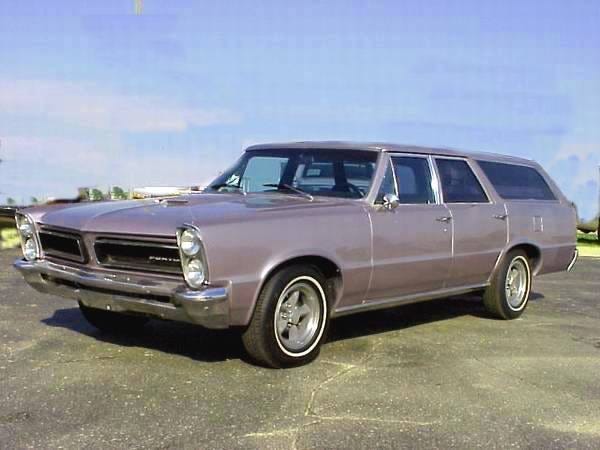
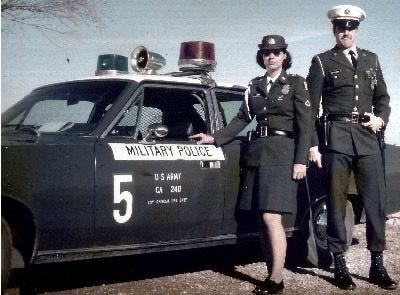
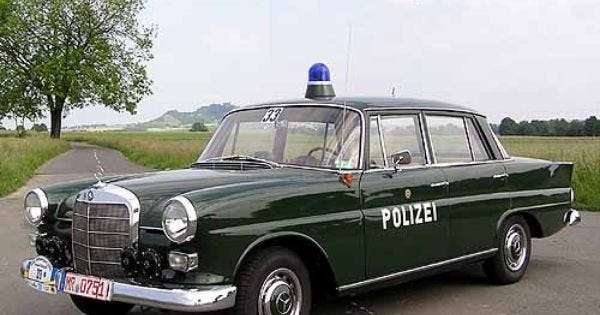
One event pierced that sense of security in a way I’ll never forget. One night, thieves stole our family’s Pontiac station wagon, our trusted vehicle for school runs and weekend drives. Soon after, we discovered that kidnappers used it in the abduction of a young woman.

German and U.S. military police came to our apartment and fingerprinted each of us to help with the investigation of the recovered vehicle. I remember the serious, methodical way they worked, my fingerprints appearing on the identifcation card, and the sense of something terribly wrong. Later, it was revealed that chlorophorm had been used during the kidnapping. Our car was returned to us, but it never felt quite the same again. Driving around in it afterward felt strange and unsettling. As a boy, I didn’t yet have the words for trauma, but I knew we had been touched by something dark.
My 5th Grade Teacher Dies of Pneumonia

Another vivid memory from that year is one of personal sorrow. My fifth-grade teacher at Heidelberg American Grade School was only 21 years old. I’ve long since forgotten her name, but not her beauty or kindness. Even at ten, I knew we were lucky to have such a lovely and caring teacher.
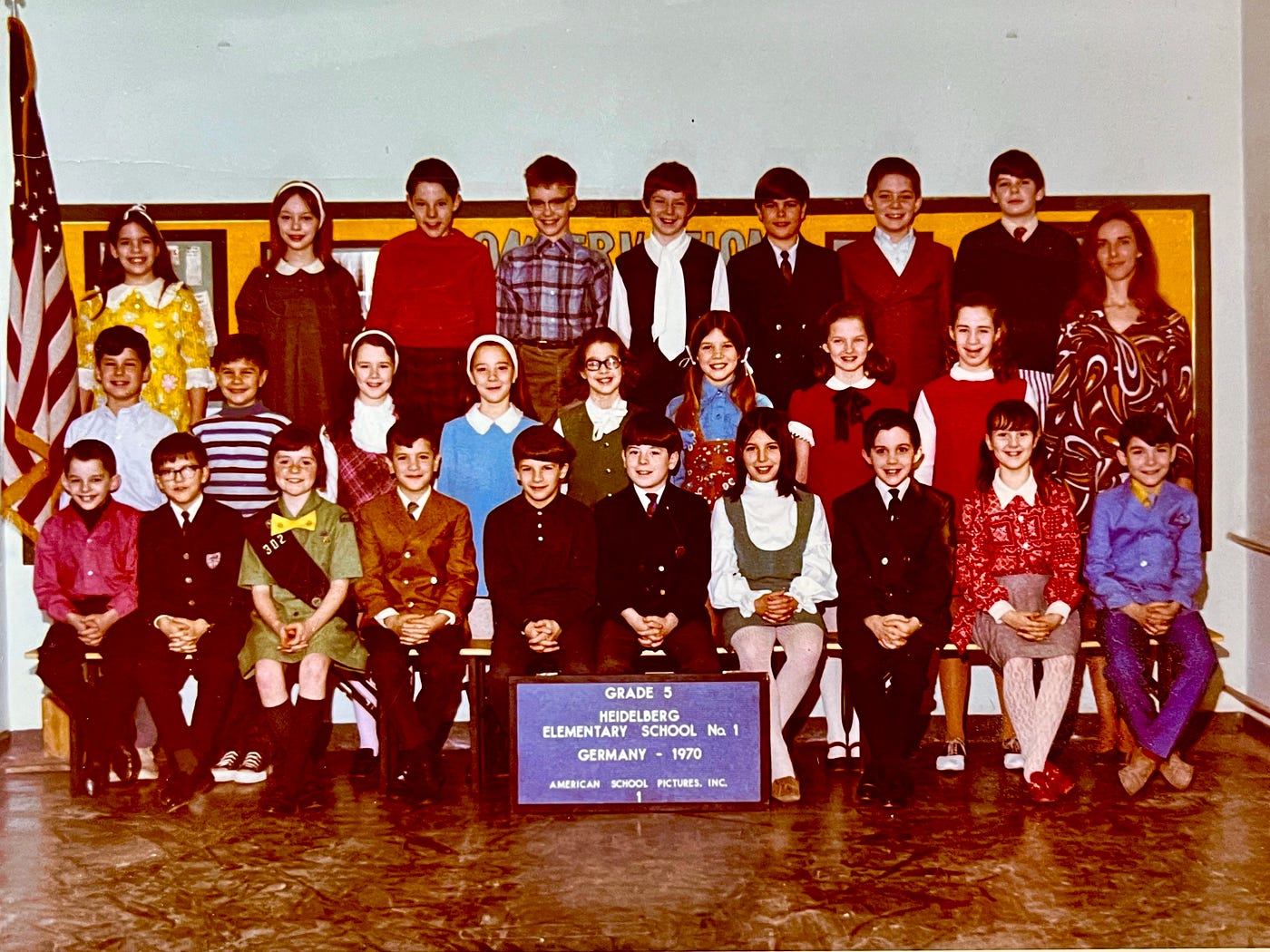
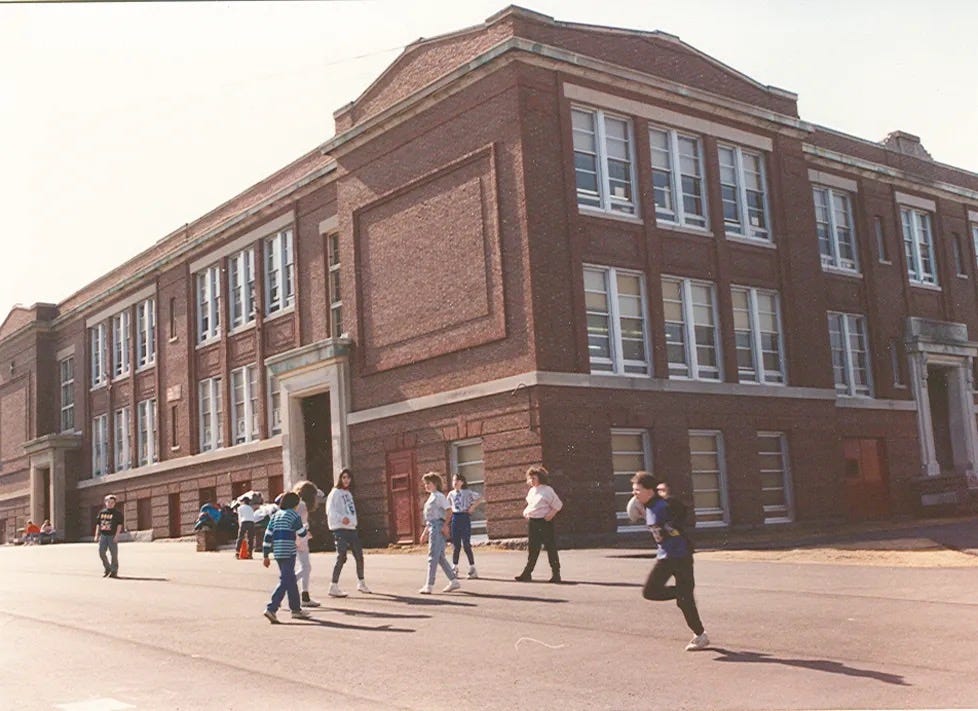
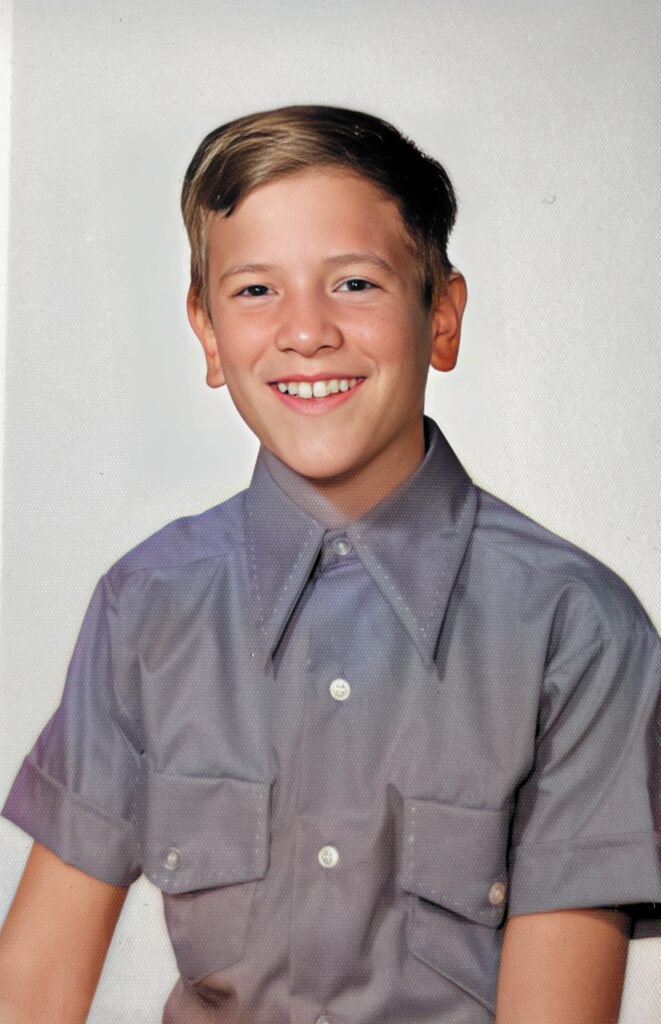
My 5th Grade Class portrait at Heidelberg Elementary School No.1 in Mark Twain Village, 1970.  I am seated in the front row, 4th from the left.

Part of the autobiography of Dr. Anthony J. Carbone, Son in the Shadow of a Green Beret Hero
5th Grade Heidelberg American Grade School. Heidelberg, Germany. I’m in the brown jacket next to my girlfriend the girl scout.

Then one day, we were in the car — my parents in the front, me sitting in the middle between them on the bench seat — and Peter, Paul & Mary’sLeaving on a Jet Plane” came on the radio. I liked the song already, but suddenly it took on a whole new meaning. My parents turned to me gently and told me that my teacher had died — of pneumonia. I was stunned. “Pneumonia?” I asked. “Isn’t that curable with antibiotics?” They nodded softly but didn’t offer much more. I sat in silence as the song played, numb with disbelief. I don’t remember another thing about fifth grade. To this day, when I hear “Leaving on a Jet Plane,” I’m transported back to that car ride and the overwhelming sadness of losing someone so young.
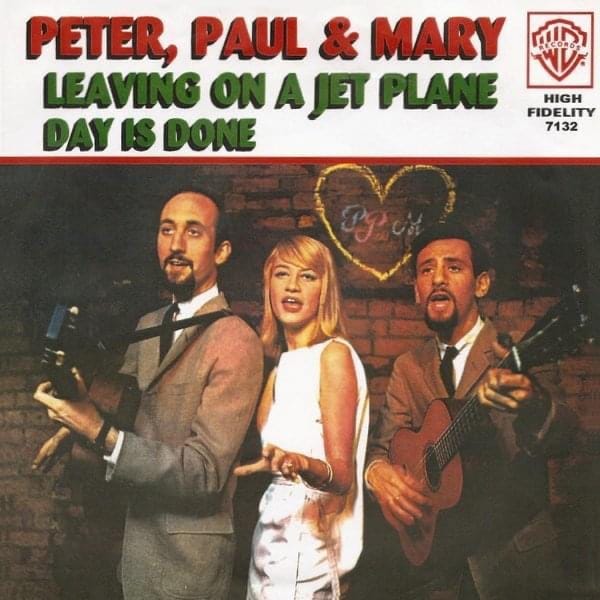
Album cover to Peter, Paul & Mary's "Leaving on a Jet Plane" in High Fidelity.


Part of the autobiography of Dr. Anthony J. Carbone, Son in the Shadow of a Green Beret Hero
Peter Paul & Mary’s “Leaving On A Jet Plane”

I learn about suicide

That was not the only moment during our time in Heidelberg that shattered my childhood innocence. I remember another day, driving down Römerstrasse with my parents in that same Pontiac station wagon. I was again sitting between them in the front seat, the hum of the engine and the rhythm of everyday life lulling me into a sense of routine.

Then I heard my father whisper something to my mother. I couldn’t catch it all, but I heard enough: “The captain’s wife… she committed suicide.” My ears perked up. “What’s suicide?” I asked. My parents hesitated, then replied with quiet gravity, “It means she killed herself.” I was stunned. “Why would anyone kill themselves?” I asked again. They explained gently that she had been terribly homesick, living so far from her family, isolated in a foreign country. But I couldn’t understand how loneliness could drive someone to end their life. It seemed unthinkable.

As we continued driving, Joni Mitchell’s “Both Sides Now” came on the radio — “Bows and flows of angel hair…” — and that haunting melody fused itself forever to that moment. I couldn’t make sense of it then, and to be honest, I still struggle with it now. The suicide of that young officer’s wife marked me deeply. From that day on, suicide became something that both baffled and upset me — and it still does.

Album cover to Joni MItchel's "Both Sides Now".


Part of the autobiography of Dr. Anthony J. Carbone, Son in the Shadow of a Green Beret Hero
Joni Mitchell’s “Both Sides Now”

Nana Carbone visits us in Heidelberg

Despite these dark memories, Heidelberg was also a place of beauty, warmth, and family connection. During this tour, we had two long-time visitors who brought their own special energy to our household. My father’s mother, Nana Carbone, came to stay with us for a while. Our three-bedroom apartment was already tightly packed — my parents had their room, my four sisters shared another, and I had a small bedroom to myself. When we had overnight guests, I gave up my room and moved in with my sisters, sleeping on the floor between their two huge wooden bunkbeds. That simple act became a routine of sorts, and I never minded.
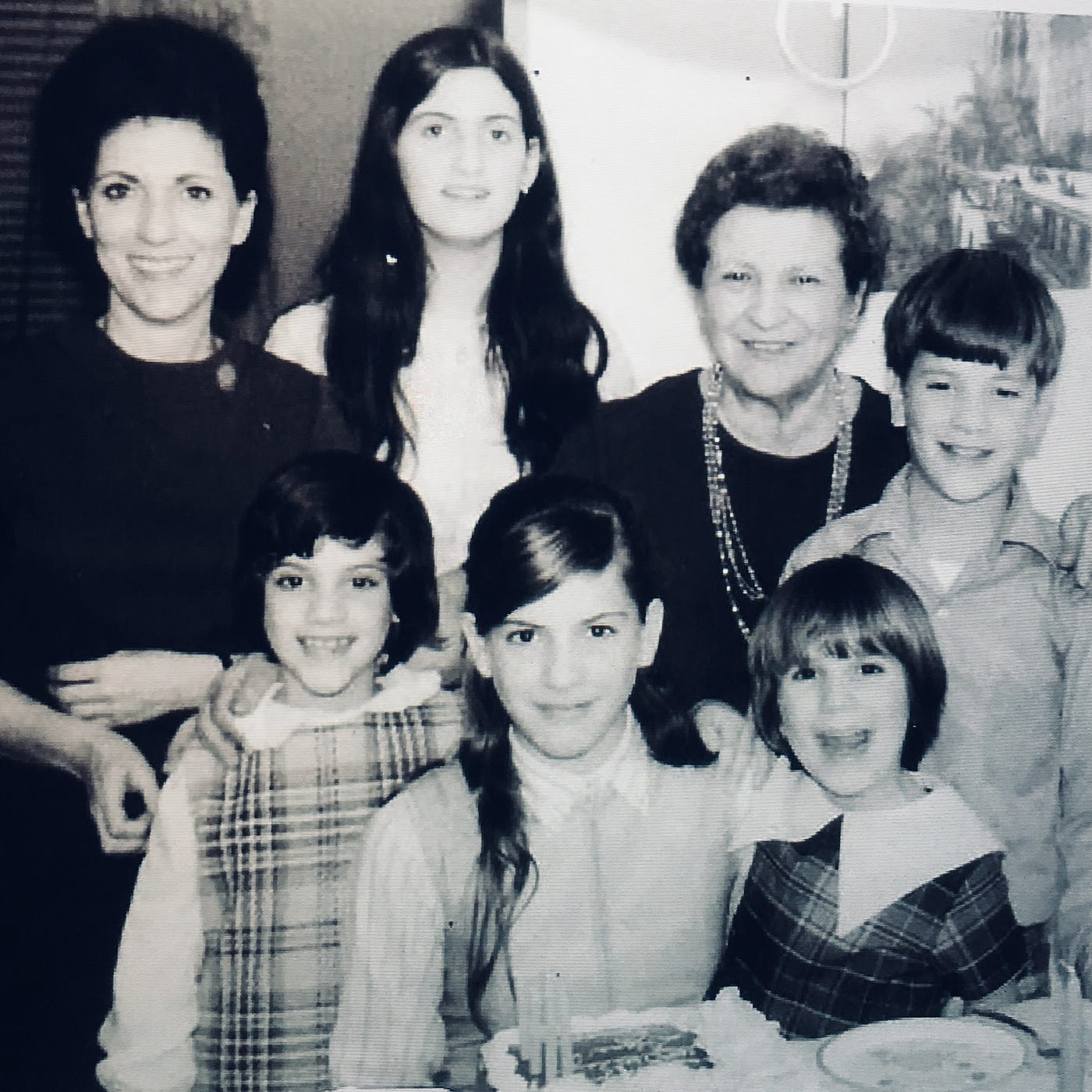
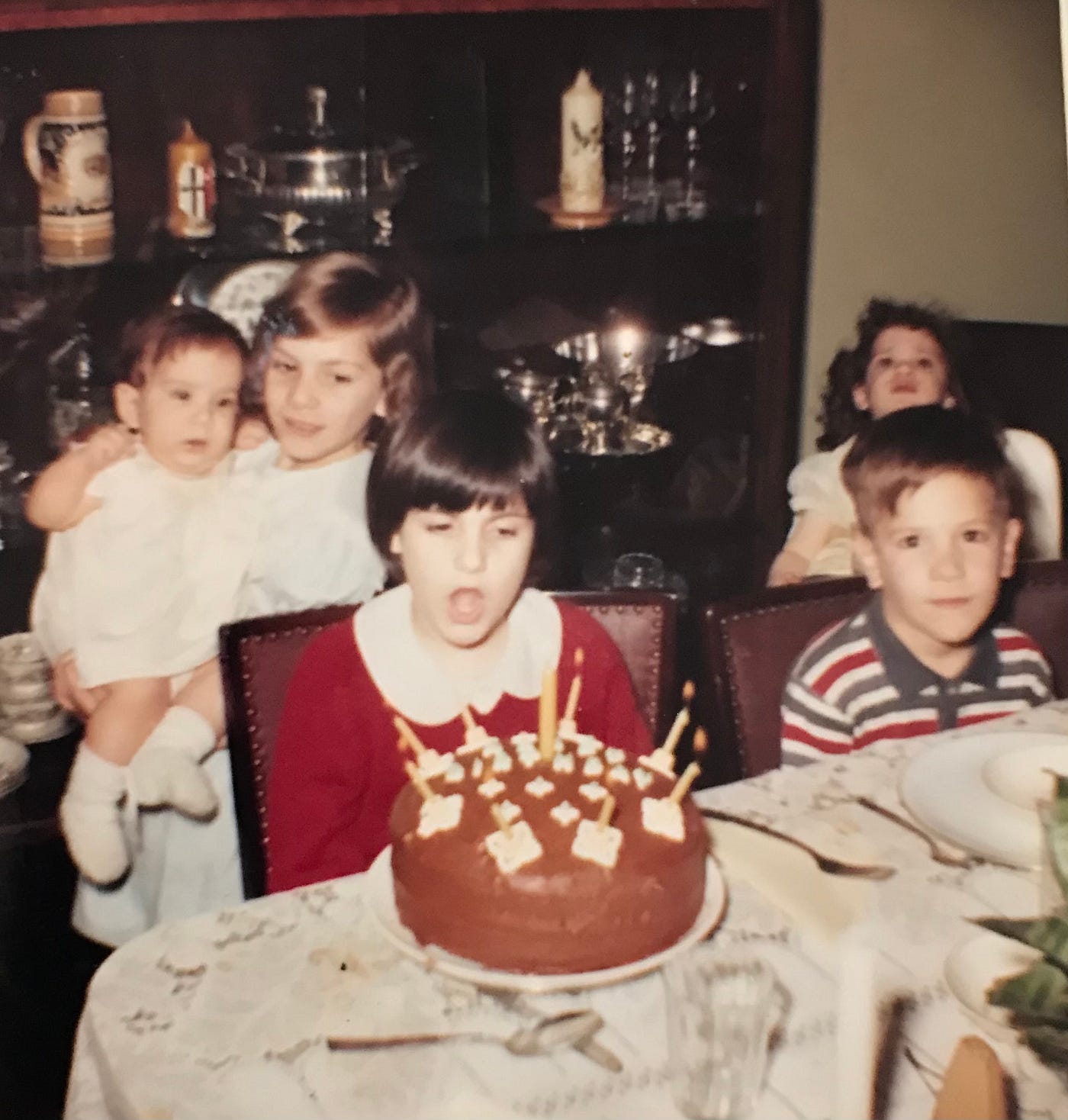
Photograph of Nana Carbone visiting us at our home in Mark Twain Village in Heidelberg, Germany.  With my mother (Edda Carbone), Sisters Lynne, Diana, Cynthia and Pamela Carbone.  Looks like it was my sister Diana's birthday with a birthday cake.  I am on the far left.

Part of the autobiography of Dr. Anthony J. Carbone, Son in the Shadow of a Green Beret Hero
Nana Carbone visiting us in Heidelberg

8 of us in a VW Beetle from Heidelberg to Paris

We took Nana sightseeing around Heidelberg and beyond, but I especially remember one spontaneous Saturday morning at the breakfast table. My father asked, “Who wants to go visit Paris?” We all exploded with excitement, raising our hands and pleading to go. He told us to gather our money — every coin and bill we could find, both American and German. We brought him our coins, our Deutschmarks, our pfennigs, and he carefully counted them up and announced that we had just enough.

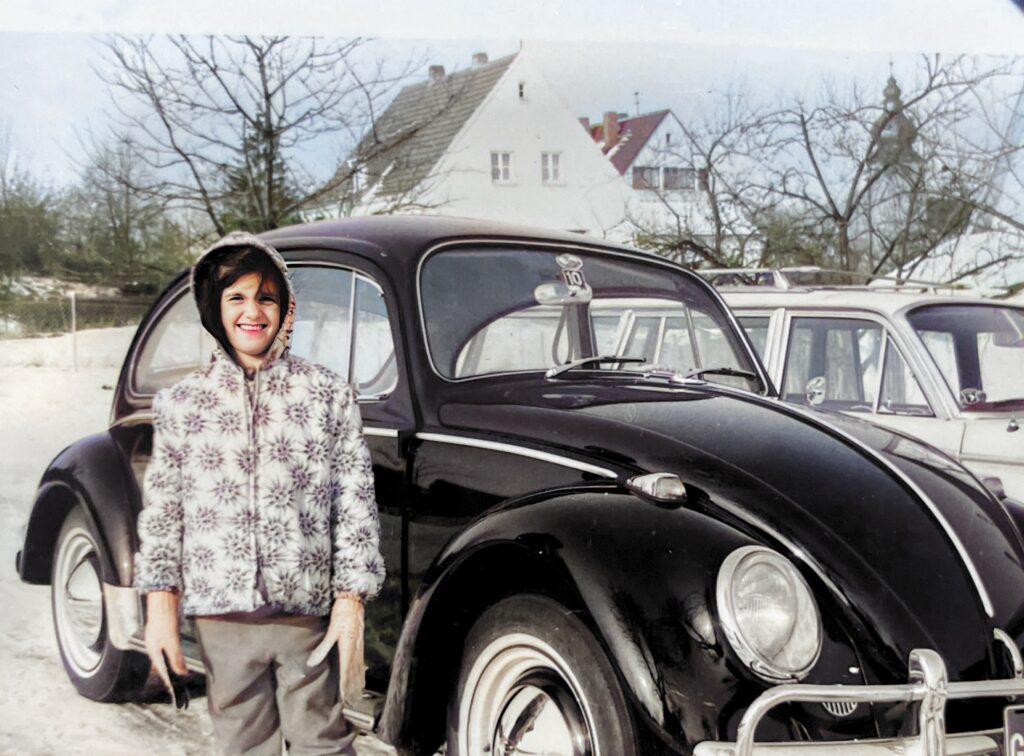
The funniest part was that we no longer had the station wagon — at the time, we only had a 1960s-era German Volkswagen Beetle. So all eight of us — my father, Nana Carbone, my mother, and the five Carbone kids — crammed into that tiny car, along with our luggage, and drove all the way from Heidelberg to Paris. My father drove, Nana rode up front, and the rest of us — every last one — sat piled in the back, sandwiched together like sardines. It was cramped, absurd, and completely unforgettable.
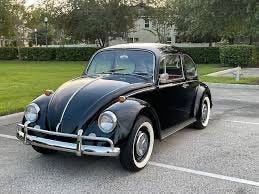
Black Volkswagen Beetle circa 1960 that 8 of us piled into to drive from Heidelberg, Germany to Paris, France when my Nana Carbone was visiting us in Heidelberg.

Part of the autobiography of Dr. Anthony J. Carbone, Son in the Shadow of a Green Beret Hero
Black Volkswagen Beetle circa 1960 that 8 of us piled into to drive from Heidelberg to Paris when my Nana Carbone visited us.
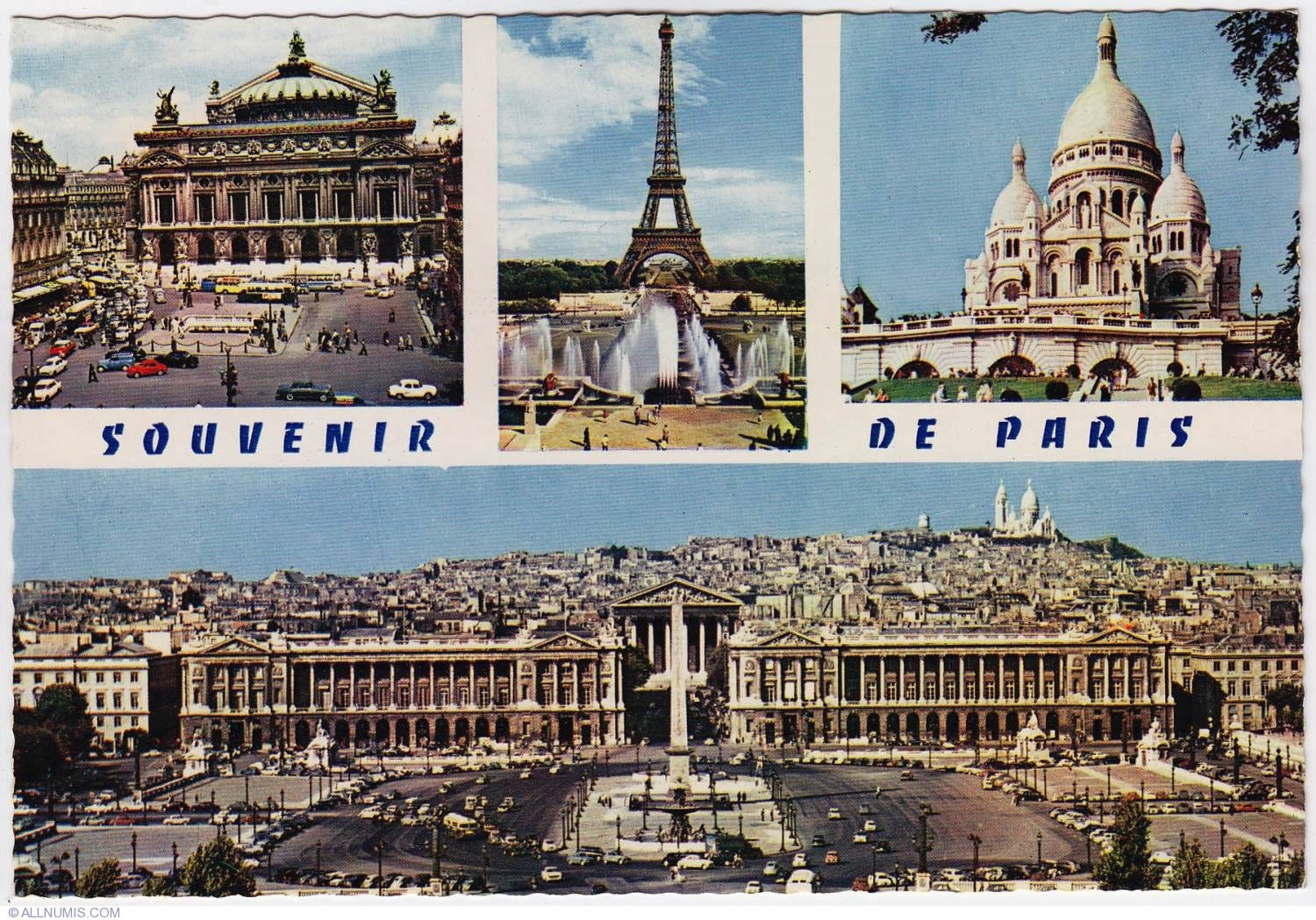
Postcard of Paris that was a souvenir from our trip to Paris in 1970 when Nana Carbone visited us in Heidelberg, Germany.

Part of the autobiography of Dr. Anthony J. Carbone, Son in the Shadow of a Green Beret Hero
Postcard of Paris that was a Souvenir from our trip to Paris with my Nana Carbone.

Auntie Norma Stays with us Again

We also hosted my Auntie Norma that year. She came to stay for an extended visit and, as always, I gave her my bedroom and joined my sisters on the floor. Auntie Norma traveled with us occasionally, but she also took full advantage of Army-sponsored trips for officer wives and soldiers. She explored Europe independently, sometimes with others, often alone, always intrepid with cameras in hand. She was fearless, curious, and full of stories. Her presence added color to our home, and her spirit of adventure made a lasting impression on me. She has always been a part of our nuclear family to me.
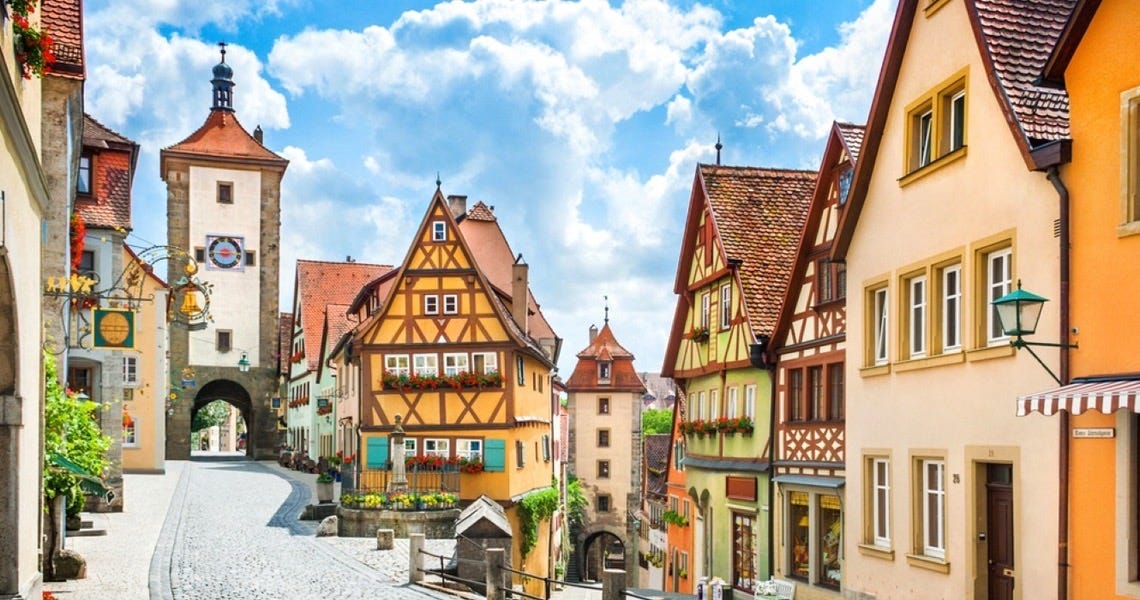
Photo of main street Rotenburg, insided the famous walled city showing the iconic tower gate.  This was one of the most favorite places for our family to visit and show our visitors.

Part of the autobiography of Dr. Anthony J. Carbone, Son in the Shadow of a Green Beret Hero
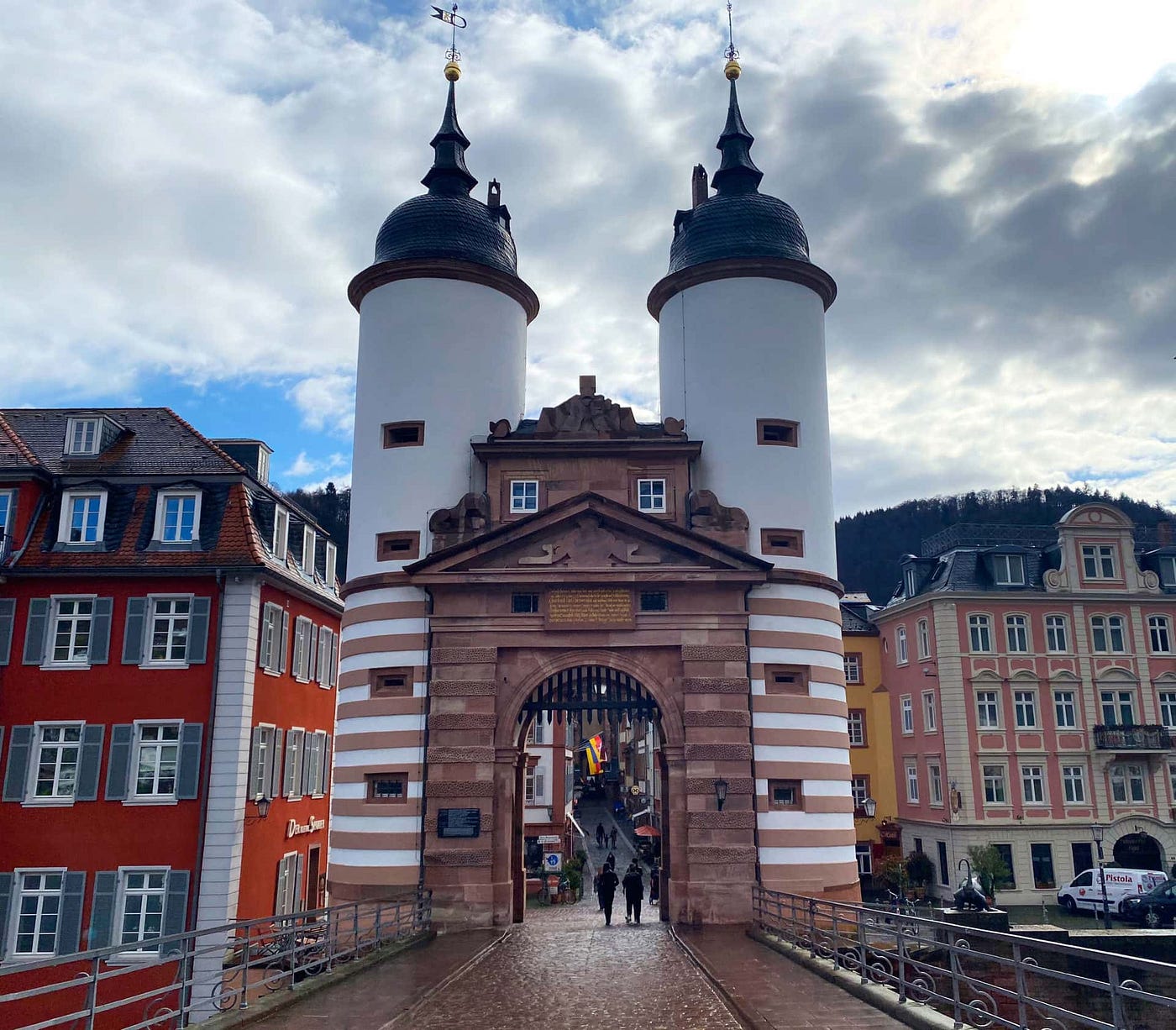
Rotenburg ob der Tauber Germany, one of our favorite places to visit

I loved Germany

Although everyone in my family lived through three tours in Germany, the timing of this particular tour in my childhood made it the most significant for me. Germany — especially Heidelberg — became an essential part of my identity. Studying the German language began both in school and independently. German history, culture, and geography sparked deep fascination, leading our family to travel throughout the country. Military life, particularly my father’s role in the U.S. Army and the broader structure of NATO forces stationed across Europe, especially captivated me.

Even then, I knew I wanted to follow in my father’s footsteps. I was determined to become an Army officer. And I dreamed of returning to Germany for as many tours as the Army would allow.
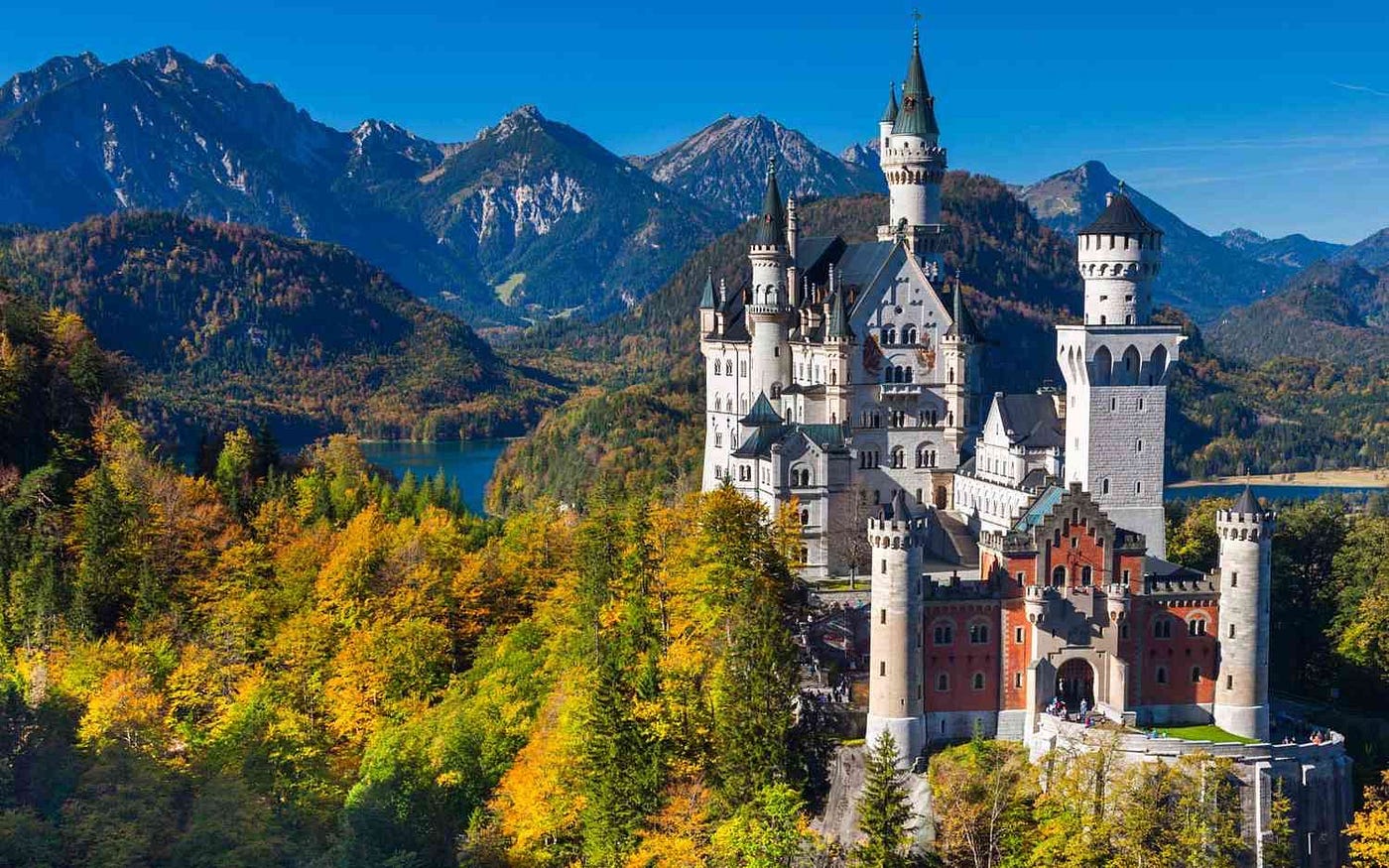
Photograph of Neuschwanstein Castle, the icon of Bavaria (the American sector of Germany).  We took our visiting guests there often.

Part of the autobiography of Dr. Anthony J. Carbone, Son in the Shadow of a Green Beret Hero
Neuschwanstein Castle Bavaria Germany

Looking back, our second tour in Germany was not just another chapter in our family’s military life — it was the foundation of my emerging sense of self. It was a time when I began to understand the complexity of the world, to absorb culture, history, and tragedy, and to see clearly the path I would one day walk. Heidelberg wasn’t just a post — it was a place where I began to grow up.
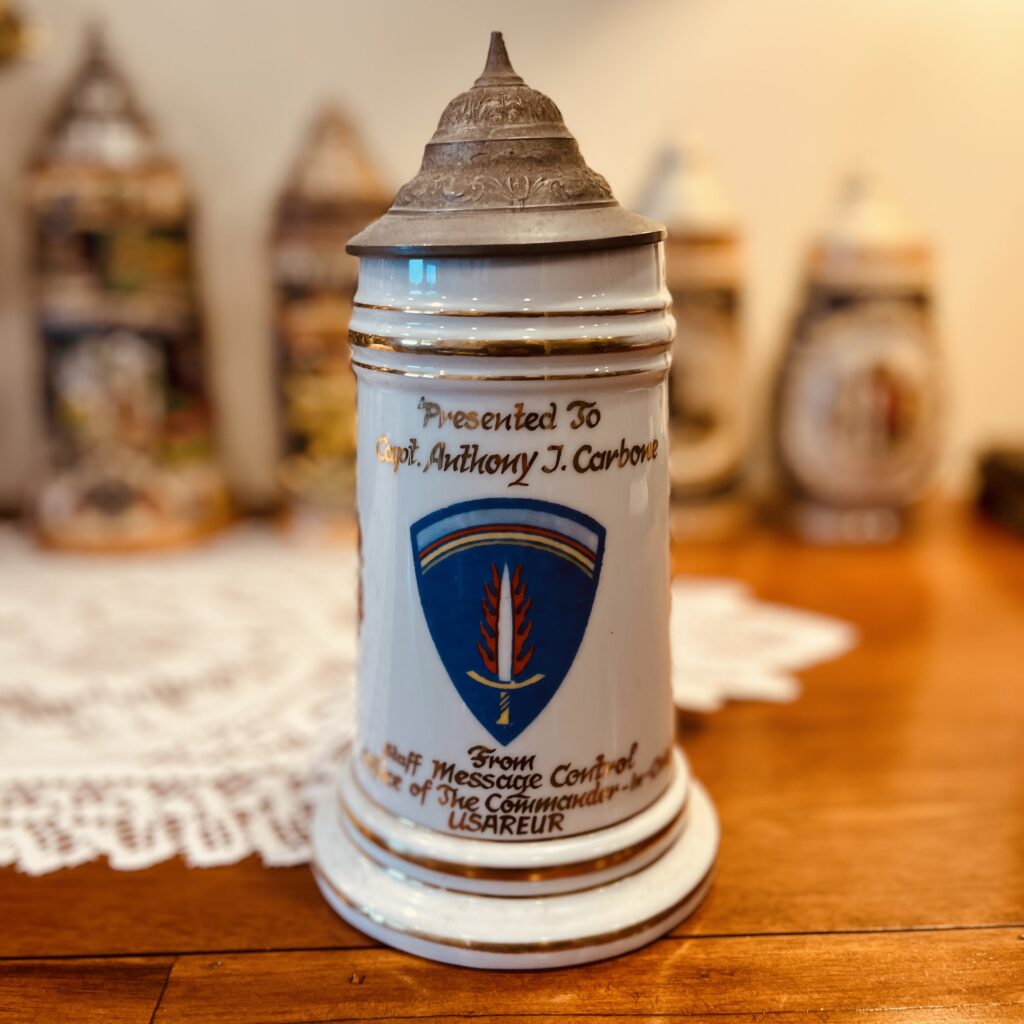
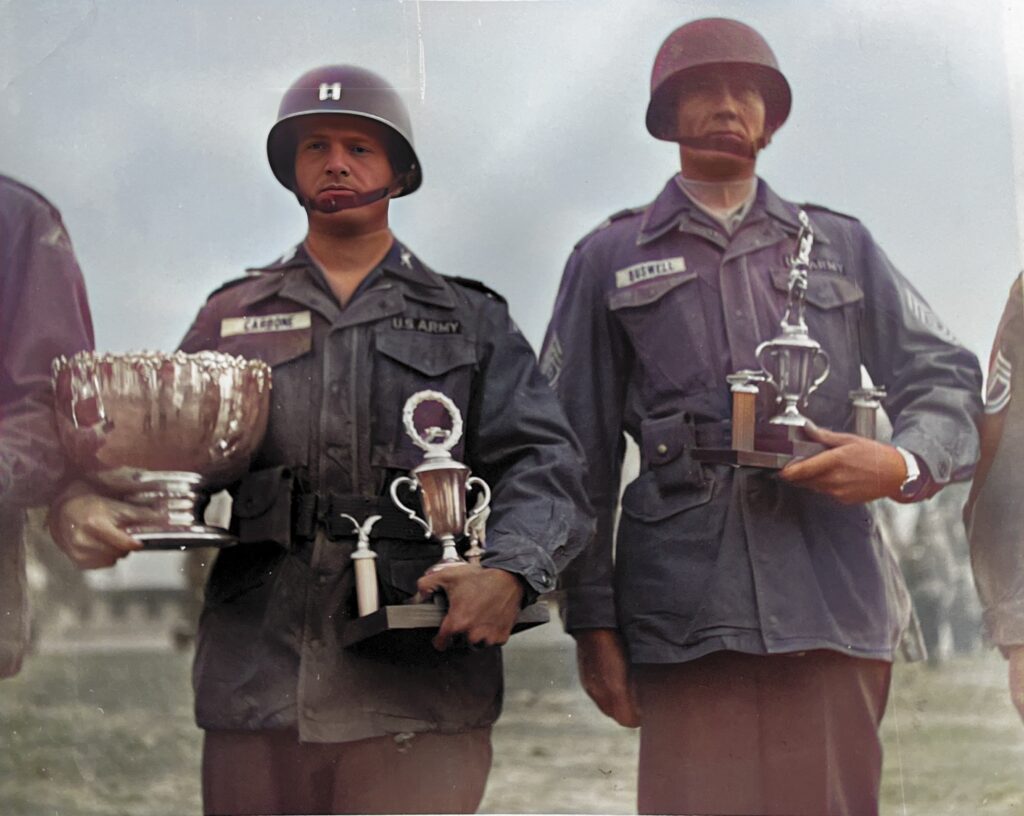
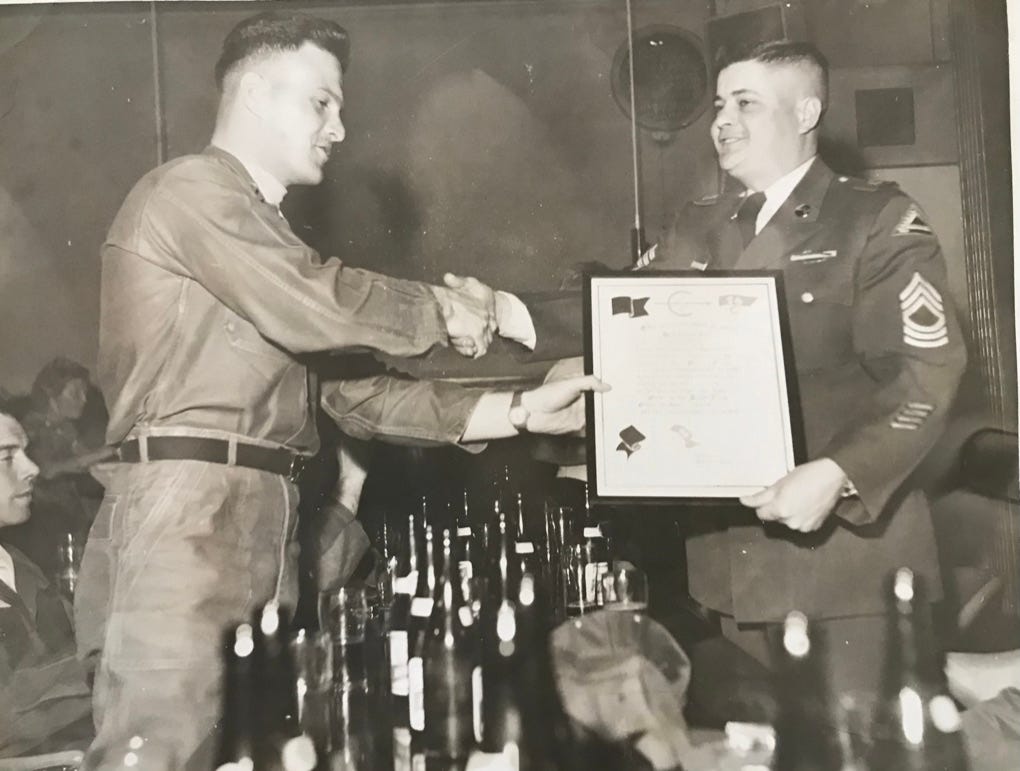
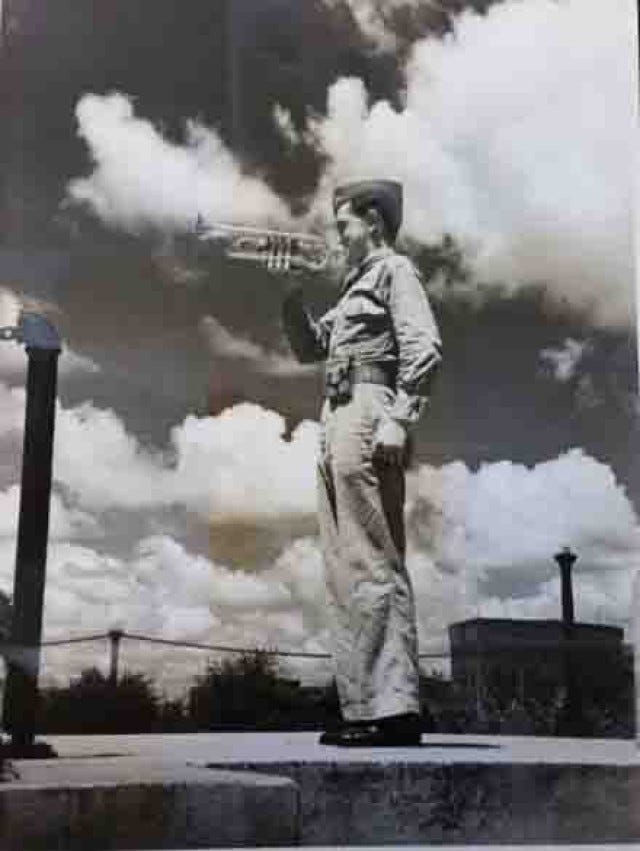
Bierstein from HQ USAREUR in Heidelberg Germany. Captain Carbone. Dr. Carbone autobiography/
Bierstein HQ USAREUR Heidelberg Germany presented to my father, Captain Tony Carbone
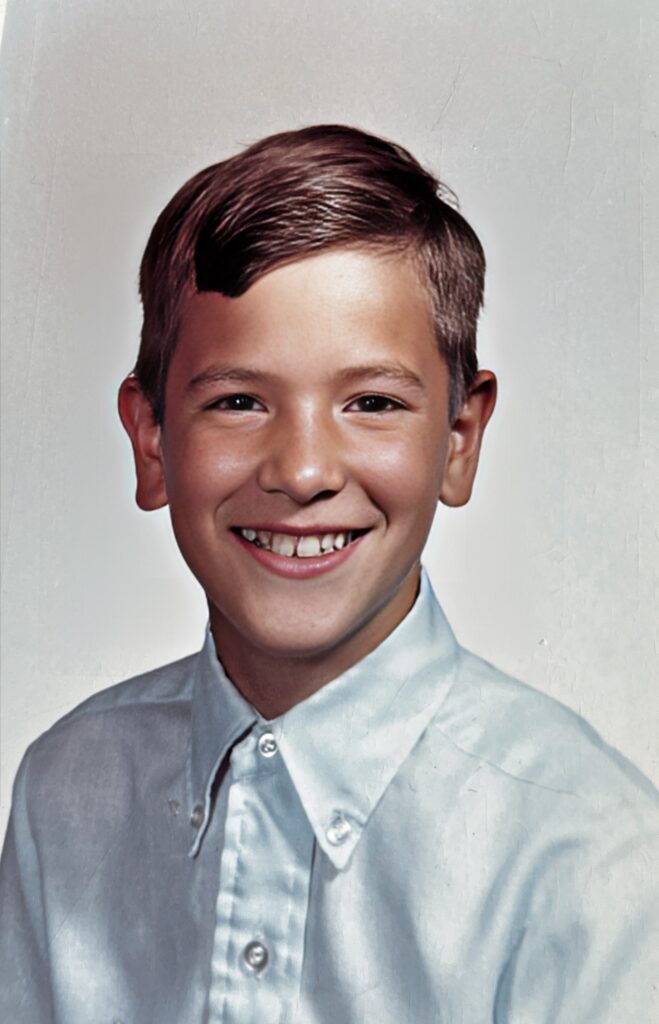
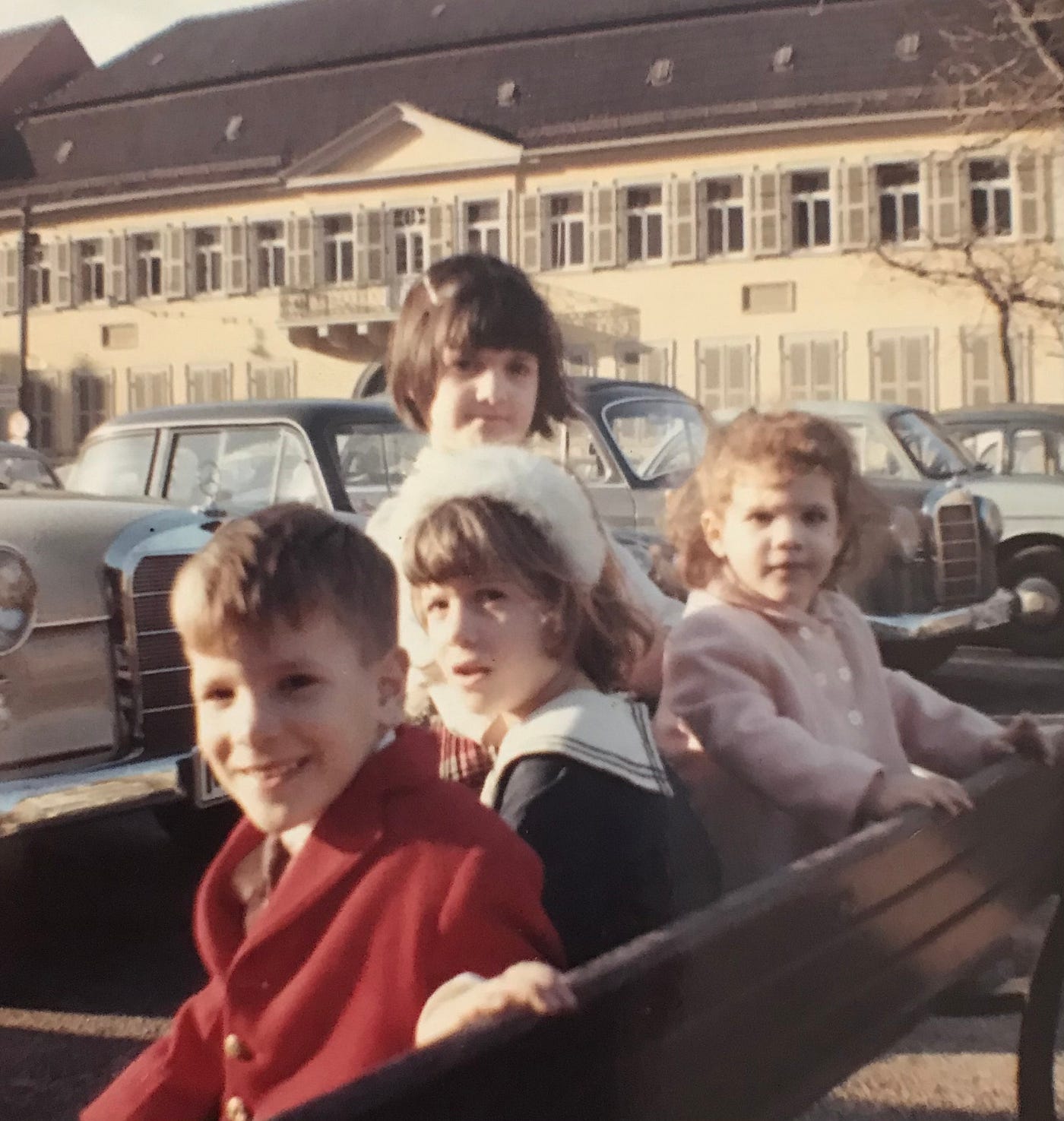
5th grade school portraits while attending Heidelberg American Elementary School in Heidelberg, Germany.  Biography of Anthony J. Carbone.

Home Page

Chapter 7: Command & General Staff College at Fort Leavenworth

US Army Command & General Staff College Seal. Autobiography of Dr. Anthony J. Carbone.

Believe Nothing You Hear, and Only Half of What You SeeA Memoir of Service, Shame, and the Search for Truth

Return to the Command & General Staff College as a Tactical Instructor

After returning from Vietnam, the Army sent my father to the Command and General Staff College (CGSC) at Fort Leavenworth. This wasn’t just another stop on the military carousel — it was a pivotal milestone in his ascending career. Officers who were selected early for CGSC earned a mark of distinction.It signaled that the Army saw him not only as a skilled officer but as a leader with long-term potential.

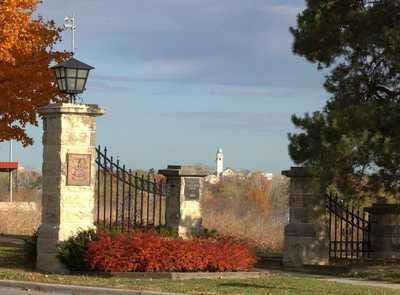
Front Gate to Fort Leavenwork, Kansas where the Command & General Staff College is located.
After returning from his first tour in Vietnam in 1967, my father received prestigious orders to attend the United States Army Command and General Staff College (CGSC) at Fort Leavenworth, Kansas. This wasn’t just another stop on the military carousel — it was a pivotal milestone in his ascending career. Being selected early for CGSC was a mark of distinction. It signaled that the Army saw him not only as a skilled officer but as a leader with long-term potential.

Front Gate to Fort Leavenworth, Kansas
The Command and General Staff College is one of the crown jewels of military education. Established in 1881 by General William Tecumseh Sherman as the School of Application for Infantry and Cavalry, it was designed to train officers in the complexities of tactics, operations, and command. By 1907 it had become the School of the Line, and eventually evolved into what is now CGSC. Its mission remains timeless: to educate and develop agile, adaptive leaders who can operate in joint, interagency, and multinational environments — and to advance the art and science of the profession of arms.

Seal of the U.S. Command & General Staff College at Fort Leavenworth, Kansas
My father knew that the college had shaped some of America’s greatest military minds. Its alumni list reads like a hall of fame: Eisenhower, MacArthur, Marshall, Patton, Bradley, Westmoreland, and later, Colin Powell and Norman Schwarzkopf. To follow in their footsteps — even to walk the same halls — was both humbling and inspiring.
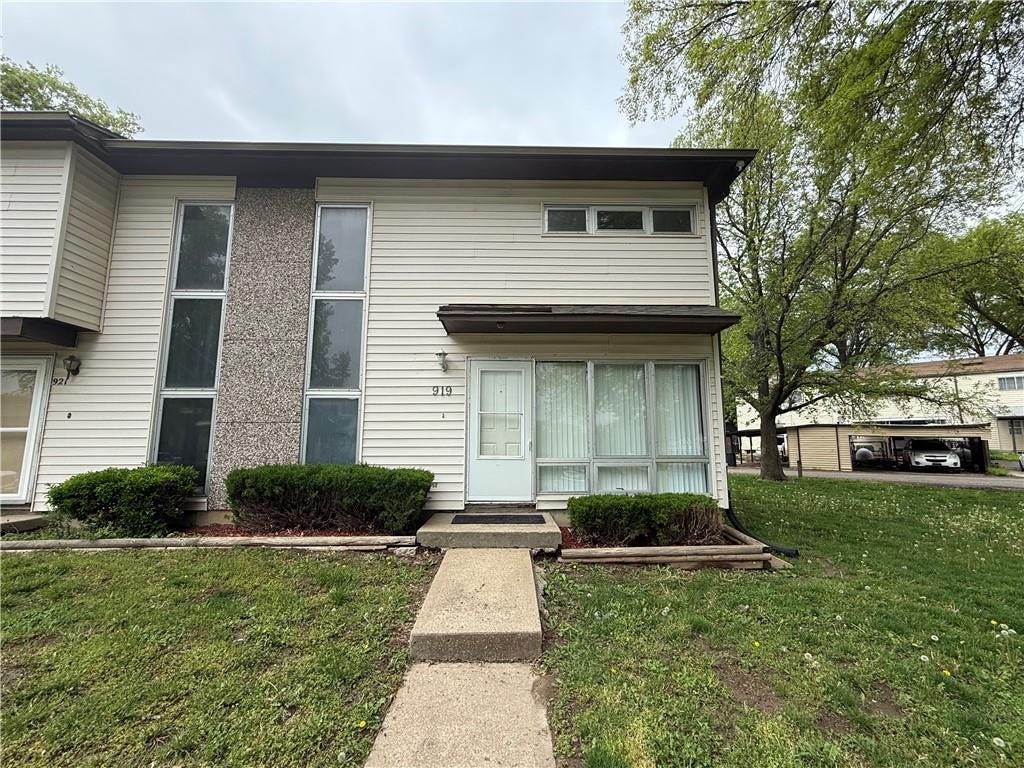
Since on-post housing was limited and claimed quickly, our family settled down in a modest townhouse in a small civilian development called Redwood Gardens, located about 35 miles southeast of Fort Leavenworth, in Kansas City, Kansas. Though a few other military families lived there, it lacked the closeness, safety, and camaraderie of post living. For us kids, it was an isolating and sometimes chaotic environment.

Civilian housing at Redwood Gardens in Kansas City, Kansas.
Our townhouse was cramped. My father turned a corner of the basement into a makeshift study where he would disappear for hours, immersed in maps, doctrine, and war histories. The workload at CGSC was intense, and the pressure to excel immense.

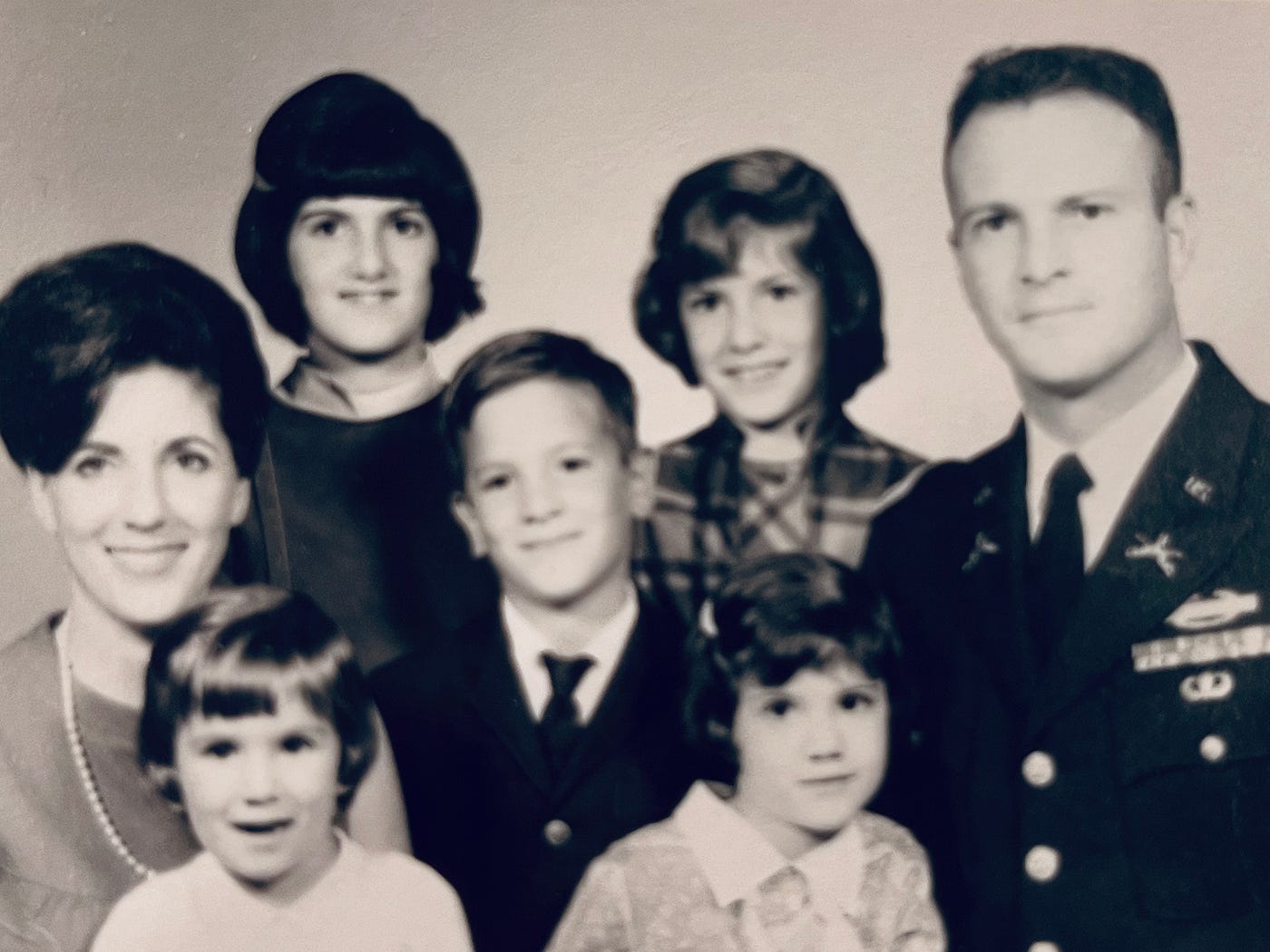
Carbone Family Portrait in the Command & General Staff College Yearbook “The Bell”
My own memories of Kansas City during that time are scattered and, for the most part, not especially fond. That year seemed filled with accidents and discomfort. Pamela fell down the basement stairs and had to get stitches on her face. Diana dove into the shallow end of the neighborhood pool and broke her front tooth in half, eventually receiving a dental cap. I got into a fight when I saw a bully beating up a younger kid — jumped in, broke my hand, and spent the rest of the summer in a cast.
One of my more cherished memories I have of our time in Kansas City was the day that Lynne, Diana, and I were all confirmed in the Catholic Church — on the same day — by the Archbishop of Kansas City, Bishop Edward Joseph Hunkeler. It was a peaceful and proud moment in an otherwise trying year.
On weekends when my father could sneak away from his studies, we would occasionally, we would make a special trip into the Italian section of Kansas City to stock up on authentic cold cuts — thin slices of mortadella, prosciutto, and provolone cheese — all tucked lovingly into crusty loaves of Italian bread. The vibrant tapestry of Kansas City in 1967 was interwoven with the rich history of its Italian community, particularly in the neighborhood then known as the North End. Having drawn immigrants — mostly from Sicily — since the 1860s, this area, which would soon be renamed Columbus Park, bustled with life centered around Holy Rosary Church and its many family-owned shops and markets. This self-sufficient “Little Italy” offered more than just delicious food — it was a place where tradition, language, and community thrived. Even as changes like the construction of Interstate 35 began to carve through its heart and displace families, the neighborhood remained a beloved reminder of cultural roots and Sunday flavors that felt like home.

Columbus Park “Little Italy” in Kansas City
But another memory stands out even more clearly — not for its peace, but for its intensity. Just a few doors down from our townhouse lived a parentless family of unruly boys who had clearly slipped through the cracks. They had long, unkempt hair — a growing trend in the late 1960s — and I remember them smoking on their back steps, jeering at us as we passed. One day, they went too far and scared my mother. That was a mistake.
I’ll never forget the moment my father found out. He calmly called out, “Hey, J.R.! Come with me!” and together we stepped into the backyard and walked down the road toward the rough boys’ unit. My father knocked on the door, and the oldest, cockiest of them answered. My father made it very clear: he didn’t want any of them speaking to his wife or his children again.
The kid smirked and said something along the lines of, “What is it to you? I don’t plan on stopping.” Without hesitation, my father grabbed the kid by his long hair and — in a move I can only describe as quiet thunder — drew his service Colt 1911 .45 caliber pistol and placed it gently but firmly under the boy’s jaw. His voice was low, measured, deadly calm. “This will be the last time that I warn you.” Then he released the boy, turned to me, and said evenly, “J.R., let’s get back to your mother… and never say a word about this to her.” That day left a mark on me. I had always admired my father, but in that moment, I saw him not only as a soldier but as a protector. I had never felt so safe in my life.
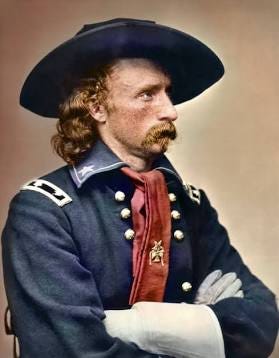
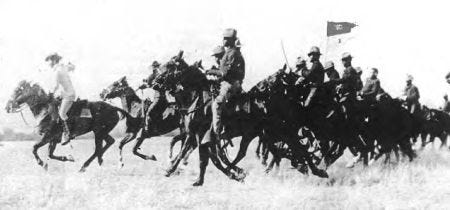
Despite all the challenges of civilian housing, my heart always returned to the post of Fort Leavenworth. Some of my fondest memories of that tour are tied to my personal fascination with the history of the fort — especially its deep connections to the U.S. Cavalry. I was captivated by the legacy of General George Armstrong Custer and his 7th Cavalry, as well as the legendary Buffalo Soldiers of the 10th U.S. Cavalry — the same regiment my father had served with during his tour in Korea. I felt a personal connection to that history, one that ran through the bloodline of my own father.

General George Armstrong Custor of the U.S. 7th Cavalry.

Buffalo Soldiers of the U.S. 10th Cavalry
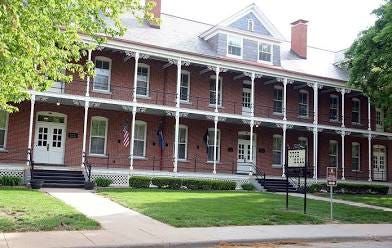
The post was still very much a place of history. Many of the old red brick buildings from cavalry days still stood, preserved like time capsules from another era. I found myself drawn again and again to the Fort Leavenworth museum, which was filled with relics from Custer, the 7th Cavalry, and the 10th Cavalry. There were even artifacts and exhibits tied to President Abraham Lincoln’s visit to the post, which added another layer of reverence. My family often made Sunday day trips to the museum. Those quiet visits — walking through dusty uniforms, sabers, saddles, and faded photographs — lit a spark in me. Even as a child, I felt that Fort Leavenworth was hallowed ground.

Typical post housing at Fort Leavenworth dating back to its cavalry days.
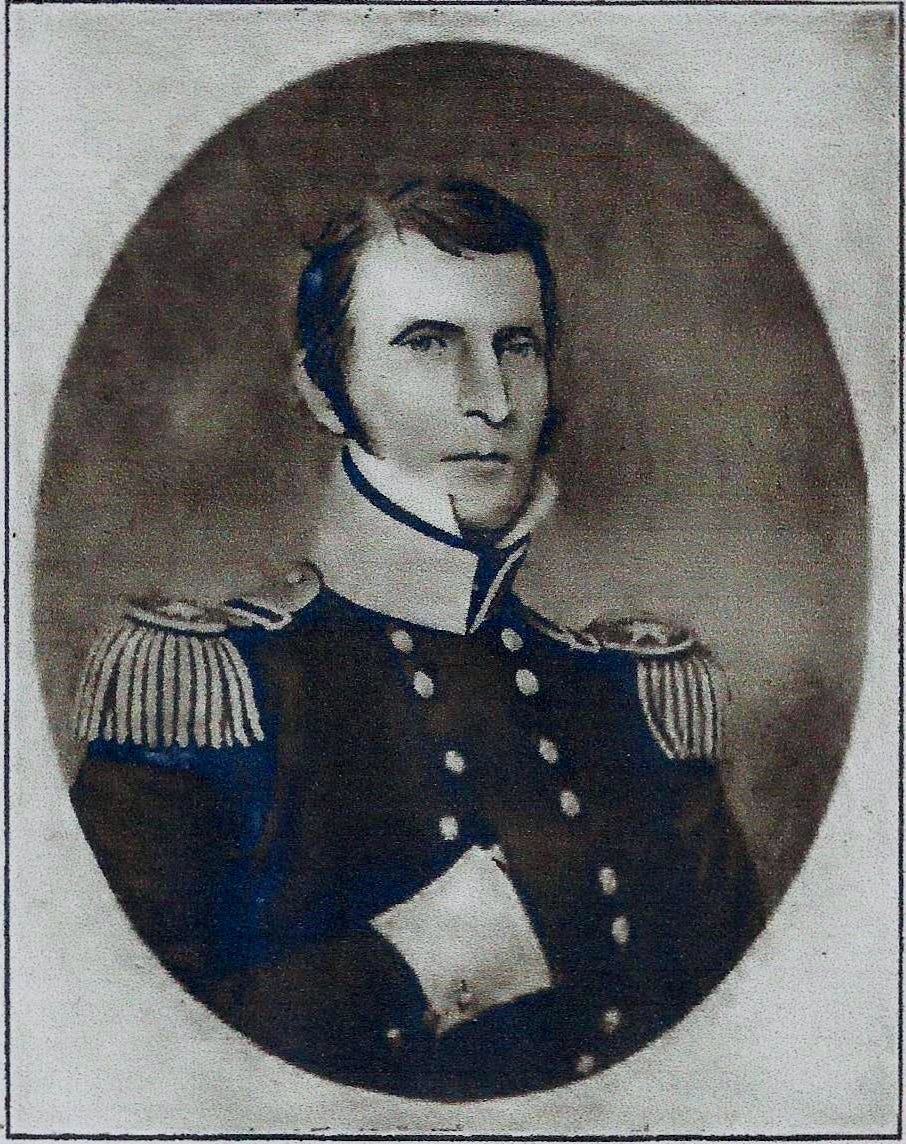
The post itself dates back to May 8, 1827, when Colonel Henry Leavenworth established Cantonment Leavenworth along the Missouri River. It became the first permanent settlement in what would eventually become Kansas, and is today the oldest active Army post west of the Mississippi River. Originally serving as a quartermaster depot, arsenal, and garrison to safeguard the fur trade and commerce along the Santa Fe Trail, the post was briefly evacuated in 1829 and occupied by Kickapoo Indians before being re-garrisoned later that same year. On February 8, 1832, it was officially renamed Fort Leavenworth.

General Henry Leavenworth
Over time, the post developed a reputation not just as a military outpost, but as an intellectual center of the Army. It housed the prestigious Combined Arms Research Library (CARL), and it became a place where strategic thought and operational planning were forged and refined.

Combined Arms Research Library at Fort Leavenworth/
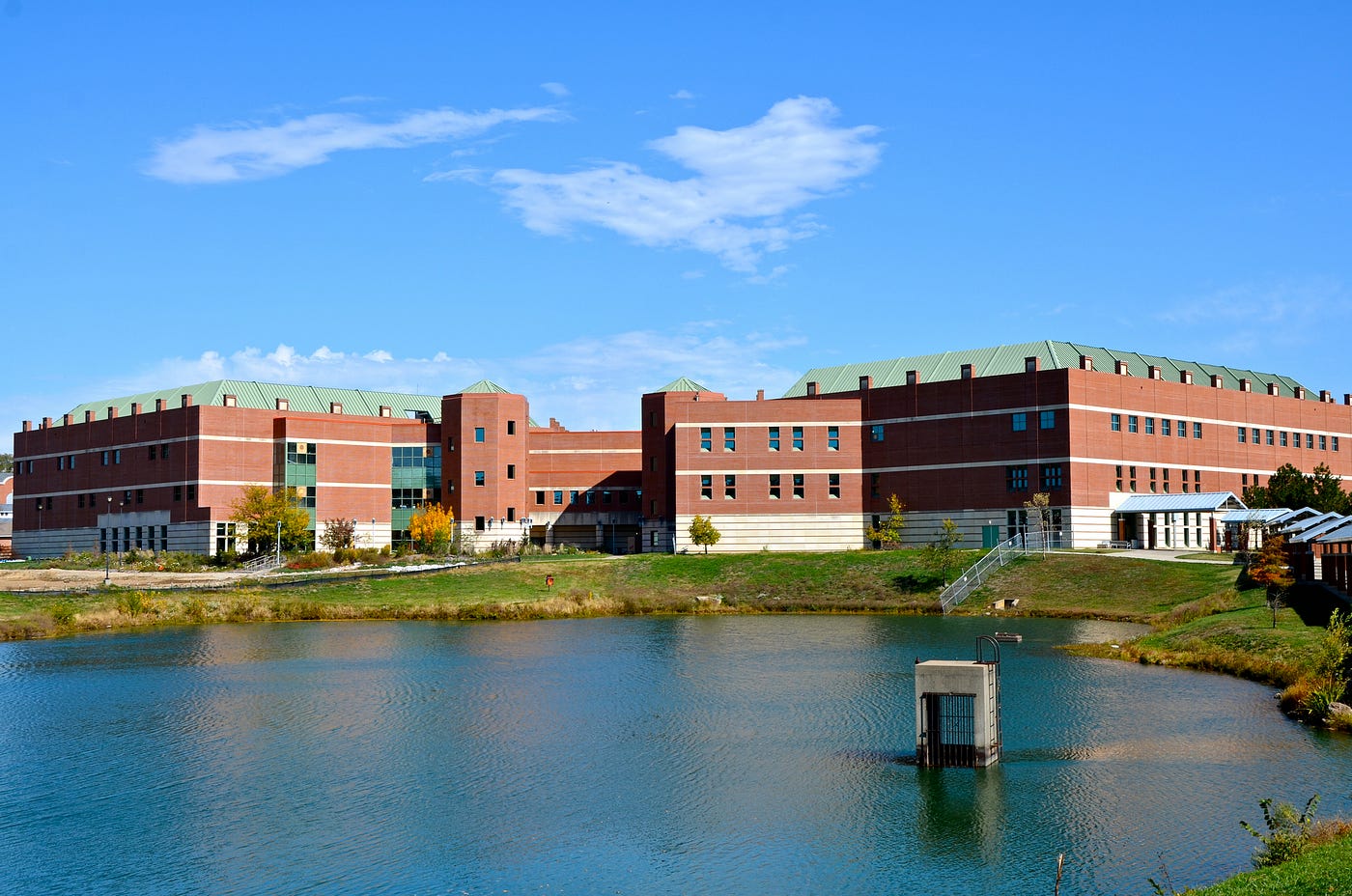
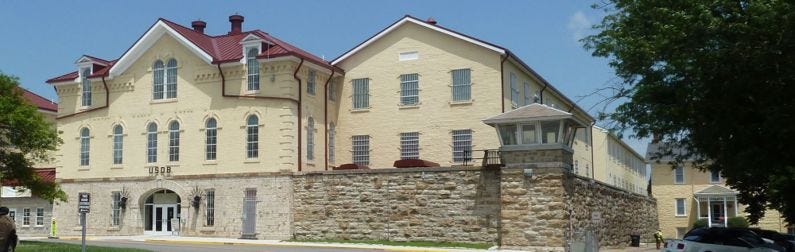
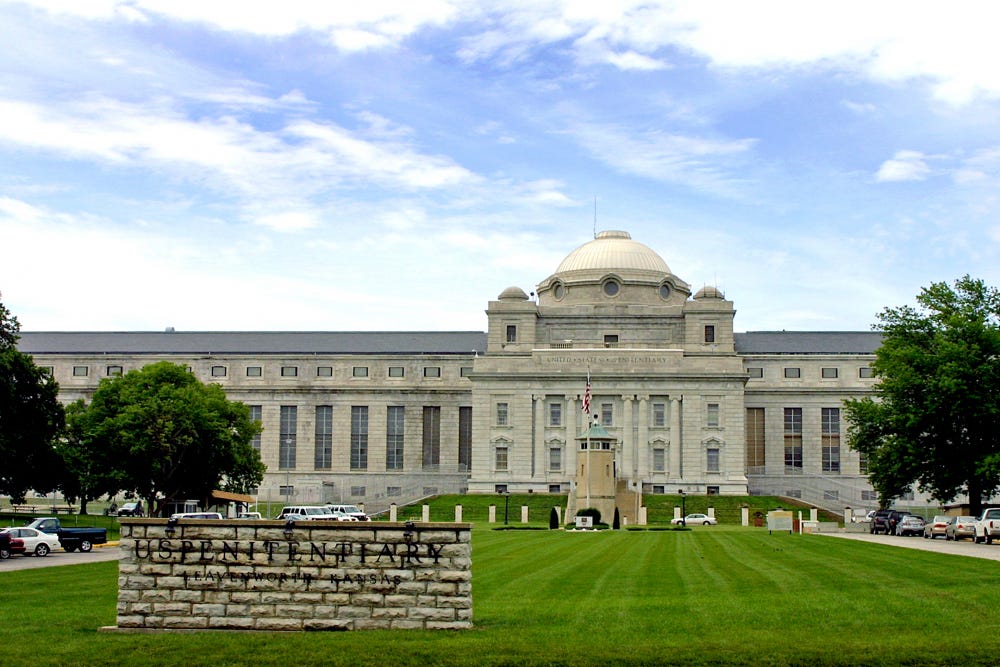
Yet there was another layer to Fort Leavenworth’s identity — its prisons. The United States Disciplinary Barracks (USDB), established in 1875, is the Department of Defense’s only maximum-security military prison. Right outside the gates, the Leavenworth Federal Penitentiary, operated by the Department of Justice, stood as a towering reminder of the civilian justice system’s reach.

U.S. Disciplany Barracks at Fort Leavenworth, Kansas.
Both institutions had reputations for housing some of the most notorious figures in American criminal and military history — from military murderers and spies to civilian outlaws like George “Machine Gun” Kelly, labor leader Eugene V. Debs, and Robert Stroud, the so-called Birdman of Alcatraz. Their stories seemed to hang in the air like myths. Even as children, we sensed the gravity of their presence, and we were always reminded not to stray too far from home. There was mystery and menace just over the horizon.

U.S. Federal Penatentary at Leavenworth, Kansas.
Despite the shadow cast by those prisons, Fort Leavenworth stood as a monument to something greater. It was a place of heritage, reflection, and deep military tradition. For my father, the CGSC experience was transformative. It shaped his approach to leadership and helped define the rest of his career. For our family, it was a time of adaptation, growing pains, and strength. And for me, Fort Leavenworth stirred something inside — an early reverence for history, heroism, and the cavalry legacy that connected us all.

Dad receiving another medal at the Command & General Staff College with my mother by his side.
Front Gate to Fort Leavenworth, Kansas

This History of Command & General Staff College

The United States Command and General Staff College is one of the crown jewels of military education. Established in 1881 by General William Tecumseh Sherman as the School of Application for Infantry and Cavalry, it was designed to train officers in the complexities of tactics, operations, and command. By 1907 it had become the School of the Line, and eventually evolved into what is now CGSC. Its mission remains timeless: to educate and develop agile, adaptive leaders who can operate in joint, interagency, and multinational environments — and to advance the art and science of the profession of arms.

Seal of the U.S. Command & General Staff College at Fort Leavenworth, Kansas.
Seal of the U.S. Command & General Staff College at Fort Leavenworth, Kansas

Famous Alumni of Command & General Staff College

My father knew that the college had shaped some of America’s greatest military minds. Its alumni list reads like a hall of fame: Eisenhower, MacArthur, Marshall, Patton, Bradley, Westmoreland, and later, Colin Powell and Norman Schwarzkopf. To follow in their footsteps — even to walk the same halls — was both humbling and inspiring.

Family Lives Off-Post in Redwood Gardens in Kansas City

Since on-post housing was limited and claimed quickly, our family settled down in a modest townhouse in a small civilian development called Redwood Gardens, located about 35 miles southeast of Fort Leavenworth, in Kansas City, Kansas. Though a few other military families lived there, it lacked the closeness, safety, and camaraderie of post living. For us kids, it was an isolating and sometimes chaotic environment.

Civilian housing at Redwood Gardens in Kansas City where we lived while my father attended the U.S. Command & General Staff College at Fort Leavenworth.
After returning from his first tour in Vietnam in 1967, my father received prestigious orders to attend the United States Army Command and General Staff College (CGSC) at Fort Leavenworth, Kansas. This wasn’t just another stop on the military carousel — it was a pivotal milestone in his ascending career. Being selected early for CGSC was a mark of distinction. It signaled that the Army saw him not only as a skilled officer but as a leader with long-term potential.

Front Gate to Fort Leavenworth, Kansas
The Command and General Staff College is one of the crown jewels of military education. Established in 1881 by General William Tecumseh Sherman as the School of Application for Infantry and Cavalry, it was designed to train officers in the complexities of tactics, operations, and command. By 1907 it had become the School of the Line, and eventually evolved into what is now CGSC. Its mission remains timeless: to educate and develop agile, adaptive leaders who can operate in joint, interagency, and multinational environments — and to advance the art and science of the profession of arms.

Seal of the U.S. Command & General Staff College at Fort Leavenworth, Kansas
My father knew that the college had shaped some of America’s greatest military minds. Its alumni list reads like a hall of fame: Eisenhower, MacArthur, Marshall, Patton, Bradley, Westmoreland, and later, Colin Powell and Norman Schwarzkopf. To follow in their footsteps — even to walk the same halls — was both humbling and inspiring.
Since on-post housing was limited and claimed quickly, our family settled down in a modest townhouse in a small civilian development called Redwood Gardens, located about 35 miles southeast of Fort Leavenworth, in Kansas City, Kansas. Though a few other military families lived there, it lacked the closeness, safety, and camaraderie of post living. For us kids, it was an isolating and sometimes chaotic environment.

Civilian housing at Redwood Gardens in Kansas City, Kansas.
Our townhouse was cramped. My father turned a corner of the basement into a makeshift study where he would disappear for hours, immersed in maps, doctrine, and war histories. The workload at CGSC was intense, and the pressure to excel immense.

Carbone Family Portrait in the Command & General Staff College Yearbook “The Bell”
My own memories of Kansas City during that time are scattered and, for the most part, not especially fond. That year seemed filled with accidents and discomfort. Pamela fell down the basement stairs and had to get stitches on her face. Diana dove into the shallow end of the neighborhood pool and broke her front tooth in half, eventually receiving a dental cap. I got into a fight when I saw a bully beating up a younger kid — jumped in, broke my hand, and spent the rest of the summer in a cast.
One of my more cherished memories I have of our time in Kansas City was the day that Lynne, Diana, and I were all confirmed in the Catholic Church — on the same day — by the Archbishop of Kansas City, Bishop Edward Joseph Hunkeler. It was a peaceful and proud moment in an otherwise trying year.
On weekends when my father could sneak away from his studies, we would occasionally, we would make a special trip into the Italian section of Kansas City to stock up on authentic cold cuts — thin slices of mortadella, prosciutto, and provolone cheese — all tucked lovingly into crusty loaves of Italian bread. The vibrant tapestry of Kansas City in 1967 was interwoven with the rich history of its Italian community, particularly in the neighborhood then known as the North End. Having drawn immigrants — mostly from Sicily — since the 1860s, this area, which would soon be renamed Columbus Park, bustled with life centered around Holy Rosary Church and its many family-owned shops and markets. This self-sufficient “Little Italy” offered more than just delicious food — it was a place where tradition, language, and community thrived. Even as changes like the construction of Interstate 35 began to carve through its heart and displace families, the neighborhood remained a beloved reminder of cultural roots and Sunday flavors that felt like home.

Columbus Park “Little Italy” in Kansas City
But another memory stands out even more clearly — not for its peace, but for its intensity. Just a few doors down from our townhouse lived a parentless family of unruly boys who had clearly slipped through the cracks. They had long, unkempt hair — a growing trend in the late 1960s — and I remember them smoking on their back steps, jeering at us as we passed. One day, they went too far and scared my mother. That was a mistake.
I’ll never forget the moment my father found out. He calmly called out, “Hey, J.R.! Come with me!” and together we stepped into the backyard and walked down the road toward the rough boys’ unit. My father knocked on the door, and the oldest, cockiest of them answered. My father made it very clear: he didn’t want any of them speaking to his wife or his children again.
The kid smirked and said something along the lines of, “What is it to you? I don’t plan on stopping.” Without hesitation, my father grabbed the kid by his long hair and — in a move I can only describe as quiet thunder — drew his service Colt 1911 .45 caliber pistol and placed it gently but firmly under the boy’s jaw. His voice was low, measured, deadly calm. “This will be the last time that I warn you.” Then he released the boy, turned to me, and said evenly, “J.R., let’s get back to your mother… and never say a word about this to her.” That day left a mark on me. I had always admired my father, but in that moment, I saw him not only as a soldier but as a protector. I had never felt so safe in my life.
Despite all the challenges of civilian housing, my heart always returned to the post of Fort Leavenworth. Some of my fondest memories of that tour are tied to my personal fascination with the history of the fort — especially its deep connections to the U.S. Cavalry. I was captivated by the legacy of General George Armstrong Custer and his 7th Cavalry, as well as the legendary Buffalo Soldiers of the 10th U.S. Cavalry — the same regiment my father had served with during his tour in Korea. I felt a personal connection to that history, one that ran through the bloodline of my own father.

General George Armstrong Custor of the U.S. 7th Cavalry.

Buffalo Soldiers of the U.S. 10th Cavalry
The post was still very much a place of history. Many of the old red brick buildings from cavalry days still stood, preserved like time capsules from another era. I found myself drawn again and again to the Fort Leavenworth museum, which was filled with relics from Custer, the 7th Cavalry, and the 10th Cavalry. There were even artifacts and exhibits tied to President Abraham Lincoln’s visit to the post, which added another layer of reverence. My family often made Sunday day trips to the museum. Those quiet visits — walking through dusty uniforms, sabers, saddles, and faded photographs — lit a spark in me. Even as a child, I felt that Fort Leavenworth was hallowed ground.

Typical post housing at Fort Leavenworth dating back to its cavalry days.
The post itself dates back to May 8, 1827, when Colonel Henry Leavenworth established Cantonment Leavenworth along the Missouri River. It became the first permanent settlement in what would eventually become Kansas, and is today the oldest active Army post west of the Mississippi River. Originally serving as a quartermaster depot, arsenal, and garrison to safeguard the fur trade and commerce along the Santa Fe Trail, the post was briefly evacuated in 1829 and occupied by Kickapoo Indians before being re-garrisoned later that same year. On February 8, 1832, it was officially renamed Fort Leavenworth.

General Henry Leavenworth
Over time, the post developed a reputation not just as a military outpost, but as an intellectual center of the Army. It housed the prestigious Combined Arms Research Library (CARL), and it became a place where strategic thought and operational planning were forged and refined.

Combined Arms Research Library at Fort Leavenworth/
Yet there was another layer to Fort Leavenworth’s identity — its prisons. The United States Disciplinary Barracks (USDB), established in 1875, is the Department of Defense’s only maximum-security military prison. Right outside the gates, the Leavenworth Federal Penitentiary, operated by the Department of Justice, stood as a towering reminder of the civilian justice system’s reach.

U.S. Disciplany Barracks at Fort Leavenworth, Kansas.
Both institutions had reputations for housing some of the most notorious figures in American criminal and military history — from military murderers and spies to civilian outlaws like George “Machine Gun” Kelly, labor leader Eugene V. Debs, and Robert Stroud, the so-called Birdman of Alcatraz. Their stories seemed to hang in the air like myths. Even as children, we sensed the gravity of their presence, and we were always reminded not to stray too far from home. There was mystery and menace just over the horizon.

U.S. Federal Penatentary at Leavenworth, Kansas.
Despite the shadow cast by those prisons, Fort Leavenworth stood as a monument to something greater. It was a place of heritage, reflection, and deep military tradition. For my father, the CGSC experience was transformative. It shaped his approach to leadership and helped define the rest of his career. For our family, it was a time of adaptation, growing pains, and strength. And for me, Fort Leavenworth stirred something inside — an early reverence for history, heroism, and the cavalry legacy that connected us all.

Part of the autobiography of Dr. Anthony J. Carbone, Son in the Shadow of a Green Beret Hero.
Civilian housing at Redwood Gardens in Kansas City, Kansas.

Dad sets up basement as Study

Our townhouse was cramped. My father turned a corner of the basement into a makeshift study where he would disappear for hours, immersed in maps, doctrine, and war histories. The workload at CGSC was intense, and the pressure to excel immense.

Carbone Family Portrait in the U.S. Command & General Staff College Yearbook "The Bell".

Part of the autobiography of Dr. Anthony J. Carbone, Son in the Shadow of a Green Beret Hero.
Carbone Family Portrait in the Command & General Staff College Yearbook “The Bell”

The bad memories of Kansas City

My own memories of Kansas City during that time are scattered and, for the most part, not especially fond. That year seemed filled with accidents and discomfort. Pamela fell down the basement stairs and had to get stitches on her face. Diana dove into the shallow end of the neighborhood pool and broke her front tooth in half, eventually receiving a dental cap. I got into a fight when I saw a bully beating up a younger kid — jumped in, broke my hand, and spent the rest of the summer in a cast.

Lynne, Diana and I get Confirmed

One of my more cherished memories I have of our time in Kansas City was the day that Lynne, Diana, and I were all confirmed in the Catholic Church — on the same day — by the Archbishop of Kansas City, Bishop Edward Joseph Hunkeler. It was a peaceful and proud moment in an otherwise trying year.

Papa Carbone Dies

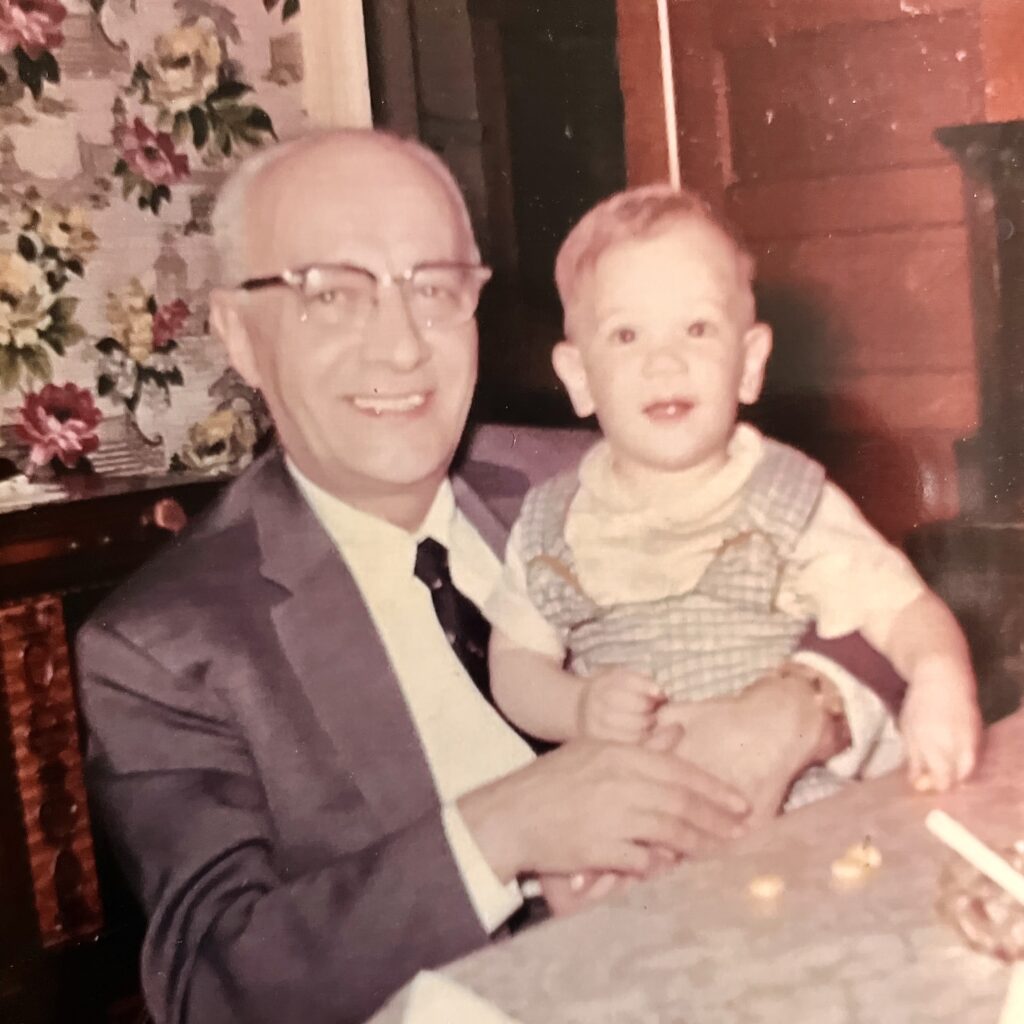
The saddest memory I have from our time in Kansas City was the death of my grandfather, Papa Carbone (Anthony Benjamin Carbone). He had just retired and moved to Florida with my grandmother when he suffered a fatal stroke. I remember my father calling me into my bedroom one evening. I could see that he was upset, and at first I worried I had done something wrong. We both sat on my bed, and he said quietly, “I have some bad news. Your grandfather—my father—died today.” I don’t remember another word after that, but what has stayed with me all these years is that my father cried. It was the first time I had ever seen him cry, and in my whole life with him, I would only see him cry once more. My parents quickly flew to Florida for the wake and funeral, while Auntie Norma came to Kansas City to care for us children.

Photograph of my grandfather, Papa Carbone (Anthony Benjamin Carbone the tailor) holding me when I was about one year old.  Gray haired gentleman wearing a suit and tie holding a toddler boy in his arms.  Autobiography of Dr. Anthony J. Carbone.
Papa Carbone holding me when I was about one year old.

Columbus Park–The Italian Section of Kansas City

On weekends when my father could sneak away from his studies, we would occasionally, we would make a special trip into the Italian section of Kansas City to stock up on authentic cold cuts — thin slices of mortadella, prosciutto, and provolone cheese — all tucked lovingly into crusty loaves of Italian bread.

In 1967, Kansas City’s vibrant tapestry reflected the rich history of its Italian community, especially in the neighborhood then known as the North End. Since the 1860s, Sicilian immigrants actively built a lively, close-knit area—soon renamed Columbus Park—centering it around Holy Rosary Church and filling it with family-owned shops and bustling markets.

This self-sufficient “Little Italy” offered more than just delicious food — it was a place where tradition, language, and community thrived. Even as changes like the construction of Interstate 35 began to carve through its heart and displace families, the neighborhood remained a beloved reminder of cultural roots and Sunday flavors that felt like home.

Columbus Park "Little Italy" section of Kansas City.

Part of the autobiography of Dr. Anthony J. Carbone, Son in the Shadow of a Green Beret Hero.
Columbus Park “Little Italy” in Kansas City

My Badass Father the Soldier

But another memory stands out even more clearly — not for its peace, but for its intensity. Just a few doors down from our townhouse lived a parentless family of unruly boys who had clearly slipped through the cracks. They had long, unkempt hair — a growing trend in the late 1960s — and I remember them smoking on their back steps, jeering at us as we passed. One day, they went too far and scared my mother. That was a mistake.

I’ll never forget the moment my father found out. He calmly called out, “Hey, J.R.! Come with me!” and together we stepped into the backyard and walked down the road toward the rough boys’ unit. My father knocked on the door, and the oldest, cockiest of them answered. My father made it very clear: he didn’t want any of them speaking to his wife or his children again.

The kid smirked and said something along the lines of, “What is it to you? I don’t plan on stopping.” Without hesitation, my father grabbed the kid by his long hair and — in a move I can only describe as quiet thunder — drew his service Colt 1911 .45 caliber pistol and placed it gently but firmly under the boy’s jaw. His voice was low, measured, deadly calm. “This will be the last time that I warn you.” Then he released the boy, turned to me, and said evenly, “J.R., let’s get back to your mother. And never say a word about this to her.” That day left a mark on me. I had always admired my father, but in that moment, I saw him not only as a real soldier. I had never felt so safe in my life.

History of Fort Leavenworth

Despite all the challenges of civilian housing, my heart always returned to the post of Fort Leavenworth. Some of my fondest memories of that tour stem from my personal fascination with the fort’s history, particularly its deep connections to the Cavalry. I actively explored the legacy of General George Armstrong Custer and his 7th Cavalry, as well as the legendary Buffalo Soldiers of the 10th U.S. Cavalry— the same regiment my father had served with during his tour in Korea. I felt a personal connection to that history, one that ran through the bloodline of my own father.

General George Armstrong Custer of the U.S. 7th Cavalry.

Part of the autobiography of Dr. Anthony J. Carbone, Son in the Shadow of a Green Beret Hero.
General George Armstrong Custor of the U.S. 7th Cavalry.
Buffalo Soldiers of the U.S. 10th Cavalry.

Part of the autobiography of Dr. Anthony J. Carbone, Son in the Shadow of a Green Beret Hero.
Buffalo Soldiers of the U.S. 10th Cavalry

The Fort Leavenworth Museum

The post was still very much a place of history. Many of the old red brick buildings from cavalry days still stood, preserved like time capsules from another era. I repeatedly visited the Fort Leavenworth museum, eagerly exploring its relics from Custer, the 7th Cavalry, and the 10th Cavalry.

There were artifacts and exhibits tied to President Abraham Lincoln’s visit to the post, which added another layer of reverence. My family often made Sunday day trips to the museum. Those quiet visits — walking through dusty uniforms, sabers, saddles, and faded photographs — lit a spark in me. As a child, I regarded Fort Leavenworth as hallowed ground.

Classic Cavalry-Era Post Housing

Typical post housing at Fort Leavenworth dating back to its cavalry days.

Part of the autobiography of Dr. Anthony J. Carbone, Son in the Shadow of a Green Beret Hero.
Typical post housing at Fort Leavenworth dating back to its cavalry days.

The post itself dates back to May 8, 1827, when Colonel Henry Leavenworth established Cantonment Leavenworth along the Missouri River. It became the first permanent settlement in what would eventually become Kansas, and is today the oldest active Army post west of the Mississippi River. Originally serving as a quartermaster depot, arsenal, and garrison to safeguard the fur trade and commerce along the Santa Fe Trail, the post was briefly evacuated in 1829 and occupied by Kickapoo Indians before being re-garrisoned later that same year. On February 8, 1832, it was officially renamed Fort Leavenworth.

Portrait of General Henry Leavenworth.

Part of the autobiography of Dr. Anthony J. Carbone, Son in the Shadow of a Green Beret Hero.
General Henry Leavenworth

Combined Arms Research Library

Over time, the post developed a reputation not just as a military outpost, but as an intellectual center of the Army. It housed the prestigious Combined Arms Research Library (CARL), and it became a place where strategic thought and operational planning were forged and refined.

Photograph of the Combined Arms Research Library at Fort Leavenworth, Kansas.

Part of the autobiography of Dr. Anthony J. Carbone, Son in the Shadow of a Green Beret Hero.
Combined Arms Research Library at Fort Leavenworth/

US Disciplinary Barracks at Fort Leavenworth

Yet there was another layer to Fort Leavenworth’s identity — its prisons. The United States Disciplinary Barracks (USDB), established in 1875, is the Department of Defense’s only maximum-security military prison.

Photograph of the U.S. Disciplinary Barracks at Fort Leavenworth, Kansas.

Part of the autobiography of Dr. Anthony J. Carbone, Son in the Shadow of a Green Beret Hero.
U.S. Disciplany Barracks at Fort Leavenworth, Kansas.

Leavenworth Federal Penitentiary

Right outside the gates, the Leavenworth Federal Penitentiary, operated by the Department of Justice, stood as a towering reminder of the civilian justice system’s reach.

Photograph of the U.S. Federal Penitentiary at Leavenworth, Kansas 

Part of the autobiography of Dr. Anthony J. Carbone, Son in the Shadow of a Green Beret Hero.
U.S. Federal Penatentiary at Leavenworth, Kansas.

Famous Resident Convicts

Both institutions had reputations for housing some of the most notorious figures in American criminal and military history — from military murderers and spies to civilian outlaws like George “Machine Gun” Kelly, labor leader Eugene V. Debs, and Robert Stroud, the so-called Birdman of Alcatraz. Their stories seemed to hang in the air like myths. Even as children, we sensed the gravity of their presence, and we were always reminded not to stray too far from home. There was mystery and menace just over the horizon.

Despite the shadow cast by those prisons, Fort Leavenworth stood as a monument to something greater. It was a place of heritage, reflection, and deep military tradition. For my father, the CGSC experience was transformative. It shaped his approach to leadership and helped define the rest of his career. For our family, it was a time of adaptation, growing pains, and strength. And for me, Fort Leavenworth stirred something inside — an early reverence for history, heroism, and the cavalry legacy that connected us all.

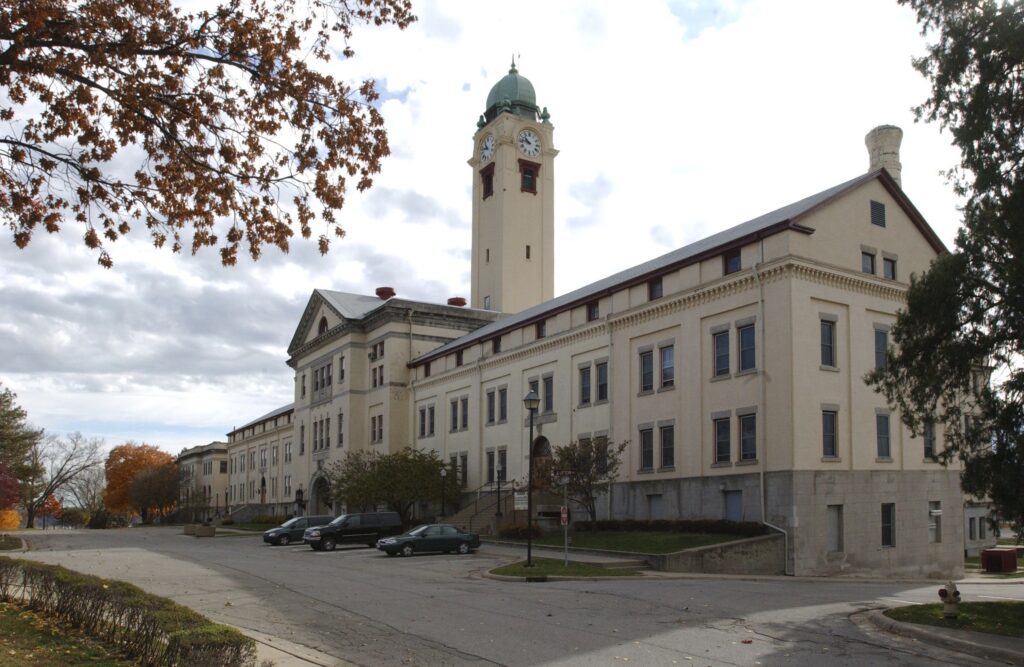
Grant Hall at Fort Leavenworth, Kansas.  Headquarters of the U.S. Army Combined Arms Center.  Autobiography of Dr. Anthony J. Carbone.
Grant Hall at Fort Leavenworth, Kansas. Headquarters of the U.S. Army Combined Arms Center
4th Grade School Photo in Kansas City, Kansas while Dad was attending the U.S. Command & General Staff College at Fort Leavenworth. Biography of Dr. Anthony J. Carbone.
4th Grade Class Photo from Kansas City, Kansas

Home Page

Chapter 6: A Year in Vermont as Dad Returns to His Alma Mater

Seal of Norwich University (Military College of Vermont) in Northfiield, Vermont. Autobiography of Dr. Anthony J. Carbone.

Believe Nothing You Hear, and Only Half of What You SeeA Memoir of Service, Shame, and the Search for Truth

Return to Norwich University

After completing his tour of duty in Korea, my father received new orders that must have filled him with pride: he was to return to his alma mater, Norwich University — the Military College of Vermont — as an Assistant Professor of Military Science. For him, it was more than just a job; it was a return to the place that had shaped him as a young man and launched his military career. For our family, it became a unique and vivid chapter — one filled with snowy landscapes, small-town charm, and a few lessons we never forgot.

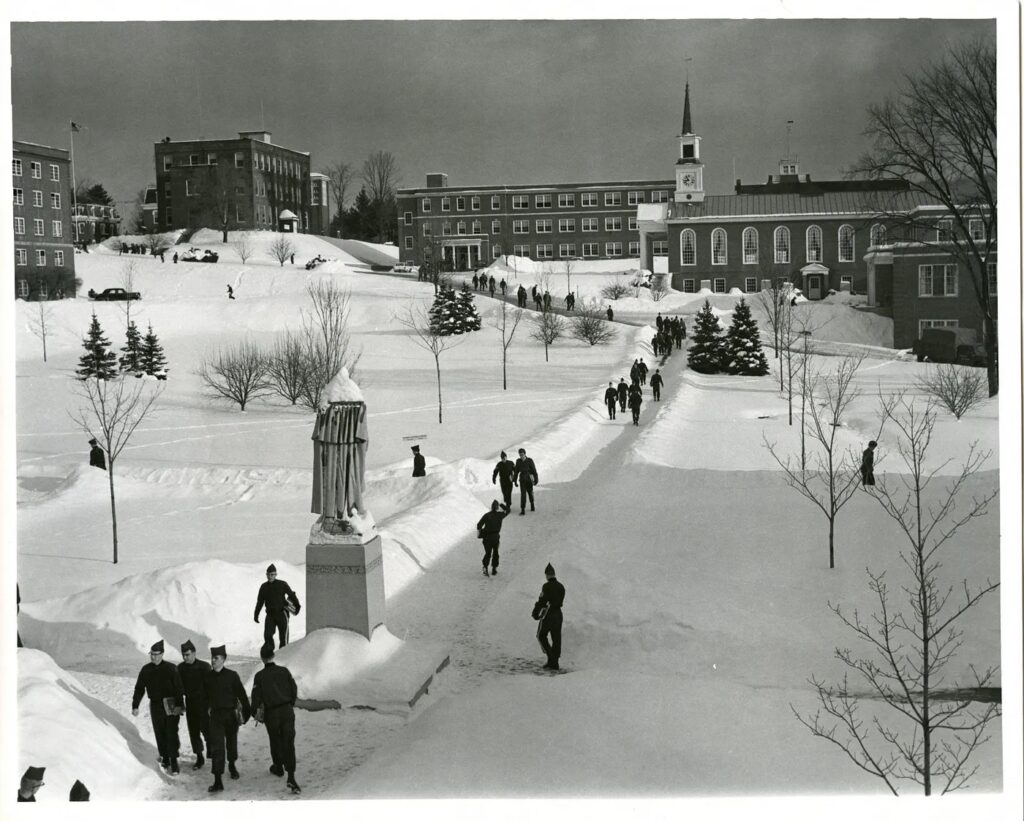
Photograph of Norwich University circa 1969 with snow covered quad.  Red brick academic buildings and barracks.  Cadet Chapel.  Part of biography of Dr. Anthony J. Carbone.
Cadets walking on snow-covered campus of Norwich University.

We move to off-campus house in Northfield, Vermont

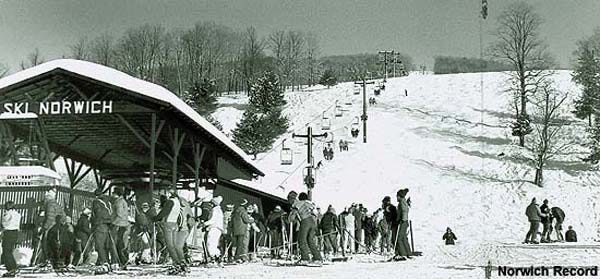
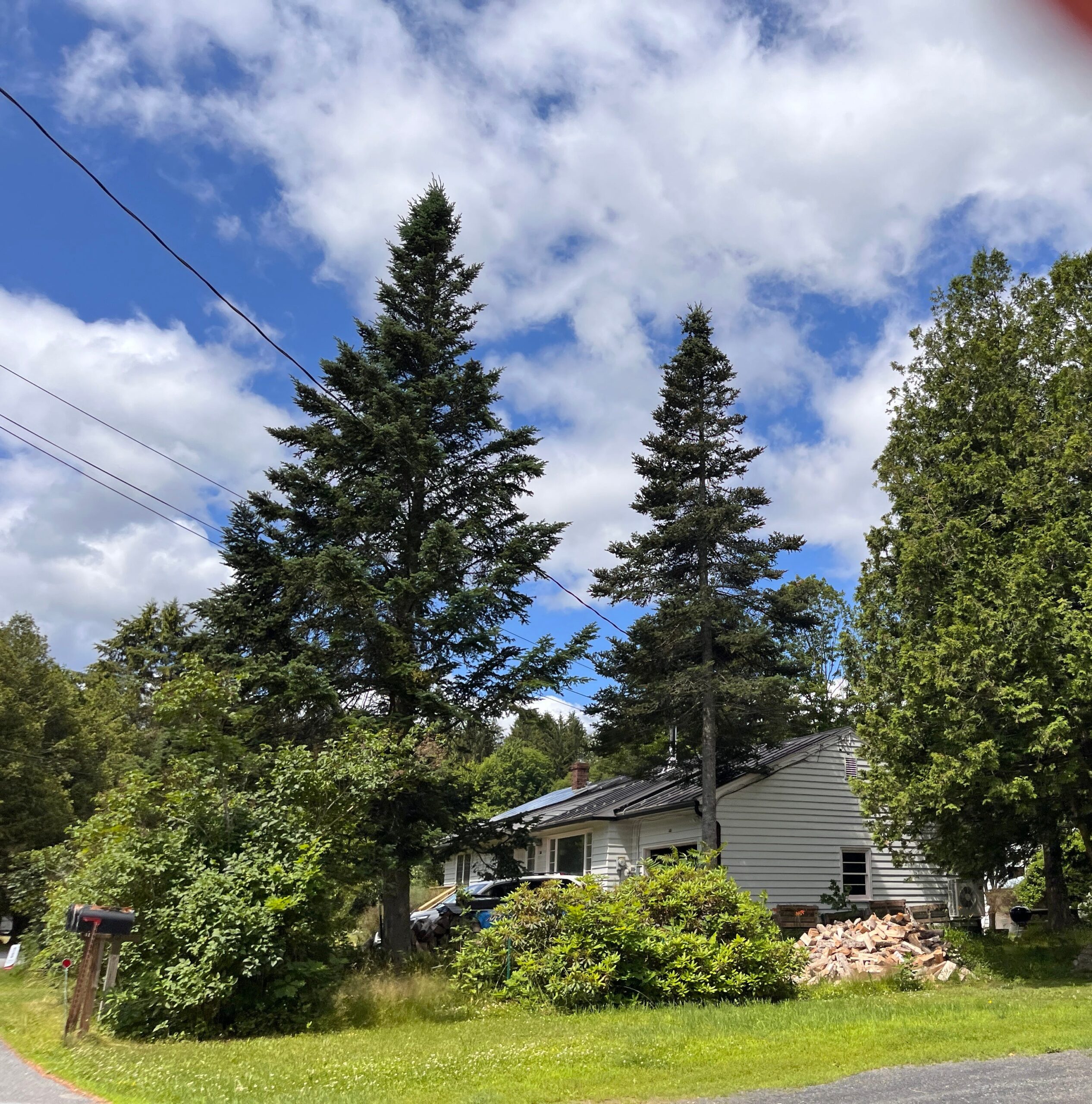
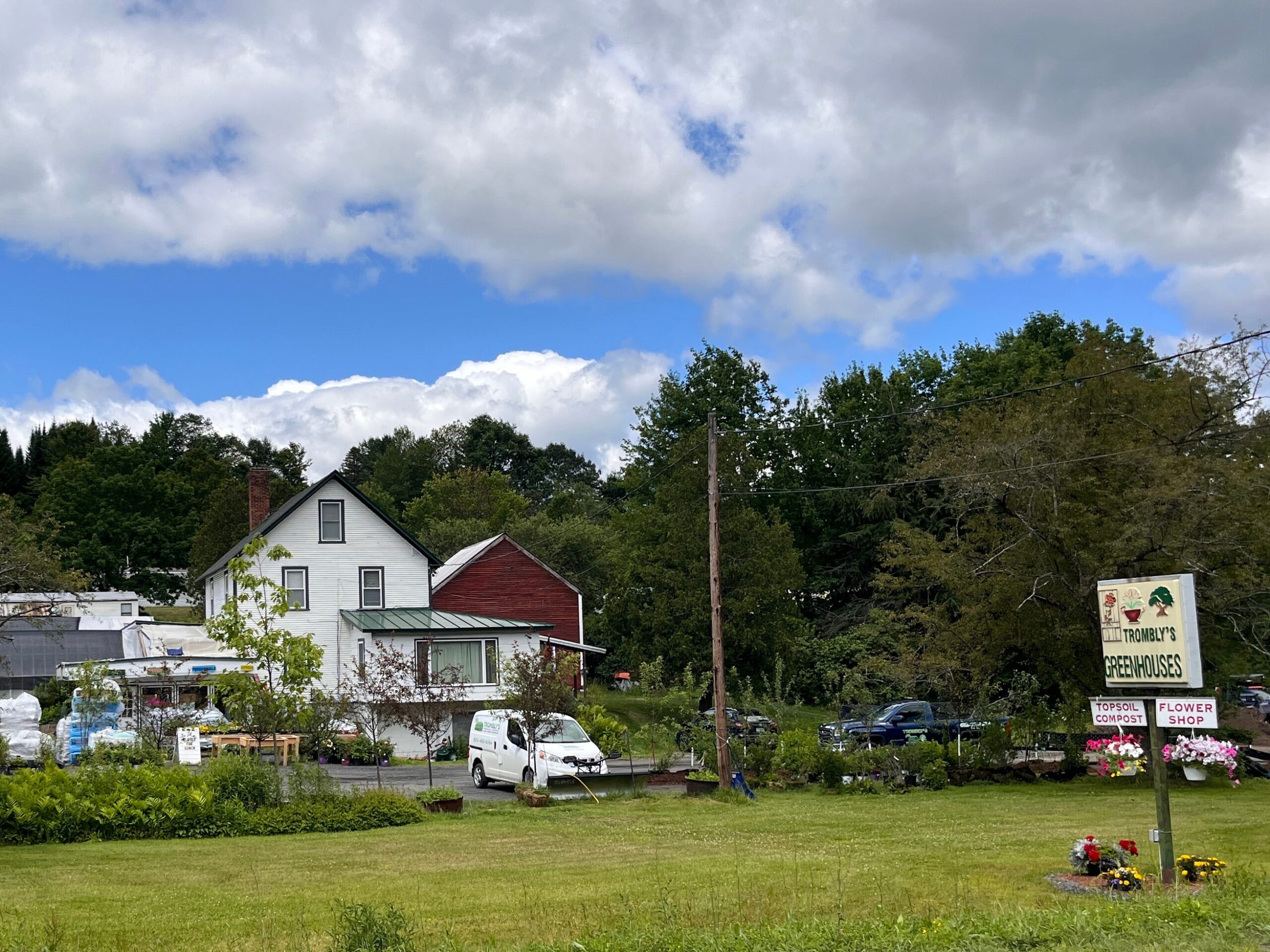
We moved into a modest white ranch house at the foot of the Norwich ski slope, within easy walking distance of the campus. The house was small but cozy, and the setting was pure Vermont. Behind us sat Trombley’s greenhouse, where we could buy ears of corn and other fresh vegetables. It was one of those places where the seasons announced themselves through what was available at the roadside stand.

Norwich University Ski Slope & Lift across the street from our home in Northfield, Vermont.
Part of the autobiography of Dr. Anthony J. Carbone, Son in the Shadow of a Green Beret Hero.
Norwich University Ski Slope & Lift across the street from our home in Northfield.
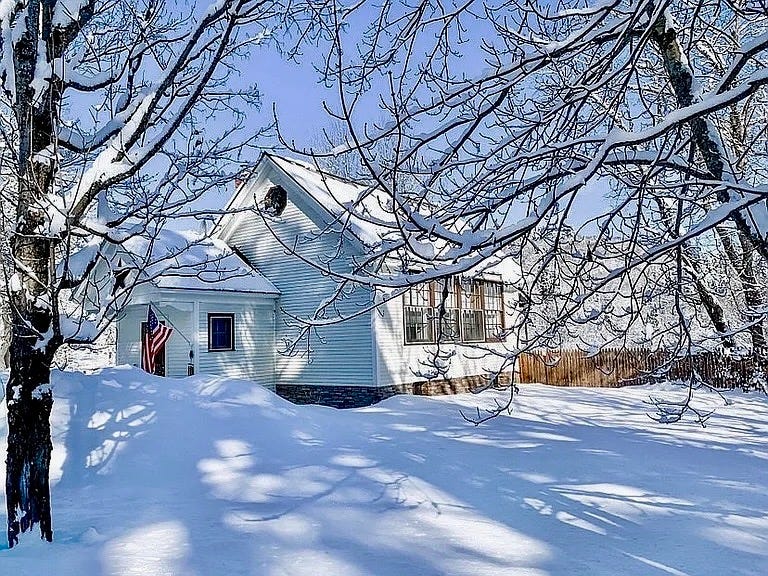
Our home on Terrace Place in Northfield, Vermont where we lived while my father was working at Norwich University (his alma mater) as the Assistant Professor of Military Science (PMS).
Part of the autobiography of Dr. Anthony J. Carbone, Son in the Shadow of a Green Beret Hero.
Our home on Terrace Place in Northfield, Vermont where we lived while my father was working at Norwich University (his alma mater) as the Assistant Professor of Military Science (PMS).
Trombly's Greenhouse near our home in Northfield, Vermont where we bought fresh corn and eggs.
Part of the autobiography of Dr. Anthony J. Carbone, Son in the Shadow of a Green Beret Hero.
Trombly’s Greenhouse near our home in Northfield, Vermont where we bought fresh corn and eggs.

Lynne goes to 5th Grade in One-Room Schoolhouse

My oldest sister, Lynne, went to fifth grade in a tiny white, one-room schoolhouse located in Rabbit Hollow. The school was so small that it only served fifth graders.

One-Room Schoolhouse at Rabbit Hollow where my sister Lynne attended 5th Grade while we lived in Northfield, Vermont.
Part of the autobiography of Dr. Anthony J. Carbone, Son in the Shadow of a Green Beret Hero.
One-Room Schoolhouse at Rabbit Hollow where my sister Lynne attended 5th Grade while we lived in Northfield, Vermont.

Diana and I attend 4th & 3rd Grade Together

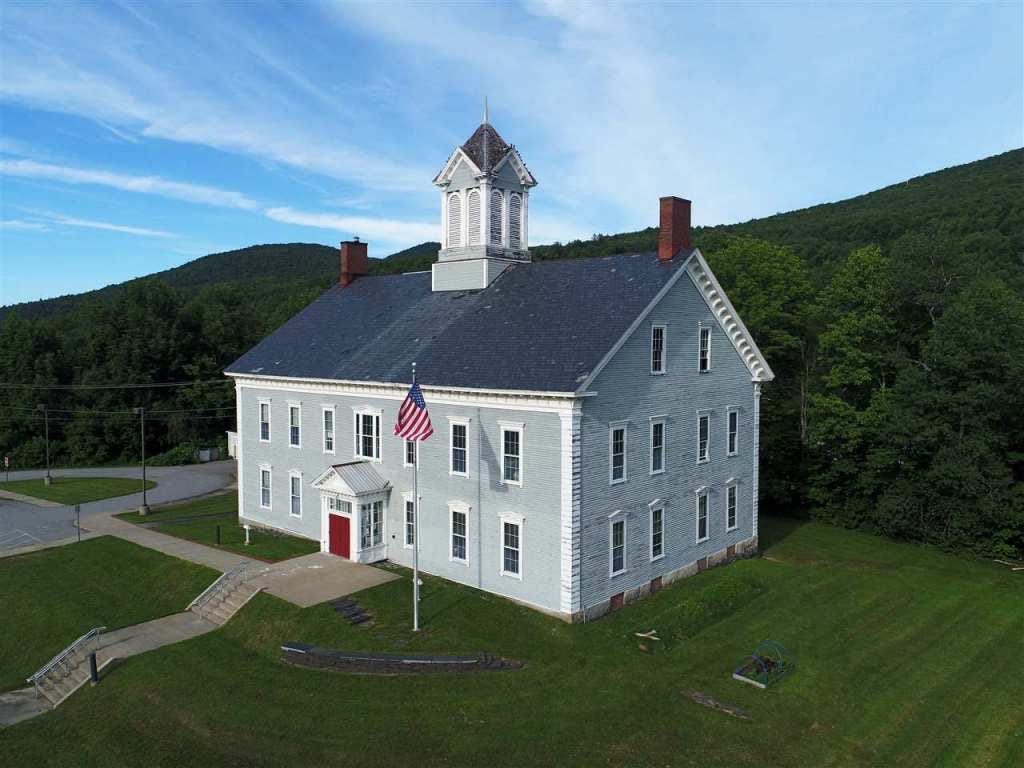
Meanwhile, Diana and I were enrolled in a two-story gray schoolhouse in Northfield that taught only third and fourth grades. She was in fourth, I was in third — and I loved knowing she was just a floor away. We rode the bus together each morning and afternoon, and often shared lunch in the cafeteria tucked down in the basement.

Northfield Grade School in the Gray Building in Northfield, Vermont where Diana and I attended 3rd and 4th grade while my father worked at Norwich University.
Part of the autobiography of Dr. Anthony J. Carbone, Son in the Shadow of a Green Beret Hero.
Northfield Grade School in the Gray Building in Northfield, Vermont where Diana and I attended 3rd and 4th grade while my father worked at Norwich University.

My favorite school cafeteria

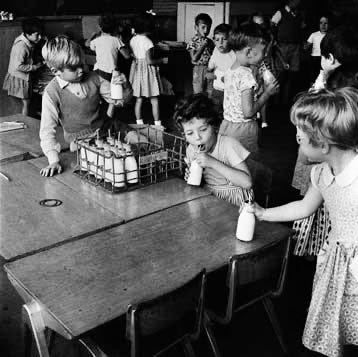
That basement cafeteria remains one of my warmest memories — especially on bitter Vermont winter days. The meals were like no other school lunches I’ve ever had. A typical menu might include a warm biscuit smothered in Chicken à la King, served alongside milk that came in small glass bottles sealed with silver foil tops. At least once a day, someone would drop a bottle, and it would shatter spectacularly on the floor. The room would erupt into clapping and cheers, as if we had just witnessed a performance.

Cold, fresh milk in tiny glass bottles

Children drinking milk from tiny glass milk bottles in the cafeteria in Vermont in the 1960s.
Part of the autobiography of Dr. Anthony J. Carbone, Son in the Shadow of a Green Beret Hero.
Drinking milk from small glass bottles in cafeteria.

Missed out on learning cursive penmanship

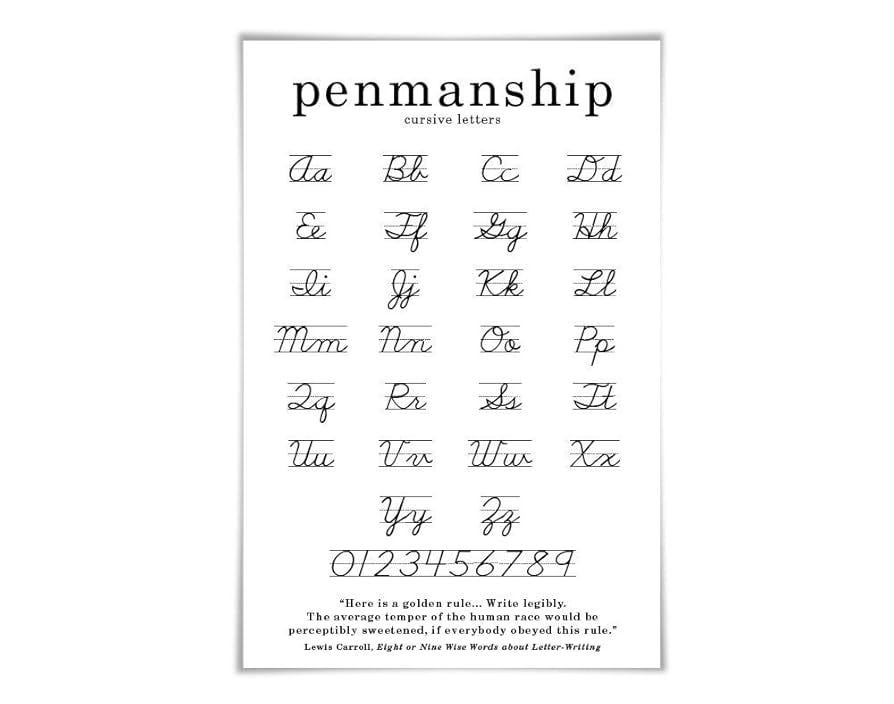
School life had its challenges, though. In Vermont, students were taught cursive writing with ink pens in the second grade. But I had just come from the German school system, where cursive wasn’t introduced until third grade. My new teacher seemed annoyed that I hadn’t learned it yet, and I remember feeling confused and even a little ashamed. It struck me as strange — even as an eight-year-old — that in a town with a military college, someone wouldn’t expect a student from out of state, or even another country. Eventually, my teacher allowed me to keep printing with a pencil, and I wouldn’t truly learn cursive until years later, when my college girlfriend Marianne patiently taught me proper penmanship. To this day, I still write in clear block letters and rarely use cursive.

Penmanship poster similar to the one hanging up in my 3rd Grade Classroom in Northfield, Vermont.
Part of the autobiography of Dr. Anthony J. Carbone, Son in the Shadow of a Green Beret Hero.
Penmanship Poster similar to the one hanging up in my 3rd Grade classroom.

While we were adjusting to Vermont life, my father was thriving. As the Assistant Professor of Military Science (PMS), he helped lead the Army ROTC program, teaching courses in close-order drill, map reading, and land navigation. I know he took real pride in shaping young cadets on the same campus where he had once marched across the quad himself. It must have felt like coming full circle.

Norwich Univeristy Cadet Handbook.
Part of the autobiography of Dr. Anthony J. Carbone, Son in the Shadow of a Green Beret Hero.
Norwich University Cadet Handbook

Winter and Hockey in Vermont

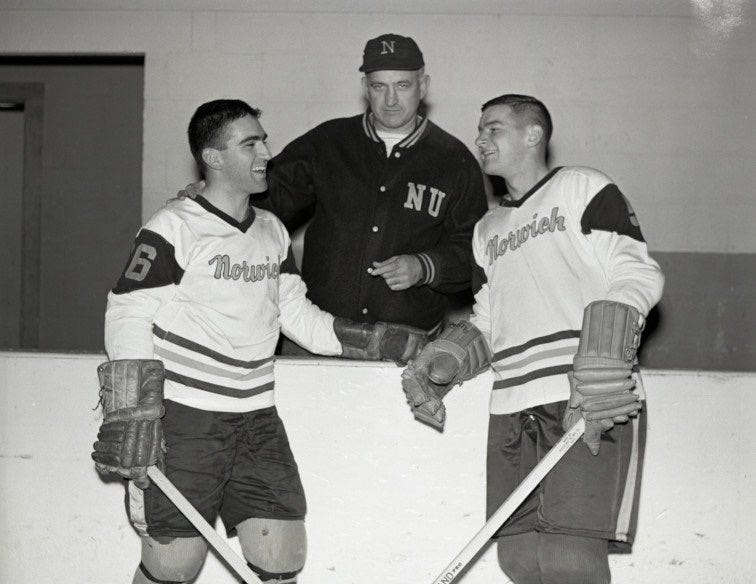
As you might expect, winters in Vermont were long, dark, and cold — but the locals seemed to thrive on it. Skiing and hockey weren’t just hobbies — they were part of the culture. Hoping I might assimilate, my father signed me up for hockey lessons offered by the Norwich University hockey coach. I gave it my best, but most of the kids had been skating since they could walk. On the other hand, I was stumbling around in skates that felt at least two sizes too small. I spent more time falling than skating, and one hard fall even chipped my front teeth. That was pretty much the beginning and end of my hockey career.

Norwich University Cadet Hockey Players and the Hockey Coach.
Part of the autobiography of Dr. Anthony J. Carbone, Son in the Shadow of a Green Beret Hero.
Norwich University Cadet Hockey Players and the Hockey Coach

Northfield Townies

Northfield was a tiny town — just over 3,400 residents in 1960. By 1967, Norwich had about 1,200 cadets, meaning they made up nearly a quarter of the town’s population. But despite that, there was always a strange tension between the college and the townspeople. For whatever reason, the locals didn’t seem particularly fond of the institution that helped sustain their town. The only time that changed was during hockey season — if the Norwich Cadets were winning, the townsfolk would turn out to cheer. Otherwise, the university and the town existed on mostly separate tracks.

Close to the Pietrantonis in Medford

One of the real blessings of that year in Vermont was our proximity to family. Northfield is less than three hours north of Boston, which meant we were finally living close to my mother’s side of the family in Medford. We visited my grandparents’ house often, and my aunts would come up to Vermont when they could. After years of being stationed far from home, it was special to have holidays, birthdays, or even just weekend visits that didn’t require a cross-country drive or plane ride. That closeness was a quiet comfort that made the cold winters feel warmer.

Photograph of a champagne colored 1967 Pontiac Tempest Stationwagon similar to the one my family owned.
Part of the autobiography of Dr. Anthony J. Carbone, Son in the Shadow of a Green Beret Hero.
We drove in a 1967 Pontiac Tempest Stationwagon

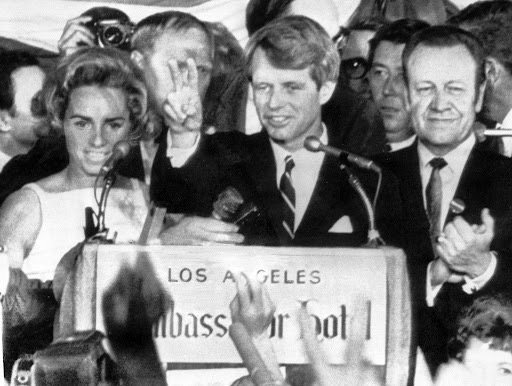
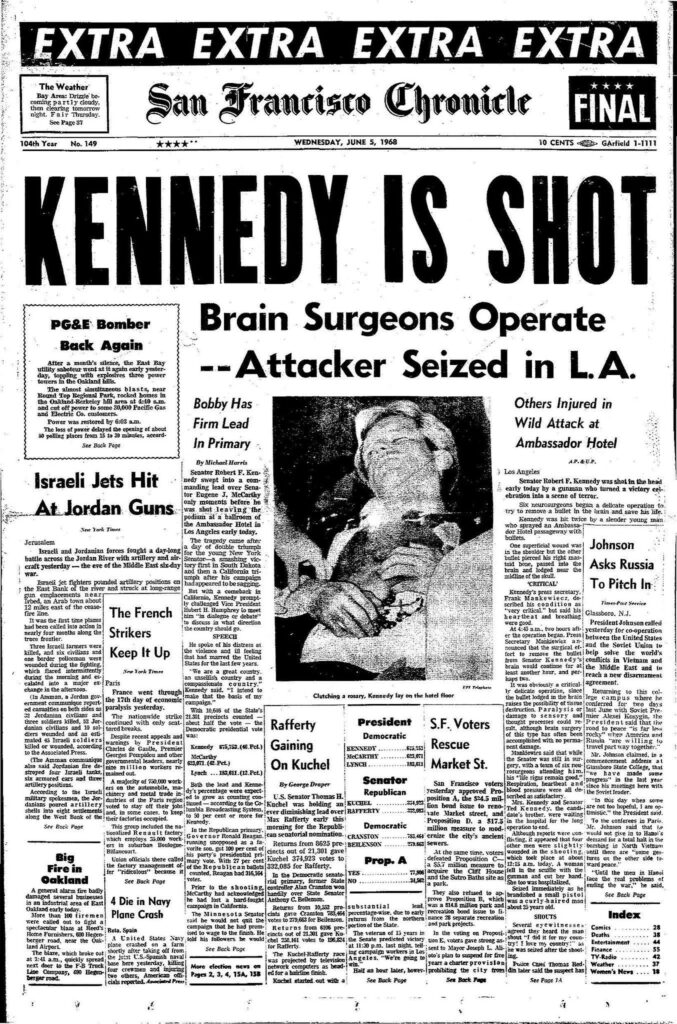
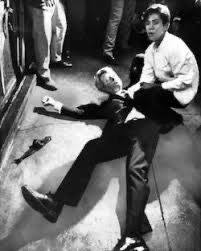
Assassination of Senator Robert Kennedy (June 6, 1968)

It was the morning of June 6, 1968, and my mother had sent me over to Trombley’s Greenhouse to pick up some milk and eggs. The day was bright and beautiful, and I remember stopping in a field along the way to admire a robin’s nest with four perfect blue eggs inside. That simple sight filled me with joy. But when I returned home, the mood was completely different. I could sense immediately that something was wrong. My mother told me that Senator Robert Kennedy had been shot by an assassin. I was still too young to fully understand the concepts of evil and murder, but I knew it was something terrible.

Only a few years earlier, I had sat in front of the television as a very small boy when President John F. Kennedy was assassinated. Now, it was his younger brother. Just eight weeks earlier, on April 4, 1968, Martin Luther King Jr. had also been assassinated. As a young boy, I struggled to process it all — the war in Vietnam that I only partly understood, and these assassinations of leaders I heard my parents speak about with respect and admiration. It felt like the world was unraveling. I remember being deeply confused, wondering why so many good men were being taken away, and why violence seemed to surround everything I was trying to make sense of.

Time to Move Again

Our year in Vermont was brief, but it stands out in memory as something rare and quietly golden. There was a steadiness to life that year — a rhythm built on snow, school buses, cafeteria clatter, and my father’s cadets drilling in neat formation. It was a pause between larger, louder chapters. And though we didn’t know it at the time, those moments would stay with us longer than many others.

Home Page

Chapter 5: Dad’s First Tour of Duty in Vietnam (1966–1967)

Dad as Tactical Advisor to ARVN Cavalry Unit in Vietnam. Autobiography of Dr. Anthony J. Carbone.

Believe Nothing You Hear, and Only Half of What You SeeA Memoir of Service, Shame, and the Search for Truth

Assignment to MACV as Cavalry Tactical Advisor in Vietnam

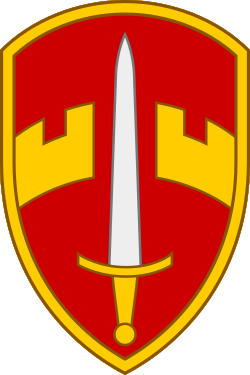
In 1966, the war in Vietnam escalated, and our family felt its reach personally. My father received orders from the Pentagon to deploy to the Republic of Vietnam, assigned to the Military Assistance Command, Vietnam — MACV — as a U.S. Army advisor. It was his first tour, and he would spend the next year embedded with Army of the Republic of Vietnam (ARVN) cavalry and armored units in the Mekong Delta, particularly near Bac LieuTan An, and Soc Trang. His mission was to help train, advise, and support the South Vietnamese military as they fought to reclaim and secure their homeland from the Viet Cong insurgency and the growing threat of the North Vietnamese Army.

U.S. Military Assistance Command Vietnam (MACV) Patch.  Worn by early American Tactical Advisors to the South Vietnamese.
Part of the autobiography of Dr. Anthony J. Carbone, Son in the Shadow of a Green Beret Hero.
U.S. Military Assistance Command Vietnam (MACV) Patch

Dad Enjoyed His First Tour in Vietnam as a Tactical Advisor to an ARVN Cavalry Unit

My father seemed to genuinely enjoy this first tour, especially compared to the more grueling Special Operations tour he would undertake later. He fell in love with the Vietnamese people — their resilience, their warmth, and especially their children. His photo albums from this era are full of beautiful, candid photographs of everyday life in the Mekong Delta: women carrying baskets at the market, children waving at the camera, families riding bicycles, soldiers resting between patrols. He always had a camera slung over his shoulder and took great pride in arranging these moments into carefully assembled albums that told his story. His affection for the people and the land of Vietnam is evident in every image.

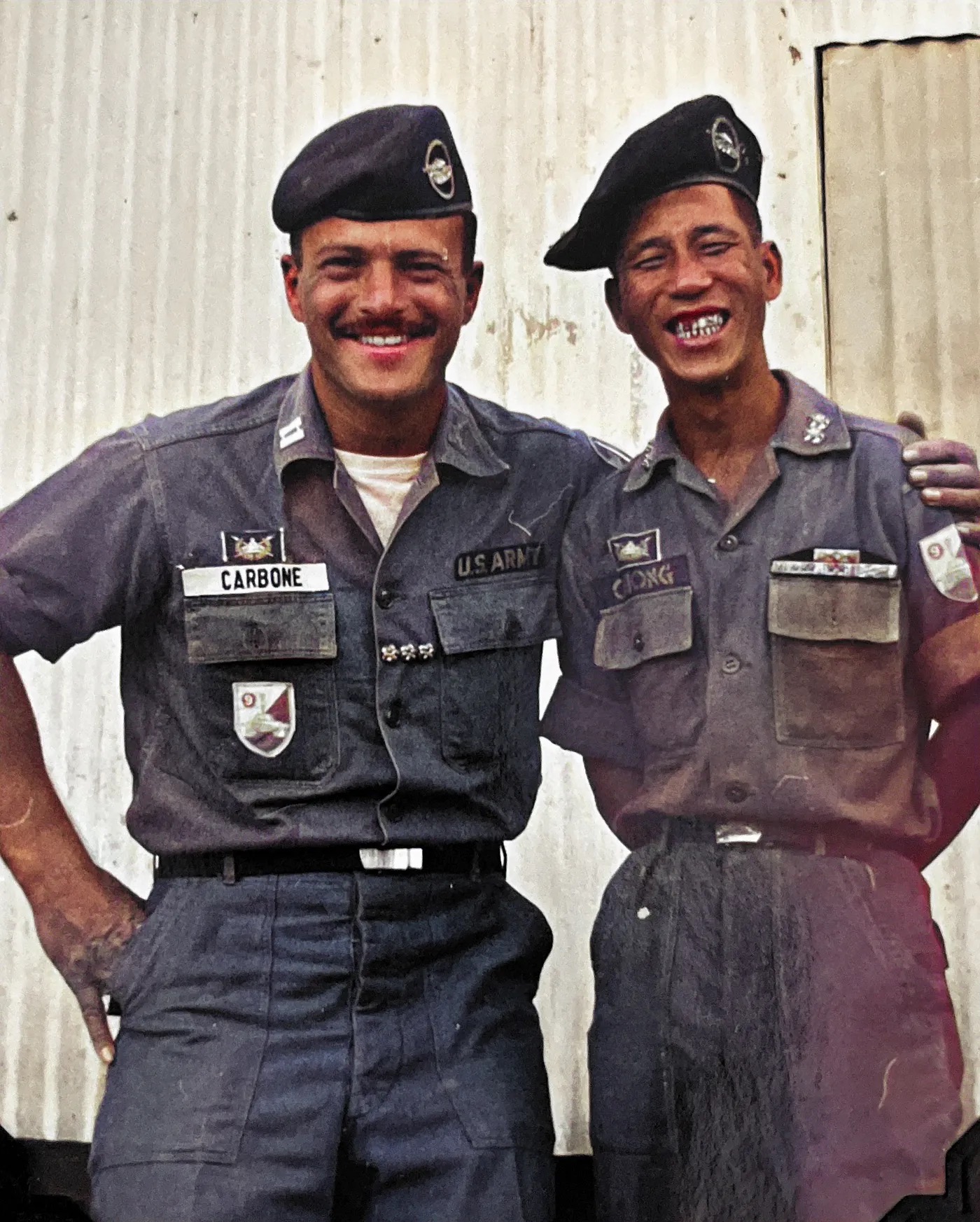
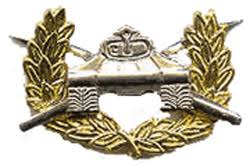
Dad (Captain Tony Carbone) with one of the many South Vietnamese officers that he advised.  Both are wearing the Vietnamese Tankers Badge proudly over their right chest.
Part of the autobiography of Dr. Anthony J. Carbone, Son in the Shadow of a Green Beret Hero.
Captain Carbone with one of the many South Vietname officers that he advised.

Dad is Awarded the ARVN Armor Officer Black Beret & Tankers Badge

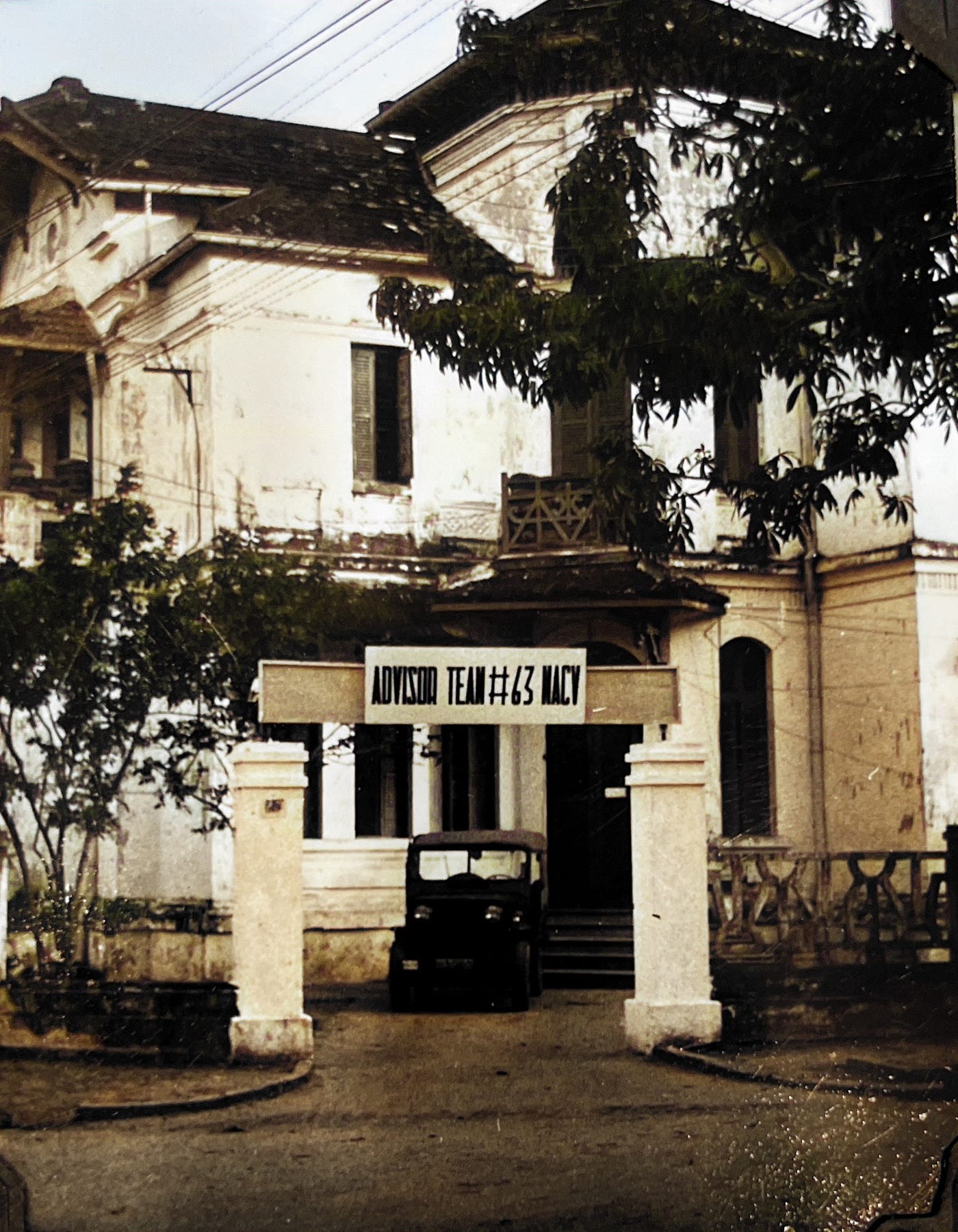
Dad was member of MACV Advisor Team #63 in Sóc Trăng

MACV Adviosry Team #63 in Soc Trang where Captain Tony Carbone was assigned during his first deployment to Vietnam.
Part of the autobiography of Dr. Anthony J. Carbone, Son in the Shadow of a Green Beret Hero.
MACV Advisory Team #63 in Sóc Trăng
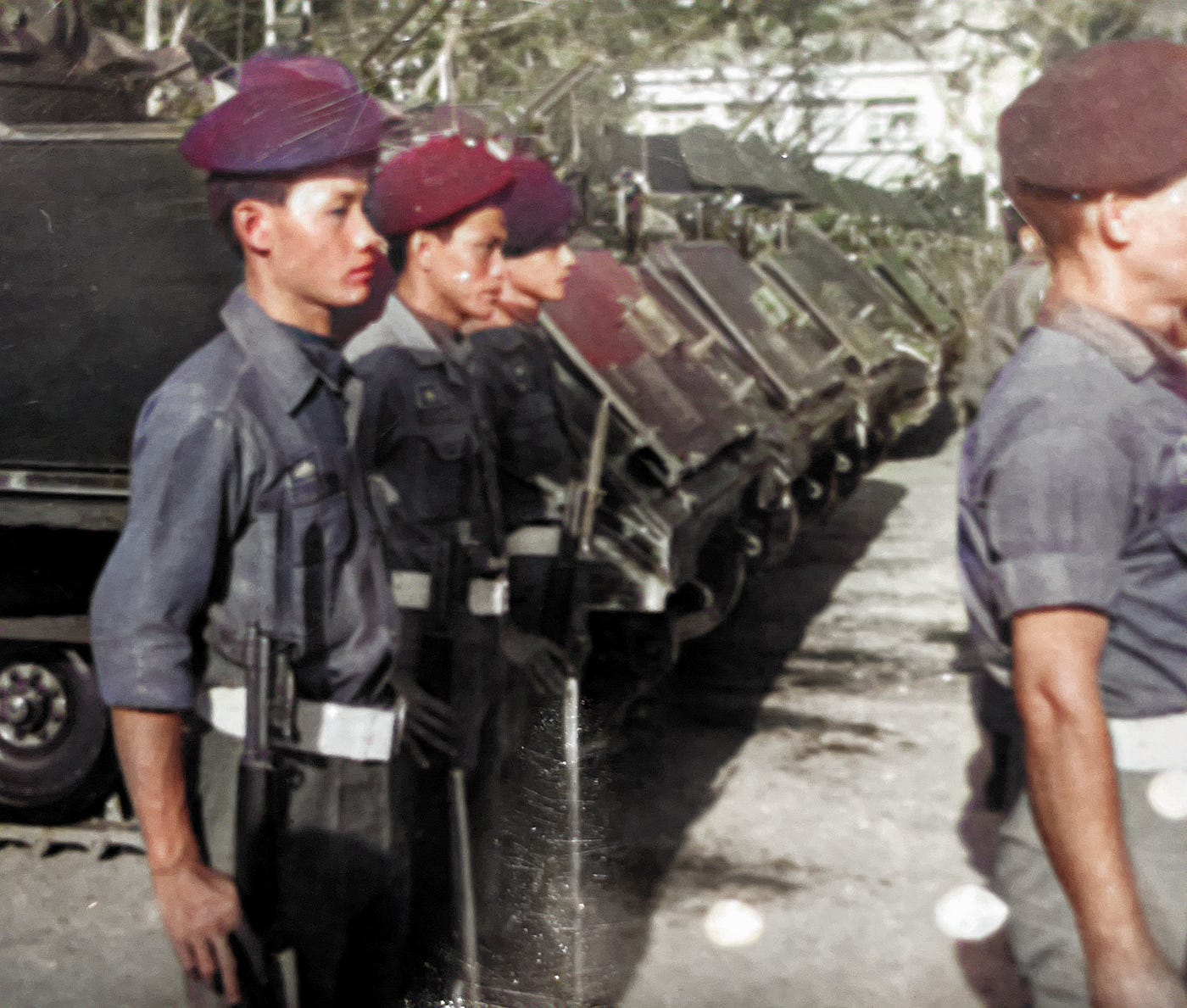
Republic of Vietnam 17th Cavalry ready for inspection. This was the ARVN cavalry unit that my father (CPT Tony Carbone) served as tactical advisor.
Part of the autobiography of Dr. Anthony J. Carbone, Son in the Shadow of a Green Beret Hero.
Army of Republic of Vietnam (ARVN) 17th Cavalry ready for inspection.
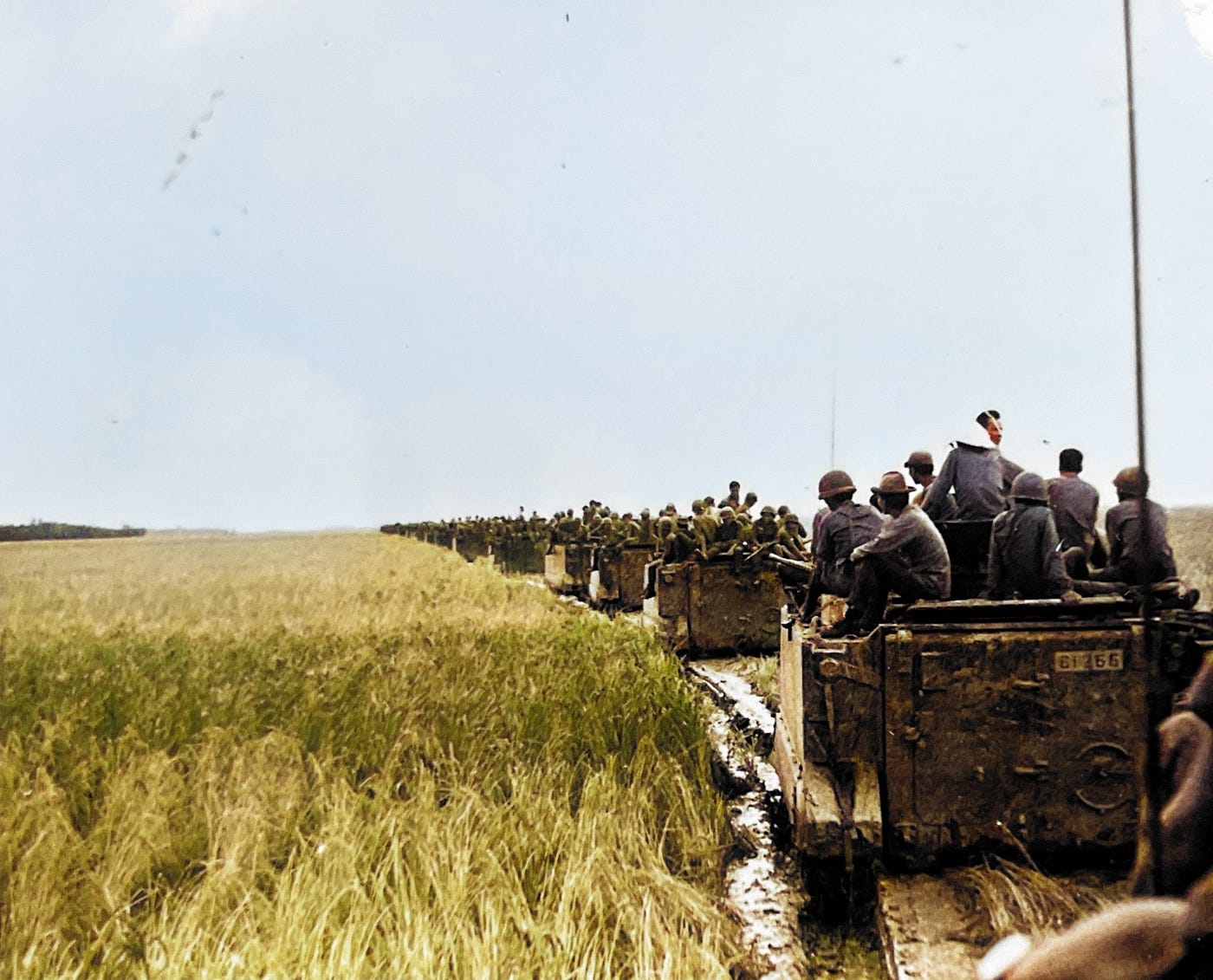
Republic of Vietnam Armored Unit on Patrol in Mekong Delta.  Line of American made M113 armored personnel carriers (APCs) and M114 armored reconnaissance vehicles.
Part of the autobiography of Dr. Anthony J. Carbone, Son in the Shadow of a Green Beret Hero.
Republic of Vietnam Armored Unit on Patrol in Mekong Delta

The unenviable dangerous job of Tunnel Rat in Vietnam

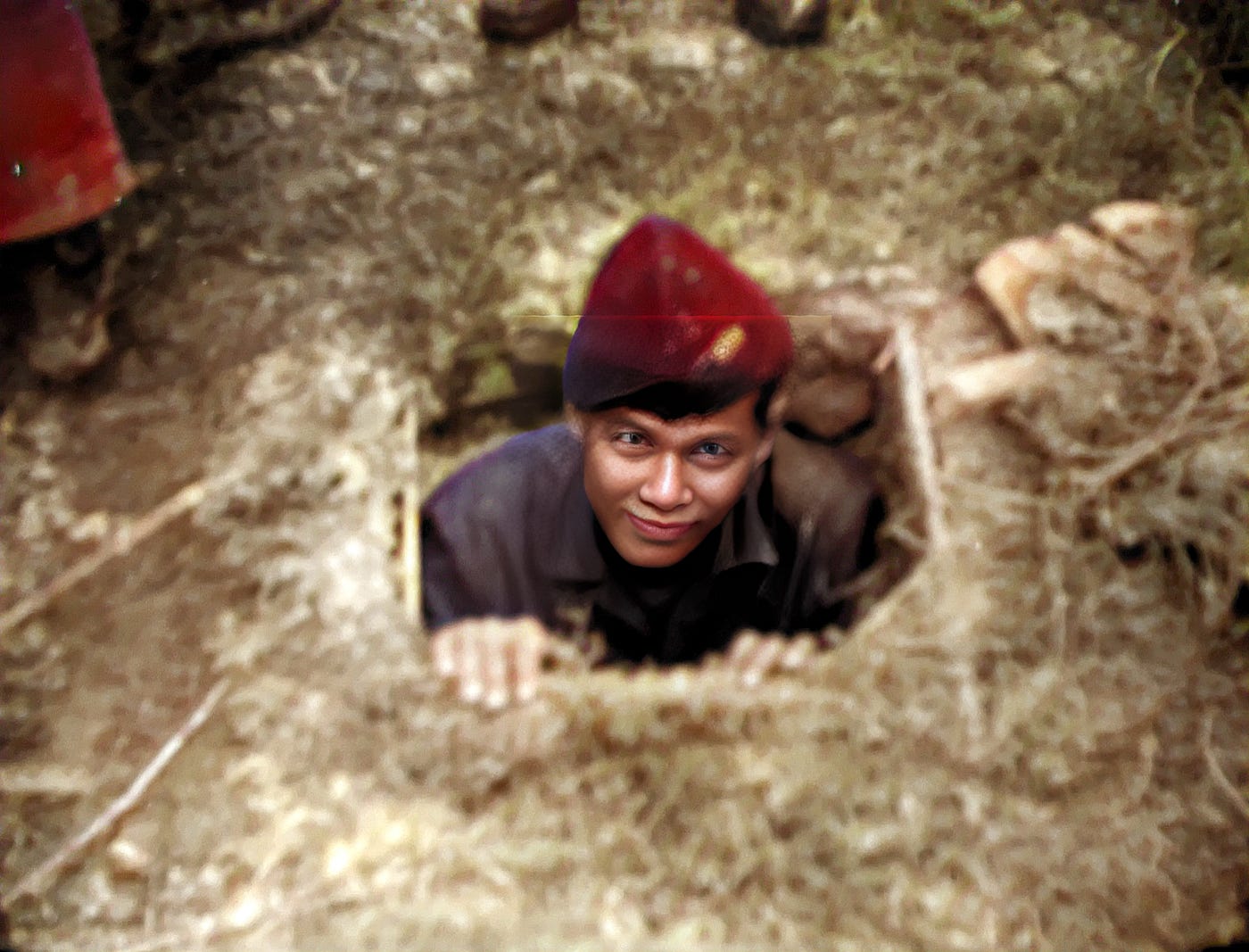
Entrance to Viet Cong tunnel system.  The soldiers who took on the dangerous task of entering and clearing enemy tunnels were affectionately refered to as "Tunnel Rats".
Part of the autobiography of Dr. Anthony J. Carbone, Son in the Shadow of a Green Beret Hero.
Entrance to Viet Cong tunnel system.

My father had a special love for the Vietnamese children

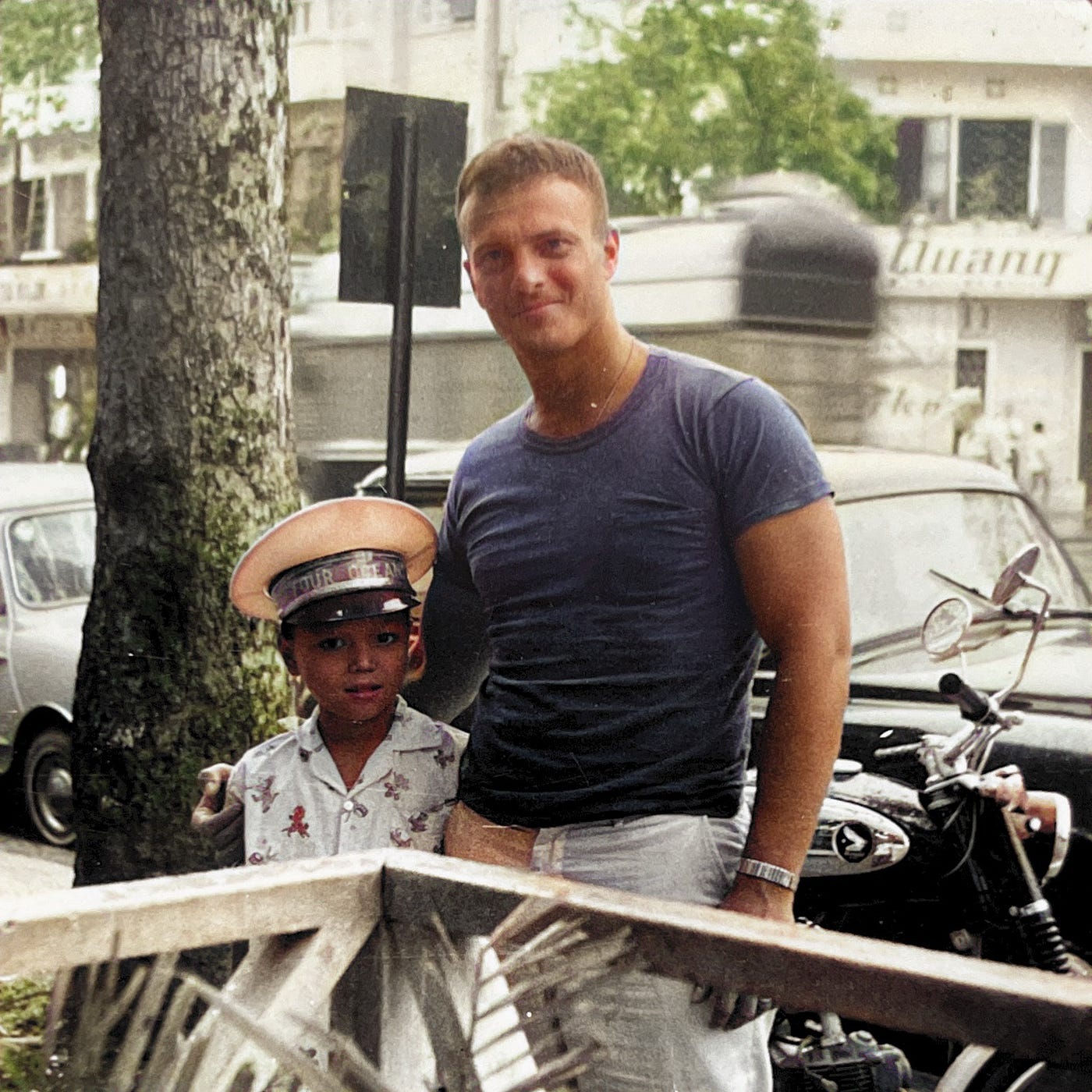
Dad (CPT Tony Carbone) was always taking photos of young Vietnamese children.
Part of the autobiography of Dr. Anthony J. Carbone, Son in the Shadow of a Green Beret Hero.
Dad with one of the many Vietnamese children he loved.

Dad met a lot of celebrities visiting the troops in Vietnam

While the duties of a MACV advisor were serious — often dangerous — there were lighter moments as well. Being based closer to Saigon gave my father access to some unique opportunities. He met a number of American celebrities who visited the troops to boost morale, including Ann Margret, Chuck ConnorsJames GarnerHenry FondaEfrem Zimbalist Jr.Don DeForeBob Meredith of the Dallas Cowboys, Dick Bass of the L.A. Rams, and Jerry Wilson of the St. Louis Cardinals. My father always had a deep appreciation for film, sports, and storytelling, and these moments added a personal highlight to an otherwise austere and high-stakes assignment.

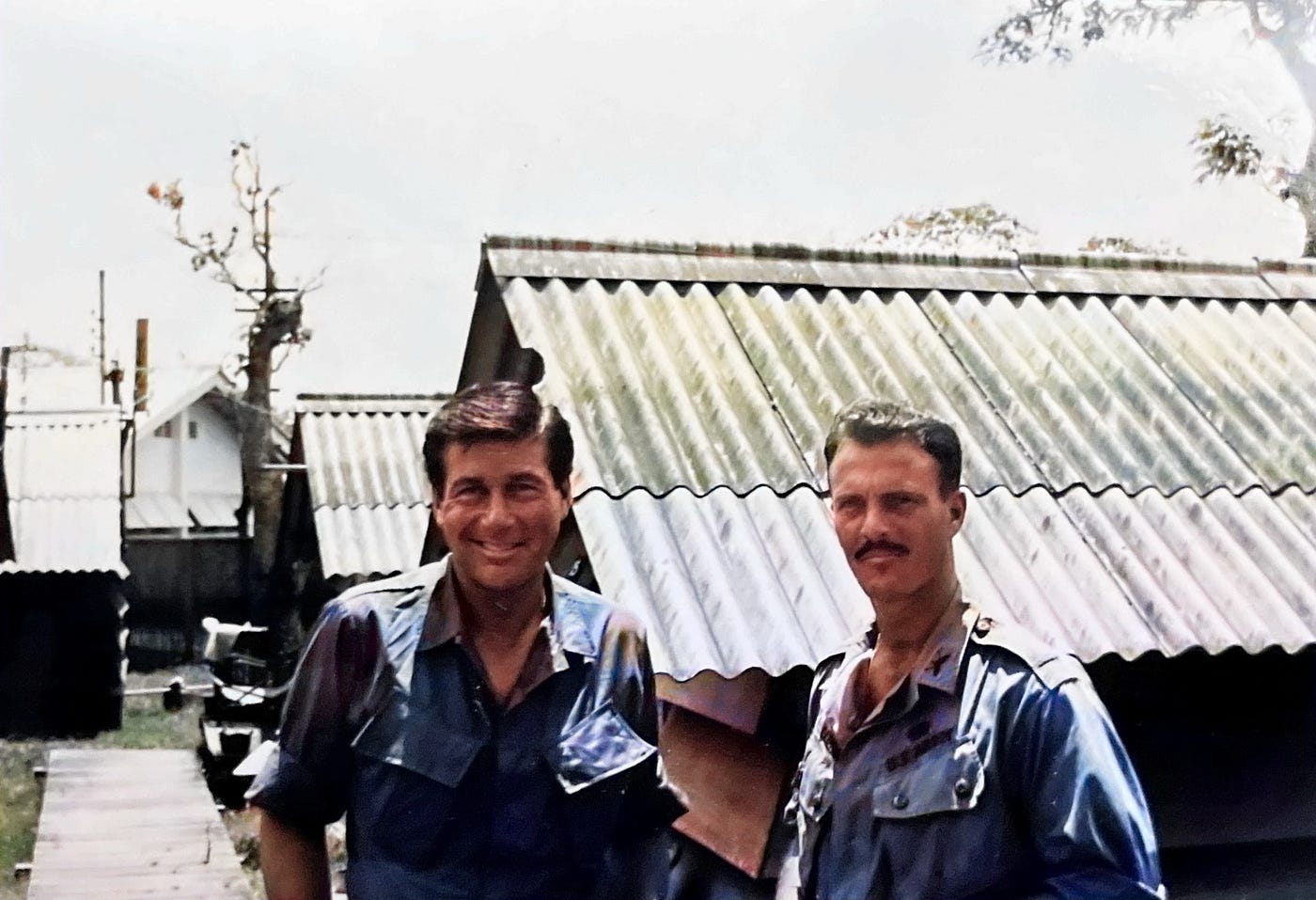
CPT Carbone with Actor Efrem Zimbalist Jr, one of the many celebrities who visited troops outside of the safety of Saigon.
Part of the autobiography of Dr. Anthony J. Carbone, Son in the Shadow of a Green Beret Hero.
Actor Efrem Zimbalist Jr
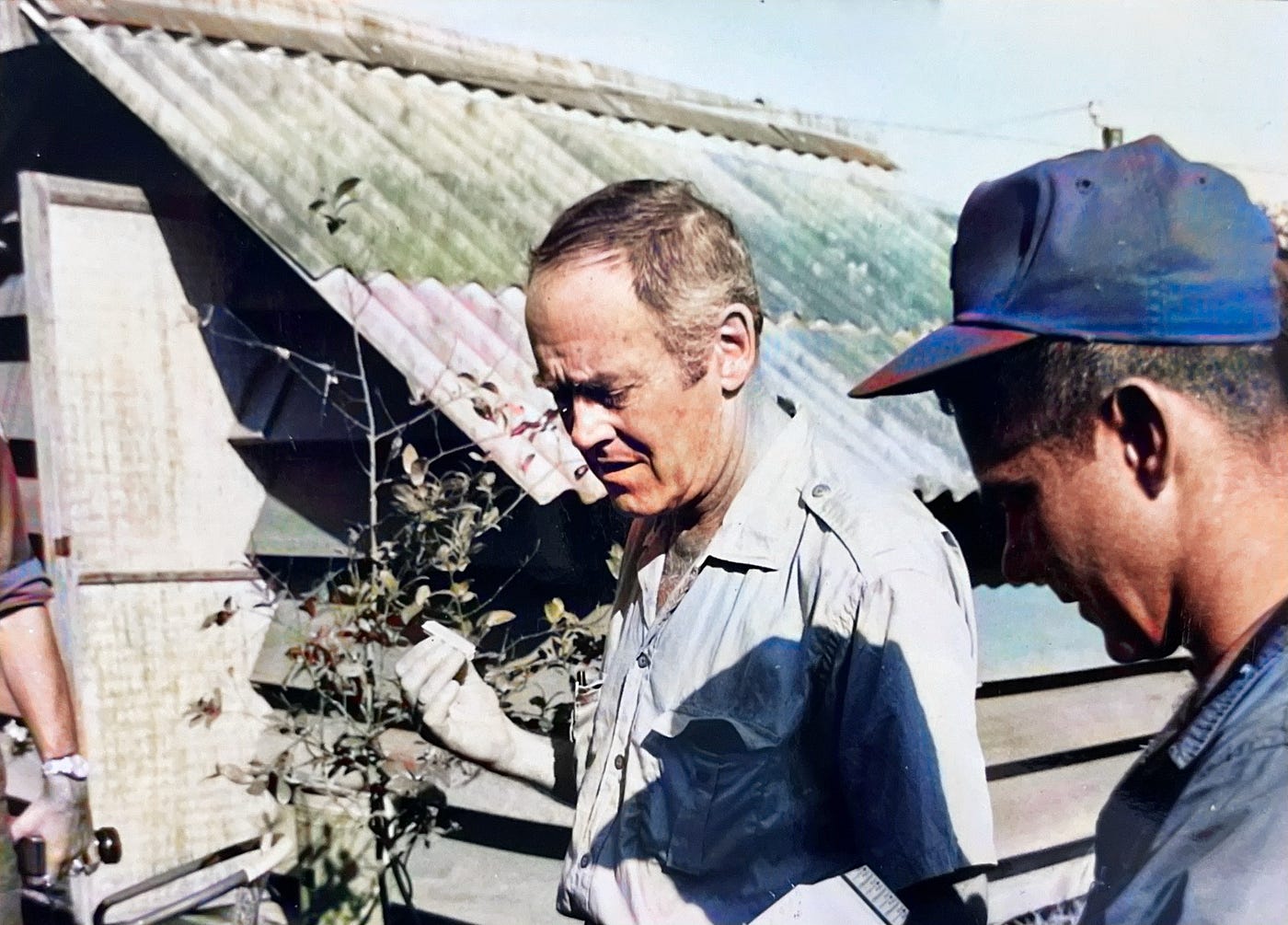
Dad spent time with Actor Henry Fonda outside of Saigon.
Part of the autobiography of Dr. Anthony J. Carbone, Son in the Shadow of a Green Beret Hero.
Actor Henry Fonda

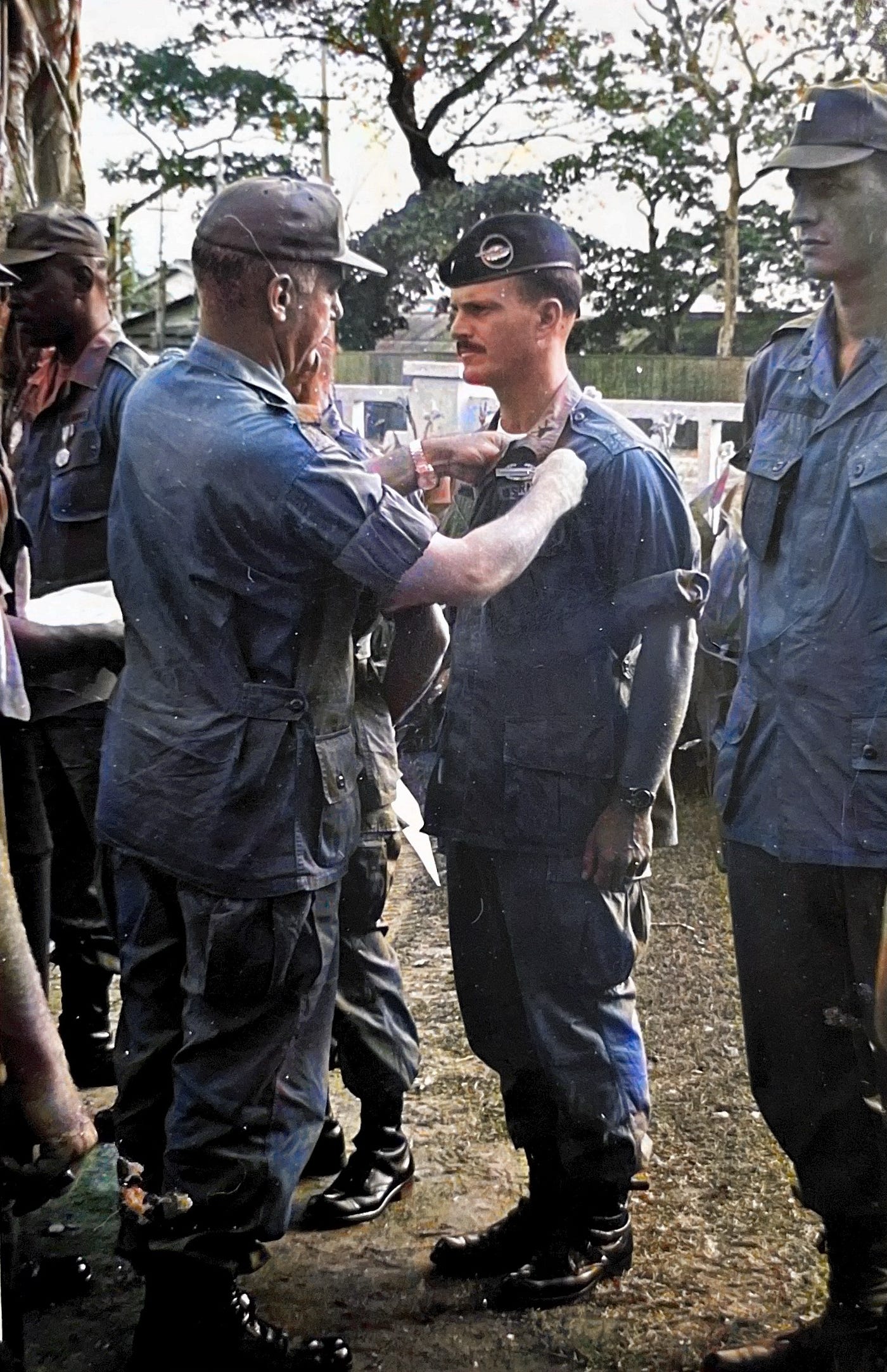
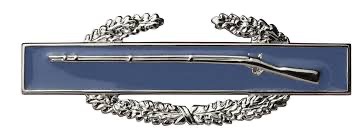
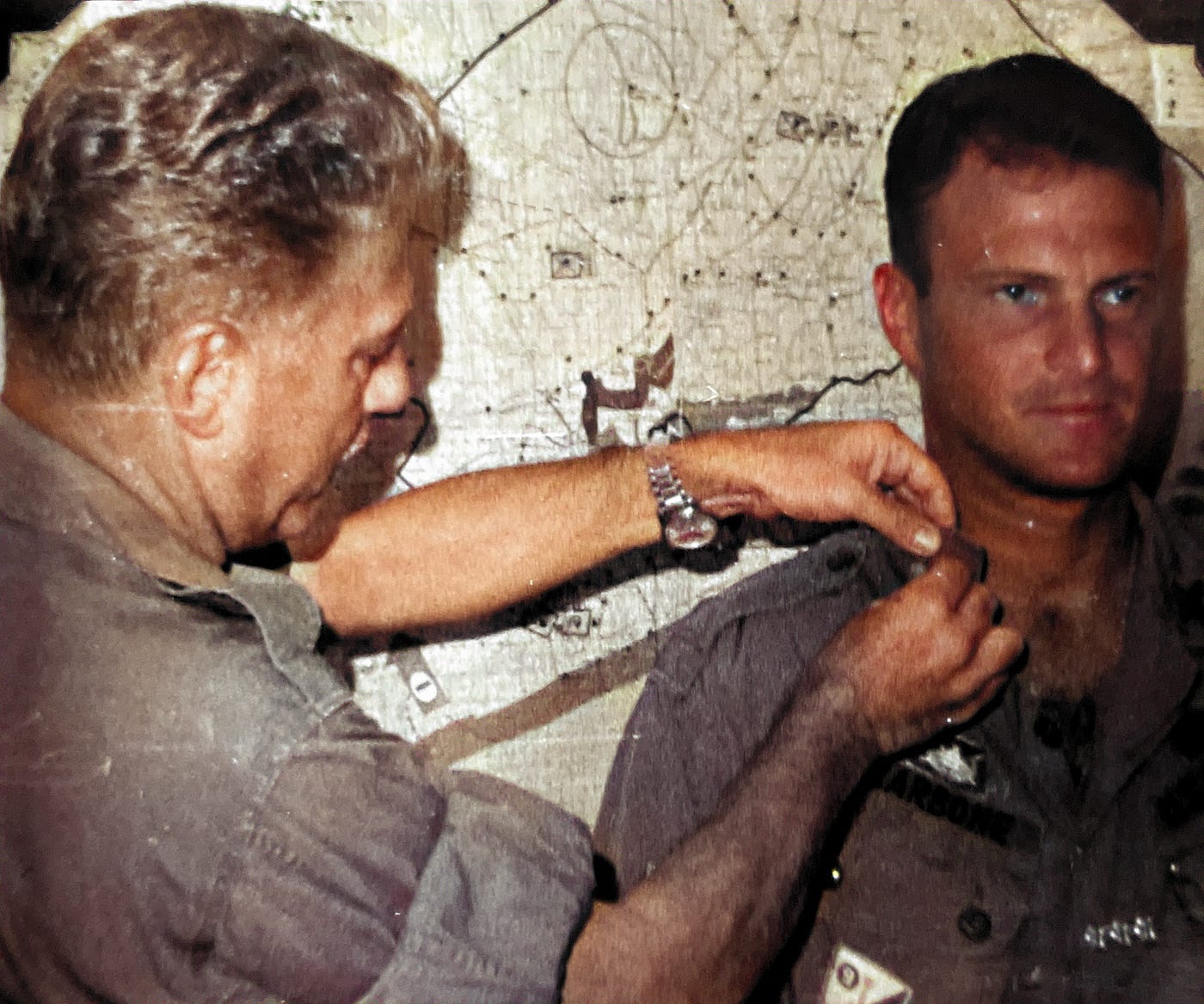
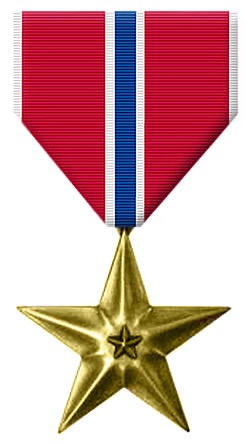
Professionally, his accomplishments during this year were significant. On February 1, 1967, he was promoted to the rank of Major. That same year, he earned two prestigious badges: the Vietnamese Armor Badge and the U.S. Combat Infantry Badge, a testament to his active engagement in combat operations alongside the Vietnamese forces he advised. He often went out with ARVN cavalry units into hostile territory, coordinating air strikes and artillery, gathering intelligence, and supporting civil pacification efforts. He used to send me letters with drawings of the elaborate Viet Cong tunnel systems he discovered — complete with false walls, hidden entrances, and escape shafts. As a young boy watching the Vietnam War unfold on our television every evening, I was both captivated and proud. His war stories made him larger than life to me.

Dad awarded the Combat Infantry Badge (CIB) in Vietnam

CPT Tony Carbone receiving the Combat Infantry Badge while serving as an Advisor for MACV in the Republic of Vietnam.
Part of the autobiography of Dr. Anthony J. Carbone, Son in the Shadow of a Green Beret Hero.
Dad being awarded the U.S. Army Combat Infantry Badge (CIB)
U.S. Army Combat Infantry Badge (CIB)

Dad gets promoted to Major while in Vietnam

Dad (CPT Tony Carbone) being promoted to the rank of Major during his first tour of duty in Vietnam.
Part of the autobiography of Dr. Anthony J. Carbone, Son in the Shadow of a Green Beret Hero.
Dad being promoted to Major.

While Dad was in Vietnam, we moved back to Medford

Back in the U.S., we were living in Medford, Massachusetts, on the first floor of a multi-family home at 44 Frederick Avenue. The building belonged to the parents-in-law of my godfather, Uncle George Pietrantoni, and we lived just downstairs from them. It was a warm, close-knit Italian-American neighborhood, and I saw Uncle George and Auntie Carole often.

44 Fredrick Avenue, Medford, Massachusetts. Carbone home in 1966. Autobiography of Dr. Anthony J. Carbone.

Went to the Dame School

I was in second grade that year and attended the Lorin L. Dame School on George Street along with my sisters Dianaand Lynne. I had second grade with old Miss Collins.

The Dame Elementary School on George Street in Medford, Massachusetts. Where I attended 1st and 2nd Grades. Autobiography of Dr. Anthony J. Carbone.

The school was about halfway between our apartment and Nana and Papa Pietrantoni’s house on Winthrop Street, and I remember spending many weekends with my grandparents.

Nana & Papa Pietrantoni’s Home

My grandfather went grocery shopping every Saturday morning and always came home with fresh Scali bread and sliced Italian cold cuts. Sunday mornings were reserved for Mass at Saint Joseph’s Catholic Church, the same church where all of us kids were baptized, where I made my First Communion, and where three of my sisters would eventually marry.

After Mass, we’d gather at Nana & Papa’s for a traditional Italian Sunday dinner of spaghetti and meatballs. Uncle Aldo would show up just long enough to eat a couple of meatballs and play a tune or two on the upright piano in the dining room. Those weekends were loud, joyful, and full of love — and food.

My Godfather, George Pietrantoni

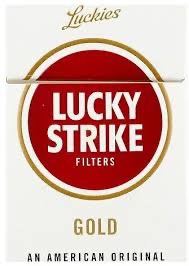
Uncle George was like a second father to me while mine was away. He’d often give me a quarter and send me down to the corner store to buy him a pack of Lucky Strikes. Back then, a six-year-old could do that without raising eyebrows.

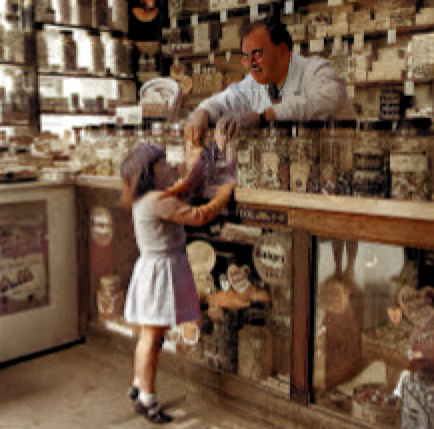
If I was lucky, he’d give me an extra nickel or dime so I could grab a few pieces of penny candy. I felt so grown up, entrusted with money and a mission.

Buying penny candy from the corner store back in the 1960s. Autobiography of Dr. Anthony J. Carbone.

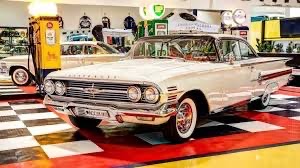
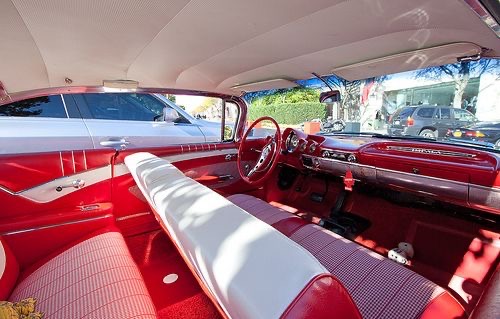
I also got to ride around with him in his stunning white 1960 Chevrolet Impala with red interior. I’d sit on his lap and “steer” the big red wheel while the windows were rolled down, the radio playing, and Lucky Strike smoke curling into the summer air. I remember those rides like they were yesterday.

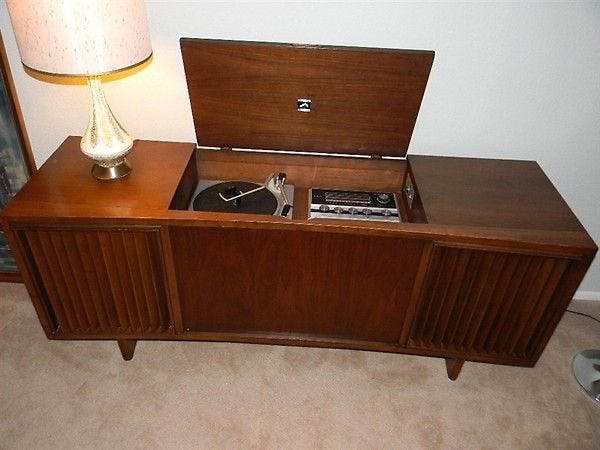
Auntie Norma, meanwhile, was working at Harvard University and still living at home with Auntie Cynthia and Yvonne. She had just bought a beautiful record RCA console that played both 45s and 33 rpm LPs.

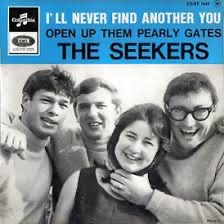
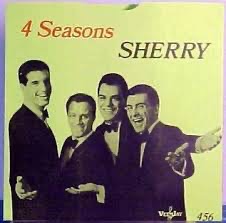
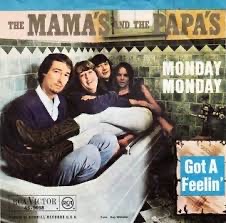
We’d all gather around to dance in the living room to songs like The Four Seasons’ “Sherry,” The Mamas and the Papas’ “Monday, Monday,”and The Seekers’ “Another You.” The music made our home feel alive and connected — even as we all missed my father terribly.

My mother wrote my father every night

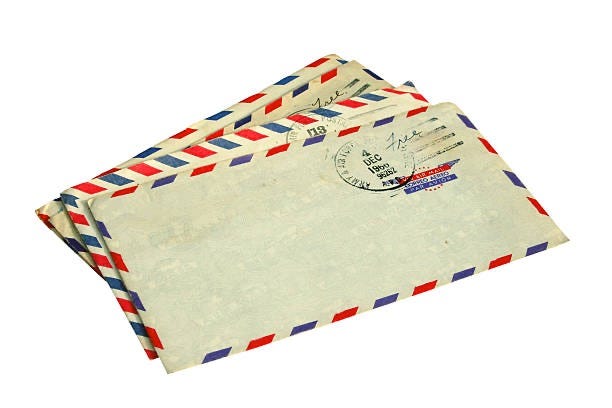
At home, my mother did everything she could to keep the family strong and grounded during his year-long absence. She wrote to him every single night. Every. Single. Night. My father, in turn, wrote back faithfully to her and to each of us. His letters weren’t just updates — they were expressions of love, encouragement, and longing. They brought him home to us in every envelope. I still have many of those letters today, yellowed with time but full of heart. I am amazed by how my parents stayed so deeply in love during such a prolonged and uncertain separation and know that their love letters helped — that steady rhythm of writing and receiving, day after day, page after page, was their emotional lifeline.

Red, White, & Blue striped envelopes used to send Air Mail.
Part of the autobiography of Dr. Anthony J. Carbone, Son in the Shadow of a Green Beret Hero.

R&R in Waikiki, Hawaii

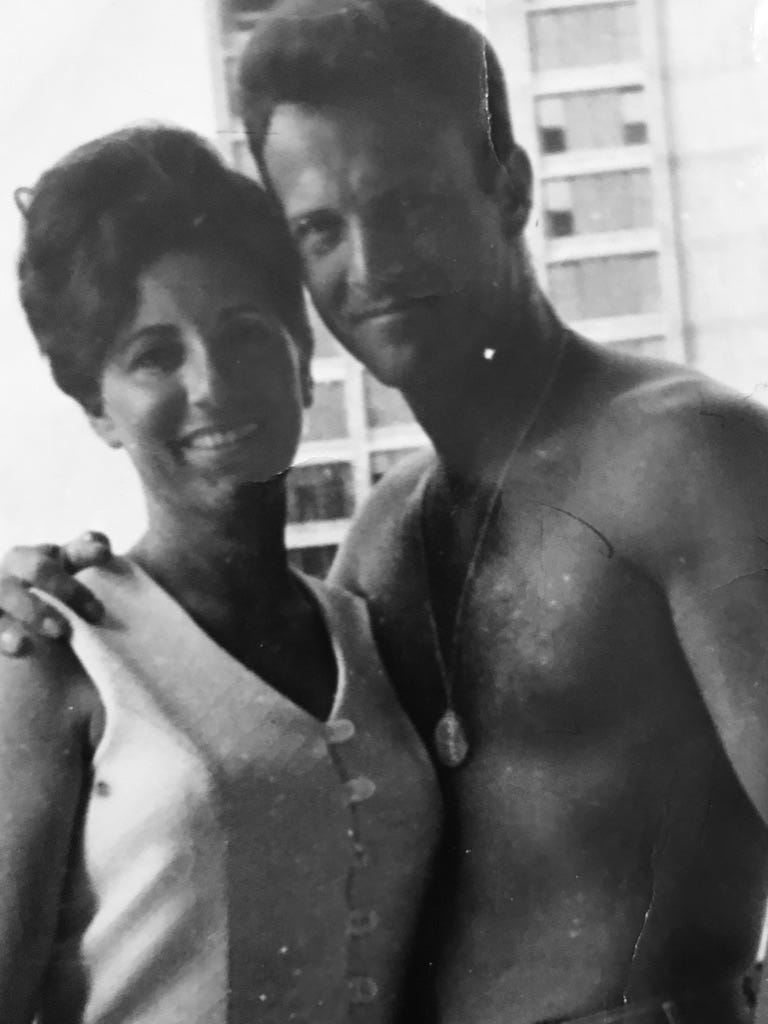
In the middle of his tour, they were reunited for a brief but beautiful week of R&R in Waikiki, Hawaii, paid for by the military. The photographs from that vacation are among my favorites. My parents looked like newlyweds again — smiling, tanned, holding hands on the beach. You can see it in their eyes: how much they missed each other, and how much they cherished every second of that week. Love, real love, endures like that.

Mom and Dad on R&R at Waikiki, Hawaii during his first tour of Vietnam.
Part of the autobiography of Dr. Anthony J. Carbone, Son in the Shadow of a Green Beret Hero.
Mom & Dad on R&R at Waikiki, Hawaii during his first tour of Vietnam.

The Apollo One Disaster (January 27, 1967)

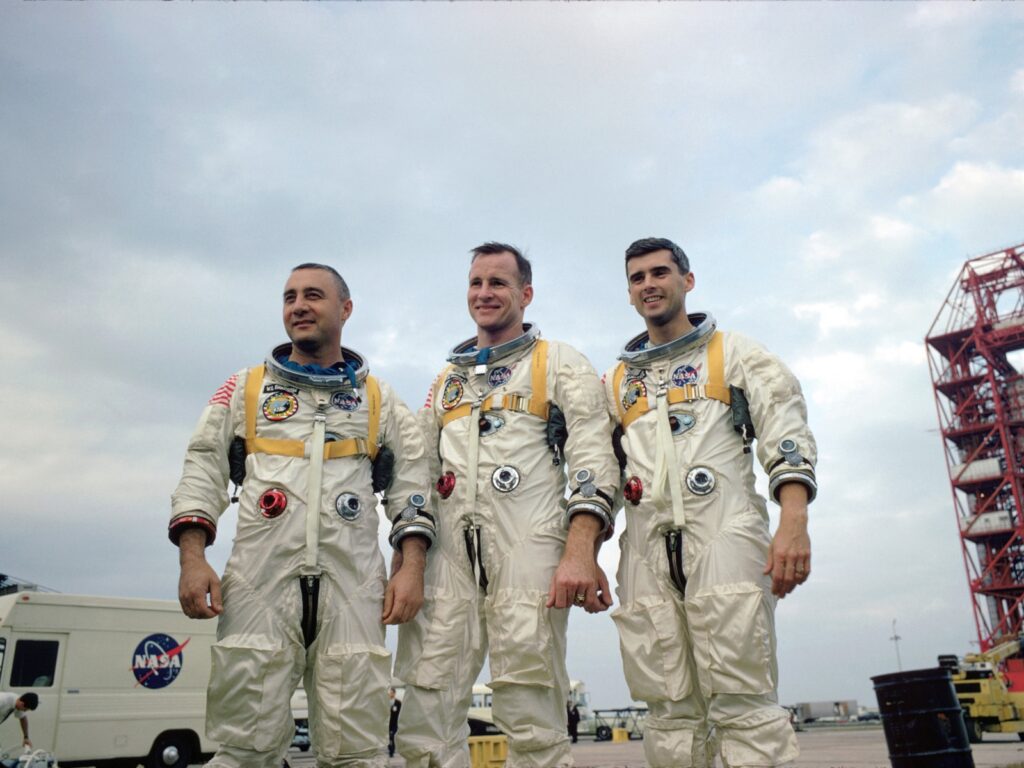
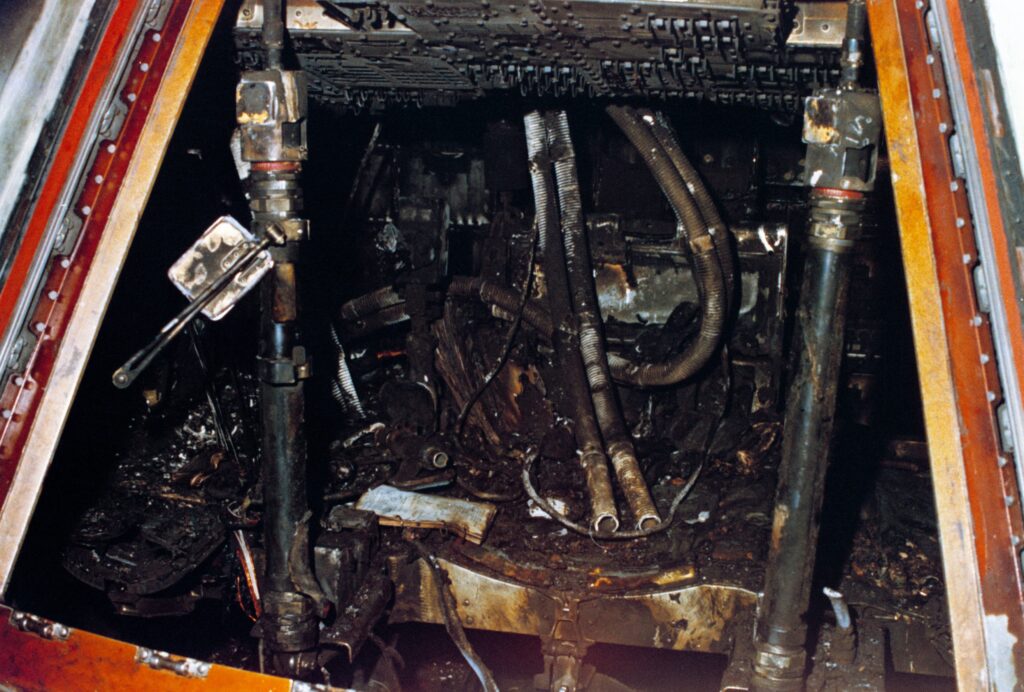
I still remember one cold evening in our apartment at 44 Frederick Avenue in Medford. It January 27, 1967 around 6:30 PM, and we were gathered around the television as the Apollo 1 spacecraft was preparing for liftoff. In those days, America was captivated by the space race, and for young boys like me, NASA was nothing short of magical. But that excitement turned to horror. A fire erupted inside the command module during a pre-launch test, killing astronauts Gus Grissom, Ed White, and Roger Chaffee. The tragedy shocked the nation and forced NASA to halt manned missions until major safety changes could be made. I was just a boy, but I never forgot that night. It was the first time I realized that even heroes could be vulnerable, and that the pursuit of exploration carried real danger.

MARS Calls from Vietnam

On a happier note, every few months the Army arranged MARS (Military Auxiliary Radio System) calls so that soldiers could connect with their families. These long-distance conversations, relayed through ham radios, required us to speak in military fashion — ending each phrase with “Over.” One particular call still makes me laugh to this day. My father had said, “I’m making you a tape,” referring to a new cassette recording. But my mother misheard him and replied, “You want me to send you a cake? Over.” The radio operator, patiently relaying both sides, jumped in to clarify: “Ma’am, I believe your husband said he is making you a tape, not a cake.” We all burst into laughter on both ends of the line.

Military Auxillary Radio System (MARS) was a network of HAM radio operators used by the military in Vietnam to communicate with family back in the United States.
Part of the autobiography of Dr. Anthony J. Carbone, Son in the Shadow of a Green Beret Hero.
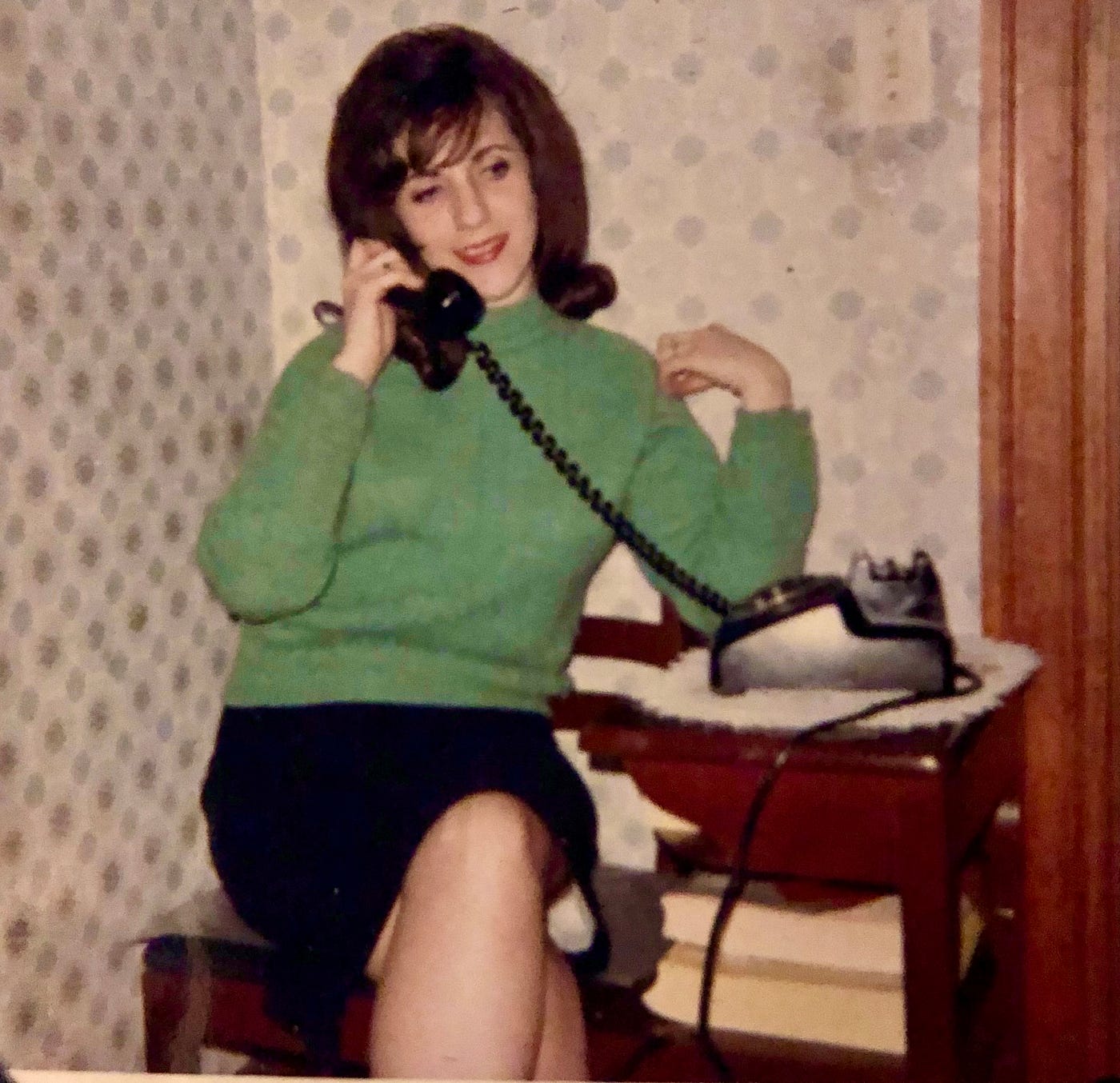
My mother on the telephone with my father, most likely using the MARS system.
Part of the autobiography of Dr. Anthony J. Carbone, Son in the Shadow of a Green Beret Hero.
My mother on the telephone with my father in Vietnam.

Cassette Tape Messages

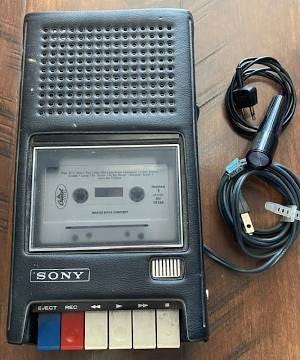
That was a time when compact cassette recorders, newly developed in Japan, allowed us to exchange audio messages across continents. We’d record ourselves talking about school, daily life, or just saying, “I love you,” and mail them across the ocean. My father would send his replies back, and we would sit together and listen to his voice on the living room floor. I wish we still had those tapes today. I would give anything to hear my parents’ voices again — those tender, hopeful, loving voices carried across time and space

One of the early SONY cassette recorders used to make recordings of messages and conversations.
Part of the autobiography of Dr. Anthony J. Carbone, Son in the Shadow of a Green Beret Hero.

This first tour in Vietnam marked a profound chapter in my father’s career — and in our family’s life. It tested our endurance, but it also revealed the depth of our bonds. While he was advising and fighting alongside his ARVN brothers in the Mekong Delta, he was still husband, father, and family man — writing letters, making tapes, taking photographs, and dreaming of home.

Home Page

Chapter 4: Our First Tour in Germany: Fulda & Heidelberg

14th Armored Cavalry Distinctive Unit Crest with Motto Suave Moi Stationed at Rose Barracks , Fulda, Germany guarding the Fulda Gap near the Soviet Border. Autobiography of Dr. Anthony J. Carbone

Believe Nothing You Hear, and Only Half of What You See — A memoir of Service, Shame and the Search for Truth

Dad Gets Orders for Fulda, Germany

In 1964, during the height of the Cold War, my father received deployment orders to Fulda, West Germany. The Berlin Wall had only recently gone up, and global tensions were at a boil. It was a serious time, and the assignment my father received reflected that gravity.

Command of C Troop, 14th Armored Cavalry

Dad was given command of C “Charlie” Troop, 14th Armored Cavalry Regiment, in Fulda, Germany — stationed at one of the most sensitive flashpoints between NATO and the Warsaw Pact.

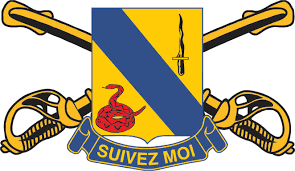
The unit insignia from the 14th Cavalry in front of crossed sabers, the U.S. military symbol of Cavalry, and the unit motto of “Suivez Moi” which is French for “follow me”. This is the unit crest that Captain Carbone wore when he commanded Troop C, 14th Armored Cavalry in Fulda, Germany.
Insignia of the 14th Armored Cavalry with Crossed Cavalry Sabers and the motto, “Suivez Moi,” which is French for “Follow Me”.

The Fulda Gap

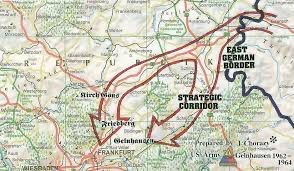
Known as the “Charging Charlies“, C-Troop (and the rest of the 14th Cavalry) was responsible for guarding the infamous Fulda Gap, the strategic corridor military planners believed the Soviets would use to launch a massive armored invasion into Western Europe.

Map of Fulda Gap Germany During Cold War

Family Prepares for a Transatlantic Transfer

My father deployed ahead of us to report for duty and secure housing, while the rest of us — my mother, my three sisters, and I — prepared for the long move overseas. The process of uprooting our lives for Germany was as complex as it was memorable. Every item we owned had to be sorted into four categories: (1) Hold Baggage — essentials that traveled by air; (2) Household Goods — the bulk of our possessions, shipped by slow-moving cargo ship; (3) Storage — items too big or unnecessary to bring; and (4) Trash or Give Away — whatever wouldn’t make the cut.

Birth of Sister #3, Cynthia

Just weeks before our departure, on January 29, 1964, my third sister Cynthia was born. Her arrival added both joy and urgency to our preparations. With a newborn in the house, the challenge of organizing an international military move became even more formidable. But as always, my mother handled everything with grace and efficiency — tending to Cynthia’s every need while managing three other young children and the complex logistics of uprooting a household. Cynthia took her very first flight as an infant in her mother’s arms, beginning a life already shaped by service, travel, and family sacrifice.

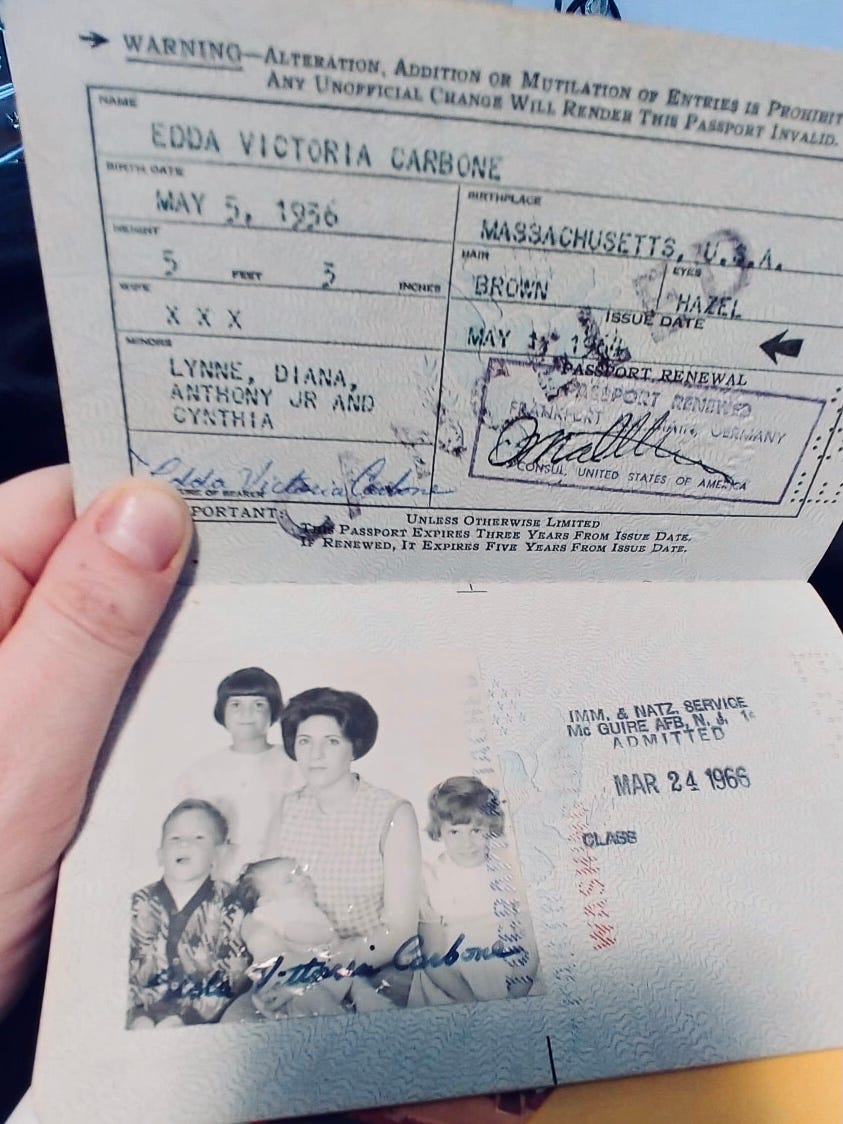
This is the passport of Anthony J. Carbone’s mother, Edda V. Carbone, and her four children: Lynne, Diana, Anthony Jr., and Cynthia. This is the passport that Mom used to get into Germany and then return home to the United States.
My mother’s passport with Lynne, Diana, Anthony Jr. and Cynthia.
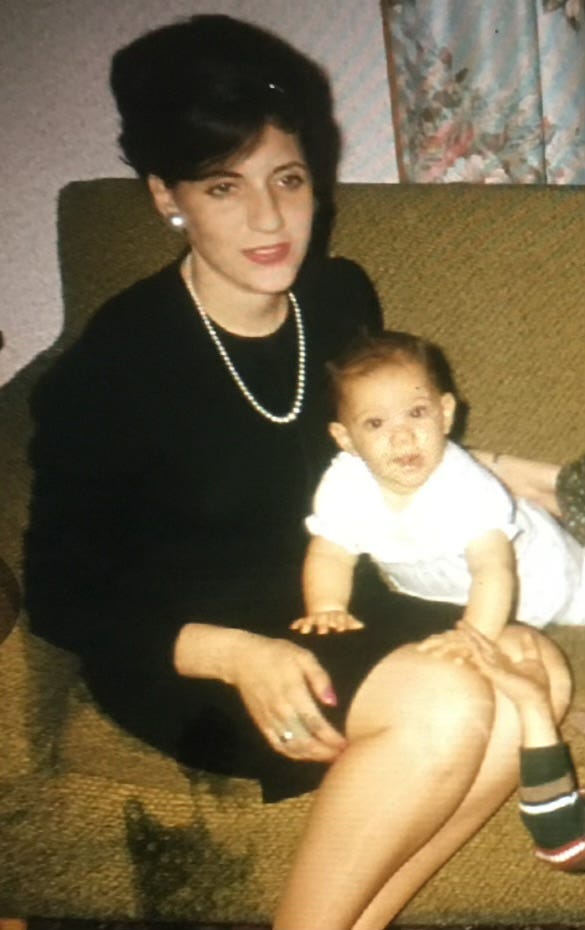
Anthony Jr.’s mother, Edda Carbone, with his baby sister Cynthia on her lap prior to our trip to Germany.
Mom with Cynthia in Medford before leaving for Germany.

Though I was very young, that journey remains burned into my memory. We traveled to McGuire Air Force Base in New Jersey, where we boarded a sleek four-propeller Douglas C-118 Liftmaster aircraft operated by the Military Air Transport Service (MATS)— packed mostly with uniformed GIs. We were one of the few military families on board. My mother, ever composed and elegant, wore a pencil skirt and sweater, her trademark pearl necklace resting neatly at her collar as she carried my baby sister Cynthia in her arms. She handled the journey with grace, even while managing four children. I remember GIs stepping in to help — each of us was being held or entertained by a soldier at one point. It was a shared moment of kindness and connection in a time of great upheaval.

Douglas C-118 Liftmaster operated by the Military Air Transport Service (MATS) out of McGuire Air Force Base. This is the type of plane that we flew from McGuire to New Foundland to Shannon, Ireland, to Frankfort, Germany.
Douglas C-118 Liftmaster operated by the Military Air Transport Service (MATS) out of McGuire AFB.

Family Flies to Germany — Headed to Fulda

The flight took us from McGuire to Gander, Newfoundland, then across the Atlantic to Shannon, Ireland, and finally to Rhein Main Air Force Base in West Germany. It took 16 to 18 hours, and when we landed, we were met by my father and our “sponsors” — an Army family assigned to help us transition into German life.

The Famous Welcome Sign to Europe at Rhein-Main Air Base in Frankfurt, West Germany in the 1960s.
The Famous Welcome Sign to Europe at Rhein-Main Air Base in Frankfurt, Germany.
Coat of Arms for the city of Fulda, Germany with a shield that is a black cross on white border on left half, and 3 white eidelweiss flowers on a red border on the right, topped with a crown of stone.  Autobiography of Dr. Anthony J. Carbone
Coat of Arms for Fulda, Germany

We live on a farm on the Germany “Economy”

At that time, there were no on-post quarters available for us in Fulda, so we rented a home “on the economy,” Army-speak for off-base living. Our rented house sat on a small German farm, nestled in the hills above a Catholic school that I attended for kindergarten alongside my sisters Lynne and Diana. The nuns who taught us wore full habits and ran a tight ship. I remember the heavy wooden Brio toys we played with, the scent of peppermint tea served before naps, and the solemn atmosphere of strict German discipline.

Lynne and Diana with their snowman in front of our house on the economy (off-post) in Fulda, West Germany. Our kindergarten and elementary school, run by German Catholic nuns, was right down the hill in our backyard.  Autobiography of Dr. Anthony J. Carbone.

Our landlord’s daughter, Effie, was a teenage girl with long blonde braids who lived downstairs and was mainly Lynne’s friend. Our babysitter was Marlena lived up the street from us. She spoke just enough English to make herself understood and was endlessly patient with us.

My oldest sister Lynne with our first German Volkswagen Beetle in Fulda, Germany.  All bundled up for the German winter.  Autobiography of Anthony J. Carbone.

My favorite sights, sounds and smells of Germany

Some of my most vivid childhood memories are rooted in that farm — the air thick with the scent of wildflowers, blossoming trees, and the unforgettable smell of “honeywagons,” large wooden barrels filled with manure used to fertilize the fields. Coal was still the primary source of heat, and the smoky, sulfur-rich air had a strange health to it — earthy and alive, part of the rural rhythm of Fulda. Another sensory thread woven deeply into those memories is the sound of church bells. They marked the hours with gentle regularity, rang out at midday for the Angelus, and on Sundays, filled the valley almost nonstop from dawn to dusk. Even now, the tolling of bells brings me instantly back to Germany — awakening a sense of calm, nostalgia, and rootedness that no other sound quite can.

One of Fulda, Germany's icons--the 18th Century Baroque Saint Salvator Cathedral whose bells could be heard all over the village.  Autobiography of Dr. Anthony J. Carbone.
18th Century Baroque Cathedral of Saint Salvatore in Fulda, Germany
All of Bavaria at the time (1960s) was gorgeous farmlands with incredible smells of nature. This is a view of the farmland in Fulda, West Germany.
The rolling farmlands of Fulda, Germany.

Dad Commands F Troop, 14th Armored Cavalry on Soviet Border

I don’t believe we owned a car at the time, so my father was picked up daily by his jeep driver to report to the regiment. It didn’t matter to me that we didn’t have a car because we loved living on the German farm. I was utterly captivated by the world we had entered. Even then, as a small boy, I had already made up my mind: I wanted to be a cavalry officer just like my father. I watched him closely, studying how he wore his uniform, how soldiers saluted him, how he led. To me, he was a hero, and I never questioned that I would follow in his footsteps someday.

My father, CPT Tony Carbone (center) with First Sergeant (left) and jeep driver (background). This is the same jeep and driver who used to pick up my father at our home on the economy and drive his to and from Downs Barracks where his cavalry troop was located.  Autobiography of Anthony J. Carbone.
Dad with his First Sergeant and jeep driver in the background.
Captain Tony Carbone (Dad) received the coveted award of First In Tank Gunnery (next to Troop First Sergeant Buswell) while commanding C Troop, 14th Armored Cavalry in Fulda, West Germany during the Cold War (c.1965).  Autobiography of Dr. Anthony J. Carbone.
CPT Carbone received the coveted award of First In Tank Gunnery (next to Troop First Sergeant Buswell)
Dad receiving a certifiicate for commaning C Troop, 14th Armored Cavalry in Fulda, West Germany (c. 1965)
Dad receiving a certifiicate for commaning C Troop, 14th Armored Cavalry in Fulda, West Germany.

We move on post into government quarters on Rose Barracks

Eventually, our family received government quarters. We moved into a tall, gray three-story apartment building that housed twelve Army families. The fourth floor had maid’s quarters built by the Nazis decades earlier. It wa, a haunting reminder of Germany’s past tucked above American military life. From my bedroom window, I could see the military airfield nearby. At night, as I lay in bed reading comic books under the covers. The rotating airfield beacon would cast alternating flashes of green and two white lights into my room. That rhythm of light, sweeping silently across my walls and pages, felt like a lullaby — strange, comforting, and unforgettable.

14th Armored Cavalry Regiment at Downs Barracks, Fulda, Germany (c. 1964). These were typical military buildings that the U.S. Army took over buildings from the Nazi forces after the war. This is a “Pass in Review” portion of an Army parade involving armored vehicles (M114 armored personel carriers used by the U.S. cavalry).
14th Armored Cavalry Regiment at Downs Barracks, Fulda, Germany
Fulda Army Airfield c.1964 showing the control tower and airfield beacon. Cessna L-19/O-1 Bird Dog ingle propeller aircraft were used for reconnaissance by the cavalry.
Fulda Army Airfield c.1964 showing the control tower and airfield beacon. The U.S. Army cavalry used Cessna L-19/O-1 Bird Dog aircraft were for reconnaissance.

Life on a cavalry post thrilled me. My father gave me occasional tours of the motor pool, the barracks, and the tanks. I couldn’t get enough. The Military Police (actually Unit Police–UPs) at the gate would sometimes let me stand next to them, waving in vehicles and offering salutes. The whole environment was electric to a young boy with big dreams.

Colors and Guidons of the full 14th Armored Cavalry Regiment at Downs Barracks. CPT Tony Carbone is somewhere in the line with other troop commanders. The Troop C, 14 Cavalry guidon can be seen if you look close enough.
Colors and Guidons of the full 14th Armored Cavalry Regiment at Downs Barracks

The Grim Reality of Guarding the Soviet Border

It wasn’t all parades and salutes for the 14th Armored Cavalry Regiment. Their mission was deadly serious. The regiment’s men actively guarded the infamous Fulda Gap, stationed at the spear’s tip.

Military planners expected that if the Soviet Union ever unleashed its armored divisions into Western Europe, the main thrust of their invasion would come roaring through this very corridor.

Photograph showing the West-East German border at the Fulda Gap with barricade with sign saying "Halt! Zonengrenze" (Stop! Border).  Autobiography of Dr. Anthony J. Carbone.

To the untrained eye, the countryside around Fulda was idyllic. Rolling hills, fertile farmland, and quiet villages created the picture of peace. The landscape gave no hint of the threat that loomed just across the line. However, the soldiers of the 14th Armored Cavalry knew better. They patrolled the NATO border daily, often within meters of East German and Soviet forces. From their observation posts, they could see the enemy through field glasses—watching them as intently as they were being watched in return.

Double barbed wire border at West-East Germany border in Fulda Gap.  Autobiography of Dr. Anthony J. Carbone
A border between East & West Germany that is just two barbed wire fences.
Families vist the border looking for the families in the East

Need for Tank Gunnery Proficiency

For these troopers, there was no illusion of safety. Tank gunnery, live-fire ranges, and field maneuvers weren’t training games—they were rehearsals for survival. Every round fired, every drill practiced, was preparation for the day the balloon might go up, when the border could erupt in fire and steel without warning.

14th Armored Cavalry M60 tanks practicing tank gunnery at Grafenwohr in Germany. Autobiography of Dr. Anthony J. Carbone.

The 14th Cavalry’s unspoken duty was to slow the Soviet juggernaut long enough for NATO reinforcements to mobilize. Everyone knew what that meant: if war broke out, the enemy would overrun the regiment in hours, perhaps even minutes.

It was a grim reality, but one they carried out with quiet professionalism. To a boy watching from the safety of Army quarters, the regiment looked like knights in armor. Unfortunately for the men who wore the spurs, it was a mission shadowed by constant danger.

Dad smoking his infamous Italian stogie followed by his Executive Officer (XO) Lieutenant Ron Meyer and 3rd Platoon Leader Lt Jim Zimmerman of the 14th Armored Cavalry at Fulda, Germany.  Autobiography of Dr. Anthony J. Carbone.
C Troop Commander, Captain Tony Carbone, with his Executive Officer (XO) Lieutenant Ron Meyers.

Baby Sister, Pamela, is born in Germany

During this tour, our family grew again. My baby sister Pamela was born on September 11, 1965 at the 97th General Hospital in Frankfurt, Germany. My mother was too far along in her pregnancy to make the long trip home, so Pamela became the only one of us not born at Lawrence Memorial Hospital in Medford, Massachusetts. She even held dual American-German citizenship until she turned eighteen.

This is the 97th General Hospital in Frankfurt, Germany, where my baby sister Pamela Carbone was born in 1965.
97th General Hospital in Frankfurt, Germany.
My baby sister Pamela riding on my mother in Germany
My baby sister Pamela's baptism party in our on-post quarters on Rose Barracks, Fulda, Germany.  Autobiography of Dr. Anthony J. Carbone.
My sister, Pamela’s, baptism party in our post quarters in Fulda, Germany.

Our first deployment to Germany wasn’t just a posting — it was the beginning of my lifelong identification with the Army, with cavalry tradition, and with the kind of honorable service my father embodied. It was the chapter where I began to understand who I was becoming — and who I aspired to be.

Dad Gets Orders for HQ USAREUR in Heidelberg, Germany

As his command in Fulda came to an end, our family received new orders: a transfer to Headquarters, US Army Europe and 7th Army (HQ USAREUR) Heidelberg. This meant a new home for our family — one unlike any we had experienced before. We relocated to an American military housing area called Patrick Henry Village (PHV), located just on the outskirts of Heidelberg.

This is the Headquarters US Army Europe (USAREUR) in Heidelberg, Germany. Another Nazi military building that was conviscated and repurposed by the U.S. Army after the war.
Headquarters US Army Europe (USAREUR) in Heidelberg, Germany

Our Family Moves Into Post Housing — Patrick Henry Village

PHV was more than just a place to live; it was a self-contained American suburb transplanted into the heart of Germany. During the Cold War, it became one of the largest military family housing areas in Europe, with over 16,000 Americans living in approximately 1,500 apartment buildings. Every building looked exactly the same — white-painted concrete blocks with terra cotta roof tiles, lined up in precise rows. Each building contained three stairwells, with 18 apartments stacked over three floors.

The fourth floor usually housed maids’ quarters or temporary billeting units. From the outside, there were no distinguishing features. That fact became a nightmare on my very first day of school when I got hopelessly lost trying to find my way back home. Every building looked the same, and the playgrounds behind them all were full of noisy children. To this day, I have no idea how my mother managed to find me in that uniform maze of concrete, stairwells, and unfamiliar faces — but she did.

Apartment Buildings at Patrick Henry Village. Classic goverment multi-family housing units that housed American military families and were found all over Germany after the war.
Apartment Buildings at Patrick Henry Village

Aerial View of PHV Shows Size and Similarity of Post Housing

Aerial view of Patrick Henry Village showing the uniform multi-family governement quarters.

Playing freely on Post Housing Area in Patrick Henry Village

Despite that early trauma, I quickly adapted and grew to love life in Patrick Henry Village. Behind each building was a small playground, usually occupied by a noisy cluster of children from different corners of the country, brought together by the rhythm of Army life. After school and on weekends, those playgrounds became our kingdom. We ran wild until the familiar rituals of military tradition called us back to order.

An unknown military dependent (Army brat) resting in the playground behind housing units in Patrick Henry Village.
Playground behind housing units in Patrick Henry Village.
Children met in the playground without the need for mothers supervising us. This was the usual diversity of cultures and backgrounds that I grew up with in the military.
Children met in the playground without the need for mothers supervising us.

Military Bugle Calls

Every evening at exactly 1700 hours, a cannon blast echoed across the post, followed by the bugler’s mournful notes of “Retreat” and “To The Color.” At that moment, everything on base stopped. Cars pulled to the side of the road. Soldiers stepped out and faced the flag. Children froze in mid-play, instinctively turning toward the post colors. Everyone stood silently until the last note faded. That simple act — performed every day — instilled in me a deep and abiding sense of patriotism. Even today, the memory of it gives me goosebumps.

Bugler sounds Reville (usually at sunrise), Retreat (usually at 1700 at the end of the work day), Tattoo (which traditionally meant “last call” or “close the taps” around 2000), and Taps (usually at 2100) that can be heard across the post.
Bugler sounds Reville, Retreat, Tattoo, and Taps at scheduled times that can be heard post-wide.

HQ USAREUR at Patton Barracks in Heidelberg

My father’s duty station was at Patton Barracks, which housed the Headquarters of United States Army Europe (USAREUR) and the 7th Army. As a boy, I didn’t fully grasp the weight of those names or the significance of the command my father now served. But I understood that he wore his uniform with pride, and that our family’s life revolved around a larger mission. We belonged to something big.

Front gate with MP shack for Patton Barracks, Heidelberg, West Germany c. 1960s,
Patton Barracks, Heidelberg, Germany

We Enjoy Off-Post Visits to Altstadt Heidelberg

Though Patrick Henry Village was distinctly American, we were just a short ride away from one of the most beautiful cities in all of Europe — Heidelberg. Nestled on the banks of the Neckar River, Heidelberg is a city of old-world charm and deep historical roots. Dating back to the time of the Celts and Romans, it is best known for its stunning Schloss Heidelberg — a romantic, partially ruined castle perched on a hill overlooking the river and the old city.

Lynne, Cynthia and Anthony Jr. Carbone sitting along the Necker River in Heidelberg, West Germany in the early 1960s. The Alte Brücke (Old Bridge) and der Heidelberg Schloss (Heidelberg Castle) can be seen in the background.
Lynne, Cynthia and me sitting at the Necker River with the Alte Brücke and the Heidelberg Castle behind us.
Lynne, Diana, Cynthia and me (Anthony Jr.) Carbone during our Sunday outing in Old Town Heidelberg. That’s our old tan colored Mercedes.
Lynne, Diana, Cynthia and me during our Sunday outing in Old Town Heidelberg. That’s our old Mercedes.
My parents (Captain Anthony and Edda Carbone) during one of our many Sunday trips to Old Heidelberg. My mother in her skirt, heels and pearls like I always remember her. Dad always looked good in and out of uniform.
Mom & Dad in Old Heidelberg

Altstadt Heidelberg

My favorite part of Heidelberg was the Altstadt — Old Heidelberg — located along the river beneath the castle. Its cobblestone streets wound past the Heiliggeistkirche (the Church of the Holy Ghost) and over the beautiful Alte Brücke, the Old Bridge. We spent many Sundays wandering those streets, exploring castle ruins and soaking in the beauty of this ancient town. On most Sundays, our family ritual began with mass at the post chapel, where I served as an altar boy. Afterward, we’d drive to the Officer’s Club for Sunday brunch — a tradition that blended sacred and social rhythms into a weekly ceremony of our own.

Heidelberg Castle with the Alte Brücke over the Necker River.
Heiliggeistkirche (the Church of the Holy Ghost) in the old section of Heidelberg.
Heiliggeistkirche (the Church of the Holy Ghost) in Heidelberg.
The medevel style entrance to Die Alte Brücke, that crosses the Necker River in Heidelberg.
The Entrance to Die Alte Brücke

Auntie Norma Stays with us Again

During this period, one of the most beloved figures in our family life came to stay with us — my mother’s younger sister, Norma Pietrantoni. Auntie Norma had always been a special presence in our lives, visiting us at every post we were assigned to, often stepping in as a second mother or nanny. In the 1960s, she worked as the personal secretary to the President of Harvard University. But when her boss took a sabbatical, Auntie Norma made a bold decision: she packed her suitcase and lived with us in both Fulda and later in Heidelberg for several months.

At a time when it was rare for single women to travel alone, Auntie Norma became a fearless explorer. While helping my mother care for my baby sisters, she also toured Europe — sometimes joining military-sponsored trips with soldiers, and other times venturing out entirely on her own. She was an avid photographer and the person behind most of the 16mm movie reels that captured our childhood in Germany. Thanks to Auntie Norma, so many of our memories from that magical time were not only lived but beautifully preserved.

Auntie Norma Pietrantoni holding baby Cynthia Carbone along with the rest of the family (Captain Tony Carbone, Edda Carbone, Lynne, Diana and Anthony Jr.)
Auntie Norma holding baby Cynthia

Lynne’s Birthday in Heidelberg

Lynne’s birthday in Heidelberg with Diana, Tony, Cynthia and baby Pamela.
Lynne’s birthday in Heidelberg with Diana, Tony, Cynthia and baby Pamela

Heidelberg became more than just a city to me. It was a place of magic and mystery, history and reverence. The contrast between the crisp, ordered life of Patrick Henry Village and the timeless elegance of Heidelberg shaped my understanding of the world. One was duty, the other was beauty — and I was lucky enough to be raised with both.

Home Page

Prologue

BELIEVE NOTHING YOU HEAR, AND ONLY HALF OF WHAT YOU SEE — A Memoir of Service, Shame, and the Search for Truth

This prologue introduces the emotional and philosophical foundation of this memoir. While many of the events it alludes to are revealed later, it offers a glimpse of the deeper truths that shaped my life’s journey.

The Prologue

My father gave me that advice when I was a boy still learning to trust the world. “JR,” he said (short for Anthony Jr.), “believe nothing you hear, and only half of what you see.” I didn’t understand it then. I thought truth was obvious and justice inevitable. But as I got older, as life broke me down and built me back in ways I never expected, those words became my anchor.

I grew up in the long, complicated shadow of a Green Beret hero. My father was the kind of man little boys want to become, and grown men feel unworthy to follow. I spent my life trying to live up to his ideals—of duty, honor, country, family, courage—and paid a high price when I couldn’t.

I served my country–I wore the uniform. And later, I was a soldier and a healer. But under the surface, I was unraveling. Crushed by trauma I didn’t yet understand. Haunted by what I saw, by what I didn’t see, and worst of all, by what others chose to believe.

There’s a moment in every man’s life when he realizes the truth doesn’t always win. That moment came for me like a whisper—a rumor. One lie was enough to destroy a reputation I spent decades building. And it wasn’t the first. It wouldn’t be the last.

I’ve been judged for things I didn’t do. Lost friends, careers, my peace of mind. I’ve walked into rooms where the air went still. I’ve watched good people turn away because they heard something. That’s why I live by my father’s words now more than ever.

This memoir is not just about service—it’s about shame. It’s about how the system fails, how silence protects the wrong people, and how strength sometimes means learning to survive in your own skin.

I’m telling this story not to clear my name, but to reclaim my life. To show that even in the aftermath of lies, there is still truth worth telling—and a man still worth knowing.

So read what follows with open eyes. And remember what my father said.

Home Page: Believe Nothing You Hear, and Only Half of What You See