Chapter 17: Winter Break, Second Semester at Notre Dame & Summer Fun

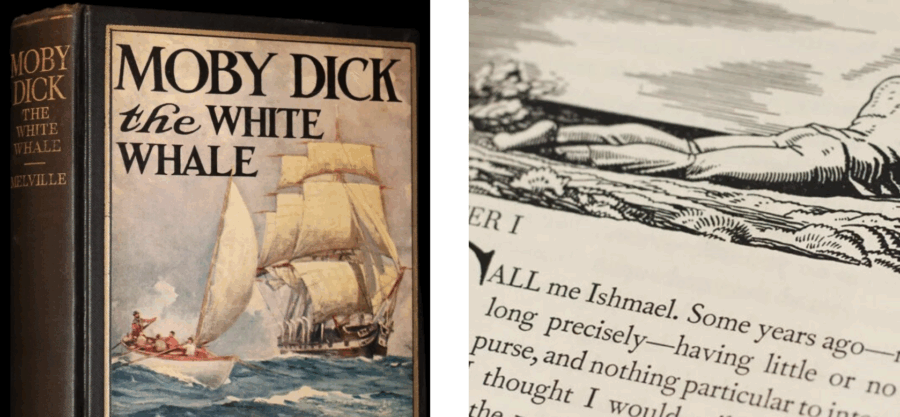
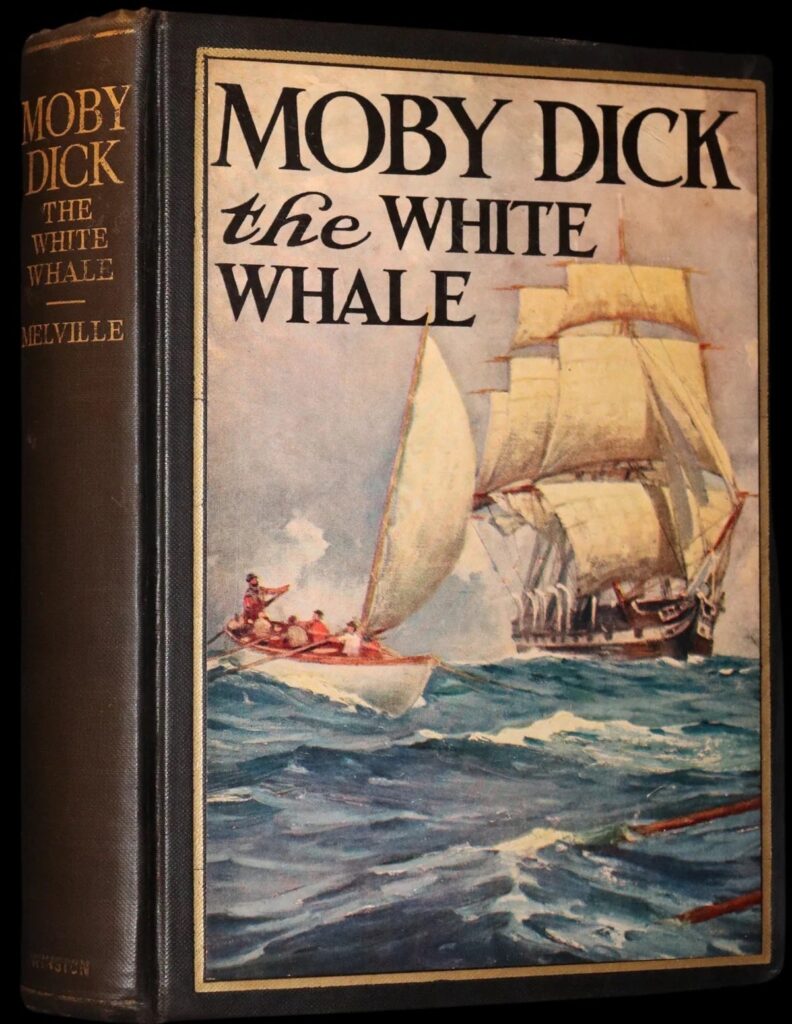
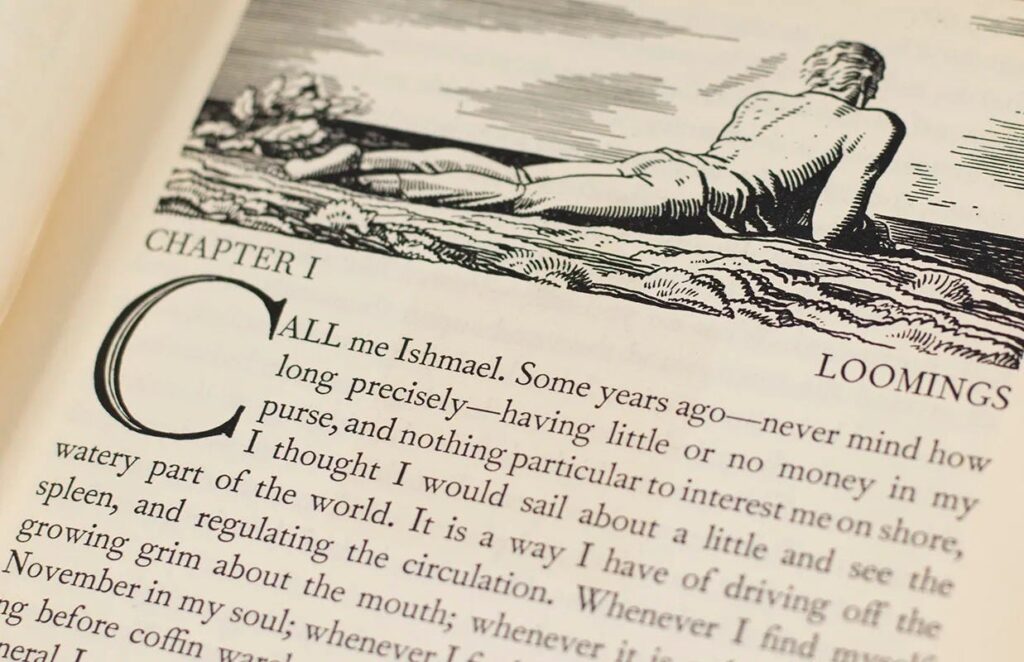
Copy of Moby Dick by Herman Melville and first page showing first line "Call me Ishmael". Part of autobiography of Dr. Anthony J. Cabone.

Believe Nothing You Hear, and Only Half of What You See — A memoir of Service, Shame and the Search for Truth

Christmas Break at Fort Leavenworth

As soon as I finished my last final examination at Notre Dame, which was on the absolute last day of finals on December 22nd, I ran back to Fisher Hall, grabbed my already packed suitcase, and called a taxi to take me to the South Bend Airport. I couldn’t wait to get home. My flight landed in Kansas City, where I was picked up and driven to our new home at Fort Leavenworth, Kansas.
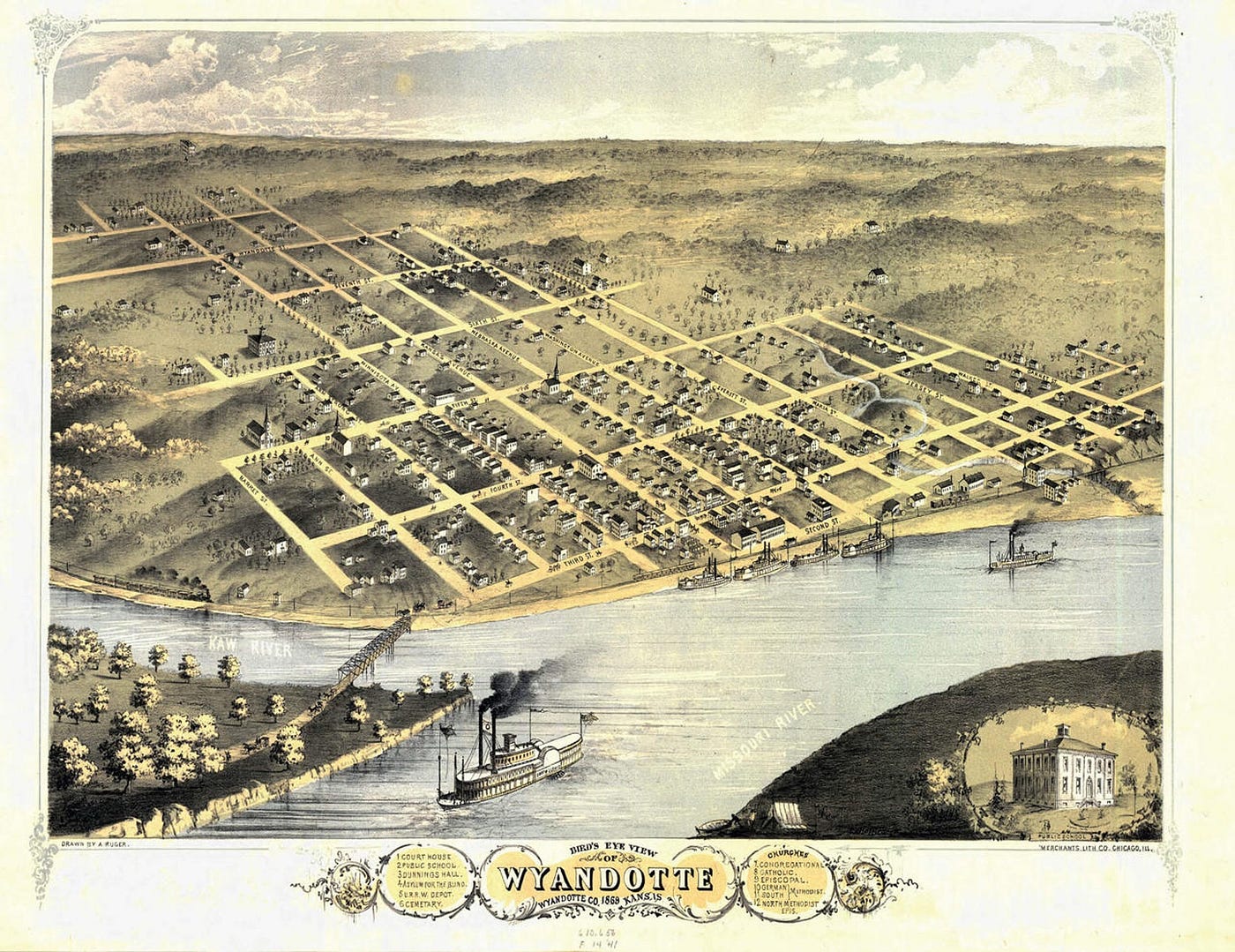
Antique map showing early Fort Leavenworth, Kansas on the Missouri River.  Autobiography of Dr. Anthony J. Carbone.
Antique Map of Fort Leavenworth, Kansas on the Missouri River

Father Assigned to US Command & General Staff College

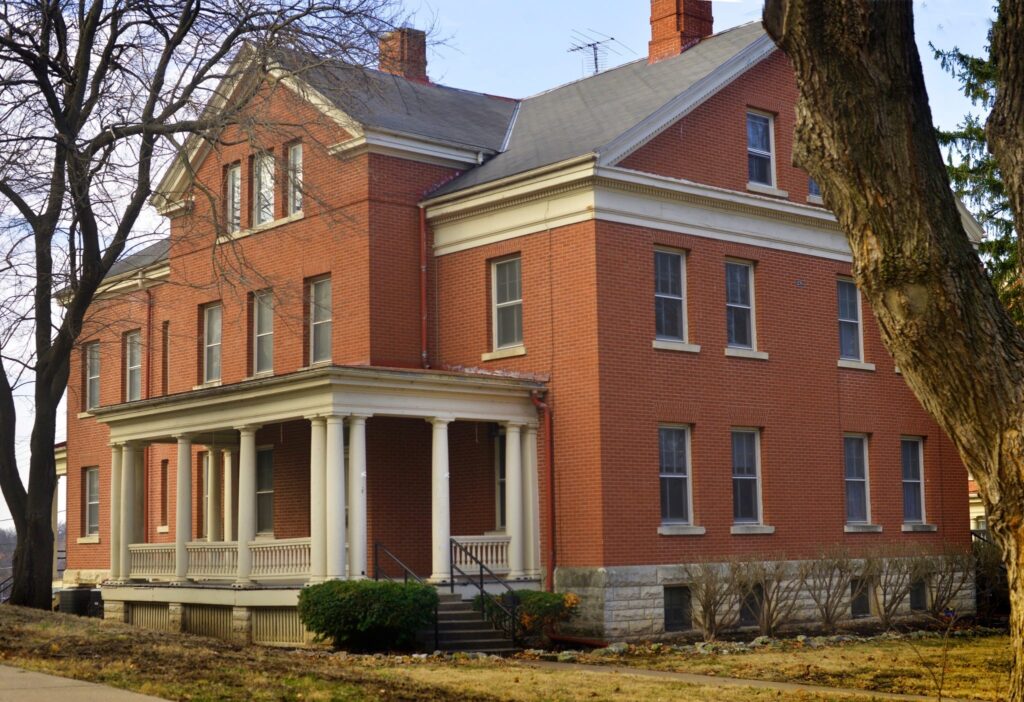
My father was now serving as a tactical instructor at the U.S. Army Command & General Staff College (C&GSC), and we lived on post in one of the older red brick cavalry-era townhouses.
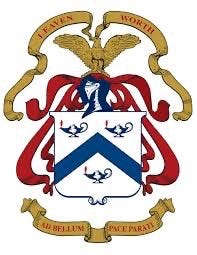
Fort Leavenworth Coat of Arms.  Autobiography of Dr. Anthony J. Carbone.
Fort Leavenworth Coat of Arms

The Carbone Family Home at Fort Leavenworth

My mother had, as always, transformed the place into an exquisitely beautifully decorated home. From the moment I walked in, I was struck by how long the house was — narrow in width, but stretched out like a hallway that never ended. The living room was the first space you entered, decorated with her signature touches and filled with the familiar scent of eucalyptus. That aroma always meant home to me. I even had a bunch of eucalyptus hanging in my dorm room back at Notre Dame.
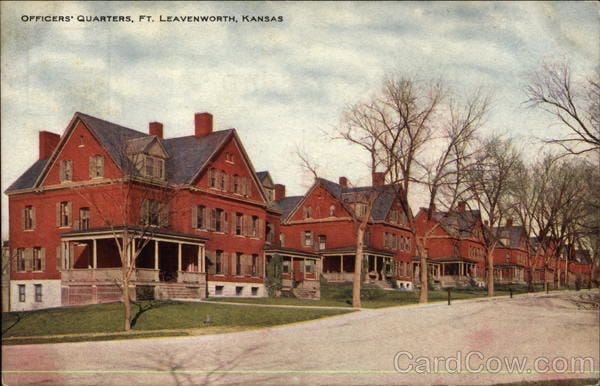
Postcard showing Officer's Quarters at Fort Leavenworth, Kansas.  Auto biography of Dr. Anthony J. Carbone.
Officers’ Quarters at Fort Leavenworth

The apartment was bright, thanks to unusually tall windows that let in generous light — even during winter. The large living room was flanked by two sets of white French doors. To the right, through one set, was a front sitting room that faced the main street. To the left, through the other, a large dining room that led into a long hallway running the entire length of the home. Off that hallway were the kitchen, four bedrooms, a bathroom, and finally, the back porch. All hardwood floors. Beautiful, classic Army housing.
The Fog of Finals

Strangely, I don’t remember much about that Christmas itself. That would become a recurring theme in the years ahead. After weeks of cramming for finals, followed by the intensity of the exams themselves and then the travel home, I was always in a kind of fog until well after Christmas. The exhaustion erased some of the joy. I remember things mostly through photographs — but I have almost none from this tour at Fort Leavenworth.
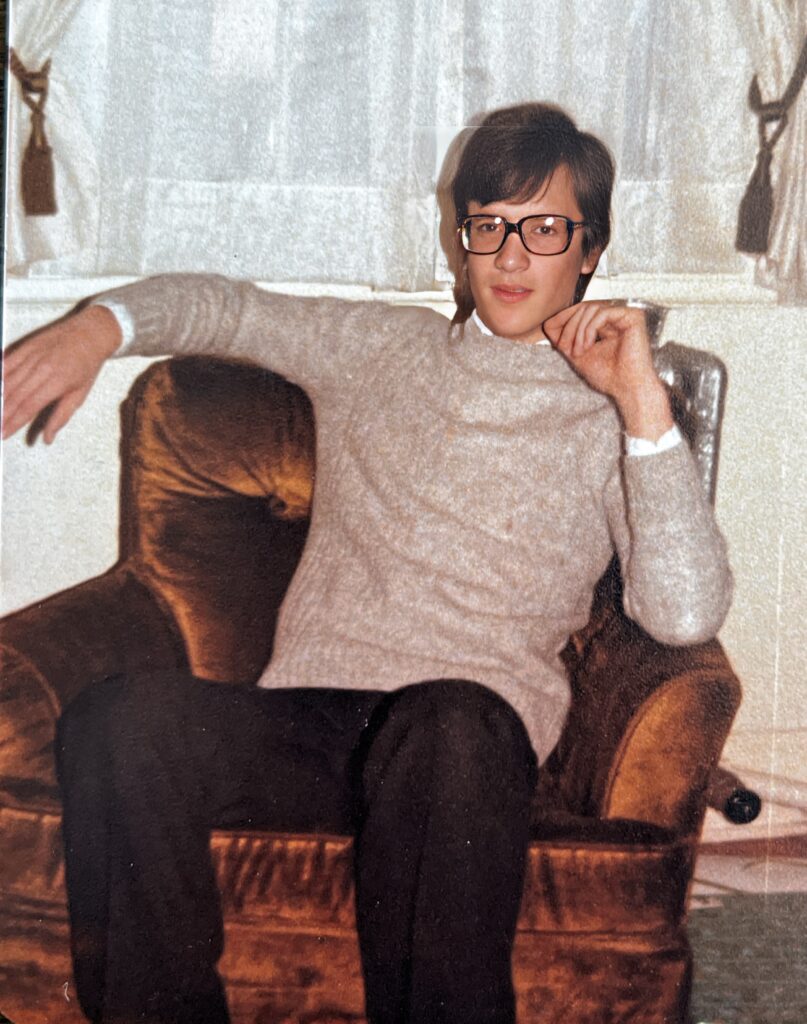
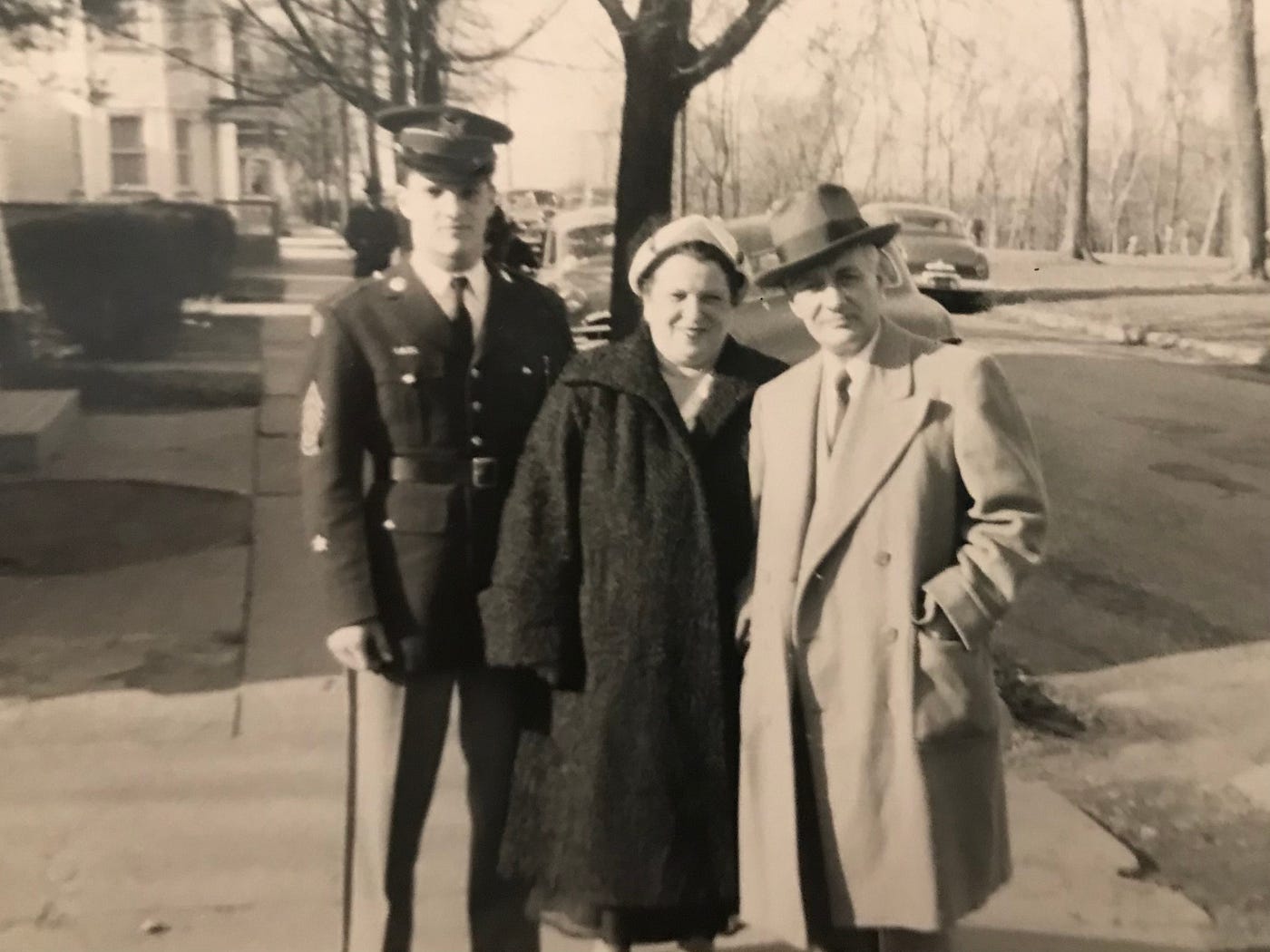
Me at home at Fort Leavenworth, Kansas, for Christmas Break (December 1977)

The Young Ladies on Post

With the exception, of course, of three beautiful young ladies who managed to capture my attention. Upstairs from us lived a family with a daughter in her freshman year of college. I remember wanting to meet her. Looking out from our back porch to the right was another red brick townhouse, and I quickly learned that a high school senior named Becky Roberts lived there. Beautiful and poised, I knew I would be asking her out by summertime.
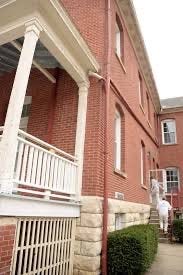
Officers' quarters at Fort Leavenworth.  Autobiography of Dr. Anthony J. Carbone.
The back porch of post quarters

The Morrison Family

Then there was the Morrison Family. Colonel Morrison was a friend and colleague of my father. His home was a warm, lively place. His wife, Mrs. Morrison, was gracious and generous, and her mother — whom everyone affectionately called “Abuela” — lived with them too. Best of all, the Morrisons had six daughters, each as beautiful and charming as the next. But it was the youngest, Cynthia, who quietly captured my attention. Because of my own shyness — and probably out of respect for the other girls — I never openly admitted which of the six daughters I favored most. I simply kept returning to their home and called upon all of them.
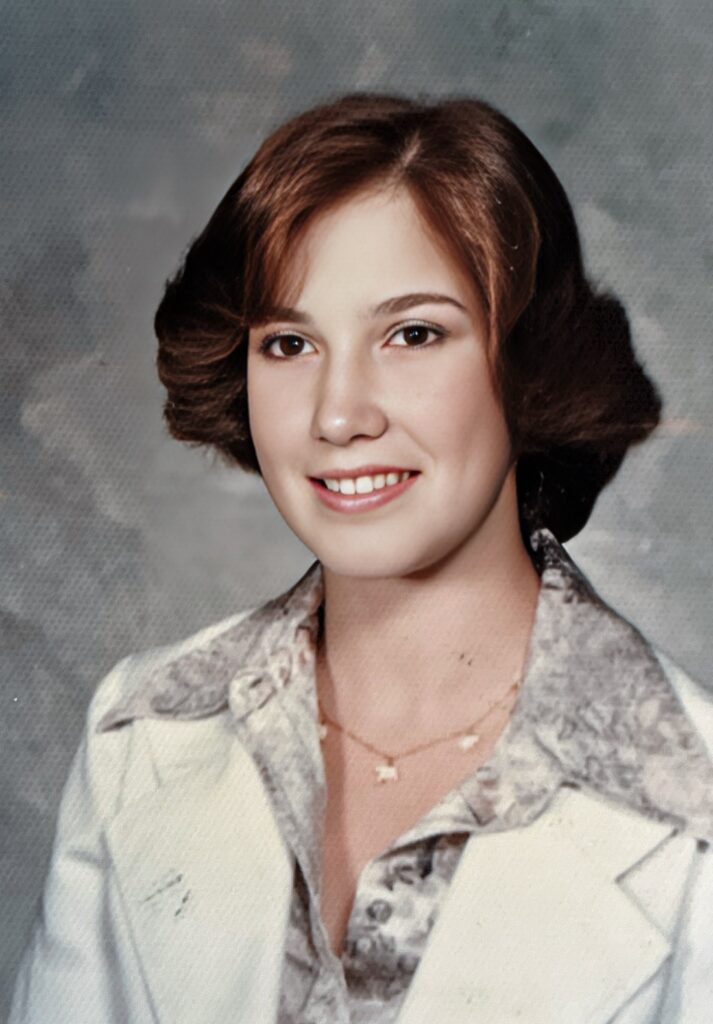
Cynthia Morrison from Fort Leavenworth, Kansas.  Biography of Dr. Anthony J. Carbone
Cynthia Morrison of Fort Leavenworth, Kansas

New Year’s Eve at the Morrison’s

The first clear memory I have of that Christmas break is actually New Year’s Eve at the Morrisons’. They introduced me to a Spanish tradition called Las Doce Uvas de la Suerte — The Twelve Grapes of Luck. As the clock struck midnight, you were to eat one grape with each chime, symbolizing good fortune for each month of the year. The tradition had originated in Spain in the late 19th or early 20th century and was still cherished in the Morrison household. It’s a tradition my oldest sister, Lynne, has adopted for her own family ever since.

The Spanish Traditions of the 12 Grapes of Luck “Las Doce Uvas de la Suerte”
Autobiography of Dr. Anthony J. Carbone.
The Spanish Traditions of the 12 Grapes of Luck “Las Doce Uvas de la Suerte”

The Morrison Home at Fort Leavenworth

I spent nearly the entire Christmas break visiting the Morrison girls. Every time I returned to Fort Leavenworth, their house was my second home. I’d sit at their long dining table, surrounded by all six daughters, talking and laughing for hours. Sometimes Abuela would sit quietly at the head of the table, listening in with a gentle smile. Then, like clockwork, Colonel Morrison would call from upstairs: “Anthony! Go home!” I’d spring up as ordered while the girls begged me to stay.

Living room set that reminds me of the beautiful home of Colonel & Mrs. Morrison.  Table where I would sit with the 6 Morrison girls and Abuela.  Autobiography of Dr. Anthony J. Carbone.

“Stay! We’ll be quiet!” they’d whisper. But I wasn’t about to get caught and reprimanded. I knew I was only allowed to be there unchaperoned because Colonel and Mrs. Morrison trusted me. I was a gentleman, and I wasn’t going to give them any reason to change their minds.
Clock at the Morrison’s house reminding me that it was time to go home. Autobiography of Dr. Anthony J. Carbone.

The Carbone Home and Rules

The Carbone Home had a curfew too. It was rare for any of us — Lynne, Diana, or me — to be out past 10 PM, even into adulthood. Pamela and Cynthia, who were younger, seemed to have grown up under a different, slightly more relaxed set of rules. But for us, it just wasn’t done.

Before I knew it, the days had passed. It was time to pack my suitcase again and return to Notre Dame for my second semester.

Back to Notre Dame: Second Semester Begins

Back to South Bend

Christmas break ended far too quickly. I was just beginning to get to know some of the young ladies on post, and I couldn’t wait to return for summer break. Still, I packed my bags and flew back to South Bend. From the airport, I headed straight to Fisher Hall. Despite the bitter cold, I was genuinely excited to see the guys in my section again and to hear about their Christmas adventures. What gifts had they received? Had any of them found romance over the holidays?

The Boys are Back in Town

I figured Andy Cordes had probably picked up a dozen new LPs — no doubt rare imports or something obscure and progressive. Matt Bedics, ever the deep thinker, had probably unwrapped some esoteric philosophy textbook. Al Emory, our resident metallurgist, almost certainly came back with the newest Texas Instruments TI-59 programmable calculator. I returned with a couple of crewneck sweaters and a few small odds and ends to brighten up my dorm room.

Registration for Second Semester Classes

Bob Terifay was back and eager to start the second semester with a fervor that I was lacking–I was nervous about the next round of classes. Registration was held on Tuesday, January 17th, and classes began the next morning. My second-semester schedule was just as grueling as the fall term: Basic Leadership (Military Science), with weekly Army ROTC drill, General Chemistry II, with weekly lab, Calculus B, Intermediate German II, English Composition & Literature, and Introduction to Philosophy.
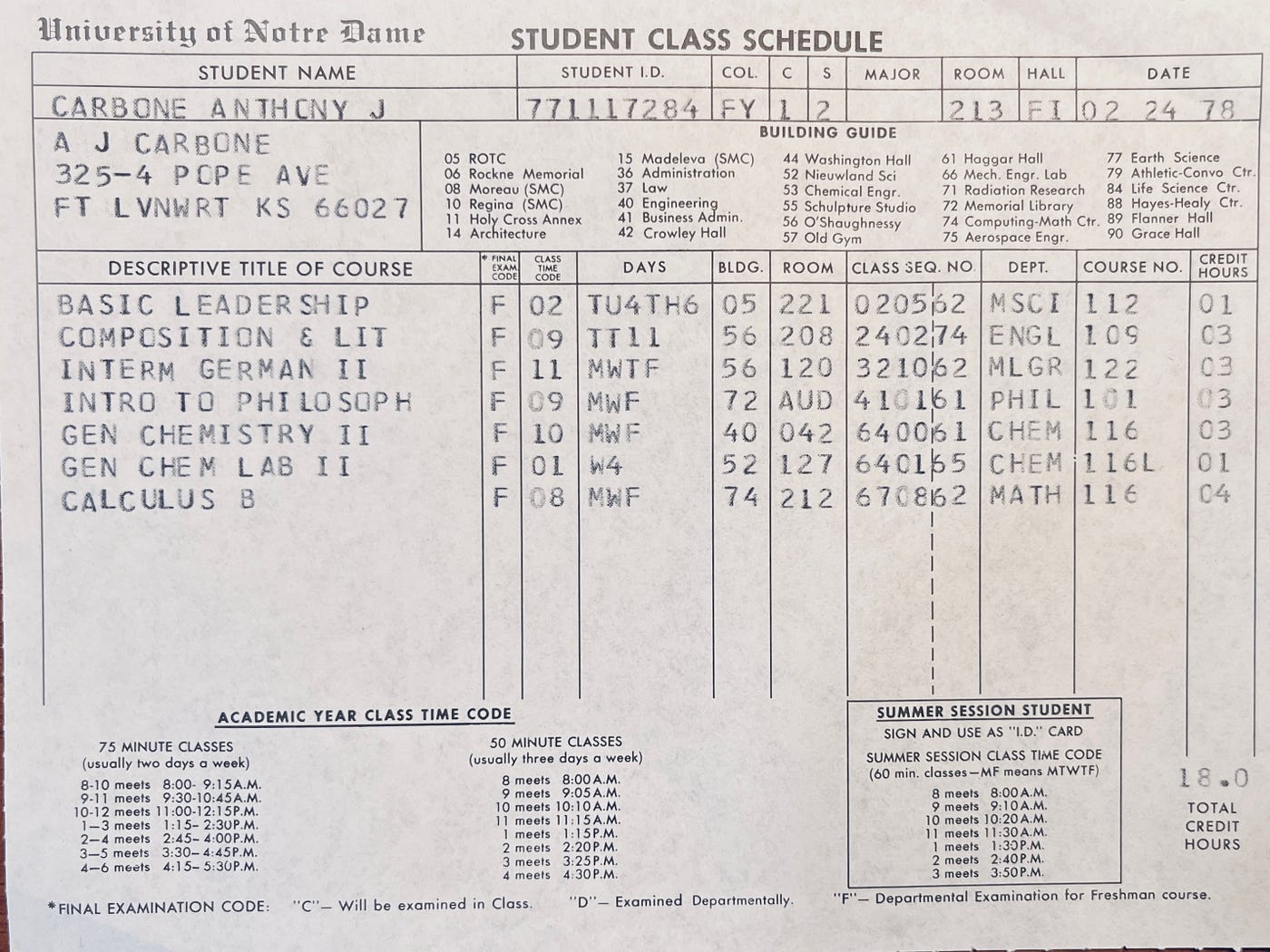
University of Notre Dame Second Semester of freshman year schedule.  Autobiography of Dr. Anthony J. Carbone.

It was another heavy academic load, and I found myself constantly buried in study. What made it worse was how uneven the core curriculum felt. There were easier math and science tracks for non-STEM (Science-Technology-Engineering-Math) majors, but we — the pre-meds and engineers — had no such luxury. We were expected to hold our own in the same Humanities courses as English majors and philosophy buffs and write papers and essays at the Humanities Major level.

Typing Papers before Word Processing

This was long before laptops, Google Docs, or even word processors. At Notre Dame in the late 1970s, writing a term or research paper meant starting with a legal pad and pen, scratching out sentences by hand, and then heading over to the bulletin board in Fisher Hall to find a typist. Most of the ads were posted by coeds from the women’s dorms who earned extra cash typing papers for guys like me.

You would take your handwritten draft over to one of the girls’ halls, and for ten cents a page, they’d type it up. Revisions — of which I always had many — were typically five cents a page. I never thought of myself as a strong writer, but I was a pretty good editor. That meant I’d go back and forth with the typist again and again, burning through pages, coins, and much of my monthly stipend in the process. But I was determined to get each paper just right — even if it meant wearing out both my budget and my welcome.
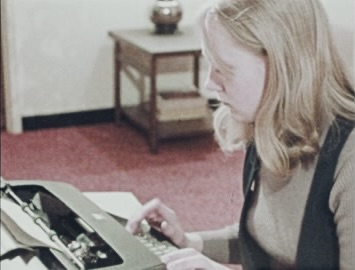
College coed typing for money at University of Notre Dame.  Autobiography of Dr. Anthony J. Carbone.

The Blizzard of 1978

Return to Campus for Second Semester

Returning to campus in January meant facing another long stretch of South Bend winter. Snowbanks rose higher than the dorm windows, and cold wind whipped across the quads as we hurried to class bundled in every layer we owned. But there was one winter storm that would mark our semester forever: the Blizzard of 1978.

On January 26, 1978, the snow began falling — and didn’t stop for three straight days. In the end, 41 inches fell, bringing the month’s total to a record-breaking 85 inches. Snow drifts piled up to 20 feet in places. The University of Notre Dame, famous for never canceling classes, shut down for three days straight. That had never happened before.
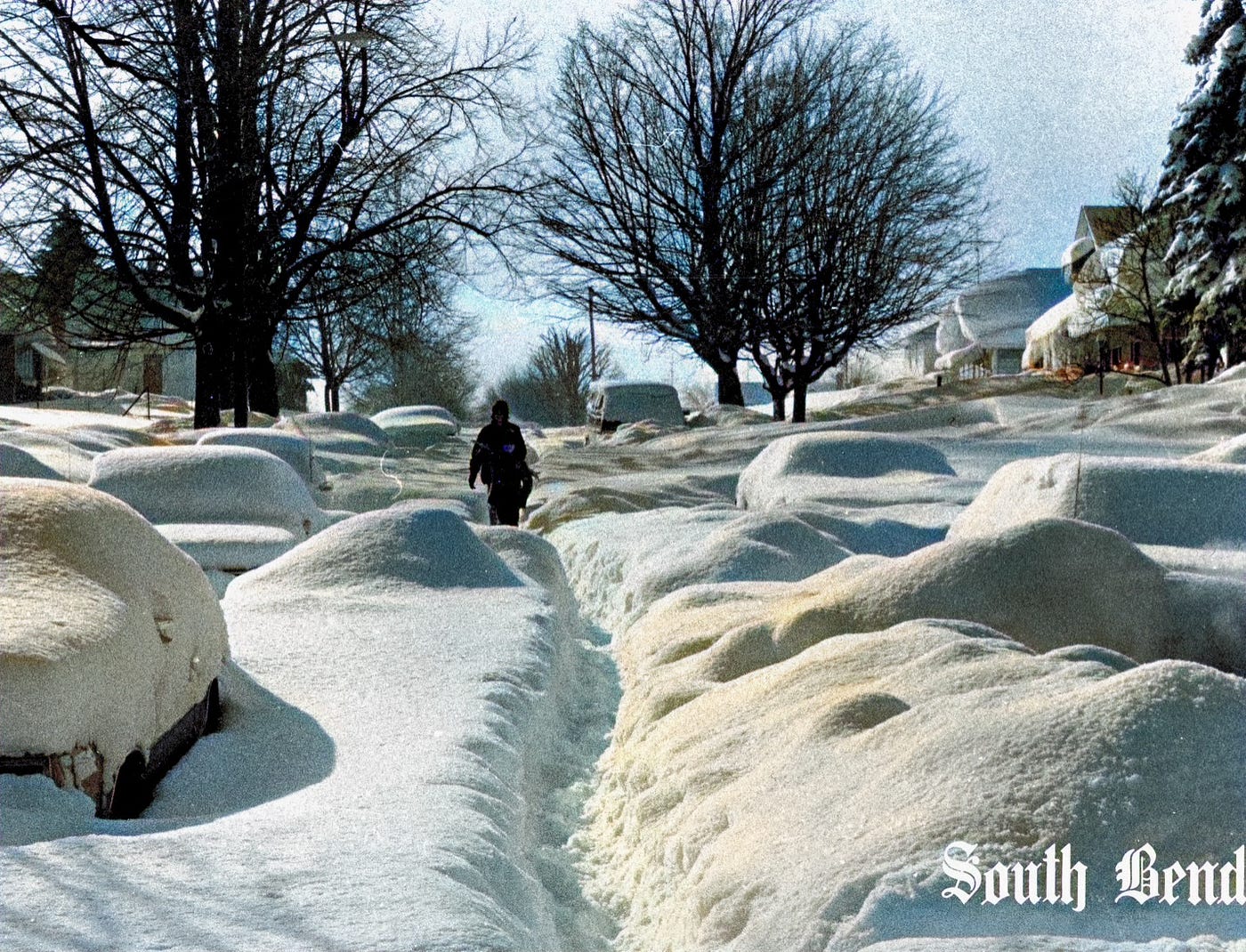
Blizzard of 1978 while attending the University of Notre Dame. As part of the autobiography of Dr. Anthony J. Carbone.

Blizzard at Fisher Hall

Fisher Hall became our snowbound fortress. The wind howled outside, but inside we were checked on multiple times a day by nuns and nurses who came bearing medicine, hot soup, and tea. They brought comfort and compassion that warmed us more than the broken radiators ever could. If we dared to leave Fisher Hall, Verna the maid would insist that we wear at least 3 layers of clothing, a hat, and a hood.
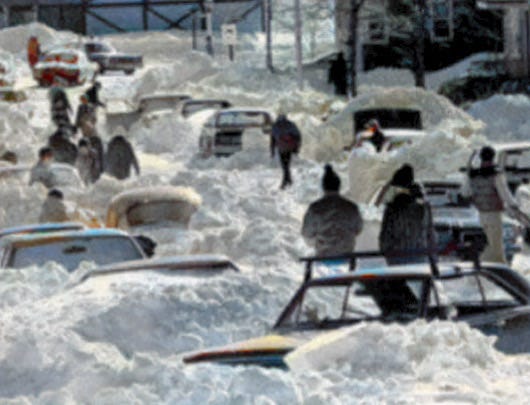
Blizzard of 1978 while attending the University of Notre Dame. As part of the autobiography of Dr. Anthony J. Carbone.

Most of the roads into South Bend were impassable. Emergency vehicles were stuck, students from the Campus View Apartments tried to help a stranded woman in labor, and the Red Cross had to step in. Our food service workers and power plant staff slept in dining hall basements and locker rooms, doing all they could to keep the University running. In response, hundreds of students volunteered to shovel snow for local residents. We found ways to amuse ourselves: diving off porches into ten-foot snow drifts, building snow forts, and braving trench-like walkways carved between buildings.

Tunnels Through the Snow Across Campus

The Notre Dame groundkeepers worked endlessly moving snow. They carved out 3-foot wide paths in the 6 foot snow that led to major points on campus. One to the dining hall. Another to the library. One to the Science Building. You could only pray that you chose the right path, because you couldn’t see. I’ll never forget the sight of students walking to the basketball arena to watch Notre Dame play the University of Maryland — only their heads visible above the snow walls carved into campus walkways, like some winter World War I battlefield. We were cold, tired, and mostly trapped, but we were together.
Blizzard of 1978 while attending the University of Notre Dame. As part of the autobiography of Dr. Anthony J. Carbone.

Now Back to the Academic Grind

Back to Class

After the snow, classes resumed and second semester quickly fell into a rhythm. I became more focused. I knew what was expected and understood the system a little better. My grades improved, and I made more friends. I was studying like crazy and always tired. Still trying to prove myself. Still afraid of failing.

English Comp & Lit

I remember sitting in English Composition & Literature surrounded by students who had attended elite prep schools and taken AP Literature. Many of them had read Moby-Dick half a dozen times before college. I, on the other hand, was reading “Call me Ishmael” for the very first time — while they were already pondering the symbolic implications of the whiteness of the whale.
My Essay on Einstein’s Theory of Relativity Goes Unappreciated

For one assignment, we were required to read a novel and submit an analytical essay. I decided to take an interdisciplinary approach and crafted a thoughtful comparison between the novel’s theme and Einstein’s Theory of Relativity — a bold analogy that I felt reflected the character’s emotional disorientation. I was proud of the result and handed it in with confidence.

When the paper was returned, I was stunned to see a bold red F at the top of the page. Upset, and completely out of character, I marched straight to my professor’s office. “Why did you give me an F on my paper?” I asked. She glanced at me and said flatly, “Because I didn’t understand it. I don’t know anything about the Theory of Relativity.”
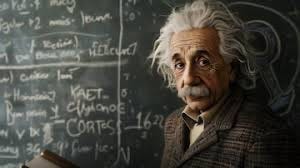
Albert Einstein Theory of Relativity. Autobiography of Dr. Anthony J. Carbone

I stood there, dumbfounded. “That’s not my fault,” I replied. “It’s a brilliant analogy, and I deserve a better grade. Can I have your permission to have my paper graded by a Physics professor?” She paused, gave a dismissive little harrumph, and said, “That won’t be necessary, Anthony. I’ll re-read your paper.”

She never did change the grade and that moment stayed with me — the frustration of being penalized for creativity, thinking outside the box, and for trying to bridge my scientific background with literature. That paper didn’t just represent my thoughts — it represented me. And at that moment, being misunderstood felt like a kind of failure I didn’t know how to fix. It’s a struggle that I have battled my entire life.

Calculus for STEM Majors

Unfortunately, English wasn’t my only challenge. I was especially struggling in Calculus. Bad Kreuznach American High School hadn’t offered it, and most of my classmates had already taken AP Calculus in high school. I was falling behind fast and trying to climb a wall without tools.

Calculus textbook. Autobiography of Dr. Anthony J. Carbone.

Summoned to See the Chairman of Pre-Med

Then I received the summons I had been dreading: I was to report to Father Joseph L. Walter, C.S.C., Chairman of the Department of Preprofessional Studies — the pre-med program.
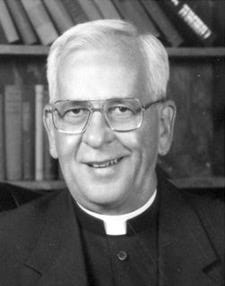
Father Joseph L. Walter, C.S.C., Chairman of the Department of Preprofessional Studies — the pre-med program. Autobiography of Dr. Anthony J. Carbone.
Rev. Joseph L. Walter, CSC

I walked into his elegant office, trembling. It was imposing, with a massive polished mahogany desk that looked like it belonged in the Oval Office. Father Walter sat behind it like a judge in chambers. My heart was pounding.
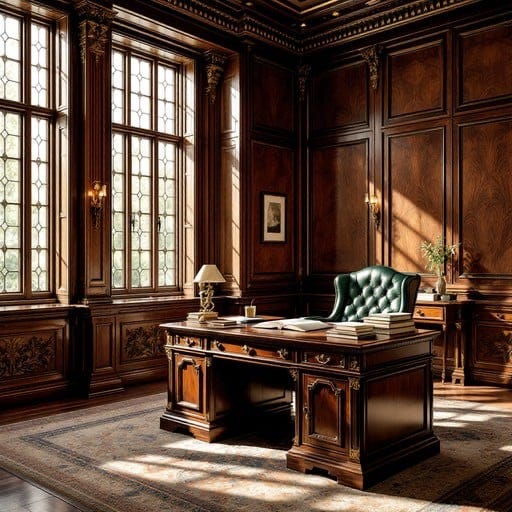
Example of Dean Walter's wood paneled room at Notre Dame with his huge mohogany desk. Autobiography of Dr. Anthony J. Carbone.

Failing Calculus

He got right to the point. “Anthony, you’re failing Calculus,” he said. “You may want to consider whether medicine is truly the right path.” My heart dropped. My entire life plan — everything I had worked for — teetered on that one conversation. I was sweating. I could barely speak.

Blackboard of Calculus. Autobiography of Dr. Anthony J. Carbone.

Father Walter Gives Me a Calculus Tutor

Father Walter admirably chose not to cut me loose. He arranged for me to work with a Calculus tutor. But he also wrote a letter to my parents, advising them that perhaps I should consider another path within the health sciences — something more suitable, he implied, than medicine. That letter crushed what was left of my pride. But I kept it.

Calculus Tutor. Autobiography of Dr. Anthony J. Carbone.

Perseverance

Years later, when I was accepted into Georgetown University School of Medicine, I mailed Father Walter a copy of my acceptance letter — along with the letter he had written to my parents. I also wrote him a note of my own, reminding him that sometimes the best thing a struggling student needs is encouragement — not dismissal.
Georgetown University School of Medicine Seal. Autobiography of Dr. Anthony J. Carbone.

To his credit, he replied with a kind letter in return. “Anthony,” he wrote, “I admire your perseverance.” That word — perseverance — might be the one word that defines my rollercoaster life.

The Tenerife Disaster of March 1977

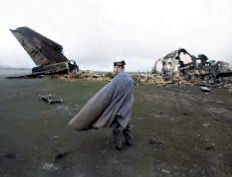
That meeting with Father Walter would stay with me for another reason. Behind his desk, mounted on the wall, was a framed airline ticket. Curious, I asked about it. He smiled. “Ah yes,” he said. “I survived the worst plane crash in aviation history.”
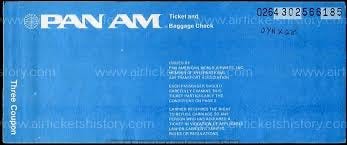
He explained that he had once booked a seat on Pan Am Flight 1736 to the Canary Islands. At the last minute, he missed the flight. That was the same flight that, on March 27, 1977, collided with a KLM 747 in the fog on the runway in Tenerife, killing 583 people in what remains the deadliest aviation disaster in history.
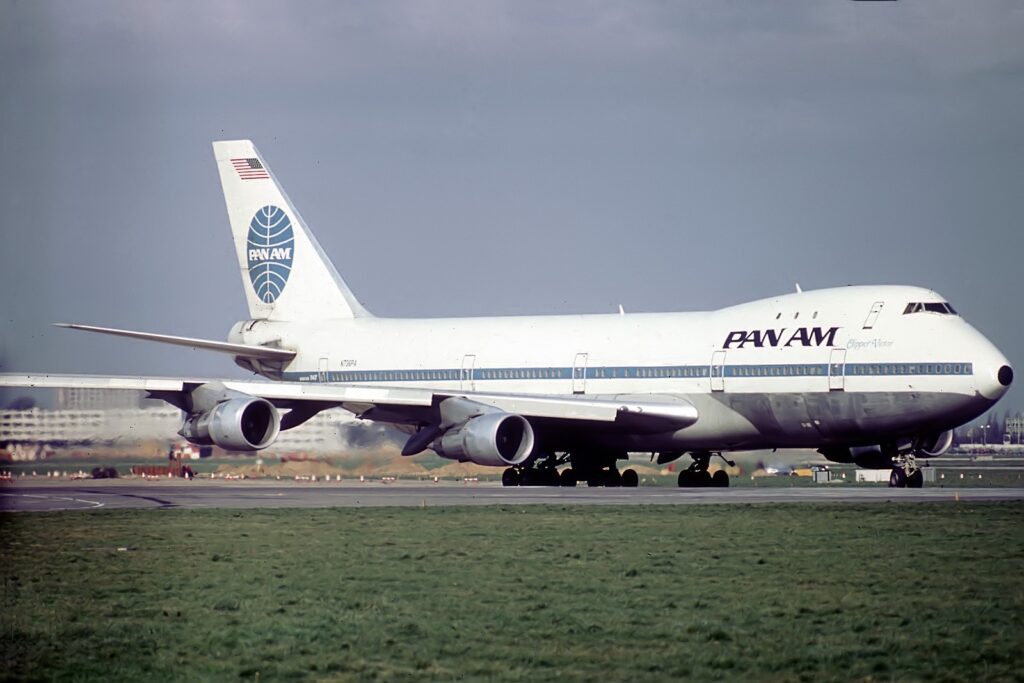
He had lived because of a twist of fate — a delay, a missed boarding call, a quirk of timing. I never forgot it. That moment planted a seed in me that would eventually grow into something more: the desire to become a Flight Surgeon. That day in Father Walter’s office, as painful as it was, became one of the sentinel events of my life. I have told the story of the Tenerife Disaster in a hundred lectures on Aviation Safety since becoming a flight surgeon. The bottom line of the story of the Tenerife Disaster was the junior officers’ fear of speaking out about the obvious danger to their superiors.

ROTC: Military Science

Not every course was astruggle that semester. Basic Leadership — my ROTC Military Science course — was practically effortless. I could do it in my sleep. That term we focused on map reading, which I had mastered years before. My father had taught me how to read maps from the time I was a kid, and before the invention of GPS, map reading was one of the most essential skills for a military officer. While others struggled to interpret topographic lines and grid coordinates, I was breezing through with confidence and even tutoring classmates.
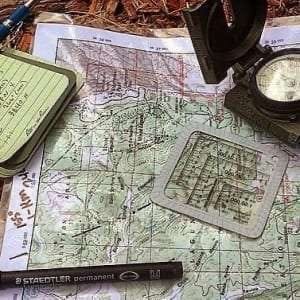
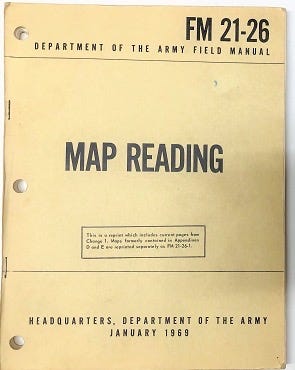
Intermediate German mit Herrn Wimmer

Another class that came relatively easily to me was Intermediate German. I had studied German in high school while living in Germany, first at Mannheim American High School and later at Bad Kreuznach. My instructor, Professor Albert K. Wimmer, took an immediate liking to me. I was the only student in the class who had ever actually lived in Germany, and he complimented me often on my authentic German accent.
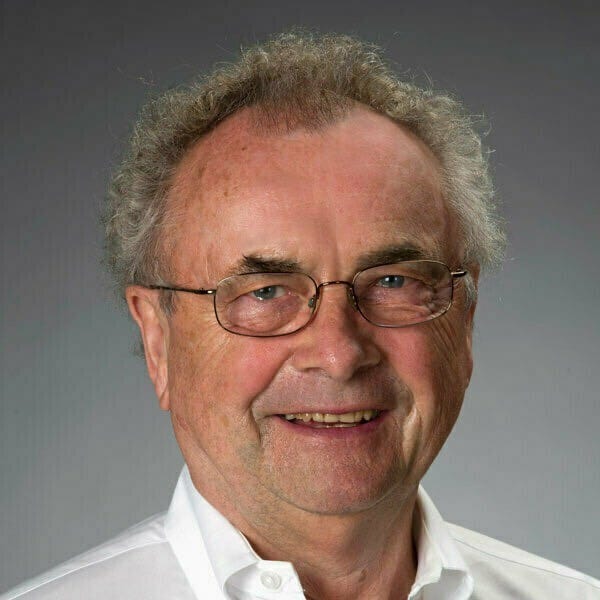
Albert K Wimmer. University of Notre Dame. Associate Professor of German. Autobiography of Dr. Anthony J. Carbone.
Professor of German & Russia Albert K. Wimmer, University of Notre Dame

Denied Study in Innsbruck, Austria

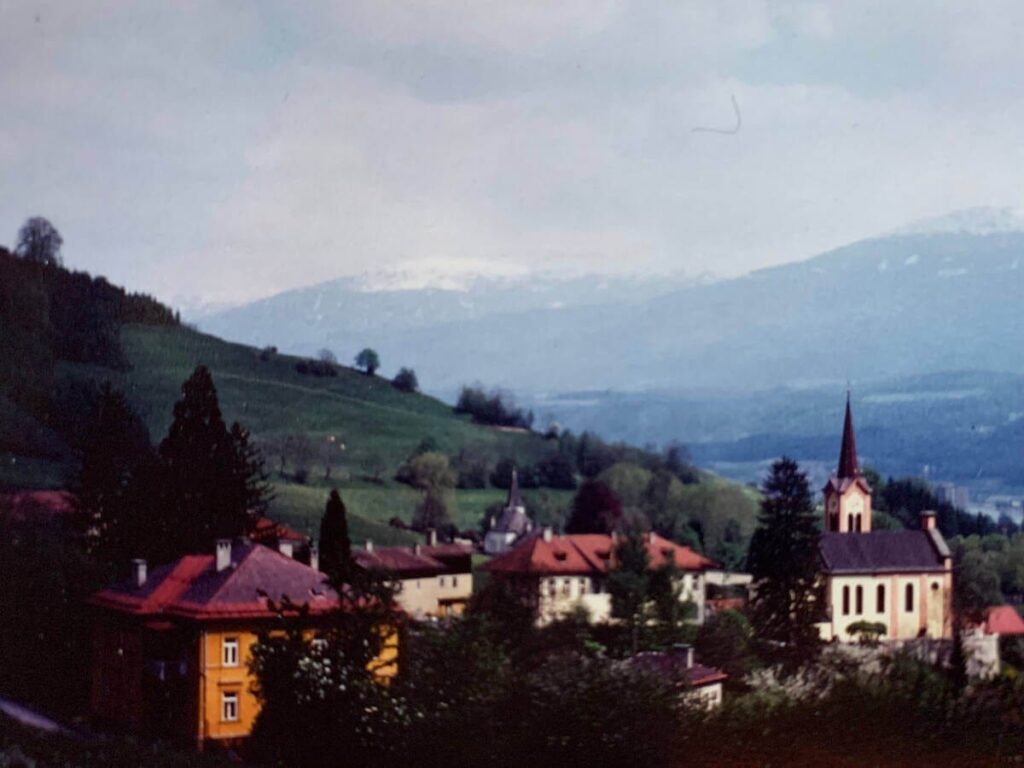
Professor Wimmer was soon to be appointed to the University of Notre Dame’s Program in Innsbruck, Austria, and he invited me more than once to join him there for a full academic year.
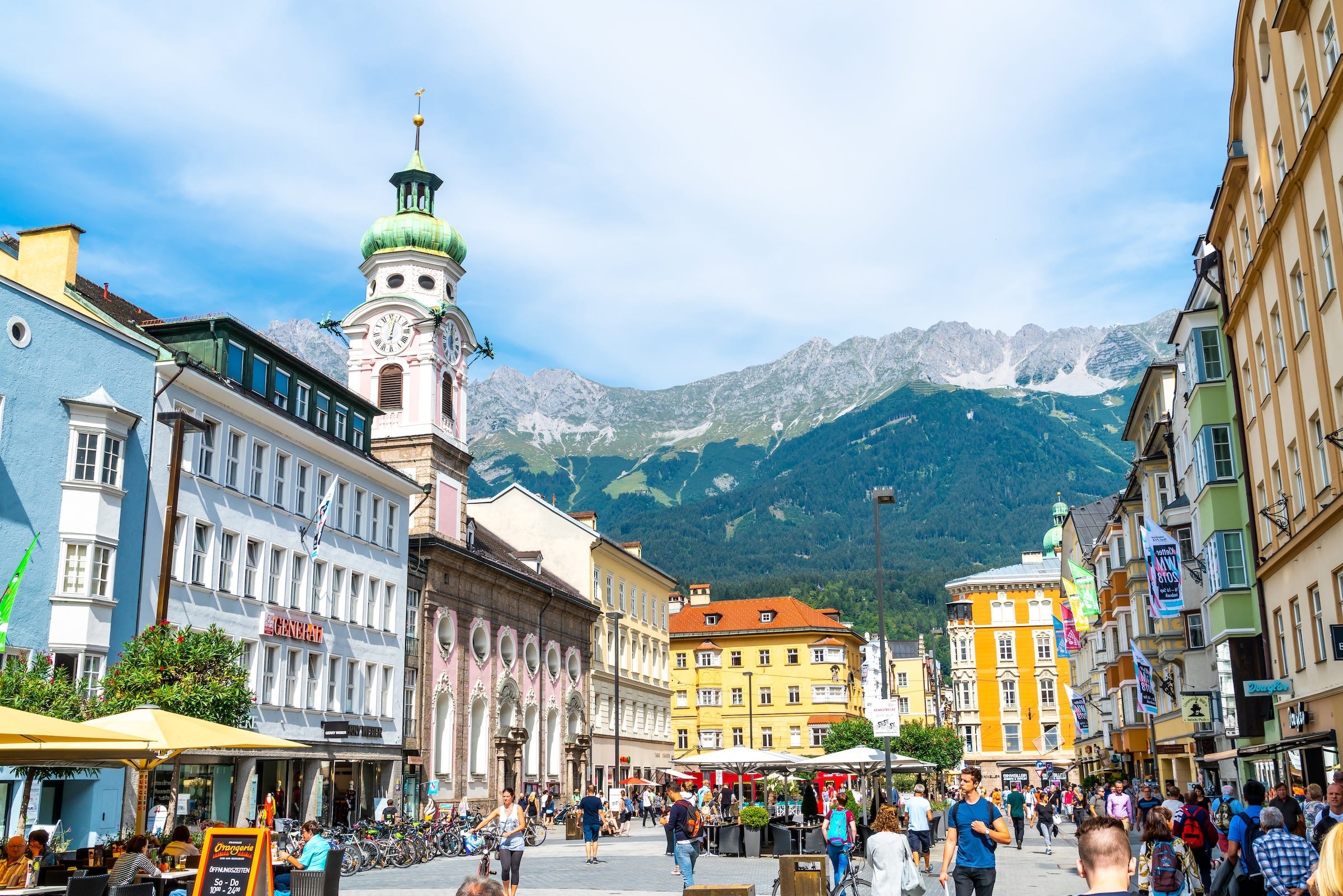
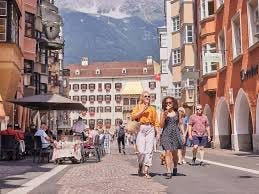
It was tempting — I love Austria, the Alps, the culture, the opportunity to study abroad with a professor who believed in me — but ultimately impossible. Neither the Pre-Med Program nor ROTC would allow a full year abroad, so I had to decline. Another door closed in the name of obligation.

The 1977–78 Fighting Irish Basketball Season

The 1977–78 University of Notre Dame men’s basketball season was exciting as well as a historic one, marking the program’s only appearance in the NCAA Final Four. Led by Coach Digger Phelps, the team finished with a 23–8 record and reached as high as №2 in the national polls. Key players included Rich Branning, Bill Laimbeer, Orlando Woolridge, Bill Hanzlik, Tracy Jackson, Bruce Flowers, Dave Batton, Kelly Tripucka, and Duck Williams. Notre Dame dominated their first three NCAA Tournament games, including a 23-point victory over Houston, before ultimately losing to Duke in the Final Four. Orland Woolridge lived in Fisher Hall and we saw him and the rest of the team often.
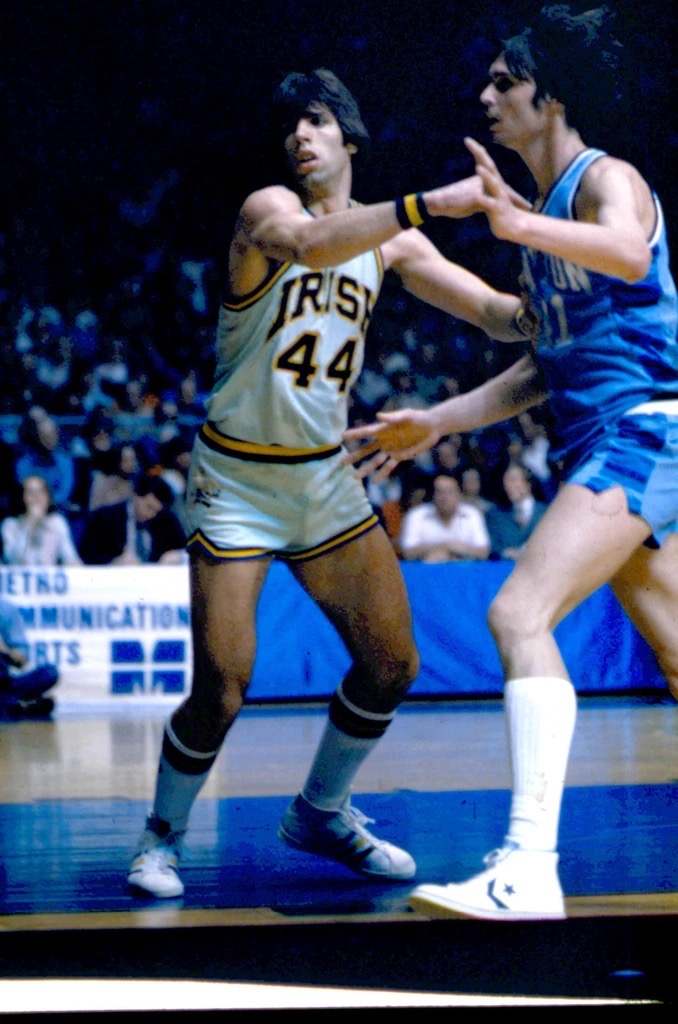
Freshman Kelly Tripuka #44 Fighting Irish Basketball team 1977-78 Season

Spring Break at Fort Leavenworth

Spring Break came before I knew it. This time, my family allowed me to come home to Fort Leavenworth for Easter break, which ran from March 18 to March 27. While most of my classmates headed south to warm beaches and wild parties in Fort Lauderdale, I returned to a chilly, gray Leavenworth, Kansas this March — rain, snow, and near-freezing temperatures all week.

Still, I was happy to be home. I caught up with my family, the Morrison girls, and my upstairs neighbor, and I appreciated the quiet. But much of my time was spent studying chemistry and calculus in preparation for final exams. I barely noticed how fast the week passed. Again, this was one of those moments where I was so sleep deprived from school, that vacation flew by before I came out of the fog.

Back to Notre Dame to Finish up 2nd Semester

Before I knew it, I was back in South Bend, grinding through another brutal exam schedule. It was a regrettable repeat of the fall semester — weeks of grueling preparation followed by equally grueling finals, with disappointing results.

Summer Break of Fun

As soon as my last exam was over, I hurried back to Fisher Hall and began packing up my dorm room for the summer. Notre Dame had a convenient system that allowed students to store their belongings on campus, which made the process easier. Within a couple of days, I was back home at Fort Leavenworth.
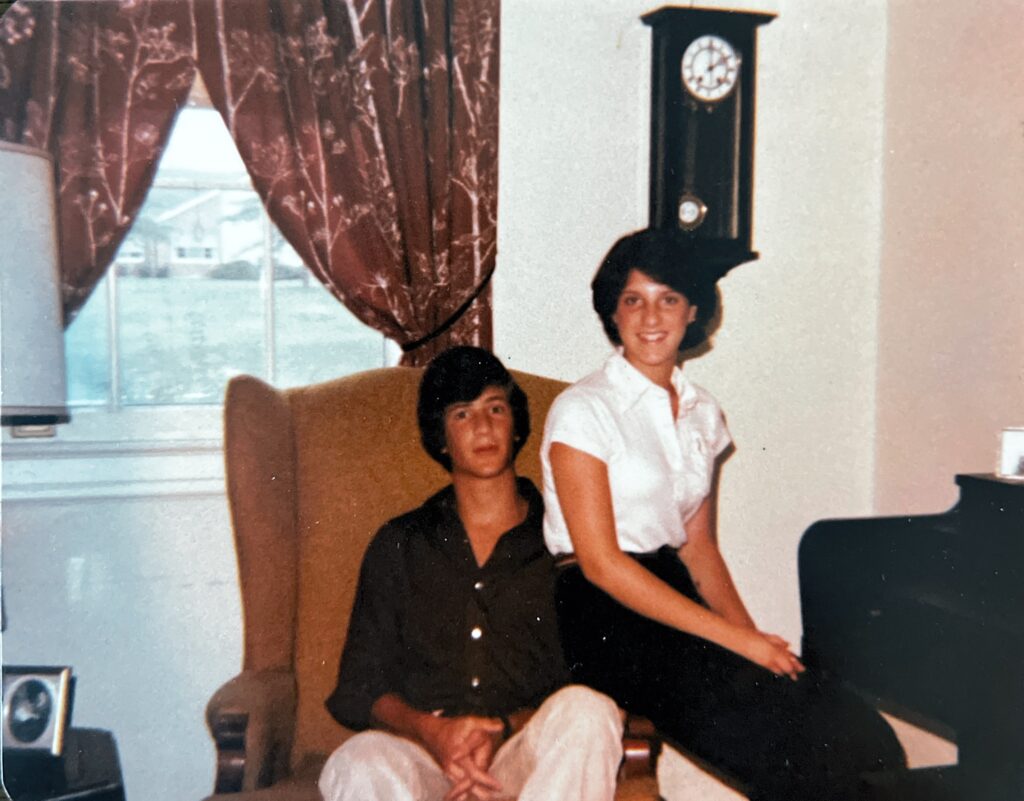
Me with my sister Cynthia in the sun room of my father's quarters at Fort Leavenworth, Kansas.  Autobiography of Dr. Anthony J. Carbone.

Got My First Driver’s License

First things first: I studied for and took the Kansas driver’s license exam. That’s right — I didn’t get my license until after my freshman year in college.
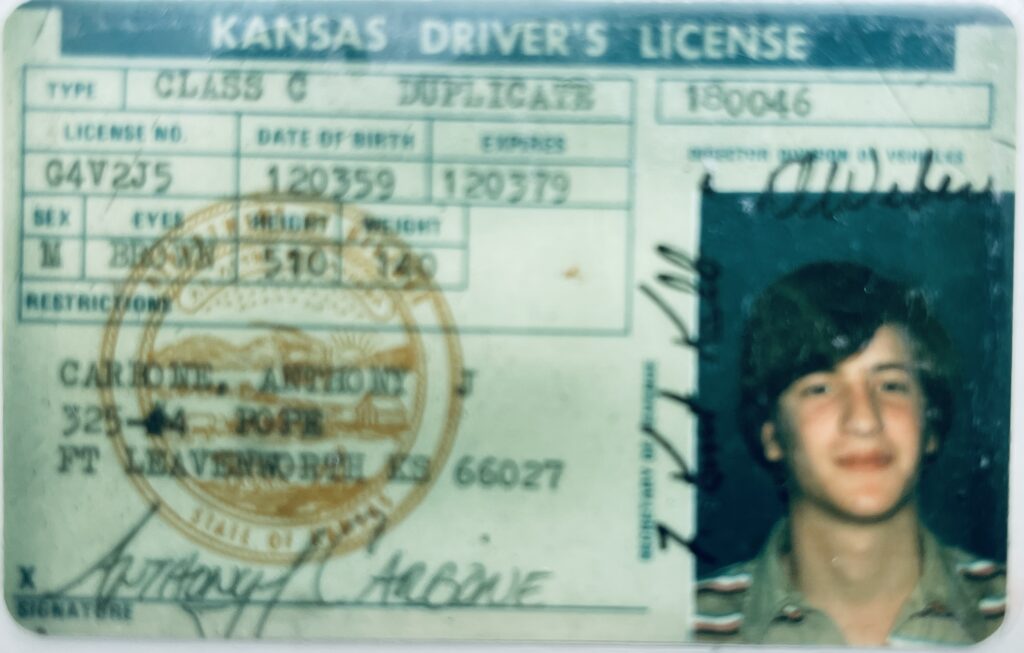
My first Driver's License from the State of Kansas issued back in 1978 while we were living in Fort Leavenworth, Kansas.  Autobiography of Dr. Anthony J. Carbone.

I passed the road test using our new Chrysler Cordoba, and from that day forward, I found every excuse to borrow it. I’d volunteer for errands to the commissary at least once a day. I made daily runs to the post exchange or the Shoppette — any excuse to cruise around in the Cordoba. And I have to give credit to my buddy Jeff Bell, who actually taught me to drive his VW Beetle in Germany back in 1976.
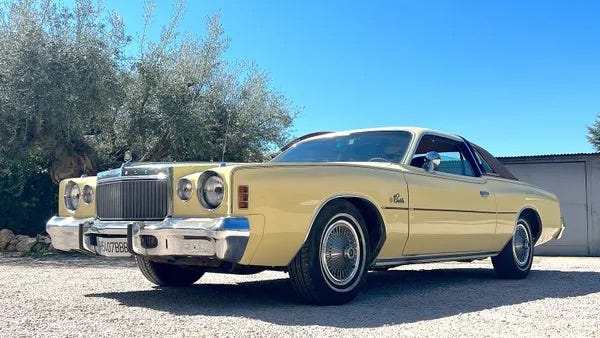
1977 Chrysler Cordoba. Carbone Family Car 1977–1980. Autobiography of Dr. Anthony J. Carbone.

First Time Asking a Girl Out on a Date

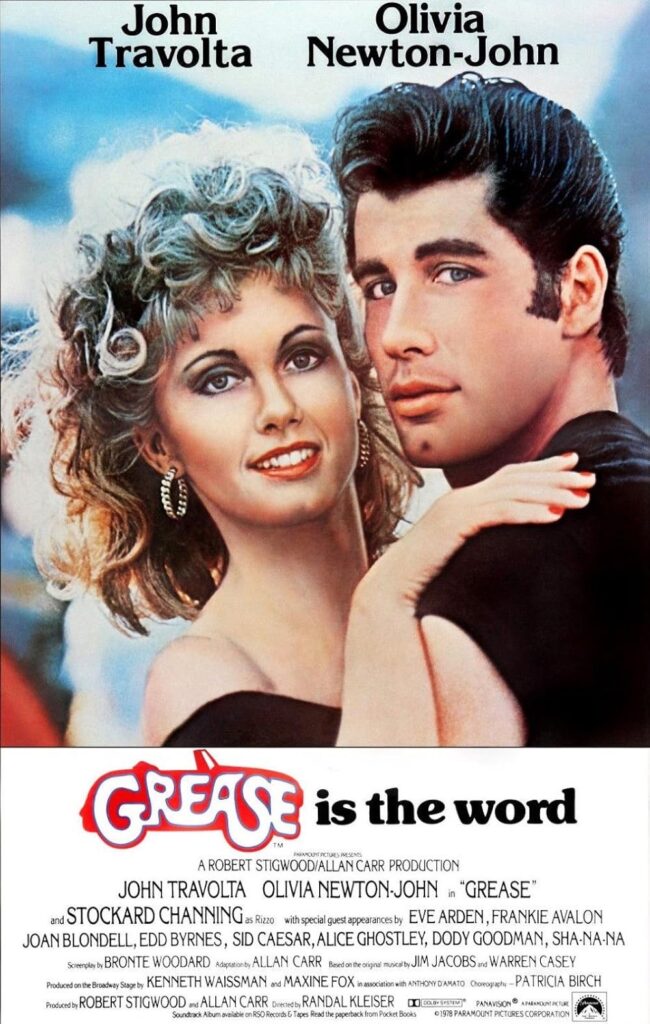
Now a college student with a driver’s license and a decent car, I figured it was finally time to go out on a real date. I worked up the nerve to ask Rebecca Roberts — a colonel’s daughter — if she’d like to go to the movies with me. I think it was the debut of Grease. She said yes, and I was over the moon.
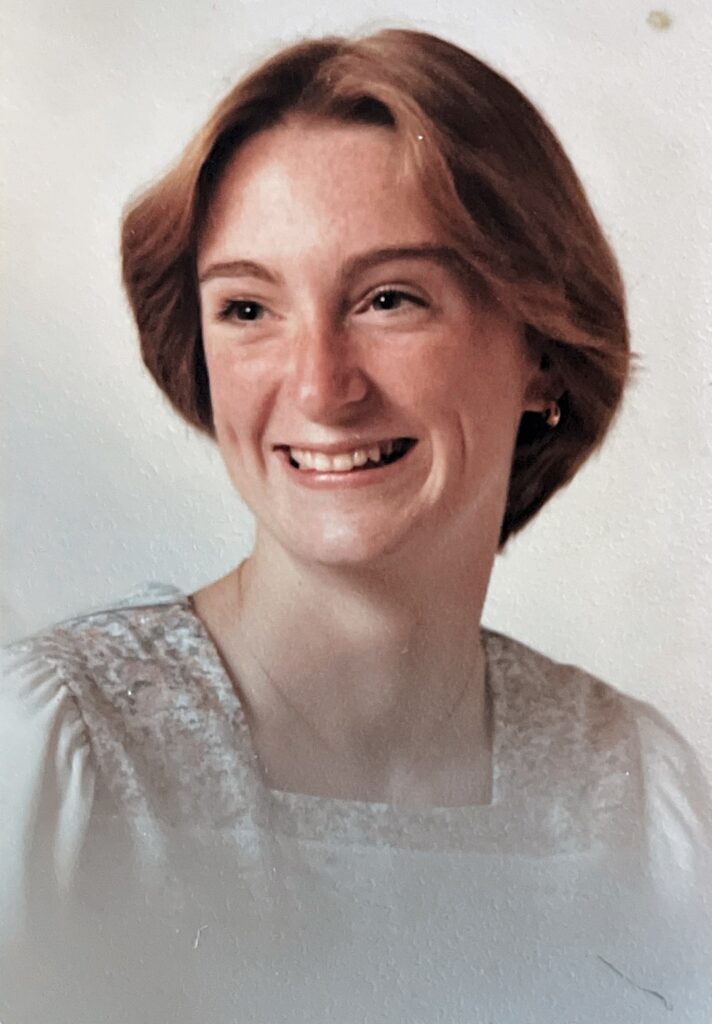
Becky from Fort Leavenworth, Kansas.  Autobiography of Dr. Anthony J. Carbone.
Becky from Fort Leavenworth

Use of Car–Denied!

I ran home to tell my family the news. Then I waited for my father to come home from work so I could ask him for the car for the big date. I expected he’d be happy for me — but he wasn’t. His response was blunt: “No. You should have thought about asking to borrow the car before you asked out a young lady.”

That was it. In our household, you got one chance to ask my father for something. He never changed his mind, and you never asked twice. Timing was everything. My friends never understood this. They’d beg me to hurry and ask him if I could go to a party or a sleepover, and I’d always say, “Not yet.” I had to wait for just the right moment — after he’d taken off his boots, after dinner, after dessert. Only then would I ask. Because I only had one shot.

So, I had to do the painfully embarrassing task of calling Becky and asking if one of her parents could drive us to the movies. She agreed, but I was humiliated — and that might explain why I never asked her out for a second date. I went from feeling like a confident young premed student at Notre Dame, to a foolish young boy being scolded by my father.

End of Summer and Return to South Bend

Before I knew it, August was here again and it was time to prepare for my return to Notre Dame. I packed up my suitcase and a few more things for my dormatory room. Had a couple of boxes shipped to Fisher Hall. I said my goodbyes to Becky Roberts and the Morrisons — and of course, my family. My mother arranged to have me drive back to South Bend with two other Notre Dame upper classmen — complete strangers to me. All I remember about that trip is an overweight guy drove the car, there was a skinny girl between us, and I sat up front on the bench seat because the back seat was filled with suitcases and other things on their way to Notre Dame.
Home Page

Chapter 16: My first semester at Notre Dame

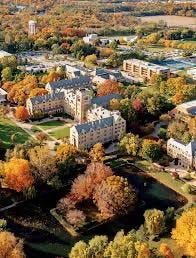
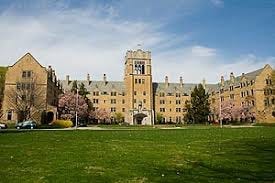
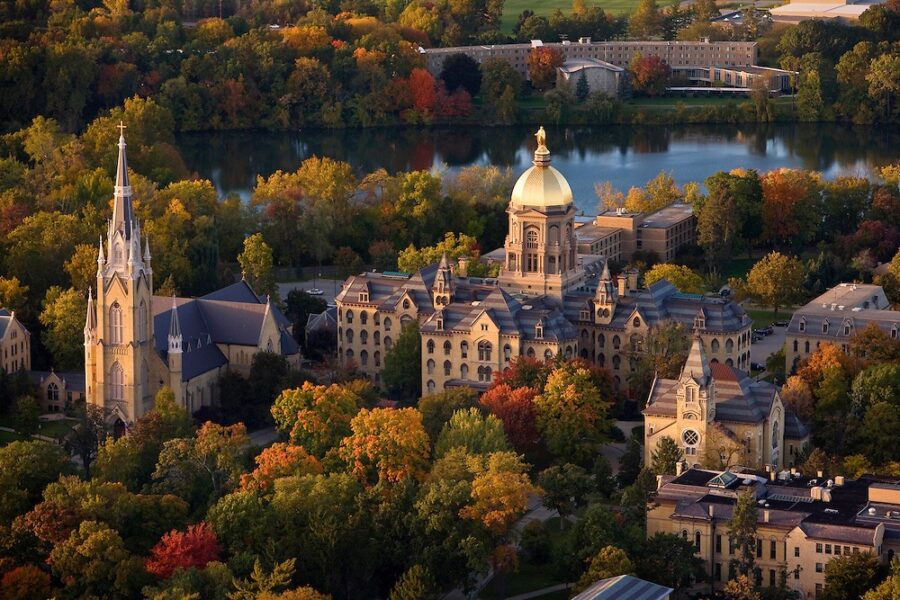
Aerial view of campus of University of Notre Dame. Showing the Golden Dome and Our Lady above the Admin Building. Autobiography of Dr. Anthony J. Carbone.
Believe Nothing You Hear, and Only Half of What You See — A memoir of Service, Shame and the Search for Truth

My First Week of College at Notre Dame

By the time the first official week of college began, our long summer of anticipation was finally over. The buzz of orientation events and the flurry of new friendships had barely settled when a singular rite of passage landed in our hands and marked our true arrival into Notre Dame life.

The Infamous Dog Book

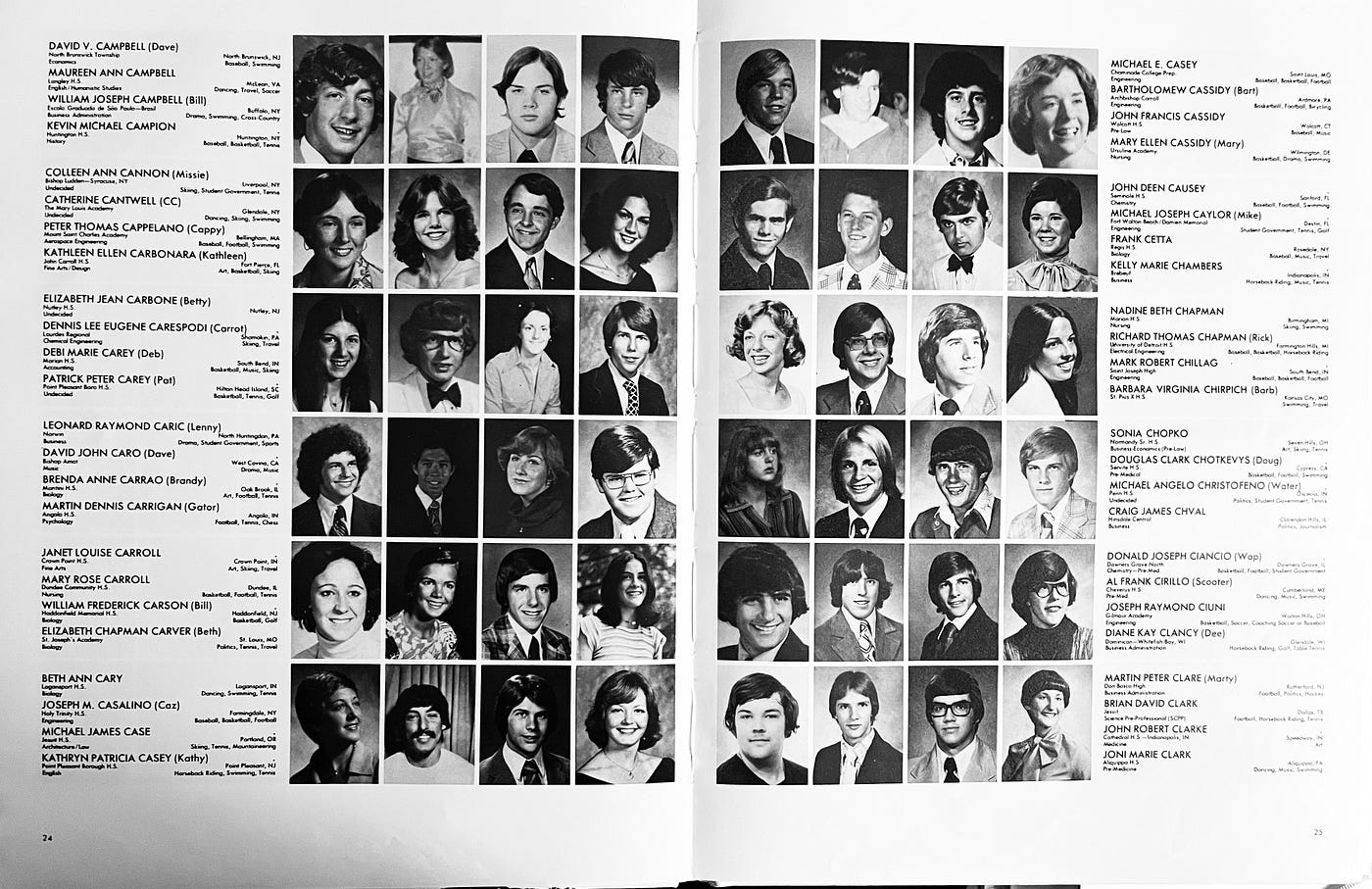
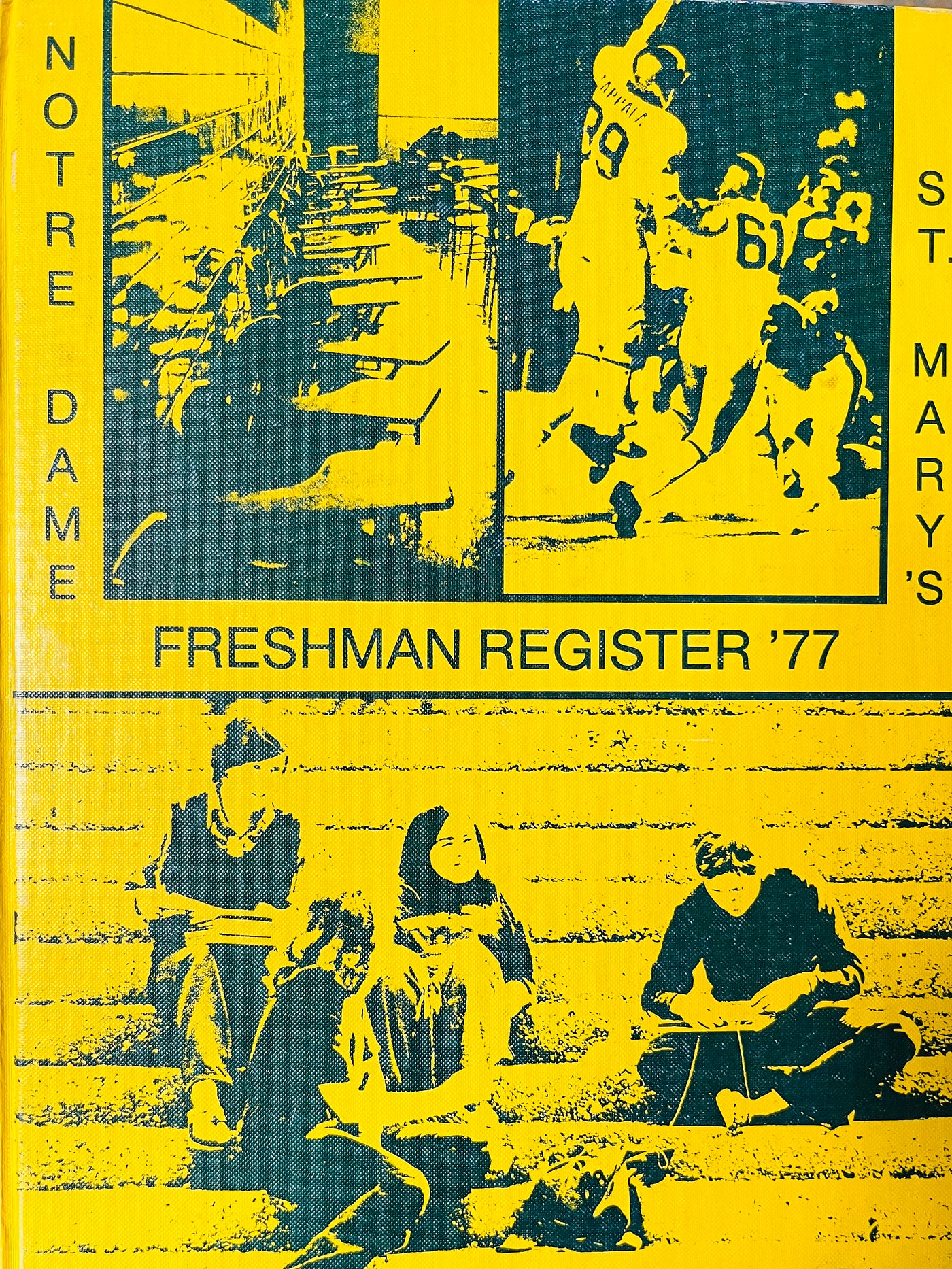
It came wrapped in glossy pages. The little blue-and-yellow hardback — formally titled The Notre Dame & Saint Mary’s Freshman Register, Class of 1977— was better known across campus by its infamous, irreverent nickname: The Dog Book.

Notre Dame & St Mary’s College Freshman Register ’77 (The “Dog Book”)

The Girls of Saint Mary’s

Now, let me clarify from the start: the girls of Saint Mary’s were anything but “dogs.” The name was a holdover from Notre Dame’s all-male history and had lingered through decades of tradition and crude humor. But if you were a freshman guy in 1977, you knew exactly what the Dog Book meant. It was your first unofficial introduction to the incoming class — your own classmates and, far more tantalizingly, the women across the road at Saint Mary’s College.

The book was laid out like a catalog: headshots of every incoming freshman at both schools, organized alphabetically. Each photo came with a name, nickname (if they had one), hometown, high school, and intended major. No bios. No blurbs. Just faces, facts, and enough fuel for hours of hallway commentary.

The moment the Dog Books were delivered to Fisher Hall, tradition took over. Guys poured out of their dorm rooms with books in hand and formed an impromptu gathering in the hallway. We sat cross-legged against the cinderblock walls, flipping pages together as if we were drafting fantasy football teams — or, more accurately, evaluating potential dates, girlfriends, and future wives.

Girls of Saint Mary’s College mingled among the boys on the campus of Notre Dame

The jokes flew fast. So did the judgments. Someone would point at a photo and say, “She looks like trouble.” Another guy would shout, “Bottom of Page 56 — dibs!” Every once in a while someone would spot a classmate or recognize a name and make a big show of it, good or bad. It was crude, superficial, often cruel — but also a strange kind of bonding ritual.

I Avoided Being in the Dog Book

And I remember one very specific feeling: relief. I wasn’t in the Dog Book. Not a picture. Not a nickname. Nothing. Because I hadn’t applied to Notre Dame the traditional way, my name had been left out of the publication entirely. I watched the teasing pile up on a few poor souls — guys and girls alike — and silently thanked the registration gods for my invisibility. That day, anonymity was a blessing.

Notre Dame & St Mary’s Freshman Register from 1977 (Showing Elizabeth Carbone and no Anthony Carbone)

For all its dated humor and objectifying overtones, the Dog Book was a tradition. And like so many Notre Dame traditions, it was one we absorbed without question — half-laughing, half-cringing, entirely immersed in the absurdity of it all.

Saint Mary’s College (SMC): The College Across the Street

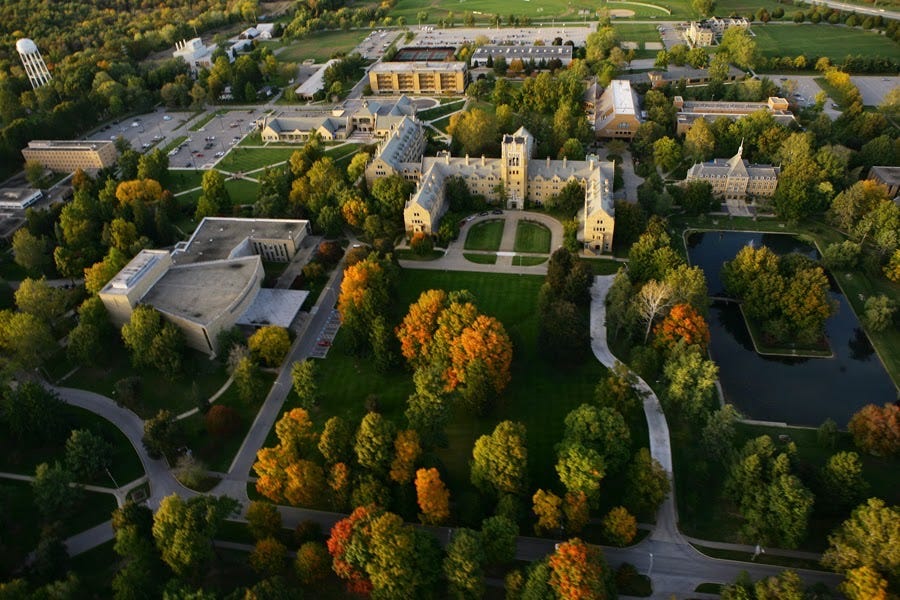
Aerial photograph of Saint Mary’s College, Notre Dame, Indiana.
Aerial view of Saint Mary’s College, Notre Dame, Indiana

To really understand the role the Dog Book played in campus life, you had to understand something about the girls across the street. Saint Mary’s College (SMC), a Catholic women’s college sponsored by the Sisters of the Holy Cross, stood just across U.S. Route 933, a short walk from the main gates of Notre Dame. But culturally, it often felt a world apart.
In 1977, Saint Mary’s enrolled 876 students, with 101 new applicants joining that fall. Student life at SMC was still steeped in tradition and governed by parietal rules that had barely budged despite the cultural revolutions of the late ’60s and early ’70s. These rules restricted when and how male visitors could enter the women’s dorms — usually limited to certain weekend hours, and always under strict supervision. The Sisters of the Holy Cross (CSC) still played an active role on campus, both academically and spiritually, guiding their students with a sense of purpose, decorum, and discipline.

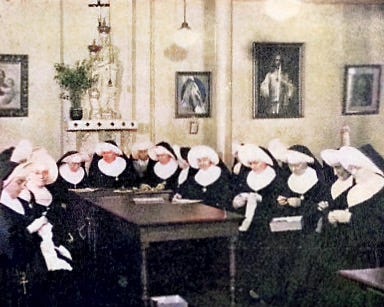
The Sisters of the Holy Cross (CSC)

My First Venture to Saint Mary’s

LeMans Hall

Like most Notre Dame freshmen, I was more than a little fascinated by the girls of Saint Mary’s. They seemed like a blend of grace, charm, mystery — and yes, temptation. I forget exactly how I met my first SMC coed, but I was invited over to her dormitory, Le Mans Hall, for a Saturday evening visit early in the semester.

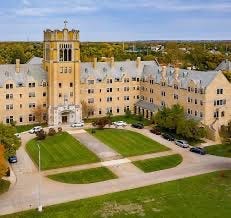
LeMans Hall at Saint Mary's College across from the University of Notre Dame.  Biography of Dr. Anthony J. Carbone.
Le Mans Hall at Saint Mary’s College

Rules of Saint Mary’s College

I was already nervous walking across the road by myself, unsure of the etiquette or expectations. But when I arrived, things got a whole lot more intimidating. There was an elderly nun stationed at the reception desk in the front hall. She asked me, in a tone that made it clear she was not one to be trifled with, what my intentions were. I stammered something about being invited, and obediently handed over my Notre Dame ID card when she requested it.

Getting Past the Front Desk

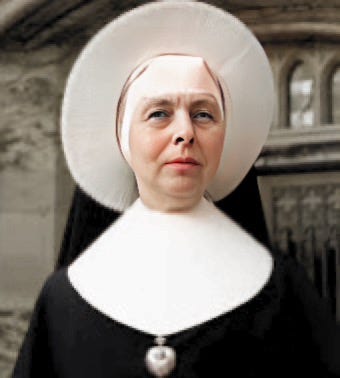
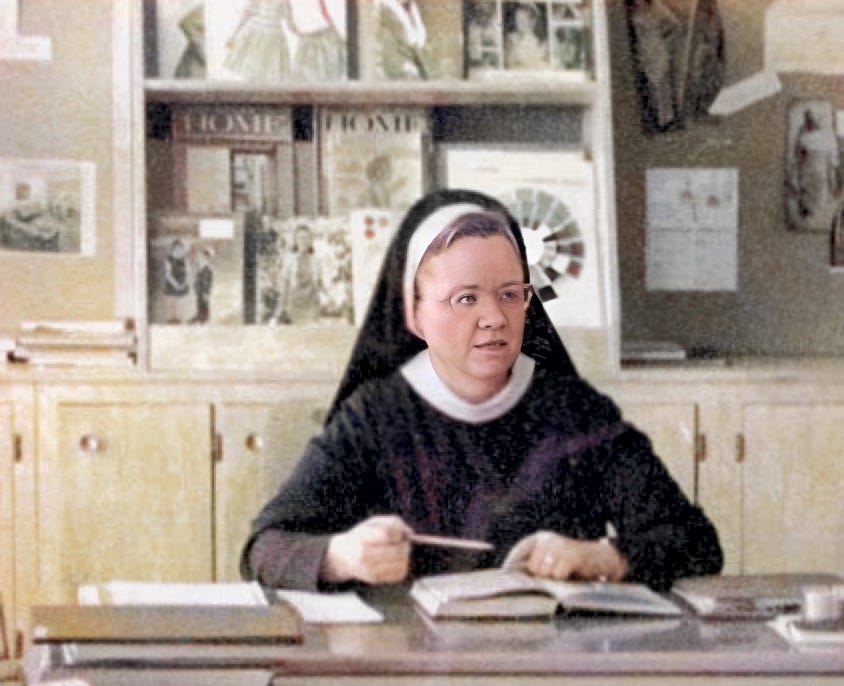
Photograph of older religious sister at a desk at Saint Mary's College.  Biography of Dr. Anthony J. Carbone.

Then came the interrogation. She called upstairs to verify that the young lady had indeed invited me, and when the coed confirmed, the nun told her to come down to escort me personally. No unsupervised wandering was allowed. Once upstairs, I was so on edge that I can barely remember the girl, her room, or what we even talked about. All I remember is the phone ringing about forty-five minutes into our visit. It was the same nun, calling the room to speak to me directly.

“Anthony,” she said in a clear, commanding voice, “you have fifteen minutes to leave the dormitory before parietal hours begin.” Parietals. That was the Notre Dame–SMC term for the formal rules regulating male visitation in female residence halls — rules that had the force of institutional and moral authority behind them. Once parietals began, all male guests had to be out, no exceptions. And this particular nun wasn’t leaving anything to chance.

I thanked her, hung up the phone, and left immediately — heart racing, palms sweating, a little dazed by the whole ordeal. I honestly don’t remember if I ever went back to that room, or even spoke to the young lady again.

It wasn’t just the strictness that kept me away. I was busy — pre-med classes, ROTC, and intramural soccer didn’t leave much space for cross-campus courtships. But I’d be lying if I said the nun hadn’t made a lasting impression. Avoiding Sisters of the Holy Cross became something of a subconscious strategy that semester.

The Saint Mary’s Panty Raids

I didn’t set foot in a Saint Mary’s dorm again until the panty raid in the spring — a decades-old tradition that had long blurred the line between innocent fun and cultural cringe. The stories from the women of Saint Mary’s say it all.

“Our room being on the second floor… provided the best view for Panty Raid. Seeing all the guys run up The Avenue near midnight, yelling, and girls screaming back, was quite a sight… Some girls actually threw panties down!” — Alice M. Tsui, Class of 1970

“I remember calling my mother and telling her I needed all new underwear because I had thrown almost all my things to the boys.” — Judy Johnson Crates, Class of 1970

“The ND guys got into the dorm and were trolling the halls… We pushed a desk up against our door and watched through the transom while the campus guards tried to chase them down!” — Karen Preston McCarty, Class of 1970

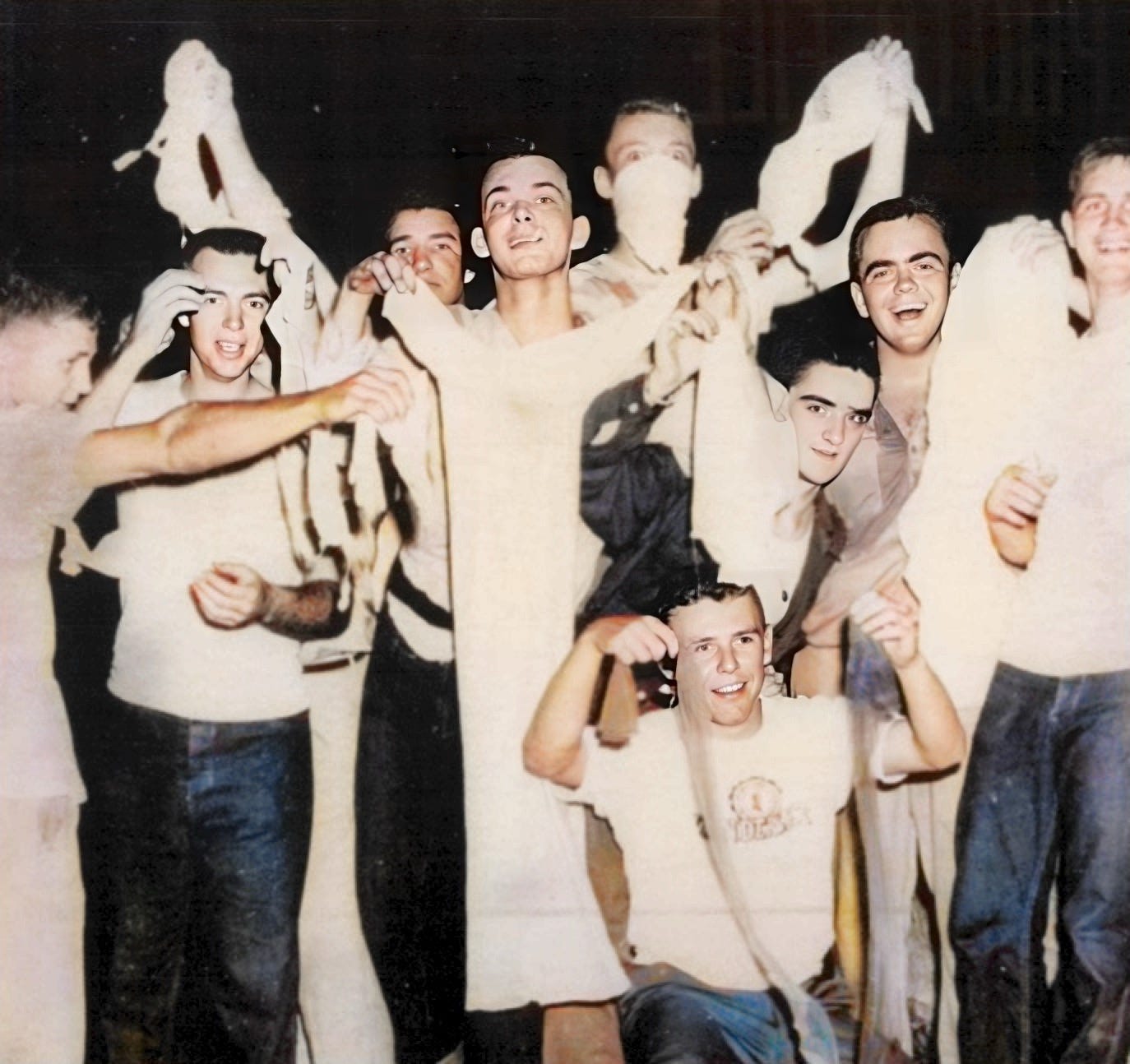
Group of Notre Dame boys holding lingerie from a recent Panty Raid at Saint Mary's College.  Biography of Dr. Anthony J. Carbone.
Notre Dame boys at St. Mary’s panty raid

It was outrageous. It was immature. And in hindsight, it’s the kind of thing that could never — and probably should never — happen today. At the time, we actively embraced many bizarre traditions as part of life under the Golden Dome.

Even by the time I was a freshman in 1977, the tradition was beginning to fade, or at least lose its luster. But the lore lingered. And for many of us, that was more than enough to keep the mystique of Saint Mary’s alive — whether we were brave enough to cross the Avenue or not.

Cadet Life Begins

While dorm pranks and hallway rituals offered a strange kind of social education, my real initiation into Notre Dame life came through two far more demanding callings — both of which began to take shape that very first week. I arrived on campus with a clear and heavy burden: two missions, equally urgent.

The first was academic. I was a pre-professional science major on the pre-med track, and I knew that earning a shot at medical school would take everything I had. There were no shortcuts. No excuses. I had to perform — and outperform — starting on day one.

The second mission was military. As an Army ROTC scholarship cadet, I actively committed—both contractually and personally—to developing into a leader capable of earning a first-class lieutenant commission by graduation.

That meant discipline, training, and excellence in every formation, drill, and leadership lab for the next four years. Two tracks. One man. No room to stumble.

So while most of my classmates were still finding their rhythm in dorm life, I was already switching gears — fast. I traded in the laughter of Dog Book hallway sessions and the chaos of panty raids for the early-morning demands of a cadet’s life. Gone were the Sperry’s and free time. In their place: combat boots, pressed uniforms, tight schedules, and 0600 alarms.

ROTC and Reality

The day of ROTC orientation began with the usual morning routine in Fisher Hall: a shower down the hall, a quick breakfast at South Dining Hall, and then a walk across campus. The morning sun lit the yellow brick buildings beautifully as I passed the Knute Rockne Memorial Gym — “The Rock” — on my way to the ROTC building.

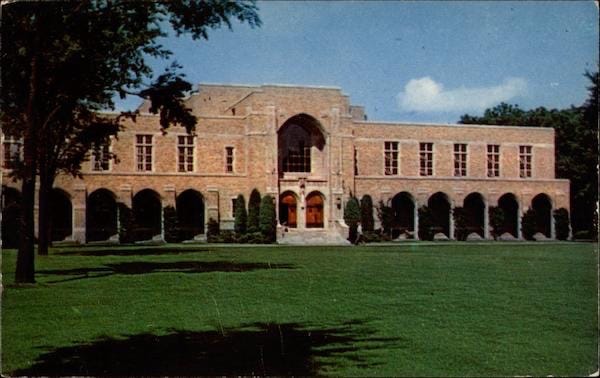
Knute Rockne Memorial Building on the South Quad of the University of Notre Dame.  Biography of Dr. Anthony J. Carbone.
Knute Rockne Memorial Building

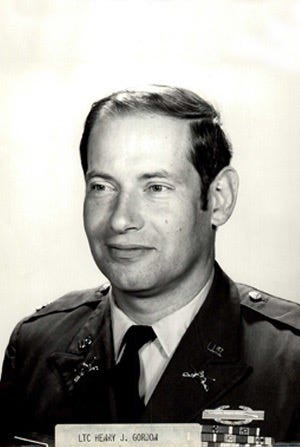
Professor of Military Science (PMS)Lieutenant Colonel Henry J. Gordon greeting us. A team of senior cadets who had clearly been through it all before also helped us.

Professor of Military Science (PMS) LTC Henry Gordon, University of Notre Dame. Biography of Dr. Anthony J. Carbone.
Professor of Military Science (PMS) for University of Notre Dame, LTC Gordon

Received my Army ROTC Basic Issue

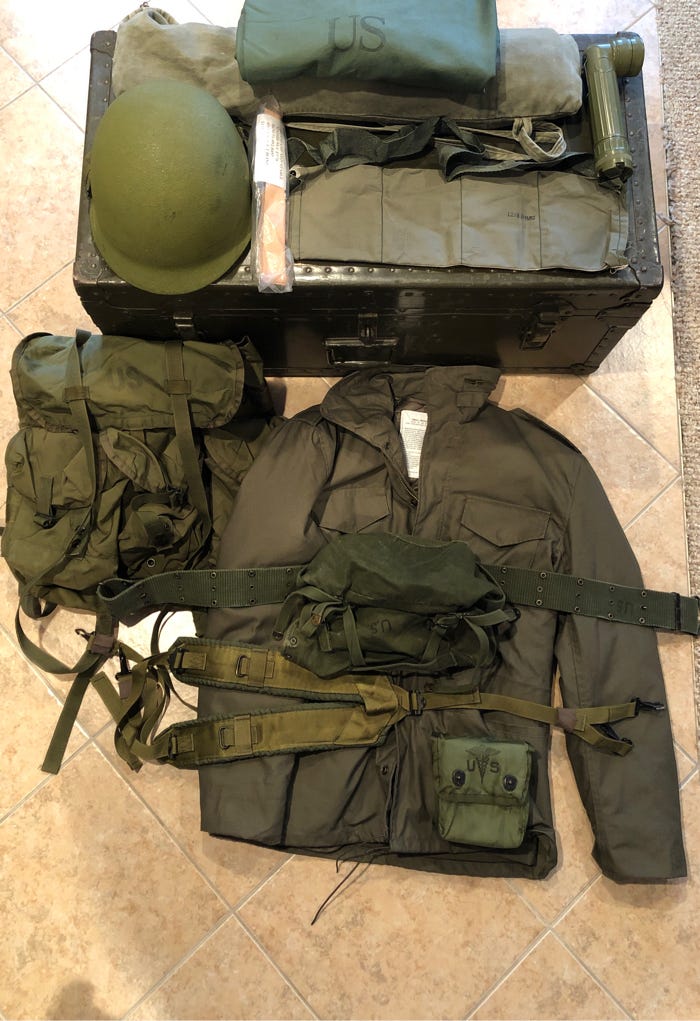
The orientation included a historical overview of Notre Dame’s long-standing military tradition, stretching back to the Civil War, officially formalized in 1951. There were about 50 of us new Army cadets. We were issued our fatigues, boots, T-shirts, caps, helmut, a few other GI items — our first taste of uniformed life.

U.S. Army basic issue of gear including steel pot Helmut, flashlight and footlocker.  Biography of Dr. Anthony J. Carbone.

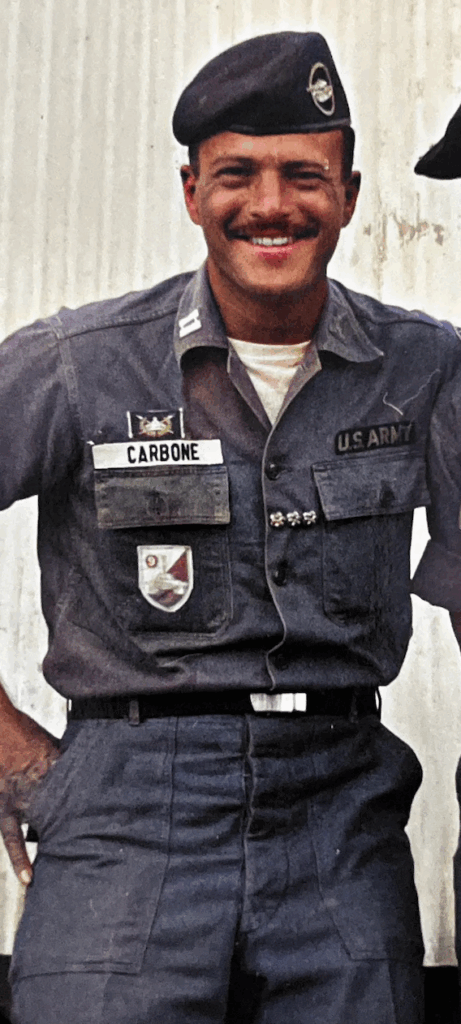
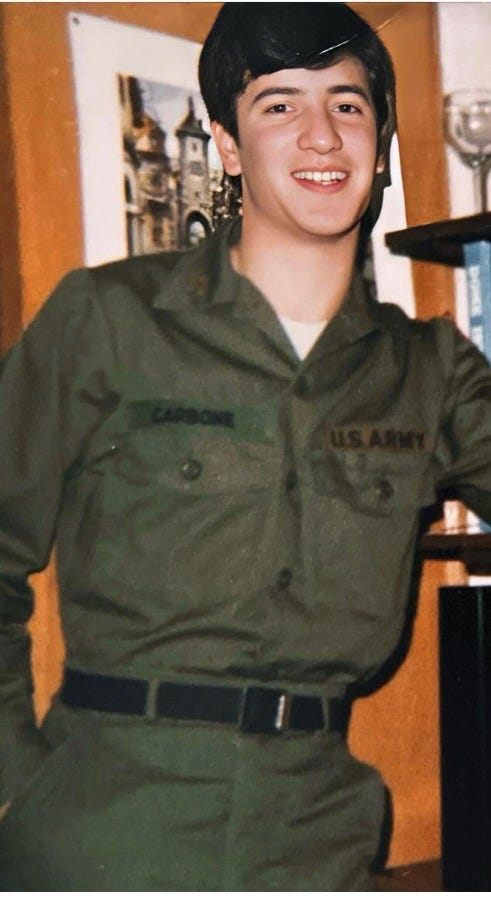
For most, it was a novelty; yet, for me, it was second nature. I had grown up watching my father in his starched olive drab fatigues, crisp white T-shirts, and brightly colored unit patches. By 1977, ROTC cadets like me were still wearing the OG-107 uniform — green fatigues with subdued patches. The details had changed, but the discipline hadn’t. I knew how a uniform should look. And as you know, I was already a master boot-shiner. The rituals felt more familiar than foreign.

My Father & Me in the Old & New Army Fatigues

Truthfully, the orientation itself felt underwhelming. Compared to what I imagined at West Point, it felt like a watered-down version. I left wondering — again — if I had made the right choice turning down my West Point appointment.

Pre-Med at Fisher Hall

Back at Fisher Hall, I connected with Bob Terifay, the other pre-med student in our section. He was brilliant, confident, and pathologically competitive — a natural leader of the freshmen, even though no one had elected him. He already seemed to have every textbook memorized. I had no problem striving for A’s, but I didn’t get any joy from beating my classmates. I would have been happy if we all aced the exams. That wasn’t Bob’s style.

Robert Terifay, Pre-Medicine at University of Notre Dame.  Biography of Dr. Anthony J. Carbone.
Bob Terifay, Pre-Med, Fisher Hall Freshman

In Bob Terifay’s defense, Bob was a great guy. A genuinely nice guy, smart as a tac, faithful Catholic boy. Bob was the unofficial leader of our Fisher Hall section. He would step out of his dorm room when it was dinnertime, clap his hands, and announce dinnertime to all by yelling “Pret!” (French for “Ready!“) Bob’s only problem was that he was a pre-med student at Notre Dame.
ROTC Scholarship Pays for Books & Supplies

I stuck close to him for a while because he had insider knowledge. He told me what to expect, what to prep for, and which professors to avoid. We walked together to the Hammes Bookstore, where a I learned a wonderful surprise — my ROTC scholarship covered all my books and supplies. That was a massive relief.

My First Year Academic Load

Many of our classes overlapped, except for Military Science and German. My first year schedule of courses included two semesters of: General Chemistry I&II with lab, Calculus I&II, English Composition & Literature, Intro to Philosophy, Intro to Sociology, Intermediate German, and Military Science.

The schedule was punishing. Science labs were four-hour marathons that earned just one credit hour. ROTC drills and PT demanded more time. Tuesdays were especially brutal — leadership labs in the afternoon, military class in the evening.

My Prep School Classmates-CLEP’d

What made it worse was this: many of the other pre-meds had come from elite Catholic prep schools and private academies. Most had CLEP’d out of chemistry, biology, or calculus thanks to AP credits. They were already a semester — sometimes a year — ahead of me. I had no such advantage. I came from a strong public high school, but I was starting from zero. And I knew I had to work twice as hard to keep up.

Advanced Placement AP Textbooks Calculus Biology Chemistry History.  Biography of Dr. Anthony J. Carbone.

Army ROTC Drill

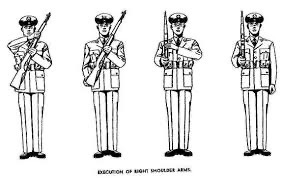
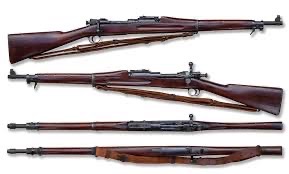
Drill periods were a throwback. We trained with M1903 Springfield rifles — heavy, nine-pound bolt-action relics from World War II. We practiced saluting, standing at attention, and performing the full 15-Count Manual of Arms. I can still snap it off to this day. If you could master the Springfield, the M16 was a walk in the park.

My First Day of Class

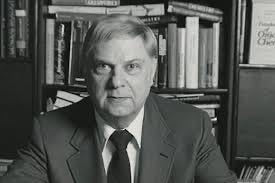
My first day of classes at Notre Dame must have been so chaotic and overwhelming that I only remember one class: General Chemistry I. The legendary Professor Emil T. Hofman, who also served as the Dean of the Freshman Year of Studies was our teacher.

The Legendary Dean Emil T. Hofman

Emil T. Hofman, Dean of Freshmen Year Studies & Professor of Chemistry. University of Notre Dame. Dr. Carbone Autobiography.
Emil T. Hofman, Dean of Freshmen Year Studies & Professor of Chemistry

He was strict. In fact, he was so strict that he once gave future Nobel Prize in Medicine winner Eric Wieschaus — Notre Dame Class of 1969 — a B in both semesters of chemistry. Over four decades, Emil T. taught more than 60 percent of each freshman class. That totaled over 32,000 students, with more than 8,000 of them going on to become doctors. He was a Notre Dame institution unto himself.

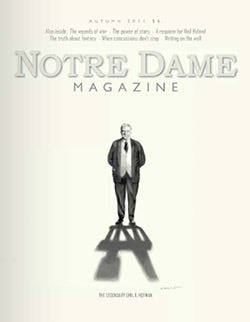
Dean Emil T. Hofman being celebrated on the cover of Notre Dame Magazine. Professor of Chemistry. Dean of Freshmen Year Studies. University of Notre Dame. Dr. Carbone autobiography.
Emil T. Hofman on the cover of Notre Dame Magazine

Basic Chemistry House Rules

First Rule: Begin with the Lord’s Prayer

The class began with a brief introduction. Then, with no warmup or small talk, Professor Hofman commanded, “Settle down!” before leading us in the Lord’s Prayer. Every class began that way. That was the First Rule of Chemistry Class. At the end of the prayer, he would say, “Queen of Peace,” and we would reply in unison, “Pray for us.” Without fail.

Second Rule: Quiz Every Friday

Next, he went straight into the second rule. There would be a mandatory seven-question multiple-choice question quiz every Friday covering the material presented during the week. These quizzes were known for being tough, motivating many students to spend their Thursday nights studying to prepare for them. The phrase “Deliver us from Emil” was a common student sentiment.

Third Rule: Assigned Seats and “These are the rows!”

Assigned Seats: A key aspect of his first day routine, and indeed the entire semester, was the assignment of seats. Students were given specific seats they had to occupy for every class, a practice that ensured attendance could be easily monitored and probably discouraged late arrivals or skipping class.

“These Are the Rows!”: Related to the assigned seating, Hofman had a particular way of emphasizing the importance of staying in one’s assigned place. He would emphatically declare, “These are the rows!” This phrase reinforced the strictness of the seating arrangement and left no doubt that deviations would not be tolerated. This was likely a combination of setting expectations for discipline and ensuring a consistent classroom environment.

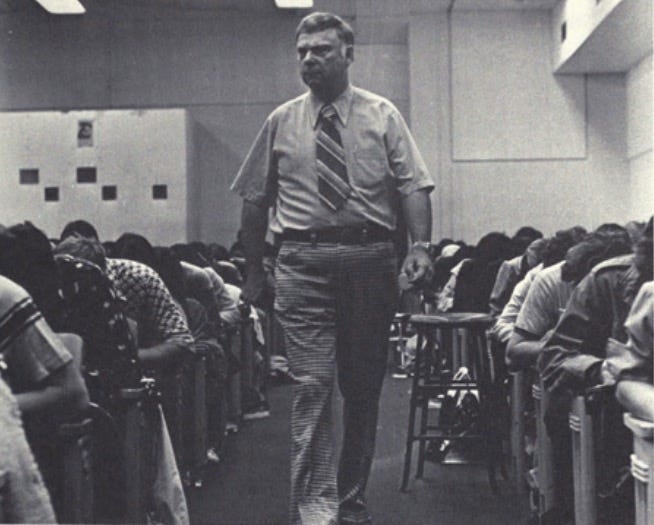
Dean Emil T. Hofman proctoring the weekly Friday Quiz. Professor of Chemistry and Dean of Freshmen Year Studies. University of Notre Dame.
Dean Emil T. Hofman proctoring the weekly Friday Quiz

When’s Your Birthday?

That’s when the girl sitting to my right turned towards me and abruptly asked, “When’s your birthday?” I told her, “Me? December 3rd. Why?” She replied, “Oh, just curious,” and she went back to listening to Professor Hofman. She didn’t say another word to me — not that day, not the next, not for months.

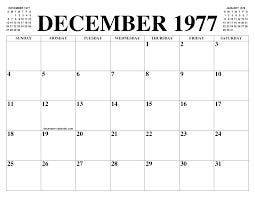
Calendar from December 1977 showing my birthday, 3 December, on Saturday.  Biography of Anthony J. Carbone.
My 18th Birthday

2 Girls and 2 Birthday Cakes

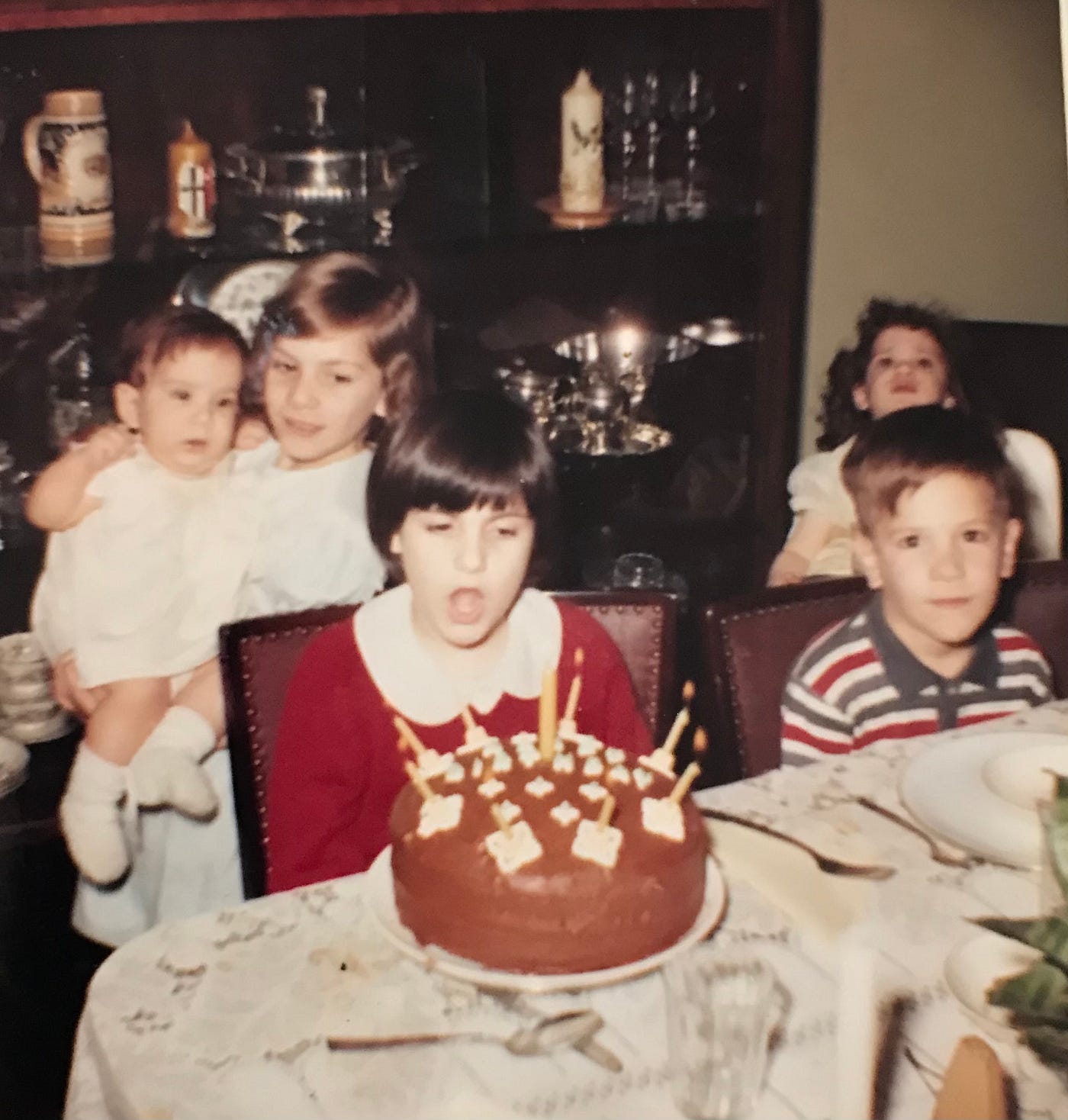
Then came Saturday, December 3rd, 1977 — I was 18 years old. Out of nowhere, that same beautiful girl and her equally beautiful roommate knocked on my door in Fisher Hall, holding a homemade birthday cake. “We came to celebrate your eighteenth birthday,” they said. They lit eighteen candles, sang “Happy Birthday to You,” and handed me a slice.
My First R-Rated Movie Followed by my First Beer in a Bar

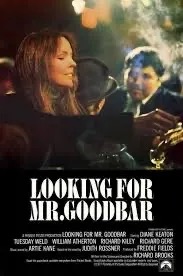
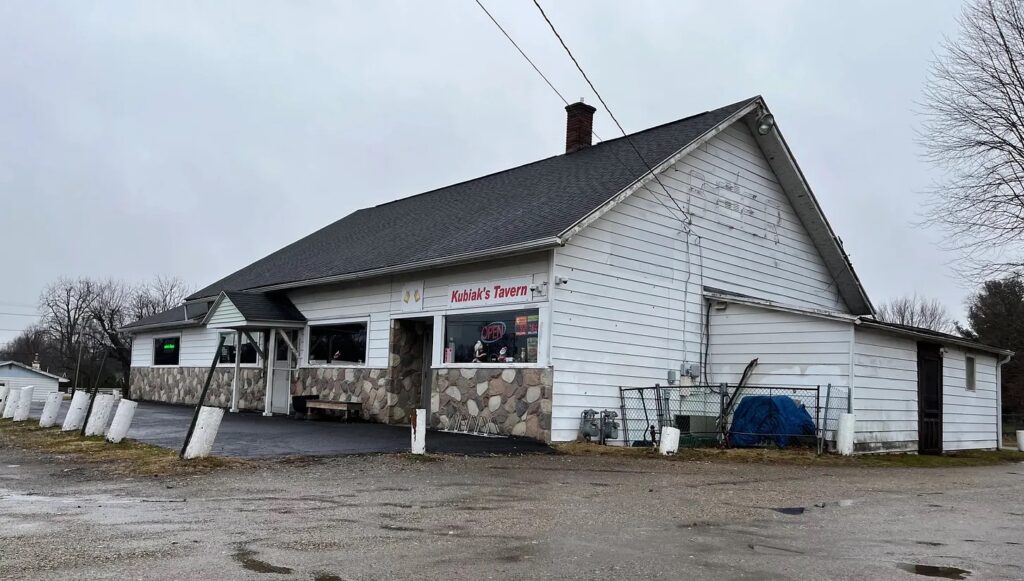
Then things got interesting. They took me to my first R-rated movieLooking for Mr. Goodbar. Sitting between two beautiful girls I barely knew during that particular film was, to say the least, uncomfortable. Afterward, they drove me across the border into Niles, Michigan to Kubiak’s Tavern so I could legally order my first alcoholic drink. I think we danced a little at the bar, laughed a lot, and eventually headed back.

The Goodnight Kisses

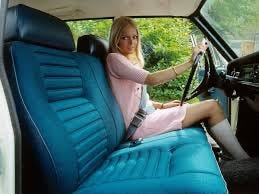
All three of us squeezed into the front bench seat of the car, me squarely in the middle. When we pulled up to Fisher Hall, I turned to thank them for the best birthday of my life and started to open the door.

Blonde girl in pink minidress and white boots in the driver's seat of a 1970s-era car with blue bench seats.  Biography of Dr. Anthony J. Carbone.

“Not so quick, Tony,” they both said. I turned back toward my classmate. “What?” She leaned in and gave me a five-minute French kiss. I was blown away. As I turned the other direction to open the door, her roommate gently pulled me back. “Slow down,” she said. Then she gave me a five-minute French kiss of her own. It was, hands down, the best birthday of my life.

Football Season and My Neighbor Joe Montana

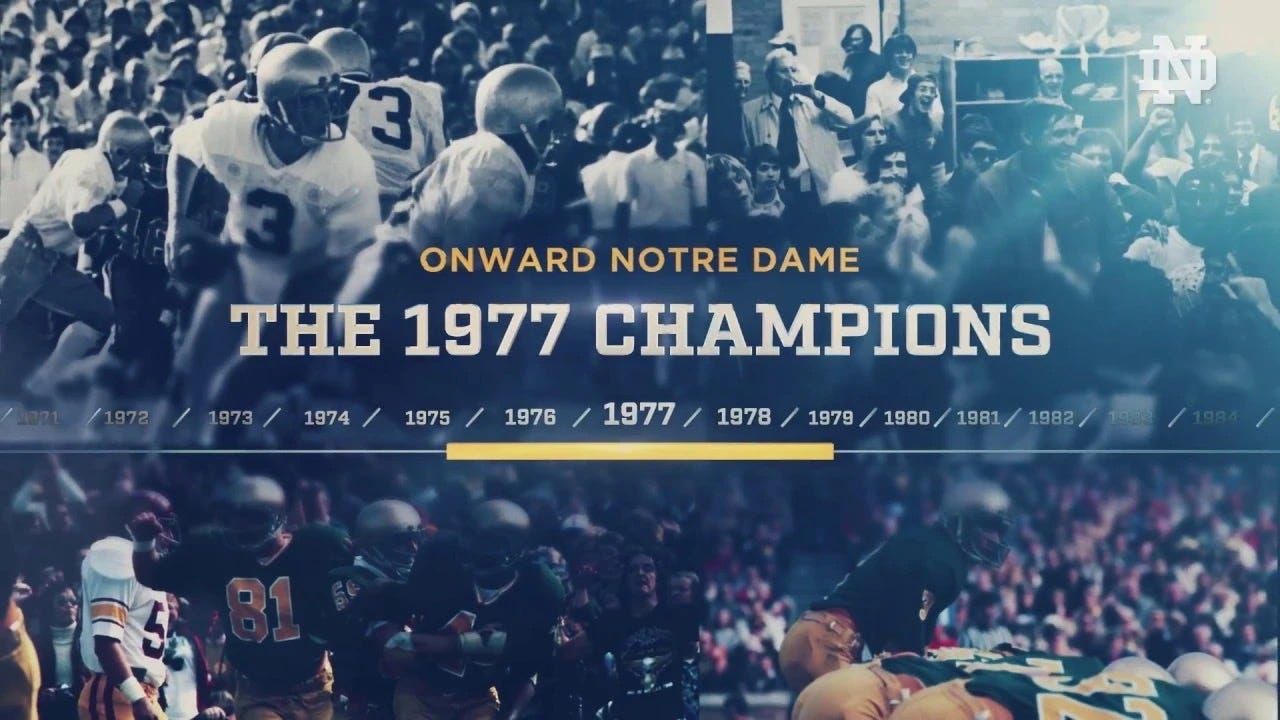
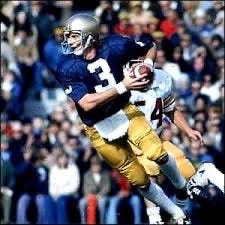
Without a doubt, the most exciting part of my freshman year at Notre Dame was football season — a highlight in any Domer’s college experience. But for me and every student in 1977, it was unforgettable because we won the National Championship.

1977 NCAA National Football Champions. University of Notre Dame Fighting Irish. Joe Montana. Dr. Anthony Carbone autobiography.

Notre Dame Fighting Irish Football Wins NCAA National Championship

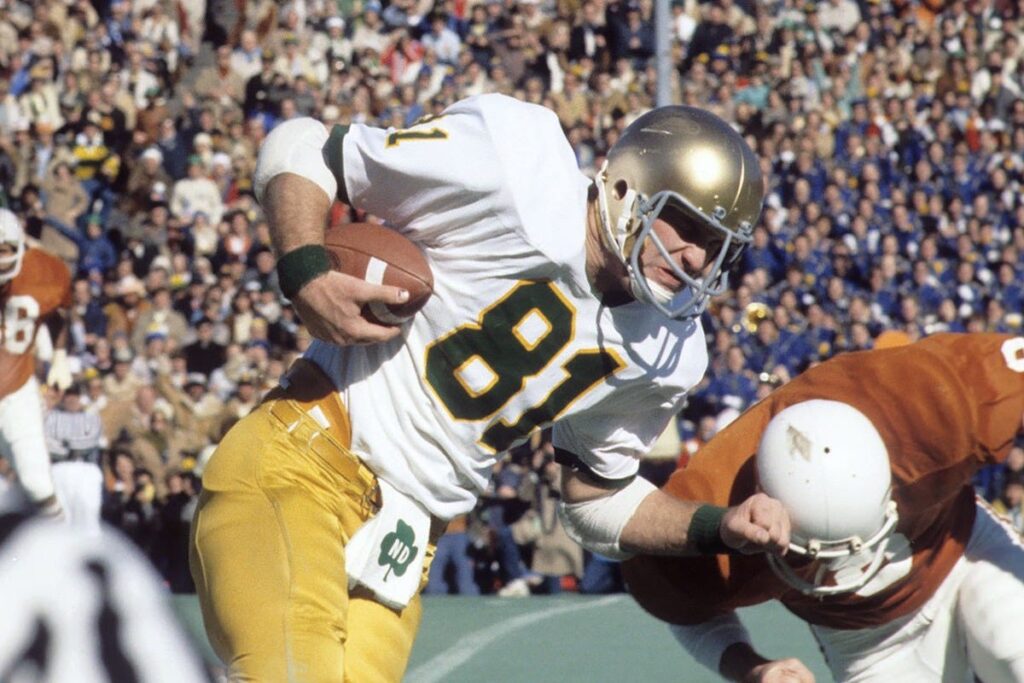
That year, the Notre Dame Fighting Irish, coached by Dan Devine and led by quarterback Joe Montana, finished the season with an 11–1 record and capped it off by demolishing the previously undefeated and top-ranked Texas Longhorns 38–10 in the Cotton Bowl. That victory sealed our tenth national title.

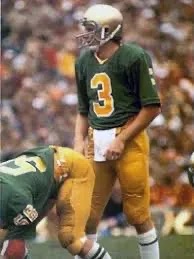
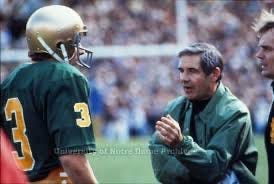
Quarterback Joe Montana and Coach Dan Devine

Photograph of Joe Montana (#3) talking to Coach Dan Devine during a football game.  Biography of Dr. Anthony J. Carbone.

Entering the 1977 season, Joe Montana was a junior quarterback, but he found himself in a precarious position on the depth chart—listed as third string after battling injuries and inconsistent play. His relationship with Coach Dan Devine wasn’t particularly warm or enthusiastic.

However, the turning point came in the third game of the season against Purdue. Notre Dame was losing 24-14, and starting quarterback Rusty Lisch was struggling. When backup Gary Forystek was injured, Devine was forced to turn to Montana, despite the previous tension. However, the turning point came in the third game of the season against Purdue. Notre Dame was losing 24-14, and starting quarterback Rusty Lisch was struggling. When backup Gary Forystek was injured, Devine was forced to turn to Montana, despite the previous tension.

Montana, a former seventh-string quarterback, was inserted into the game late in the third quarter. What followed was a classic comeback performance: Montana threw for 154 yards and a touchdown in the final 11 minutes, leading the Irish to a dramatic 31-24 victory. This comeback, in particular, helped launch Montana’s legend and reignited Notre Dame’s national championship hopes.

After this game, Devine recognized Montana’s capabilities and named him the starting quarterback. The team went on to win every game from that point forward, culminating in a dominating 38-10 victory over number one ranked Texas in the Cotton Bowl and securing the national championship. While their relationship might have been complicated, the Purdue game became a pivotal moment for both Montana and Devine, proving that despite any previous doubts or disagreements, they were a powerful combination that propelled Notre Dame to a memorable championship season.

Joe Montana and Four All-American Football Stars

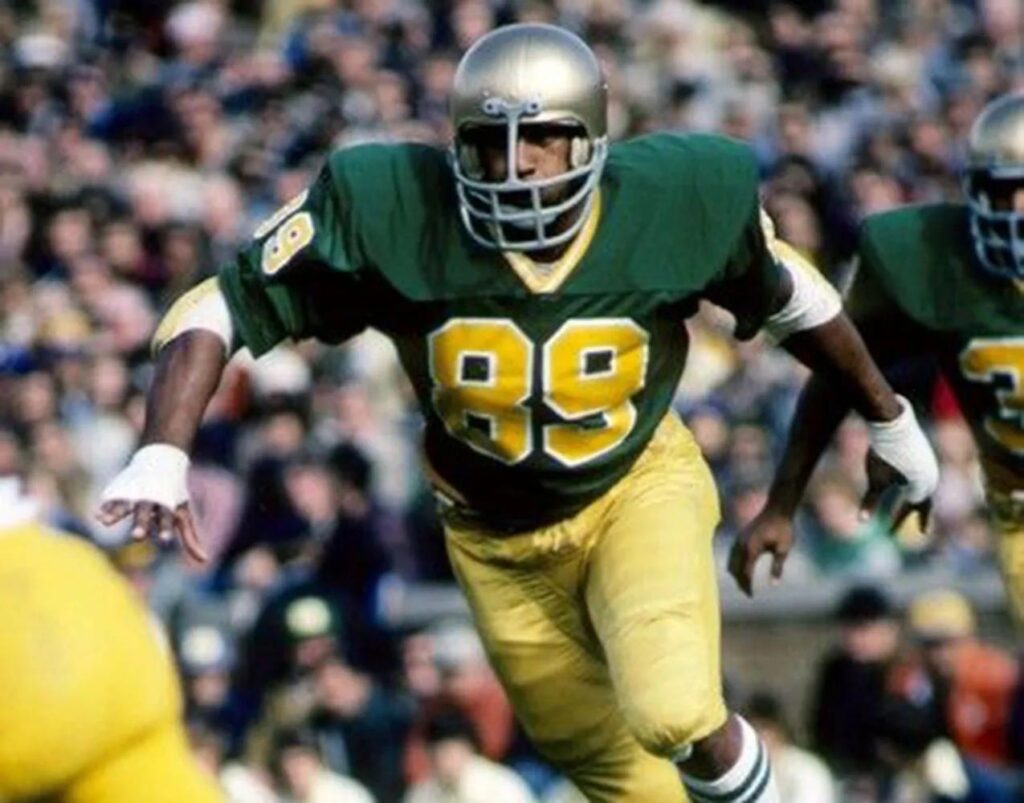
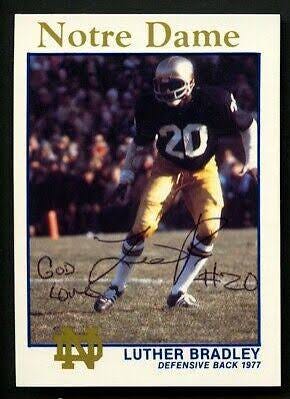
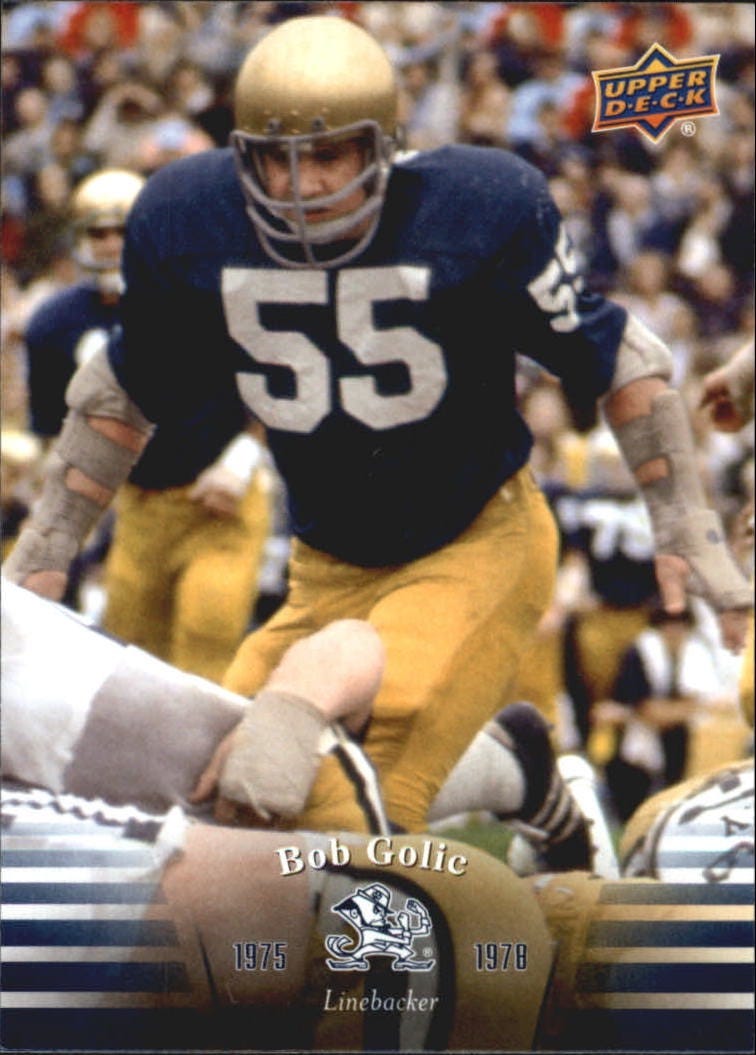
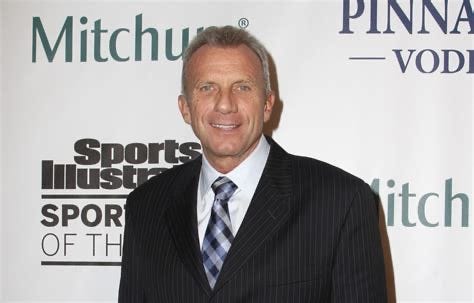
The 1977 squad was stacked with All-Americans: Ken MacAfee, Ross Browner, Luther Bradley, and Bob Golic. But surprisingly, Joe Montana — our quarterback and undeniable team leader — was not named to any All-American team. That still bothers me to this day. Joe’s later NFL career proved what a star he truly was. He led the 49ers to four Super Bowl victories and earned MVP honors in three of them. His 92-yard winning drive in Super Bowl XXIII became legendary. And his eight Pro Bowl appearances set the standard for greatness.

Bob Golic #55 of the Fighting Irish football team.  Biography of Dr. Anthony J. Carbone.
Bob Golic #55

Joe Montana My Next Door Neighbor

I knew Joe Montana–he was my next-door neighbor in Fisher Hall. The kind, funny, somewhat shy, and good-looking guy you see today in commercials and commentary — that was the exact same Joe I knew back then. He was humble and approachable. Let me give you two stories that show who Joe Montana really was.

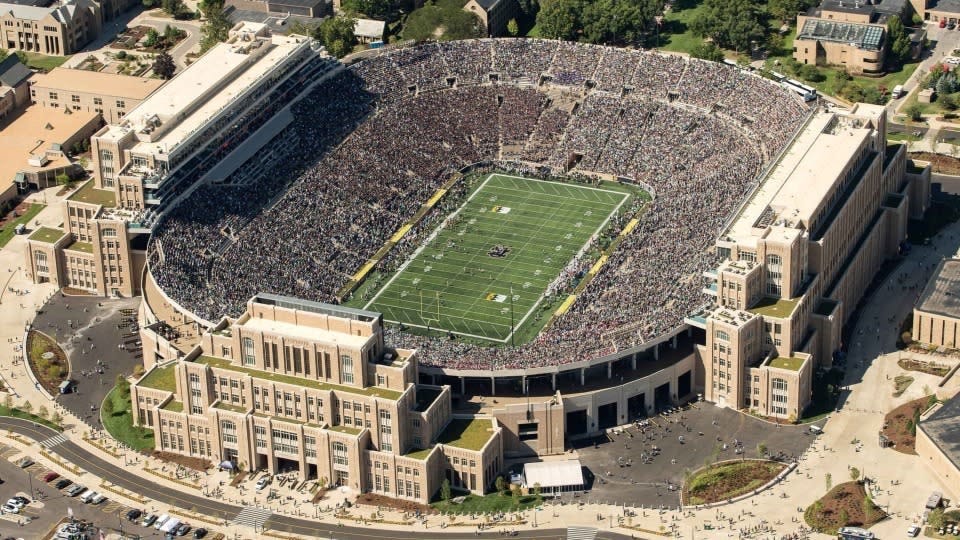
Notre Dame Football Stadium

First, during home games at Notre Dame Stadium — “The House that Rockne Built” — student seating was assigned by class year and then by residence hall. Seniors got prime seats near the 50-yard line. Freshmen like us were tucked in the end zone. Our whole Fisher Hall section sat together.

Notre Dame Football Stadium “The House That Rockne Built”. Biography of Dr. Anthony J. Carbone.
Notre Dame Football Stadium “The House That Rockne Built”

Joe Montana and His Fisher Freshmen

In nearly every game, whenever Notre Dame’s offense got into the red zone near our end zone seats, Joe Montana would pause behind the center, scan the crowd, find us — the Fisher Hall freshmen — point directly at us, and then throw a touchdown pass. That was Joe. In his biggest moments, in a deafening stadium, on national television, he remembered his freshman friends. That, to me, is what leadership looks like.

Joe Visits My Room Nightly for Snacks

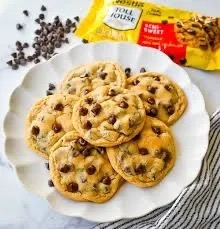
And Joe’s kindness extended off the field. Many nights, he’d quietly slip into my dorm room late, because I had a TV and he didn’t. He’d lay down on my bed, turn on the television, and say with a grin, “What do you have?” — hand outstretched. My four sisters constantly sent me care packages, especially homemade Tollhouse chocolate chip cookies. Joe knew it. So I’d break out the latest box and share it with him. He was always gracious and genuinely appreciative.

No Athletic Dorms, Cafeterias, or Tables

Notre Dame was different. Unlike big football schools, we had no athletic fraternities, no athlete-only dorms, no athlete dining halls. Our NCAA stars lived with us. Ate with us. Walked across campus like any other student. In our Fisher Hall section alone, we had Joe Montana, Jerome Heavens, and Mike Calhoun — which meant that we got to meet the other players when they visited.

Definitely, no hostesses!

I later visited schools like Alabama and Florida and saw how athletes were treated like royalty. I met women who called themselves “hostesses” and bragged about entertaining football recruits. Some even said they were on scholarship for it. When I told them that Notre Dame didn’t have hostesses, they didn’t believe me. I said, “Believe me. Notre Dame is so small, we know what goes on. And we do not have hostesses.”

1977 Music

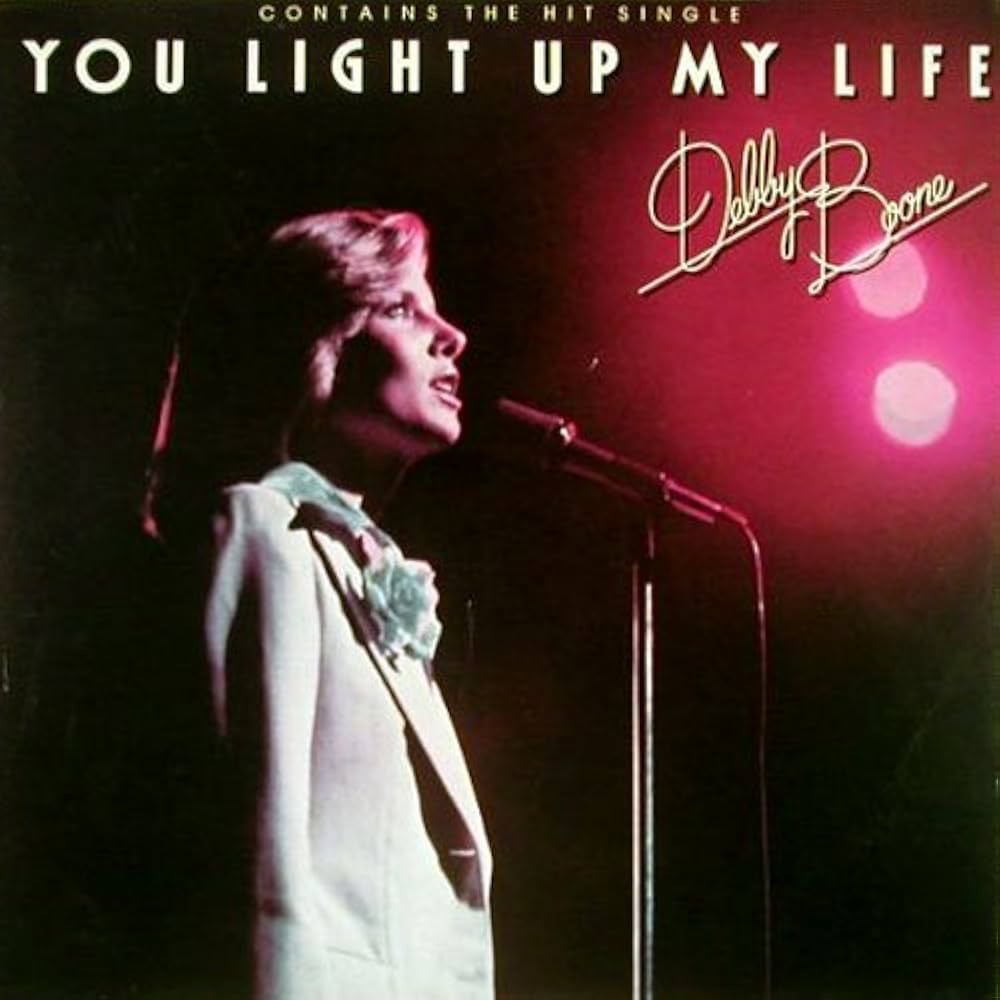
The music of 1977 was definitely not one of my favorites; I am much more of a 1960s, maybe early-1970s music fan. Debby Boone’s “You Light Up My Life” debued in October 1977 and stayed #1 until the end of the year. So “You Light Up My Life” reminds me of my first round of college final examinations, and I am happy that the song was so overplayed that it’s never been on the air since.

Crosby, Stills & Nash at Notre Dame

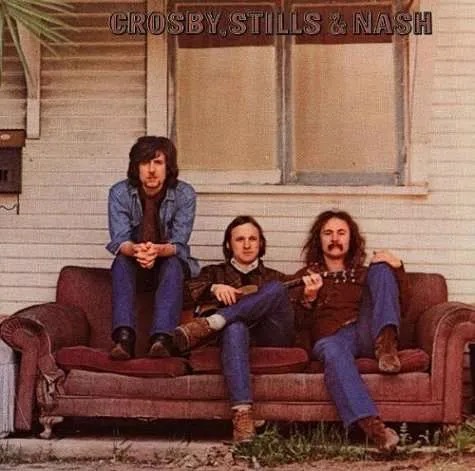
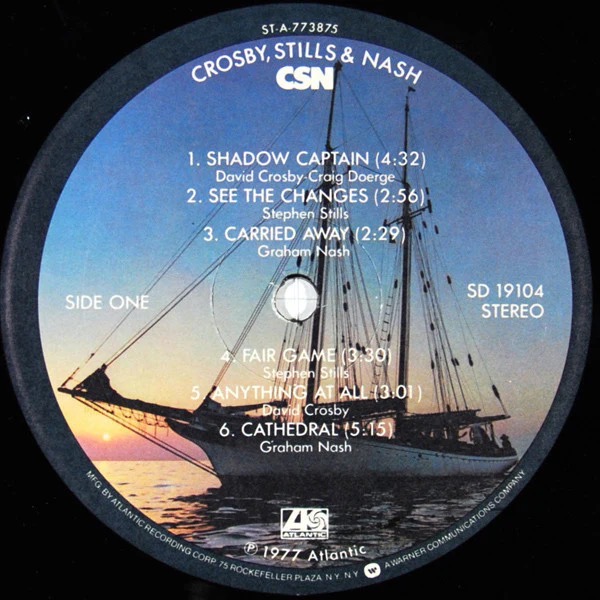
On November 5, 1977, I saw Crosby, Stills & Nash perform at the Athletics and Convocation Center. The stage setup looked exactly like their famous album cover — just the three of them sitting together on a leather couch, guitars in hand, playing pure acoustic sets. No flashy lights or backup bands, just their harmonies filling the arena. It felt intimate despite the size of the crowd, like we were all sitting in their living room. I was happy because they played all of their greatest hits.

A Wild & Crazy Night at Notre Dame

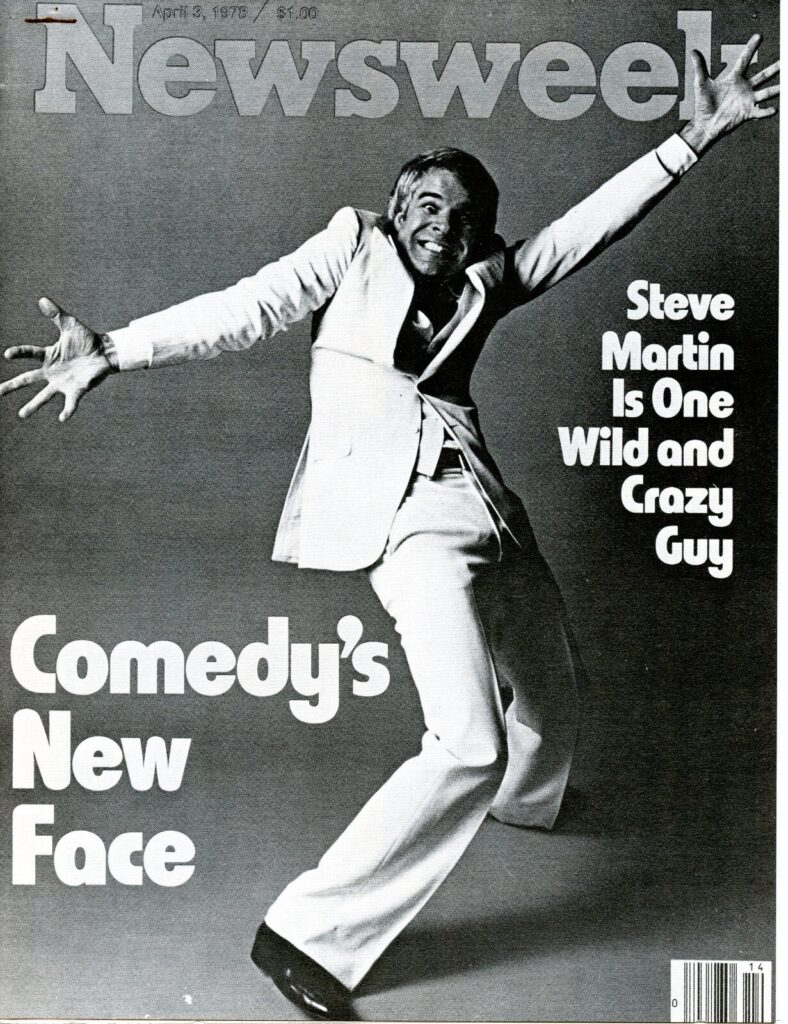
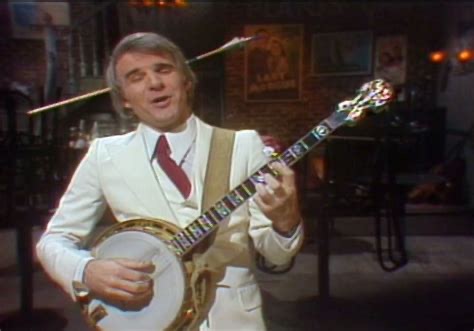
Four days later, on November 9, 1978, I had the rare treat of seeing Steve Martin perform live on campus. He was debuting his now-famous “Wild & Crazy Guy” routine from Saturday Night Live. Dressed in his classic white suit with an arrow going through his head, he alternated between cracking absurd one-liners and picking out lightning-fast banjo tunes. I had always known he was funny, but that night I also realized he was quite a musician. This was the act that catapulted him into superstardom, and I was lucky enough to see it up close and personal right there at Notre Dame.
Thanksgiving, Homesickness, and a Visit from Jeff Bell

First Thanksgiving Away From Home

Thanksgiving came, and I wasn’t able to make it home. The cost of traveling after an already expensive first semester was just too much. It was the first major holiday I had ever spent away from my family, and the homesickness hit hard. Most of the students left campus to go home, and suddenly, the bustling grounds of Notre Dame became eerily quiet.

The only people left were a handful of domestic students like me and the international students who also had nowhere to go. The University did its best to create some holiday spirit. The Dining Hall put on a Thanksgiving feast, complete with turkey, stuffing, mashed potatoes, and pumpkin pie. The food was good, and the gesture was appreciated, but it didn’t come close to the warmth and chaos of a Carbone family holiday back in Winchester. I smiled politely through dinner, then went back to the dorm, feeling the weight of distance more than ever.

Jeff Bell Visits Notre Dame

Shortly after Thanksgiving and before finals in December, I got a much-needed boost. My buddy Jeff Bell drove up from his college in Texas to visit me. His arrival felt like a taste of home, and I was excited to show him around the campus that I was beginning to call my own.

Jeff was immediately impressed. The sight of Fisher Hall, the Gothic buildings, the golden dome — he soaked it all in. But nothing impressed him more than running into Joe Montana in our dorm hallway. He was even more awestruck when we went to the South Dining Hall for dinner and spotted both Joe Montana and Ross Browner eating together like regular students. That moment stayed with him for decades. To Jeff, it was unthinkable that future NFL legends would sit among the student body without any entourage, just two guys with trays and a meal card.

But Jeff quickly realized that Notre Dame wasn’t exactly a party school. That Saturday night, he turned to me and asked, “Where is everybody?” I smiled and said, “You want to see where everyone is on a Saturday night?”

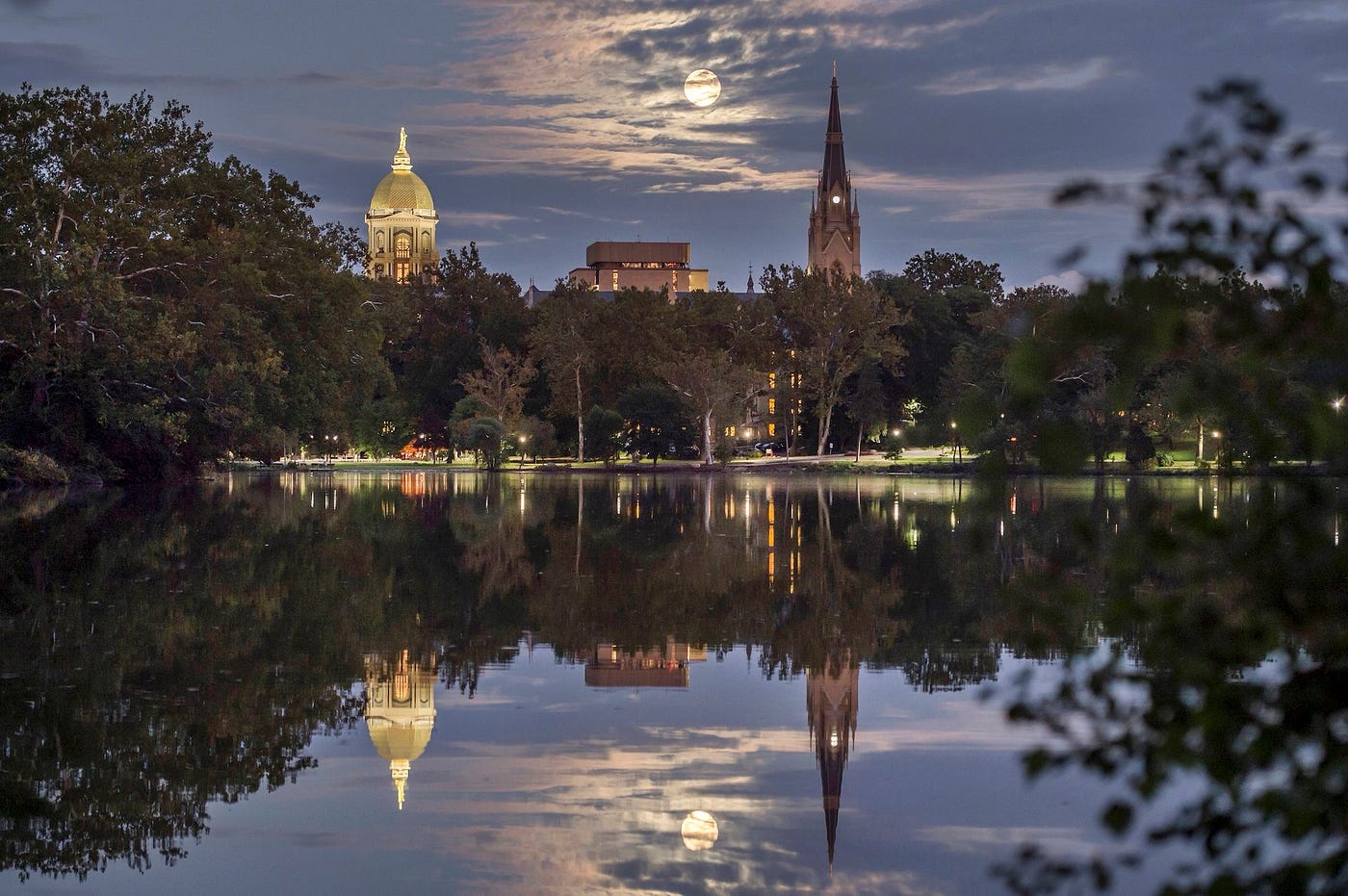
The Big 3 Icons of Notre Dame: Golden Dome, Memorial Library, Sacred Heart Basilica at Twilight

The Library

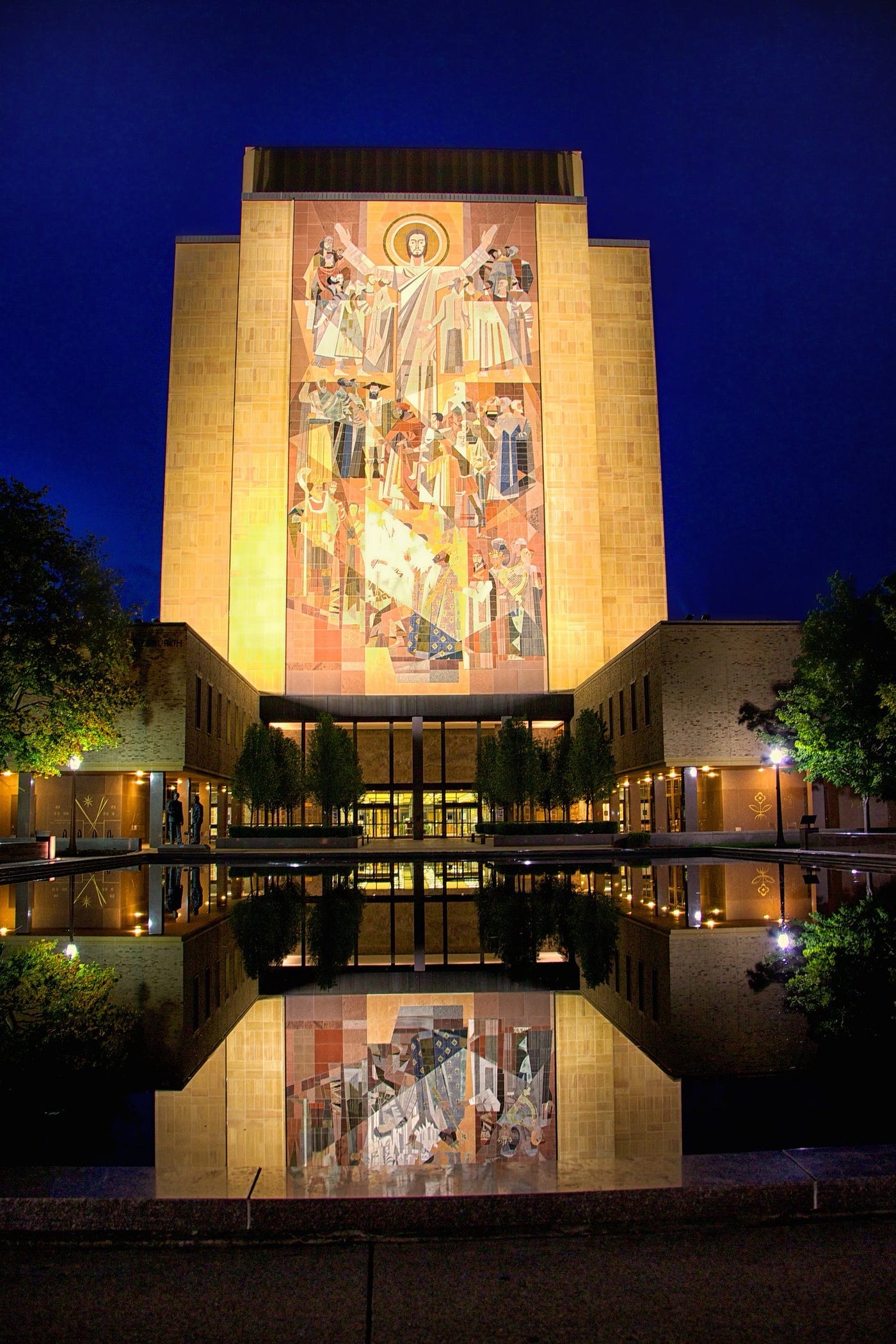
I led him to the Notre Dame Memorial Library — the 13-story tower with the massive mural of Jesus stretching his arms skyward, affectionately known as “Touchdown Jesus.” When we entered, the place was packed. The first floor buzzed with activity, the snack bar and bathrooms offering quick breaks for students deep in study.

Notre Dame’s Hesburgh Library at Night (With “Touchdown Jesus” Mural)

Jeff was baffled. “This is where everyone goes on a Saturday night?”

The “Pre-Med” Floor

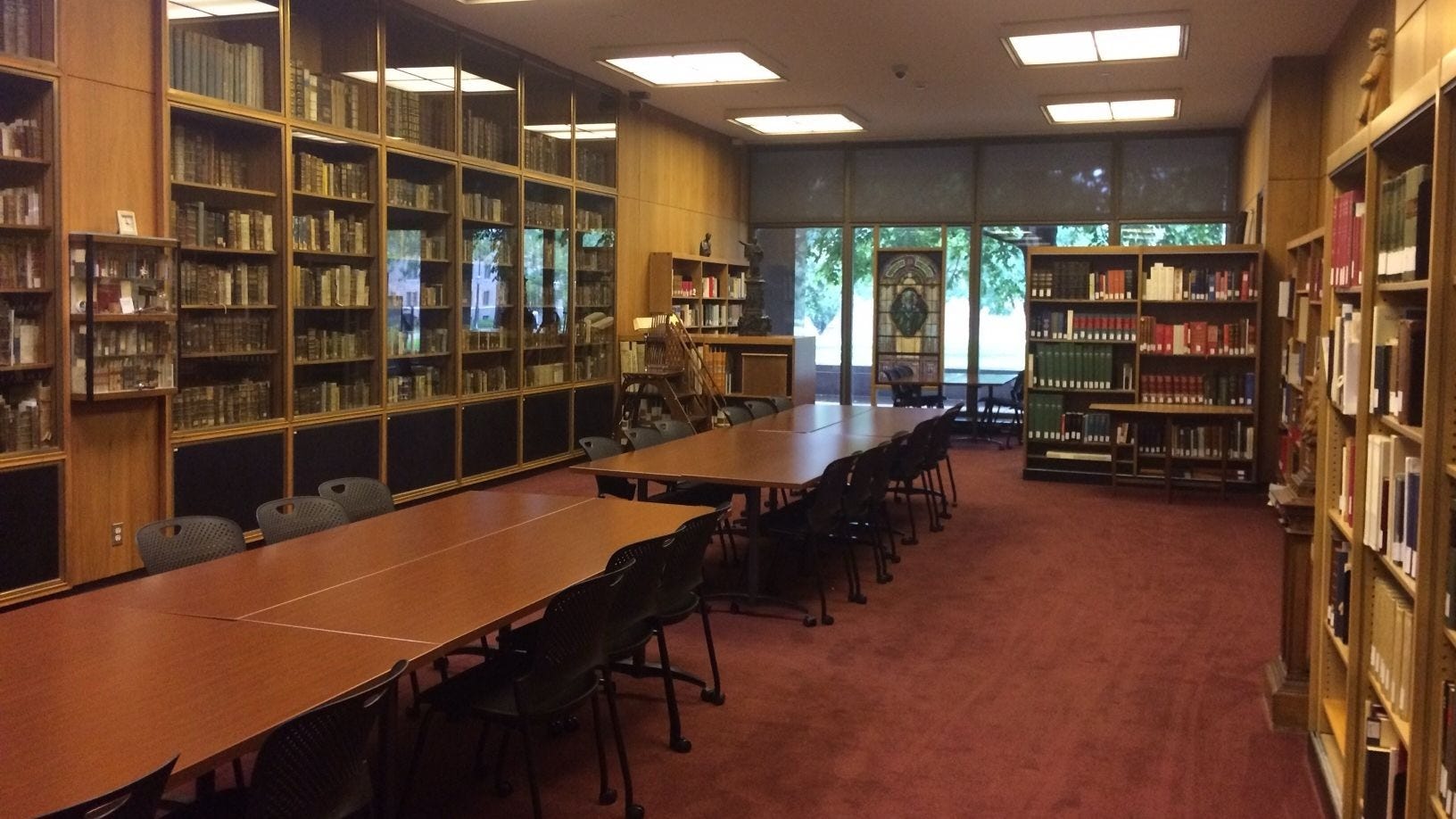
I nodded, but told him I couldn’t study there — too many distractions. So we took the elevator to the 13th floor: the “Pre-Med Floor.” As soon as the doors opened, the atmosphere shifted. You could hear every cough, every footstep, every rustle of paper. When I turned a page in my textbook, I could feel heads involuntarily lift from their cubicles just at the sound.

The Pre-Med Floor of Hesburgh Library (After Hours)

This was serious business. The Pre-Med students at Notre Dame didn’t mess around. Competition was fierce. Focus was absolute. It was a place of quiet desperation and razor-sharp ambition.

Jeff took it all in, visibly stunned. He never said much about it, but he never came back to visit again during undergrad. He waited until I made it to medical school at Georgetown. I think that night explained it all.

Final Exams: A Humbling First Encounter

All that remained of my first semester was final examinations. And let me say this clearly: they were a humbling experience.

I studied nearly 24/7 in the days leading up to exams. Every waking moment was spent buried in textbooks, notes, and problem sets. My mind was constantly racing between subjects — chemistry equations, biology lab reports, calculus proofs, and theology essays. Sleep came in short bursts. Meals were rushed. My stress was constant.

Final Exam Care Packages From Mom

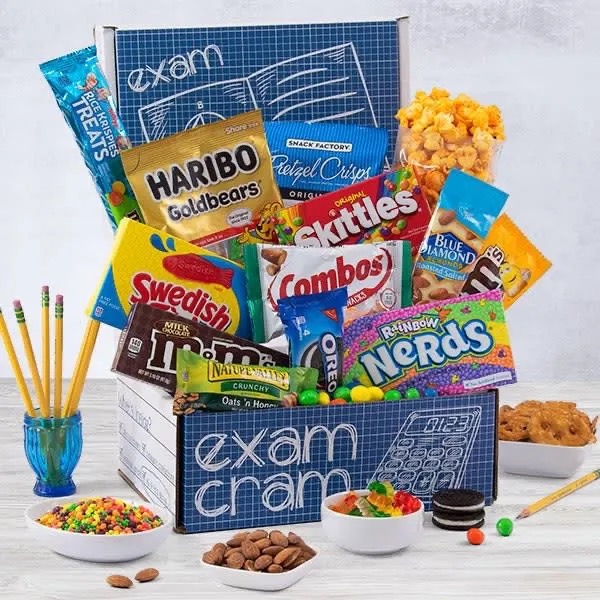
I was deeply grateful that my mother had purchased a Notre Dame-sponsored Exam Care Package, which came loaded with snacks and encouragement. Even better, my four sisters came through as always — sending their signature Toll House chocolate chip cookies and bags of gummi bears to get me through the marathon week. Those care packages felt like lifelines.

Pre-Med Exams Until the Last Day

What surprised and frustrated me most was learning that students in other majors were already finished. My friend Matt Bedics, a philosophy major, was packed up and home for the holidays while I was still knee-deep in test prep. Pre-Med and Engineering students weren’t so lucky — our final exams stretched all the way to the last possible day of the semester, often just a few days before Christmas.

Exam Time

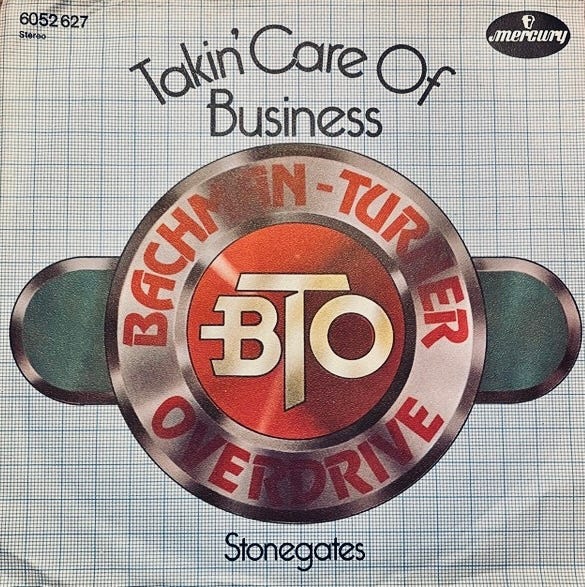
When the time came to Fisher Hall for our examination, Andy Cordes started a tradition that lasted all four years. Right when it was time for everyone to get ready to leave to take final examinations, Andy would start playing Bachman Turner Overdrive’s (BTO) “Taking Care of Business”. And one by one, each of us would open our dorm room doors and step into the hallway singing.

Album cover for Bachman Turner Overdrive (BTO) “Taking Care of Business”. Biography of Dr. Anthony J. Carbone.

The exams themselves were brutal. Chemistry in particular shook my confidence. The content was dense, the questions were sharp, and I knew I hadn’t nailed it. After everything was over, I didn’t even want to check my grades. I was too afraid. I needed a break from the pressure, the competition, and the relentless self-judgment. What should I expect from a professor who gave a pre-med Nobel Laureate a “B” in Chemistry?

Grades are Posted

But my pre-med buddy Bob Terifay had no such hesitation. He stormed back into Fisher Hall with his usual energy, grinning as he delivered the news: “You got a C in Chemistry!” I was stunned. “How the hell do you know my grade?” He just smiled. Somehow, he had remembered my Notre Dame student ID number: 7711117284. I have no idea how or why. But he did. And he looked up my grades like it was nothing.

Scholastic report card from my first semester at University of Notre Dame from 1977. Dr. Anthony J Carbone’s autobiography

Bob clearly was better at rote memorization than me. And I know he had a better academic preparation than I did. All I knew was that I had survived. And that, for my first semester at Notre Dame, would have to be enough.

When I finally made it home to Fort Leavenworth for the holidays, I was so mentally and physically drained that I didn’t feel like myself again until after Christmas Day. That’s how deeply finals had consumed me.

Home Page

Chapter 4: Our First Tour in Germany: Fulda & Heidelberg

14th Armored Cavalry Distinctive Unit Crest with Motto Suave Moi Stationed at Rose Barracks , Fulda, Germany guarding the Fulda Gap near the Soviet Border. Autobiography of Dr. Anthony J. Carbone

Believe Nothing You Hear, and Only Half of What You See — A memoir of Service, Shame and the Search for Truth

Dad Gets Orders for Fulda, Germany

In 1964, during the height of the Cold War, my father received deployment orders to Fulda, West Germany. The Berlin Wall had only recently gone up, and global tensions were at a boil. It was a serious time, and the assignment my father received reflected that gravity.

Command of C Troop, 14th Armored Cavalry

Dad was given command of C “Charlie” Troop, 14th Armored Cavalry Regiment, in Fulda, Germany — stationed at one of the most sensitive flashpoints between NATO and the Warsaw Pact.

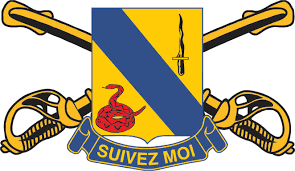
The unit insignia from the 14th Cavalry in front of crossed sabers, the U.S. military symbol of Cavalry, and the unit motto of “Suivez Moi” which is French for “follow me”. This is the unit crest that Captain Carbone wore when he commanded Troop C, 14th Armored Cavalry in Fulda, Germany.
Insignia of the 14th Armored Cavalry with Crossed Cavalry Sabers and the motto, “Suivez Moi,” which is French for “Follow Me”.

The Fulda Gap

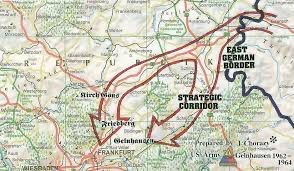
Known as the “Charging Charlies“, C-Troop (and the rest of the 14th Cavalry) was responsible for guarding the infamous Fulda Gap, the strategic corridor military planners believed the Soviets would use to launch a massive armored invasion into Western Europe.

Map of Fulda Gap Germany During Cold War

Family Prepares for a Transatlantic Transfer

My father deployed ahead of us to report for duty and secure housing, while the rest of us — my mother, my three sisters, and I — prepared for the long move overseas. The process of uprooting our lives for Germany was as complex as it was memorable. Every item we owned had to be sorted into four categories: (1) Hold Baggage — essentials that traveled by air; (2) Household Goods — the bulk of our possessions, shipped by slow-moving cargo ship; (3) Storage — items too big or unnecessary to bring; and (4) Trash or Give Away — whatever wouldn’t make the cut.

Birth of Sister #3, Cynthia

Just weeks before our departure, on January 29, 1964, my third sister Cynthia was born. Her arrival added both joy and urgency to our preparations. With a newborn in the house, the challenge of organizing an international military move became even more formidable. But as always, my mother handled everything with grace and efficiency — tending to Cynthia’s every need while managing three other young children and the complex logistics of uprooting a household. Cynthia took her very first flight as an infant in her mother’s arms, beginning a life already shaped by service, travel, and family sacrifice.

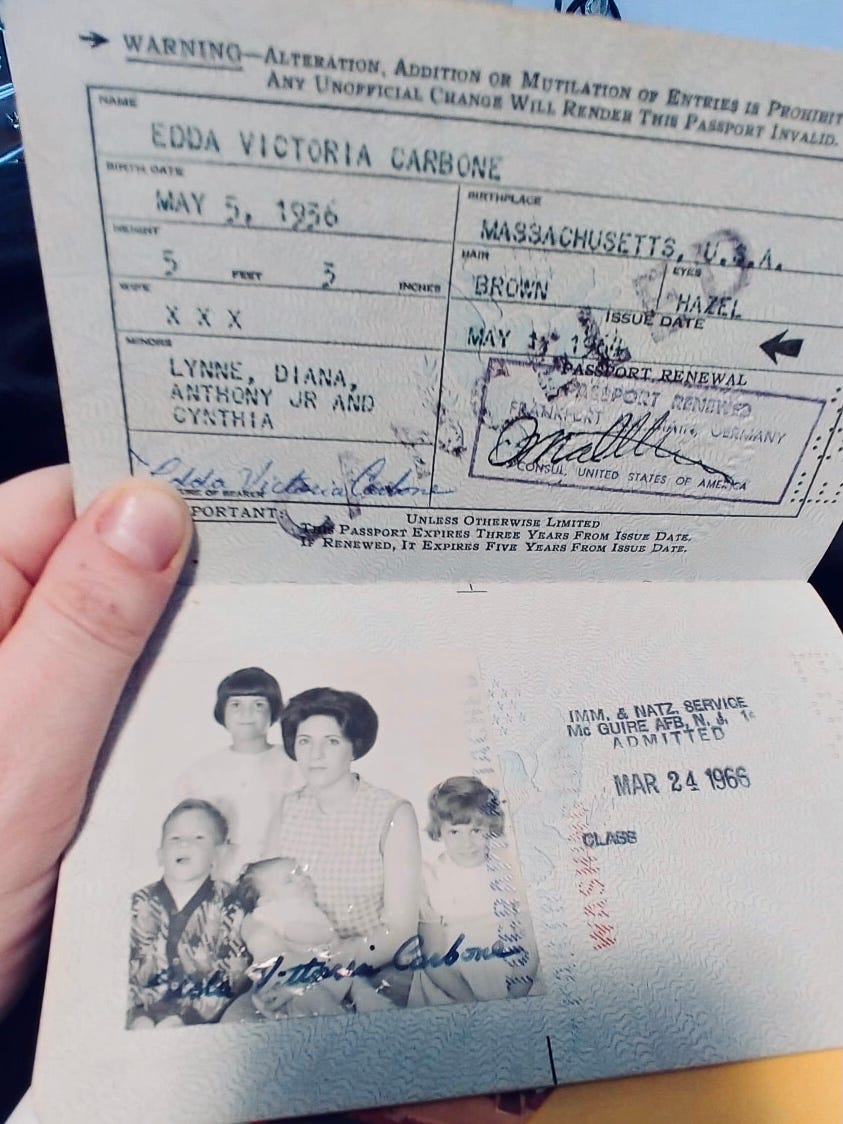
This is the passport of Anthony J. Carbone’s mother, Edda V. Carbone, and her four children: Lynne, Diana, Anthony Jr., and Cynthia. This is the passport that Mom used to get into Germany and then return home to the United States.
My mother’s passport with Lynne, Diana, Anthony Jr. and Cynthia.
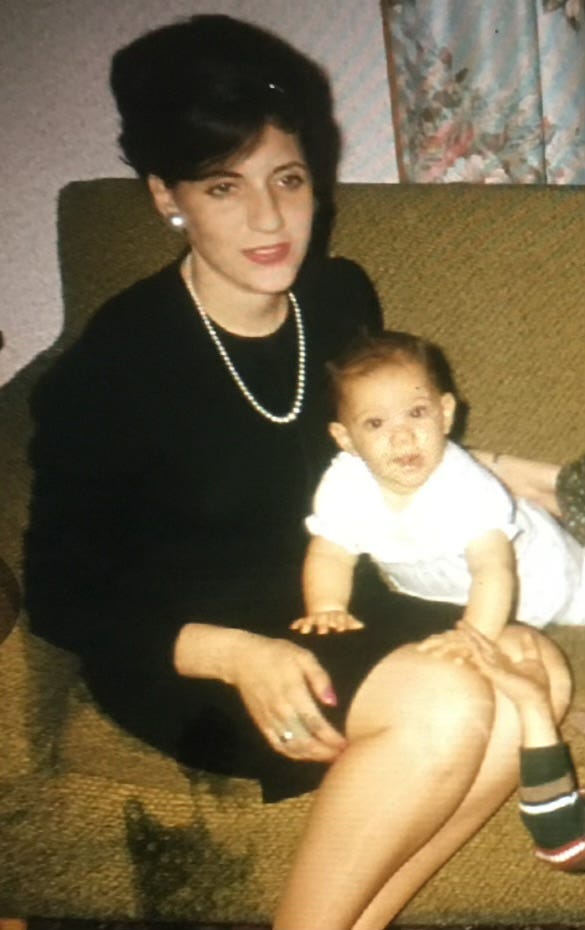
Anthony Jr.’s mother, Edda Carbone, with his baby sister Cynthia on her lap prior to our trip to Germany.
Mom with Cynthia in Medford before leaving for Germany.

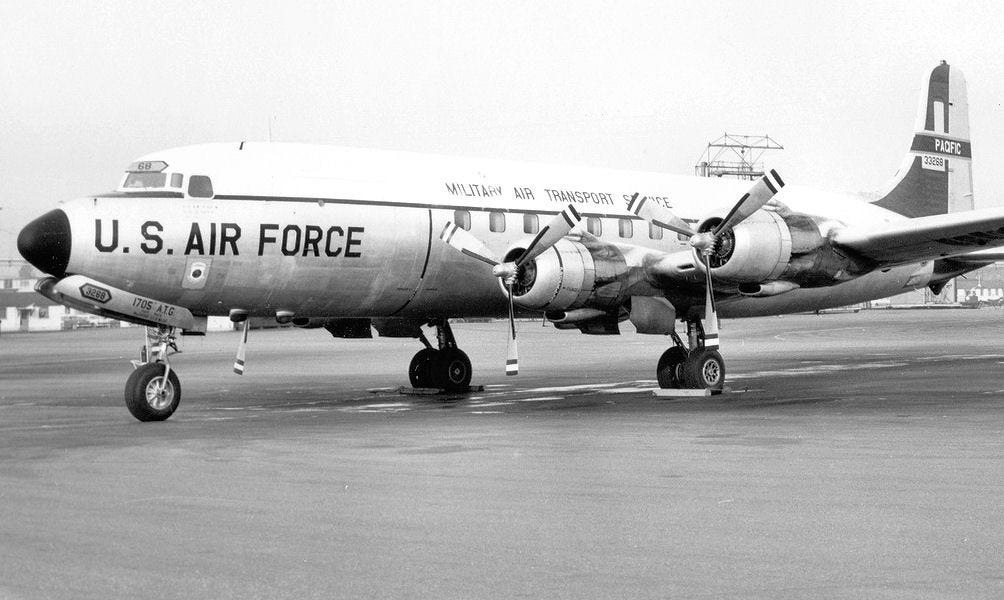
Though I was very young, that journey remains burned into my memory. We traveled to McGuire Air Force Base in New Jersey, where we boarded a sleek four-propeller Douglas C-118 Liftmaster aircraft operated by the Military Air Transport Service (MATS)— packed mostly with uniformed GIs. We were one of the few military families on board. My mother, ever composed and elegant, wore a pencil skirt and sweater, her trademark pearl necklace resting neatly at her collar as she carried my baby sister Cynthia in her arms. She handled the journey with grace, even while managing four children. I remember GIs stepping in to help — each of us was being held or entertained by a soldier at one point. It was a shared moment of kindness and connection in a time of great upheaval.

Douglas C-118 Liftmaster operated by the Military Air Transport Service (MATS) out of McGuire Air Force Base. This is the type of plane that we flew from McGuire to New Foundland to Shannon, Ireland, to Frankfort, Germany.
Douglas C-118 Liftmaster operated by the Military Air Transport Service (MATS) out of McGuire AFB.

Family Flies to Germany — Headed to Fulda

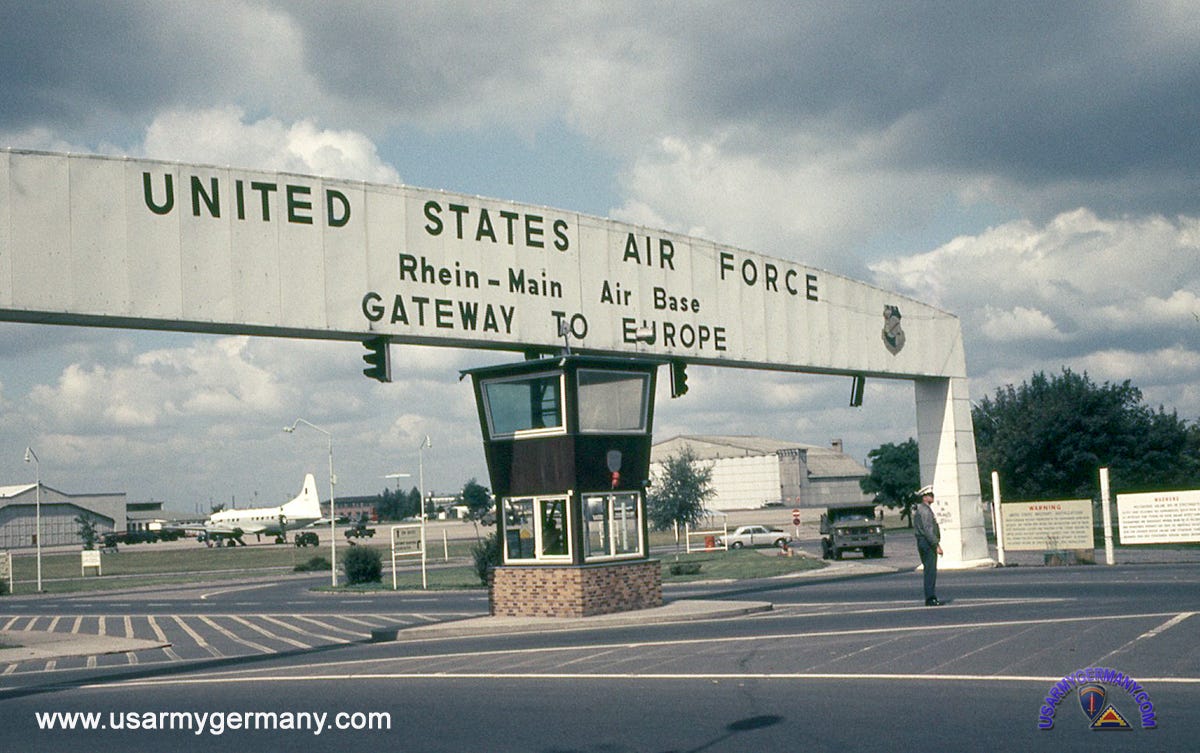
The flight took us from McGuire to Gander, Newfoundland, then across the Atlantic to Shannon, Ireland, and finally to Rhein Main Air Force Base in West Germany. It took 16 to 18 hours, and when we landed, we were met by my father and our “sponsors” — an Army family assigned to help us transition into German life.

The Famous Welcome Sign to Europe at Rhein-Main Air Base in Frankfurt, West Germany in the 1960s.
The Famous Welcome Sign to Europe at Rhein-Main Air Base in Frankfurt, Germany.
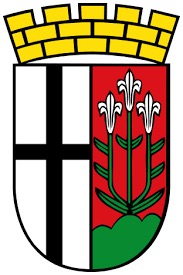
Coat of Arms for the city of Fulda, Germany with a shield that is a black cross on white border on left half, and 3 white eidelweiss flowers on a red border on the right, topped with a crown of stone.  Autobiography of Dr. Anthony J. Carbone
Coat of Arms for Fulda, Germany

We live on a farm on the Germany “Economy”

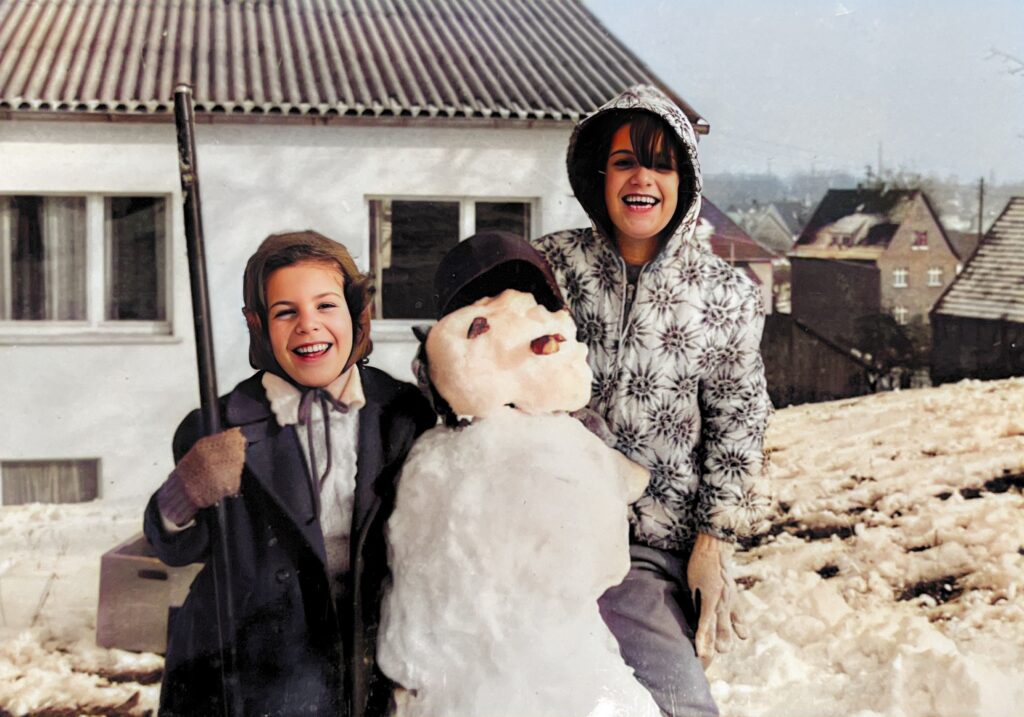
At that time, there were no on-post quarters available for us in Fulda, so we rented a home “on the economy,” Army-speak for off-base living. Our rented house sat on a small German farm, nestled in the hills above a Catholic school that I attended for kindergarten alongside my sisters Lynne and Diana. The nuns who taught us wore full habits and ran a tight ship. I remember the heavy wooden Brio toys we played with, the scent of peppermint tea served before naps, and the solemn atmosphere of strict German discipline.

Lynne and Diana with their snowman in front of our house on the economy (off-post) in Fulda, West Germany. Our kindergarten and elementary school, run by German Catholic nuns, was right down the hill in our backyard.  Autobiography of Dr. Anthony J. Carbone.

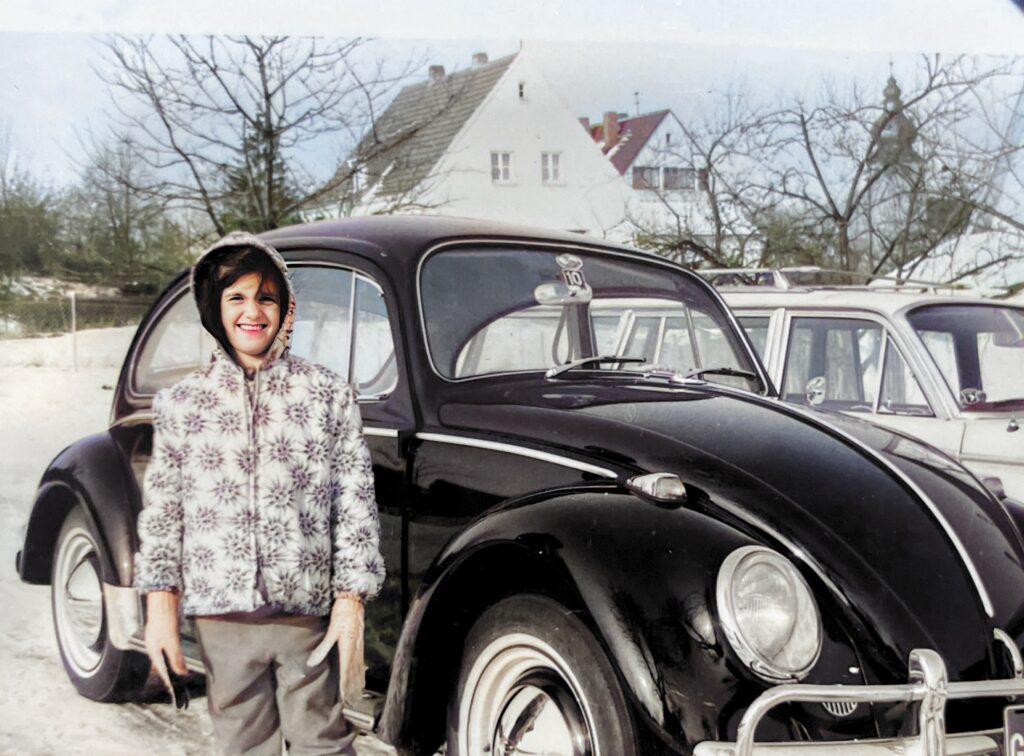
Our landlord’s daughter, Effie, was a teenage girl with long blonde braids who lived downstairs and was mainly Lynne’s friend. Our babysitter was Marlena lived up the street from us. She spoke just enough English to make herself understood and was endlessly patient with us.

My oldest sister Lynne with our first German Volkswagen Beetle in Fulda, Germany.  All bundled up for the German winter.  Autobiography of Anthony J. Carbone.

My favorite sights, sounds and smells of Germany

Some of my most vivid childhood memories are rooted in that farm — the air thick with the scent of wildflowers, blossoming trees, and the unforgettable smell of “honeywagons,” large wooden barrels filled with manure used to fertilize the fields. Coal was still the primary source of heat, and the smoky, sulfur-rich air had a strange health to it — earthy and alive, part of the rural rhythm of Fulda. Another sensory thread woven deeply into those memories is the sound of church bells. They marked the hours with gentle regularity, rang out at midday for the Angelus, and on Sundays, filled the valley almost nonstop from dawn to dusk. Even now, the tolling of bells brings me instantly back to Germany — awakening a sense of calm, nostalgia, and rootedness that no other sound quite can.

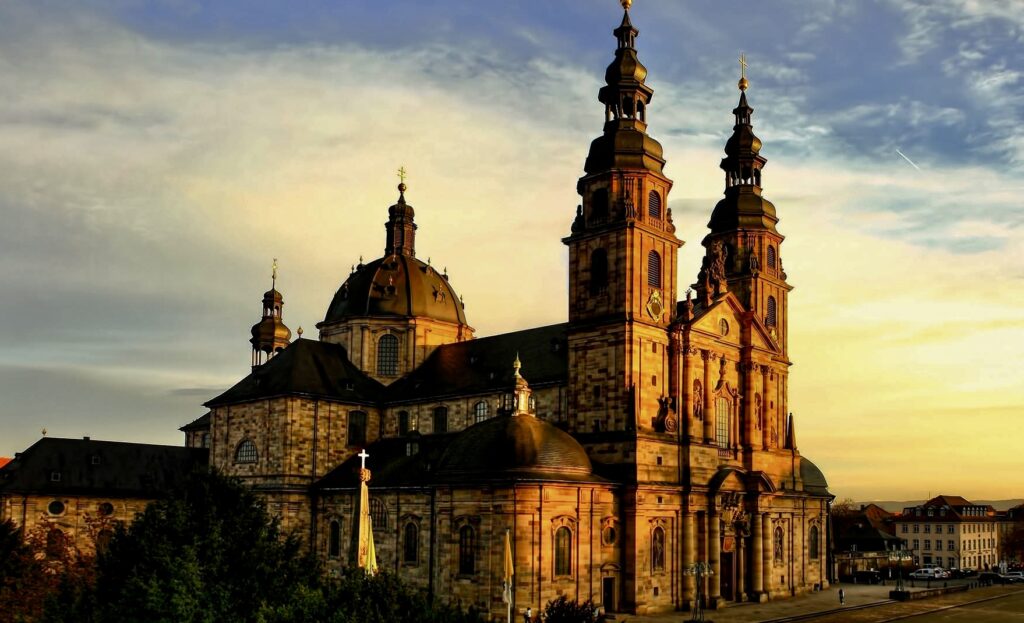
One of Fulda, Germany's icons--the 18th Century Baroque Saint Salvator Cathedral whose bells could be heard all over the village.  Autobiography of Dr. Anthony J. Carbone.
18th Century Baroque Cathedral of Saint Salvatore in Fulda, Germany
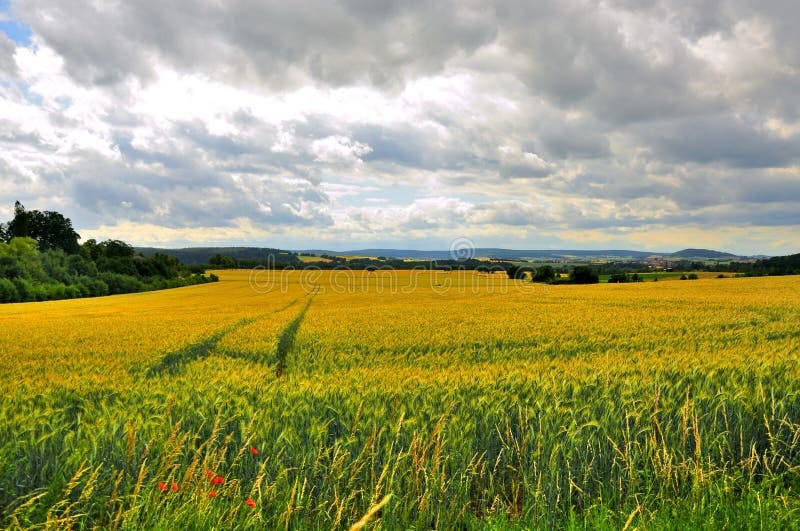
All of Bavaria at the time (1960s) was gorgeous farmlands with incredible smells of nature. This is a view of the farmland in Fulda, West Germany.
The rolling farmlands of Fulda, Germany.

Dad Commands F Troop, 14th Armored Cavalry on Soviet Border

I don’t believe we owned a car at the time, so my father was picked up daily by his jeep driver to report to the regiment. It didn’t matter to me that we didn’t have a car because we loved living on the German farm. I was utterly captivated by the world we had entered. Even then, as a small boy, I had already made up my mind: I wanted to be a cavalry officer just like my father. I watched him closely, studying how he wore his uniform, how soldiers saluted him, how he led. To me, he was a hero, and I never questioned that I would follow in his footsteps someday.

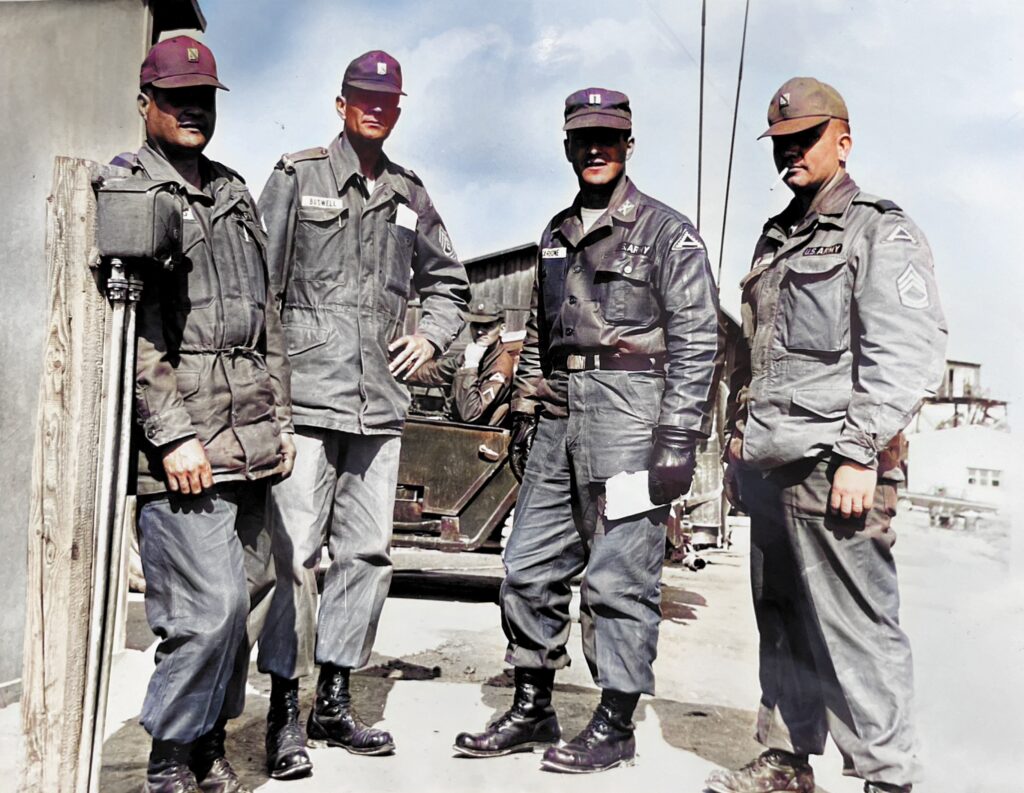
My father, CPT Tony Carbone (center) with First Sergeant (left) and jeep driver (background). This is the same jeep and driver who used to pick up my father at our home on the economy and drive his to and from Downs Barracks where his cavalry troop was located.  Autobiography of Anthony J. Carbone.
Dad with his First Sergeant and jeep driver in the background.
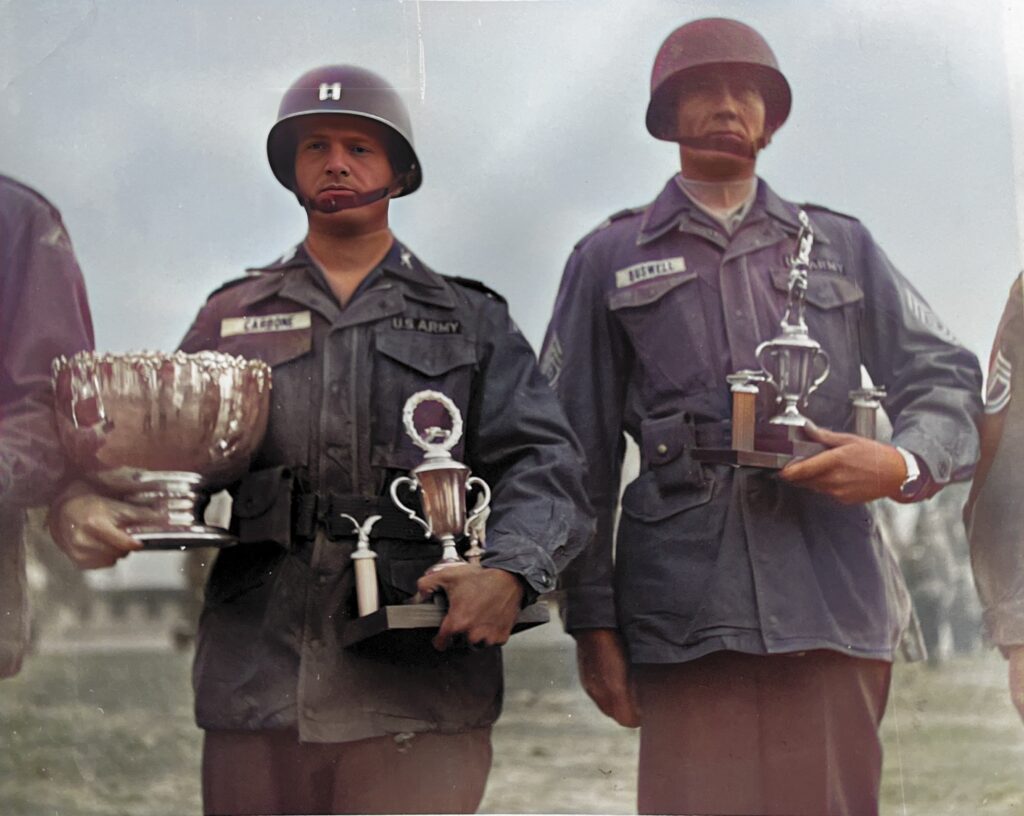
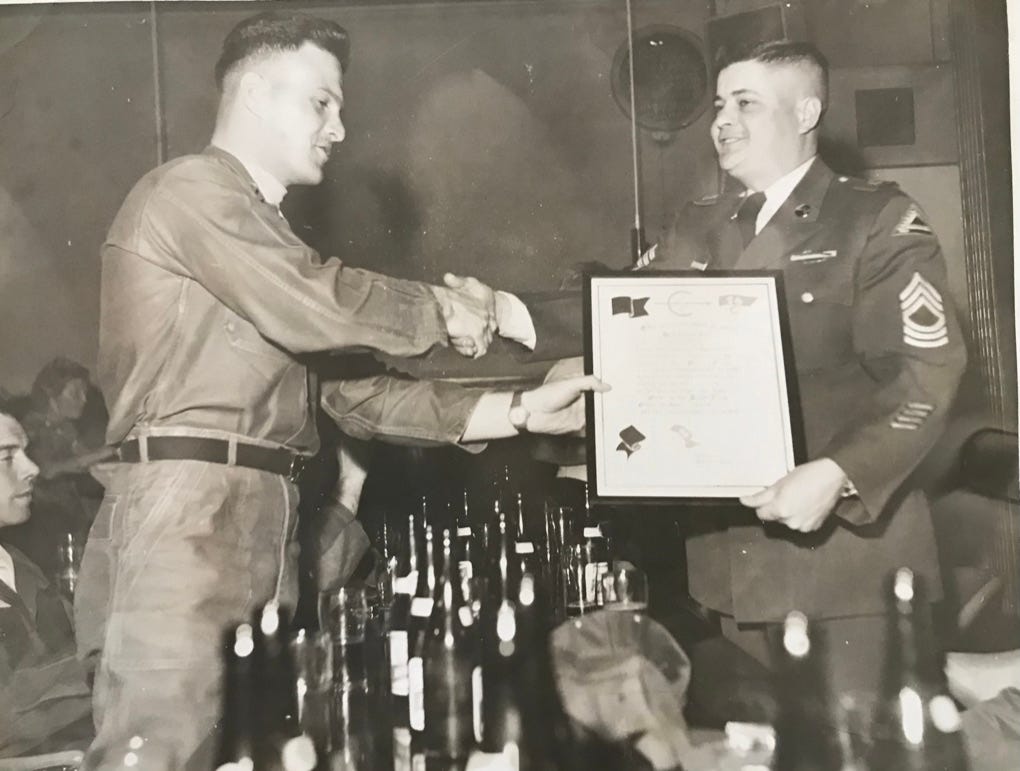
Captain Tony Carbone (Dad) received the coveted award of First In Tank Gunnery (next to Troop First Sergeant Buswell) while commanding C Troop, 14th Armored Cavalry in Fulda, West Germany during the Cold War (c.1965).  Autobiography of Dr. Anthony J. Carbone.
CPT Carbone received the coveted award of First In Tank Gunnery (next to Troop First Sergeant Buswell)
Dad receiving a certifiicate for commaning C Troop, 14th Armored Cavalry in Fulda, West Germany (c. 1965)
Dad receiving a certifiicate for commaning C Troop, 14th Armored Cavalry in Fulda, West Germany.

We move on post into government quarters on Rose Barracks

Eventually, our family received government quarters. We moved into a tall, gray three-story apartment building that housed twelve Army families. The fourth floor had maid’s quarters built by the Nazis decades earlier. It wa, a haunting reminder of Germany’s past tucked above American military life. From my bedroom window, I could see the military airfield nearby. At night, as I lay in bed reading comic books under the covers. The rotating airfield beacon would cast alternating flashes of green and two white lights into my room. That rhythm of light, sweeping silently across my walls and pages, felt like a lullaby — strange, comforting, and unforgettable.

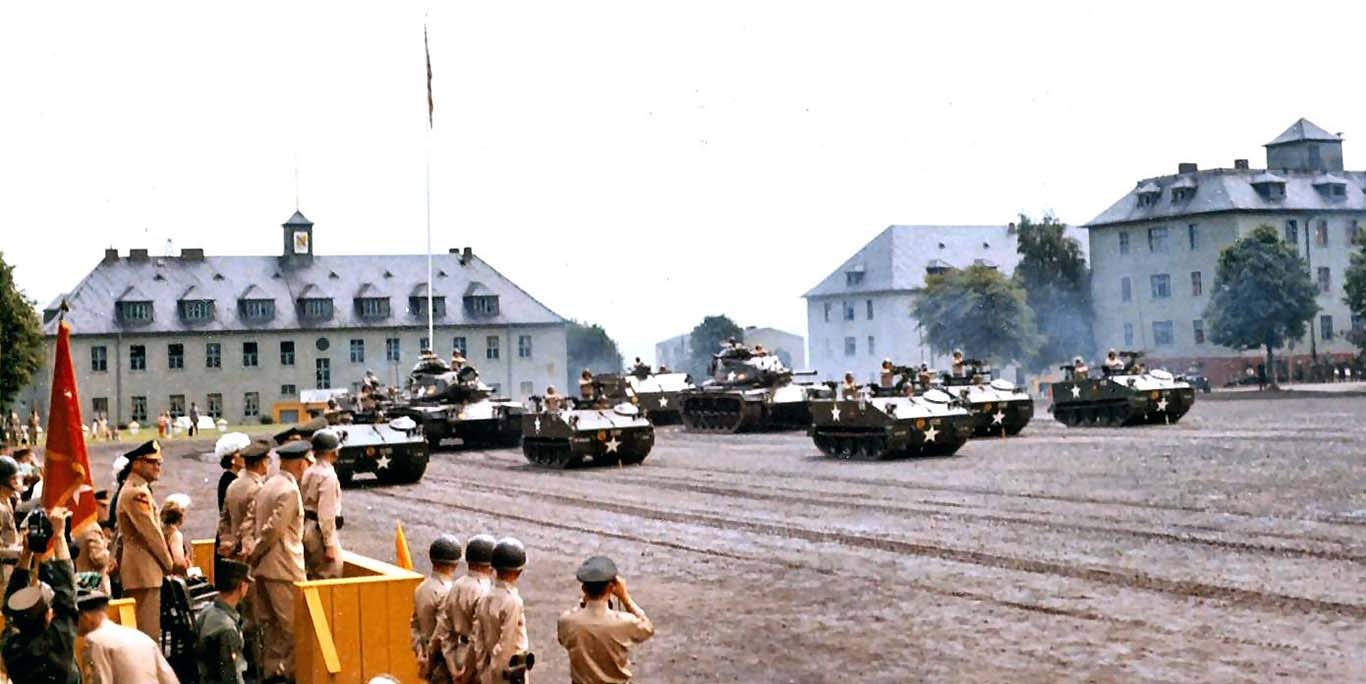
14th Armored Cavalry Regiment at Downs Barracks, Fulda, Germany (c. 1964). These were typical military buildings that the U.S. Army took over buildings from the Nazi forces after the war. This is a “Pass in Review” portion of an Army parade involving armored vehicles (M114 armored personel carriers used by the U.S. cavalry).
14th Armored Cavalry Regiment at Downs Barracks, Fulda, Germany
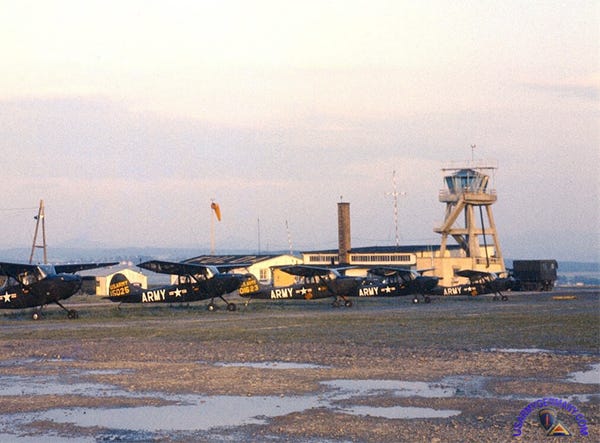
Fulda Army Airfield c.1964 showing the control tower and airfield beacon. Cessna L-19/O-1 Bird Dog ingle propeller aircraft were used for reconnaissance by the cavalry.
Fulda Army Airfield c.1964 showing the control tower and airfield beacon. The U.S. Army cavalry used Cessna L-19/O-1 Bird Dog aircraft were for reconnaissance.

Life on a cavalry post thrilled me. My father gave me occasional tours of the motor pool, the barracks, and the tanks. I couldn’t get enough. The Military Police (actually Unit Police–UPs) at the gate would sometimes let me stand next to them, waving in vehicles and offering salutes. The whole environment was electric to a young boy with big dreams.

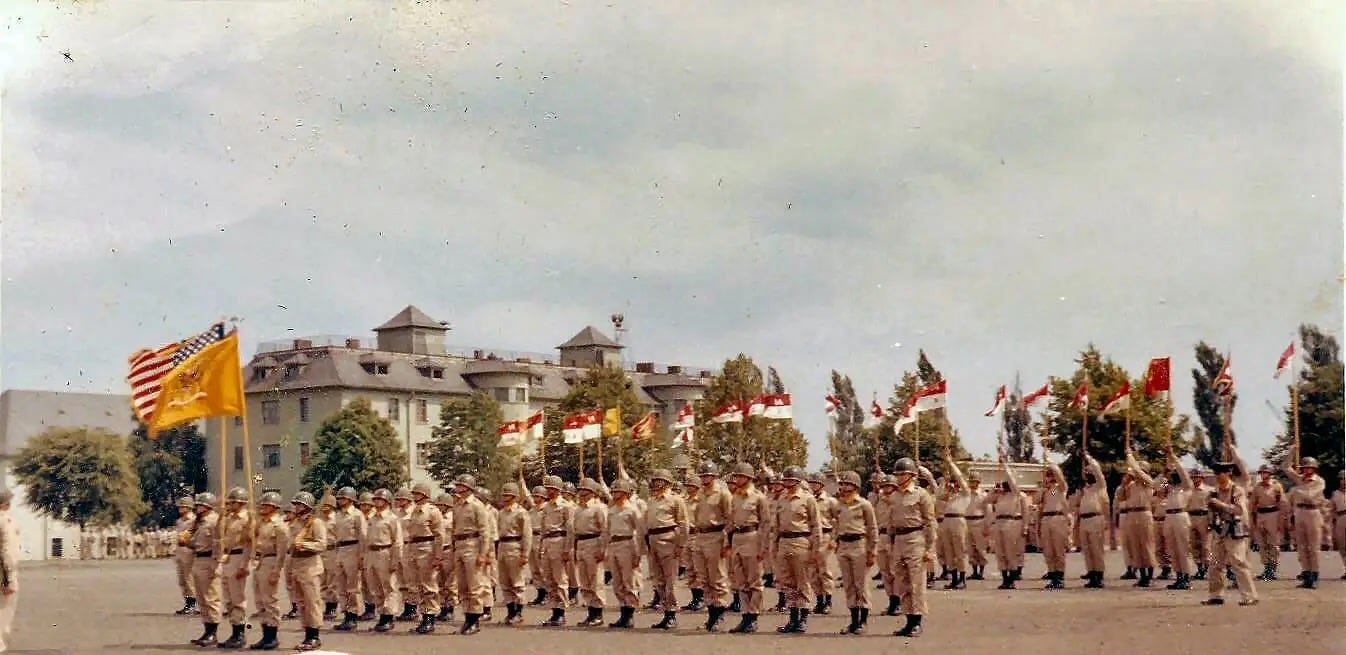
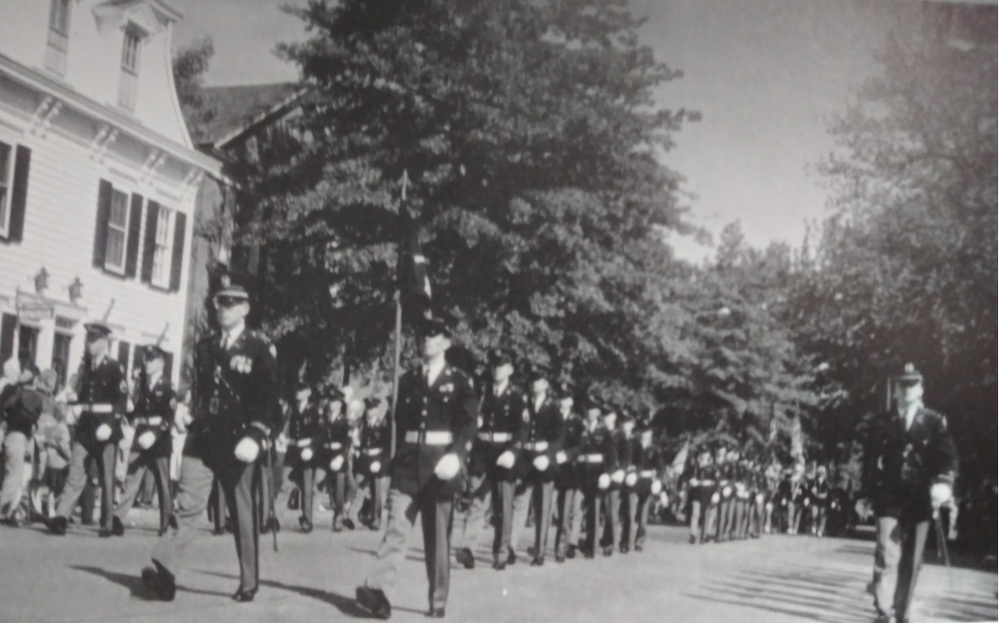
Colors and Guidons of the full 14th Armored Cavalry Regiment at Downs Barracks. CPT Tony Carbone is somewhere in the line with other troop commanders. The Troop C, 14 Cavalry guidon can be seen if you look close enough.
Colors and Guidons of the full 14th Armored Cavalry Regiment at Downs Barracks

The Grim Reality of Guarding the Soviet Border

It wasn’t all parades and salutes for the 14th Armored Cavalry Regiment. Their mission was deadly serious. The regiment’s men actively guarded the infamous Fulda Gap, stationed at the spear’s tip.

Military planners expected that if the Soviet Union ever unleashed its armored divisions into Western Europe, the main thrust of their invasion would come roaring through this very corridor.

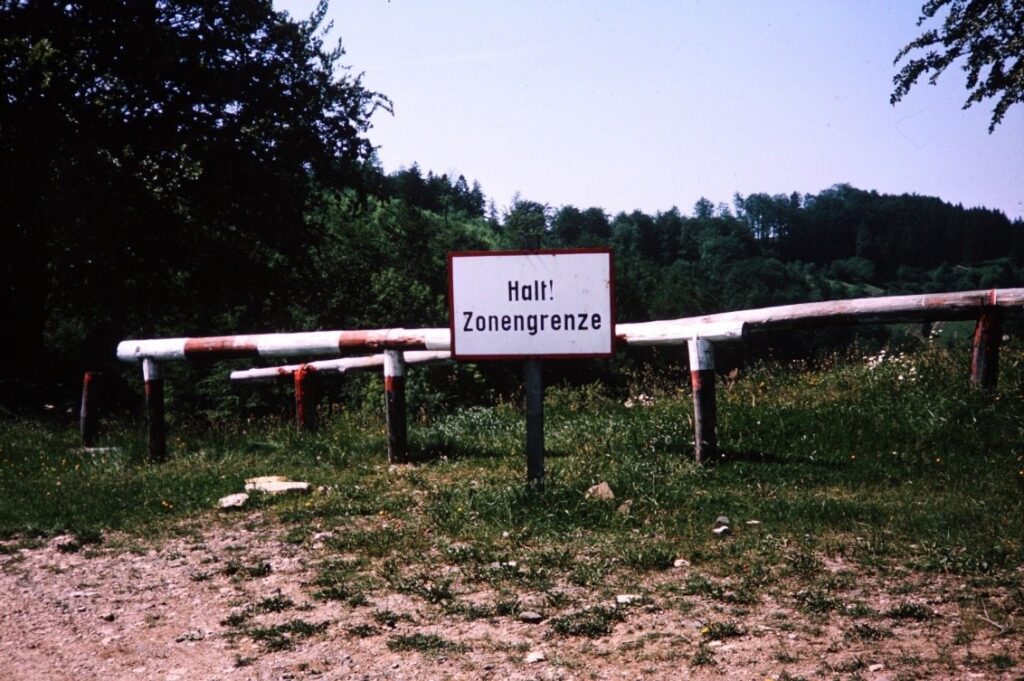
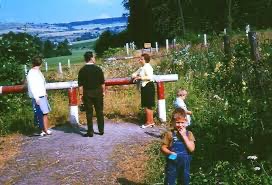
Photograph showing the West-East German border at the Fulda Gap with barricade with sign saying "Halt! Zonengrenze" (Stop! Border).  Autobiography of Dr. Anthony J. Carbone.

To the untrained eye, the countryside around Fulda was idyllic. Rolling hills, fertile farmland, and quiet villages created the picture of peace. The landscape gave no hint of the threat that loomed just across the line. However, the soldiers of the 14th Armored Cavalry knew better. They patrolled the NATO border daily, often within meters of East German and Soviet forces. From their observation posts, they could see the enemy through field glasses—watching them as intently as they were being watched in return.

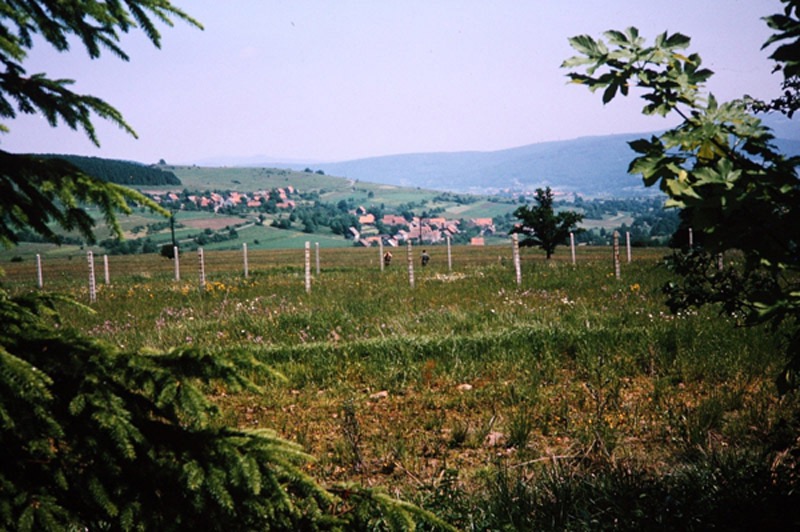
Double barbed wire border at West-East Germany border in Fulda Gap.  Autobiography of Dr. Anthony J. Carbone
A border between East & West Germany that is just two barbed wire fences.
Families vist the border looking for the families in the East

Need for Tank Gunnery Proficiency

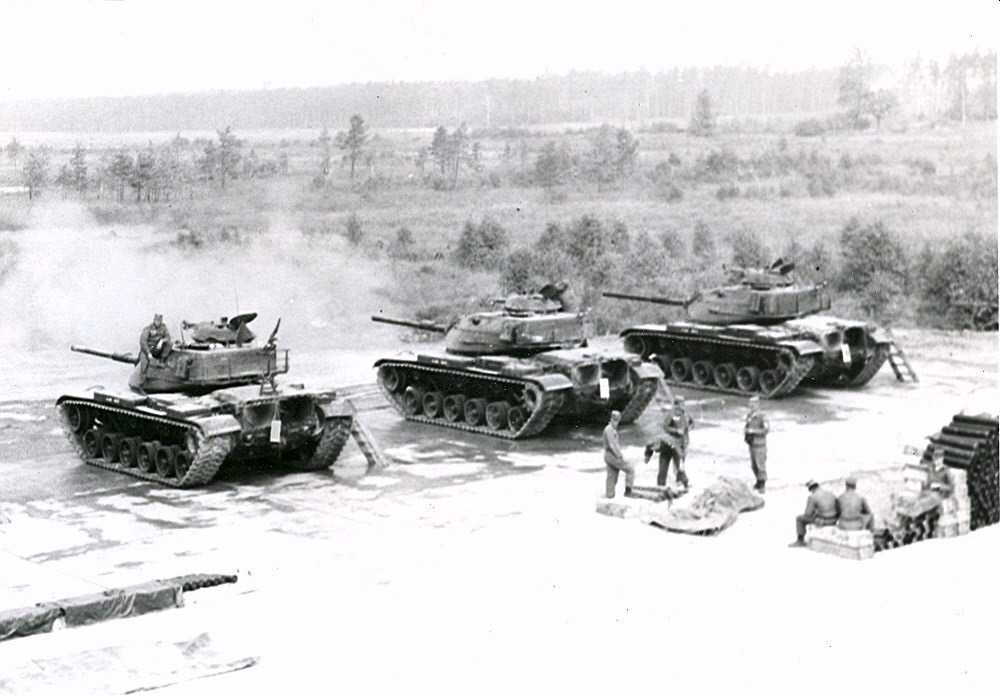
For these troopers, there was no illusion of safety. Tank gunnery, live-fire ranges, and field maneuvers weren’t training games—they were rehearsals for survival. Every round fired, every drill practiced, was preparation for the day the balloon might go up, when the border could erupt in fire and steel without warning.

14th Armored Cavalry M60 tanks practicing tank gunnery at Grafenwohr in Germany. Autobiography of Dr. Anthony J. Carbone.

The 14th Cavalry’s unspoken duty was to slow the Soviet juggernaut long enough for NATO reinforcements to mobilize. Everyone knew what that meant: if war broke out, the enemy would overrun the regiment in hours, perhaps even minutes.

It was a grim reality, but one they carried out with quiet professionalism. To a boy watching from the safety of Army quarters, the regiment looked like knights in armor. Unfortunately for the men who wore the spurs, it was a mission shadowed by constant danger.

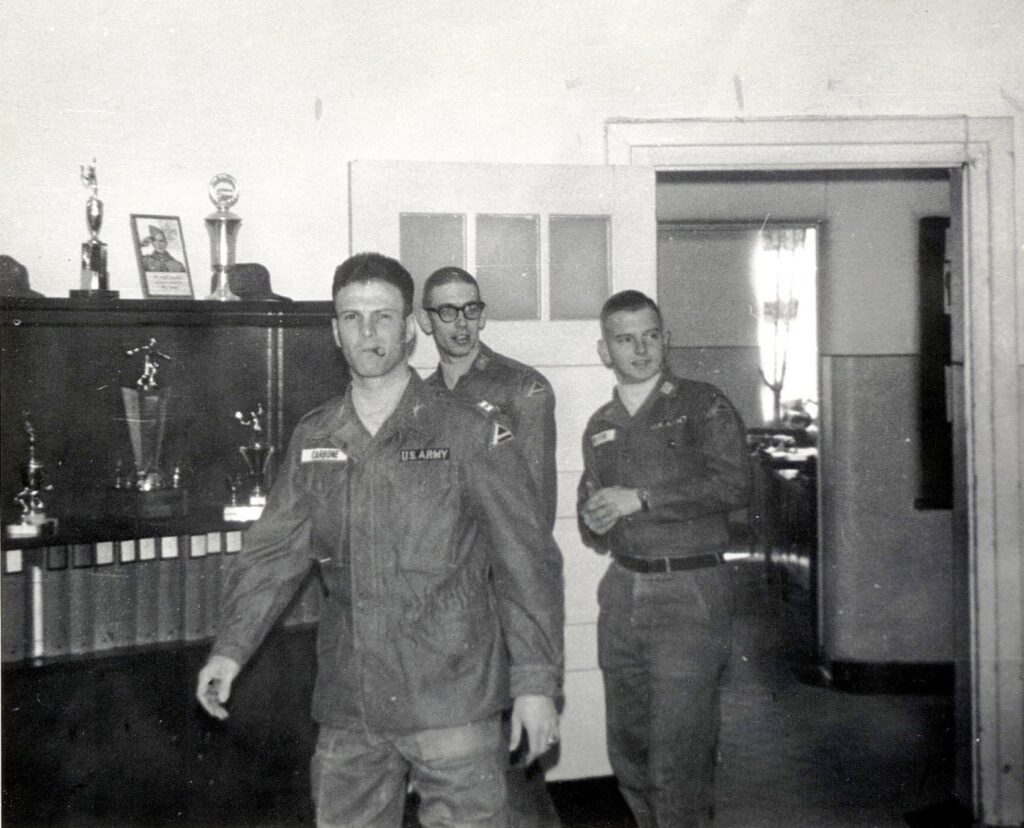
Dad smoking his infamous Italian stogie followed by his Executive Officer (XO) Lieutenant Ron Meyer and 3rd Platoon Leader Lt Jim Zimmerman of the 14th Armored Cavalry at Fulda, Germany.  Autobiography of Dr. Anthony J. Carbone.
C Troop Commander, Captain Tony Carbone, with his Executive Officer (XO) Lieutenant Ron Meyers.

Baby Sister, Pamela, is born in Germany

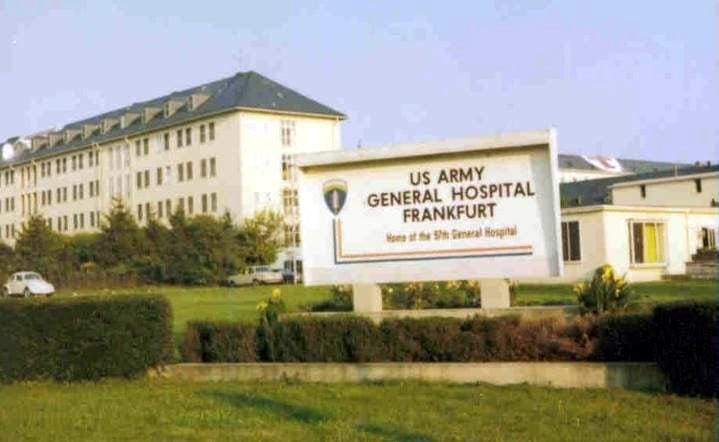
During this tour, our family grew again. My baby sister Pamela was born on September 11, 1965 at the 97th General Hospital in Frankfurt, Germany. My mother was too far along in her pregnancy to make the long trip home, so Pamela became the only one of us not born at Lawrence Memorial Hospital in Medford, Massachusetts. She even held dual American-German citizenship until she turned eighteen.

This is the 97th General Hospital in Frankfurt, Germany, where my baby sister Pamela Carbone was born in 1965.
97th General Hospital in Frankfurt, Germany.
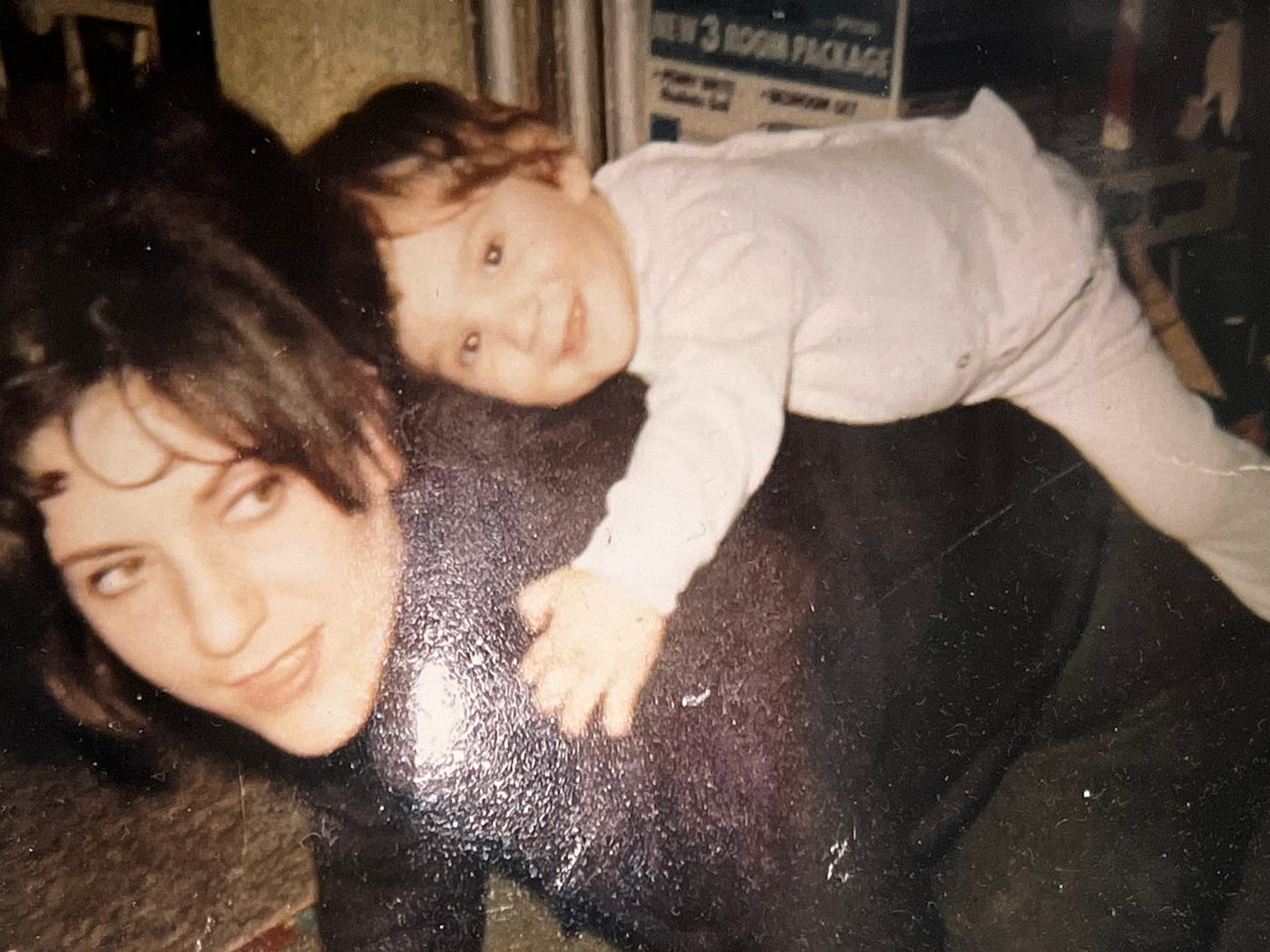
My baby sister Pamela riding on my mother in Germany
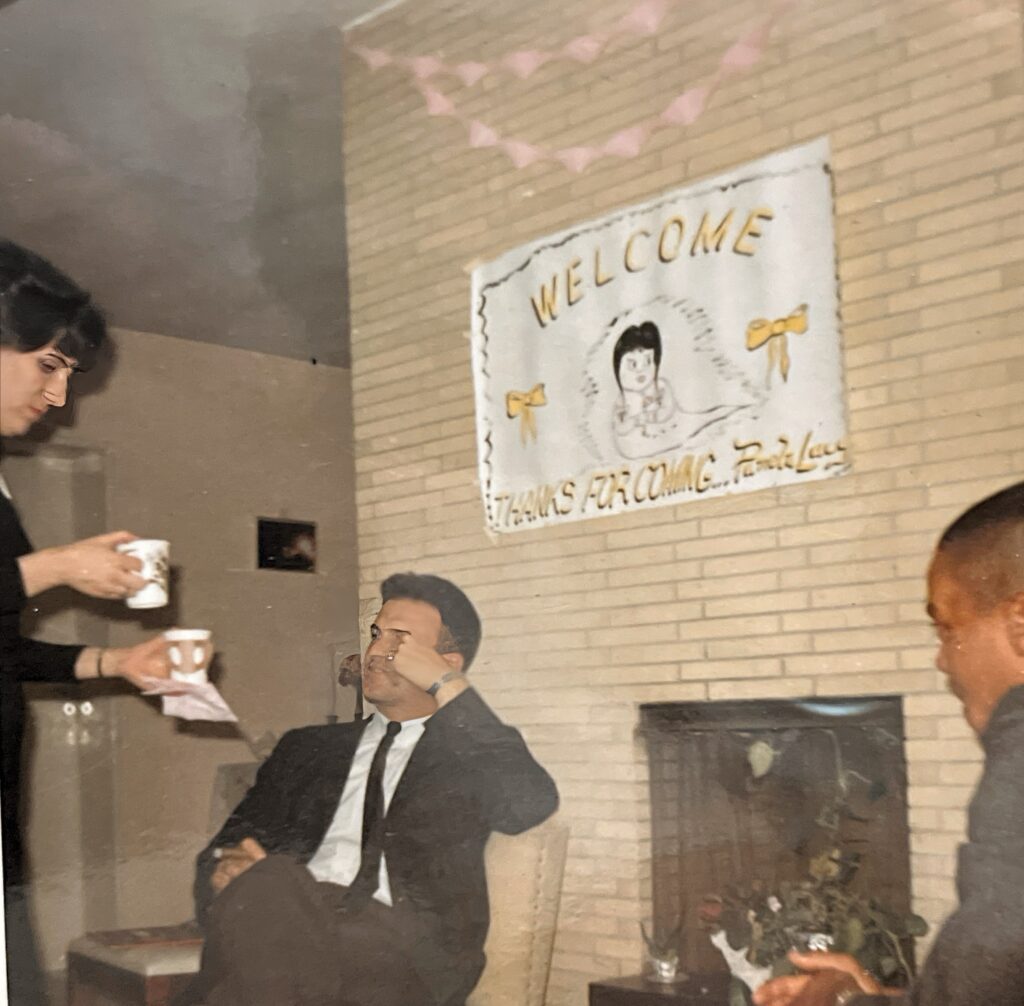
My baby sister Pamela's baptism party in our on-post quarters on Rose Barracks, Fulda, Germany.  Autobiography of Dr. Anthony J. Carbone.
My sister, Pamela’s, baptism party in our post quarters in Fulda, Germany.

Our first deployment to Germany wasn’t just a posting — it was the beginning of my lifelong identification with the Army, with cavalry tradition, and with the kind of honorable service my father embodied. It was the chapter where I began to understand who I was becoming — and who I aspired to be.

Dad Gets Orders for HQ USAREUR in Heidelberg, Germany

As his command in Fulda came to an end, our family received new orders: a transfer to Headquarters, US Army Europe and 7th Army (HQ USAREUR) Heidelberg. This meant a new home for our family — one unlike any we had experienced before. We relocated to an American military housing area called Patrick Henry Village (PHV), located just on the outskirts of Heidelberg.

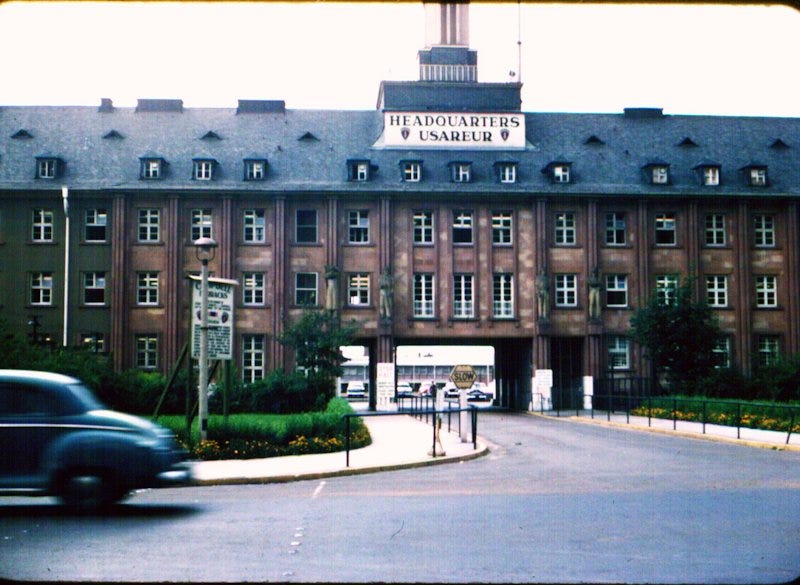
This is the Headquarters US Army Europe (USAREUR) in Heidelberg, Germany. Another Nazi military building that was conviscated and repurposed by the U.S. Army after the war.
Headquarters US Army Europe (USAREUR) in Heidelberg, Germany

Our Family Moves Into Post Housing — Patrick Henry Village

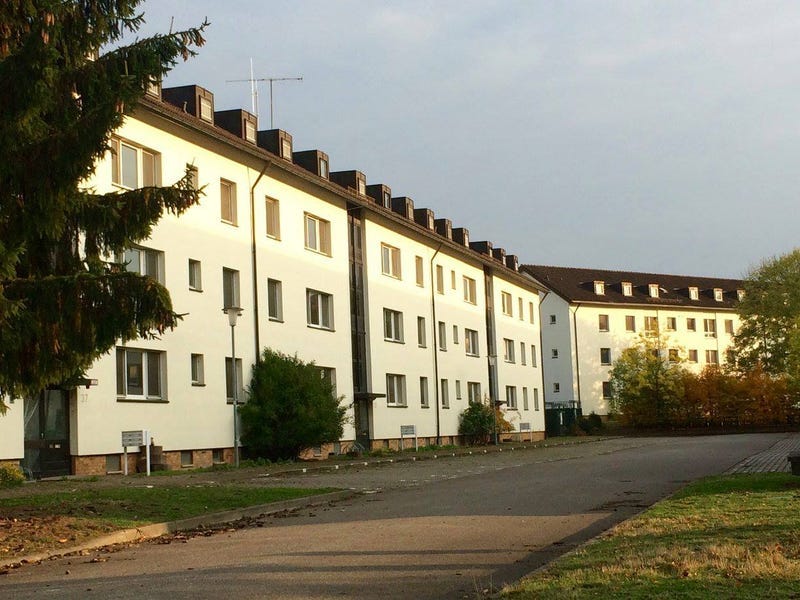
PHV was more than just a place to live; it was a self-contained American suburb transplanted into the heart of Germany. During the Cold War, it became one of the largest military family housing areas in Europe, with over 16,000 Americans living in approximately 1,500 apartment buildings. Every building looked exactly the same — white-painted concrete blocks with terra cotta roof tiles, lined up in precise rows. Each building contained three stairwells, with 18 apartments stacked over three floors.

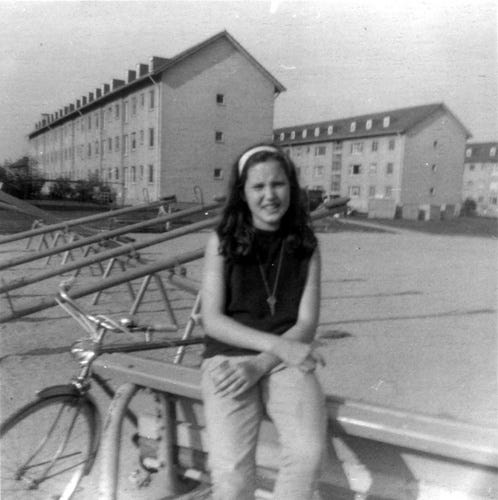
The fourth floor usually housed maids’ quarters or temporary billeting units. From the outside, there were no distinguishing features. That fact became a nightmare on my very first day of school when I got hopelessly lost trying to find my way back home. Every building looked the same, and the playgrounds behind them all were full of noisy children. To this day, I have no idea how my mother managed to find me in that uniform maze of concrete, stairwells, and unfamiliar faces — but she did.

Apartment Buildings at Patrick Henry Village. Classic goverment multi-family housing units that housed American military families and were found all over Germany after the war.
Apartment Buildings at Patrick Henry Village

Aerial View of PHV Shows Size and Similarity of Post Housing

Aerial view of Patrick Henry Village showing the uniform multi-family governement quarters.

Playing freely on Post Housing Area in Patrick Henry Village

Despite that early trauma, I quickly adapted and grew to love life in Patrick Henry Village. Behind each building was a small playground, usually occupied by a noisy cluster of children from different corners of the country, brought together by the rhythm of Army life. After school and on weekends, those playgrounds became our kingdom. We ran wild until the familiar rituals of military tradition called us back to order.

An unknown military dependent (Army brat) resting in the playground behind housing units in Patrick Henry Village.
Playground behind housing units in Patrick Henry Village.
Children met in the playground without the need for mothers supervising us. This was the usual diversity of cultures and backgrounds that I grew up with in the military.
Children met in the playground without the need for mothers supervising us.

Military Bugle Calls

Every evening at exactly 1700 hours, a cannon blast echoed across the post, followed by the bugler’s mournful notes of “Retreat” and “To The Color.” At that moment, everything on base stopped. Cars pulled to the side of the road. Soldiers stepped out and faced the flag. Children froze in mid-play, instinctively turning toward the post colors. Everyone stood silently until the last note faded. That simple act — performed every day — instilled in me a deep and abiding sense of patriotism. Even today, the memory of it gives me goosebumps.

Bugler sounds Reville (usually at sunrise), Retreat (usually at 1700 at the end of the work day), Tattoo (which traditionally meant “last call” or “close the taps” around 2000), and Taps (usually at 2100) that can be heard across the post.
Bugler sounds Reville, Retreat, Tattoo, and Taps at scheduled times that can be heard post-wide.

HQ USAREUR at Patton Barracks in Heidelberg

My father’s duty station was at Patton Barracks, which housed the Headquarters of United States Army Europe (USAREUR) and the 7th Army. As a boy, I didn’t fully grasp the weight of those names or the significance of the command my father now served. But I understood that he wore his uniform with pride, and that our family’s life revolved around a larger mission. We belonged to something big.

Front gate with MP shack for Patton Barracks, Heidelberg, West Germany c. 1960s,
Patton Barracks, Heidelberg, Germany

We Enjoy Off-Post Visits to Altstadt Heidelberg

Though Patrick Henry Village was distinctly American, we were just a short ride away from one of the most beautiful cities in all of Europe — Heidelberg. Nestled on the banks of the Neckar River, Heidelberg is a city of old-world charm and deep historical roots. Dating back to the time of the Celts and Romans, it is best known for its stunning Schloss Heidelberg — a romantic, partially ruined castle perched on a hill overlooking the river and the old city.

Lynne, Cynthia and Anthony Jr. Carbone sitting along the Necker River in Heidelberg, West Germany in the early 1960s. The Alte Brücke (Old Bridge) and der Heidelberg Schloss (Heidelberg Castle) can be seen in the background.
Lynne, Cynthia and me sitting at the Necker River with the Alte Brücke and the Heidelberg Castle behind us.
Lynne, Diana, Cynthia and me (Anthony Jr.) Carbone during our Sunday outing in Old Town Heidelberg. That’s our old tan colored Mercedes.
Lynne, Diana, Cynthia and me during our Sunday outing in Old Town Heidelberg. That’s our old Mercedes.
My parents (Captain Anthony and Edda Carbone) during one of our many Sunday trips to Old Heidelberg. My mother in her skirt, heels and pearls like I always remember her. Dad always looked good in and out of uniform.
Mom & Dad in Old Heidelberg

Altstadt Heidelberg

My favorite part of Heidelberg was the Altstadt — Old Heidelberg — located along the river beneath the castle. Its cobblestone streets wound past the Heiliggeistkirche (the Church of the Holy Ghost) and over the beautiful Alte Brücke, the Old Bridge. We spent many Sundays wandering those streets, exploring castle ruins and soaking in the beauty of this ancient town. On most Sundays, our family ritual began with mass at the post chapel, where I served as an altar boy. Afterward, we’d drive to the Officer’s Club for Sunday brunch — a tradition that blended sacred and social rhythms into a weekly ceremony of our own.

Heidelberg Castle with the Alte Brücke over the Necker River.
Heiliggeistkirche (the Church of the Holy Ghost) in the old section of Heidelberg.
Heiliggeistkirche (the Church of the Holy Ghost) in Heidelberg.
The medevel style entrance to Die Alte Brücke, that crosses the Necker River in Heidelberg.
The Entrance to Die Alte Brücke

Auntie Norma Stays with us Again

During this period, one of the most beloved figures in our family life came to stay with us — my mother’s younger sister, Norma Pietrantoni. Auntie Norma had always been a special presence in our lives, visiting us at every post we were assigned to, often stepping in as a second mother or nanny. In the 1960s, she worked as the personal secretary to the President of Harvard University. But when her boss took a sabbatical, Auntie Norma made a bold decision: she packed her suitcase and lived with us in both Fulda and later in Heidelberg for several months.

At a time when it was rare for single women to travel alone, Auntie Norma became a fearless explorer. While helping my mother care for my baby sisters, she also toured Europe — sometimes joining military-sponsored trips with soldiers, and other times venturing out entirely on her own. She was an avid photographer and the person behind most of the 16mm movie reels that captured our childhood in Germany. Thanks to Auntie Norma, so many of our memories from that magical time were not only lived but beautifully preserved.

Auntie Norma Pietrantoni holding baby Cynthia Carbone along with the rest of the family (Captain Tony Carbone, Edda Carbone, Lynne, Diana and Anthony Jr.)
Auntie Norma holding baby Cynthia

Lynne’s Birthday in Heidelberg

Lynne’s birthday in Heidelberg with Diana, Tony, Cynthia and baby Pamela.
Lynne’s birthday in Heidelberg with Diana, Tony, Cynthia and baby Pamela

Heidelberg became more than just a city to me. It was a place of magic and mystery, history and reverence. The contrast between the crisp, ordered life of Patrick Henry Village and the timeless elegance of Heidelberg shaped my understanding of the world. One was duty, the other was beauty — and I was lucky enough to be raised with both.

Home Page

Chapter 2: Family, Courtship and Commitment

Mom & Dad at my mother's prom. Autobiography of Dr. Anthony J. Carbone.

Believe Nothing You Hear, and Only Half of What You See — A memoir of Service, Shame and the Search for Truth

My Young Father Sent to Bordentown Military Institute

My father was the youngest of four children. His three sisters — Lucille, Theresa, and Rosemarie — absolutely adored their little brother throughout their lives. He was a typical roughhousing boy who loved sports and was constantly in trouble. As a result, my grandparents sent him away to military boarding school — Bordentown Military Institute in New Jersey. Bordentown turned out to be the magic solution, helping straighten out my father into an ideal soldier. It marked the beginning of an honorable 50-year military career.

Cadets from Bordentown Military Institute, New Jersey on parade (c. 1950s).
Dr. Anthony Carbone's Autobiography.
Bordentown Military Institute, New Jersey

My Father as a Cadet at Bordentown Military Institute

My father (Cadet Tony Carbone) in his Bordentown Military Institute uniform during his high school years (c.1953).
Dr. Anthony Carbone's Autobiography.
Dad at Bordentown Military Institute
My grandparents, Nana & Papa Carbone, visiting my father (Cadet Tony Carbone) at Bordentown Military Institute, in New Jersey (c.1954).
Dr. Anthony Carbone's Autobiography.
Nana & Papa Carbone visiting my father at Bordentown Military Institute

Carbone Family Moves to Stoneham, Massachusetts

By that time, the Carbone family had moved to Stoneham, Massachusetts, just outside Boston, where my grandfather worked in the garment district. One day while my father was on leave from Bordentown, he attended a high school party in Medford, Massachusetts, where my mother lived. That’s where they met — and from that night forward, my father was in love for the rest of his life. They corresponded while apart. My mother was slower to fall for him, but eventually, he won her heart.

Mom (Edda Pietrantoni) and Dad (Cadet Tony Carbone) at my mother’s prom at Medford High School, Medford, Massachusetts c.1954.
Dr. Anthony Carbone's Autobiography.
Mom and Dad at my mother’s prom at Medford High School

Father Enters Norwich University

After graduating from Bordentown, my father attended Norwich University, the Military College of Vermont, as an Army cadet. My mother was working as a secretary at Hood Milk in Boston.

Cadets in formation outside of Old Jackman Hall, Norwich University (c.1950s).
Dr. Anthony Carbone's Autobiography.
Corps of Cadets at Norwich University

My Parents Marriage

On November 25, 1955, my father convinced my mother to elope. The elopement caused an uproar. His parents insisted they actively marry in a church before living together, which they did on December 22, 1955.

My parents always celebrated both anniversaries.

My parents’ (Anthony Carbone and Edda Pietrantoni) church wedding reception December 22, 1955 in Medford, Massachusetts.
Dr. Anthony Carbone's Autobiography.
My parents’ church wedding reception December 22, 1955

Parents Get Settled at Norwich

Norwich University wasn’t happy about the marriage either — cadets were forbidden to wed — so my father was busted in rank. His father cut him off financially, forcing him to work up to three jobs at once to finish school and ROTC training. They were assigned to the “pre-fab” apartments where married cadets lived.

Mom & Dad at Norwich in front of the Prefabs near Norwich University campus when my father was a married cadet
Dr. Anthony Carbone's Autobiography.
Mom & Dad at Norwich in front of the Prefabs

Birth of My Sister, Lynne

My oldest sister, Lynne, was born in 1957, and my father graduated from Norwich University on December 18, 1958 — the same day my second sister, Diana, was born.

My mother (Edda Carbone) with my oldest sister Lynne Elizabeth Carbone (c.1957).
Dr. Anthony Carbone's Autobiography.
My mother with my oldest sister Lynne Elizabeth.

It wasn’t until after the wedding, when both families finally met, that an incredible coincidence emerged: my maternal grandfather had been working in a factory owned by my paternal grandfather for years — without either of them realizing their future connection. The discovery delighted both families, and the two grandfathers became great friends.

Death of my Father’s Sister Lucille and Brother-in-Law Patrick

Tragedy would strike the Carbone family once again. My father’s eldest sister, Lucille, and her husband Patrick Bonesera of Medford, Massachusetts, were killed by a drunk driver near their home in Lawrence Estates on Valentine’s Day. They left behind two young children, my cousins Margie and Ricky — who were raised by my Uncle John and Auntie Rosemarie Antonelli. The loss was devastating and left a permanent mark on the family’s story. My father kept a news clip with the drunk driver’s name in his wallet for many years to come.

My father’s oldest sister Auntie Lucille Bonesera & his brother-in-law, Uncle Pat Bonesara, before they were killed by a drunk driver in the 1950s.
Dr. Anthony Carbone's Autobiography.
Auntie Lucille & Uncle Pat Bonesara

My Father’s Sister Theresa Marries Uncle Arthur McDonald

My father’s second sister was Theresa B. Carbone was born on July 4, 1926. She married an Irish-American, Arthur F. McDonald, and the two of them had seven children: Dennis, Thomas, Michael, James, Arthur, Jeffrey and Susan.

My father's second sister Theresa B. Carbone and her husband Arthur F. McDonald with their firstborn, my cousin Dennis McDonald.
Dr. Anthony Carbone's Autobiography.
Uncle Arthur, Auntie Terry, and Cousin Dennis McDonald

Uncle Arthur at Kennedy Space Center

My Uncle Arthur worked for Grumman Aerospace at the Kennedy Space Center in Florida for 30 years in the Apollo Program, and focusing on the Grummun Lunar Module. I remember during the exciting early years of the American space program, Uncle Arthur would send me astronaut patches, photographs, and models of each of the space ships.

Dr. Carbone’s Autobiography: Grumman Aerospace’s Lunar Module for the Apollo Program being worked on at the Kennedy Space Center in Cape Kennedy in the 1960s. My Uncle Arthur.
Dr. Anthony Carbone's Autobiography.
Grumman Aerospace Engineers Working on the Apollo’s Lunar Module at Cape Kennedy.

My Father’s Sister Rosemarie Marries Johnny Antonelli

My father’s youngest sister Rosemarie married Johnny Antonelli, a celebrated American professional baseball player. Together, they had four children, Lisa, Donna, John Jr, and Regina and were raised in Rochester, New York.

Uncle John & Auntie Rosemarie (Carbone) Antonelli. Uncle John served in the Old Guard (3rd Infantry Regiment) that guards the Tomb of the Unknown Soldier at Arlington National Cemetery.
Dr. Anthony Carbone's Autobiography.
Uncle John & Auntie Rosemarie Antonelli. He served in the Old Guard (3rd Infantry Regiment) that guards the Tomb of the Unknown Soldier at Arlington National Cemetery.

Uncle Johnny Antonelli the Professional Baseball Pitcher

My uncle was a left-handed starting pitcher, he played for the Boston / Milwaukee Braves, New York / San Francisco Giants, and Cleveland Indians between 1948 and 1961. Noted at the outset of his career as the recipient of the biggest bonus in baseball history when he signed with the Braves for $52,000 in 1948, Antonelli became a six-time National League All-Star, a two-time 20-game winner, and an essential part of the 1954 World Series champion Giants’ pitching staff. His success brought a sense of pride and celebrity into the family at a time when hope was deeply needed.

Uncle Johnny Antonelli pitching for the New York Giants (Baseball Card).
Dr. Anthony Carbone's Autobiography.
Uncle Johnny Antonelli pitching for the New York Giants

My Parents Meet and Fall in Love for Life

My parents met during their high school years and quickly fell in love — a love that would last for more than fifty years of marriage. Their bond was something rare and beautiful, marked by a constant affection that made them seem more like sweethearts than a long-married couple. My father often called my mother “Ellie Mae” and proudly referred to her as his girlfriend. Even after decades together, whenever they were in the same room, you could still see the spark between them. Their love never faded — it only deepened with time.

Mom and Dad in an automatic photo booth in the early 1960s.
Dr. Anthony Carbone's Autobiography.
Mom & Dad were boyfriend & girlfriend for life.

Home Page

Prologue

BELIEVE NOTHING YOU HEAR, AND ONLY HALF OF WHAT YOU SEE — A Memoir of Service, Shame, and the Search for Truth

This prologue introduces the emotional and philosophical foundation of this memoir. While many of the events it alludes to are revealed later, it offers a glimpse of the deeper truths that shaped my life’s journey.

The Prologue

My father gave me that advice when I was a boy still learning to trust the world. “JR,” he said (short for Anthony Jr.), “believe nothing you hear, and only half of what you see.” I didn’t understand it then. I thought truth was obvious and justice inevitable. But as I got older, as life broke me down and built me back in ways I never expected, those words became my anchor.

I grew up in the long, complicated shadow of a Green Beret hero. My father was the kind of man little boys want to become, and grown men feel unworthy to follow. I spent my life trying to live up to his ideals—of duty, honor, country, family, courage—and paid a high price when I couldn’t.

I served my country–I wore the uniform. And later, I was a soldier and a healer. But under the surface, I was unraveling. Crushed by trauma I didn’t yet understand. Haunted by what I saw, by what I didn’t see, and worst of all, by what others chose to believe.

There’s a moment in every man’s life when he realizes the truth doesn’t always win. That moment came for me like a whisper—a rumor. One lie was enough to destroy a reputation I spent decades building. And it wasn’t the first. It wouldn’t be the last.

I’ve been judged for things I didn’t do. Lost friends, careers, my peace of mind. I’ve walked into rooms where the air went still. I’ve watched good people turn away because they heard something. That’s why I live by my father’s words now more than ever.

This memoir is not just about service—it’s about shame. It’s about how the system fails, how silence protects the wrong people, and how strength sometimes means learning to survive in your own skin.
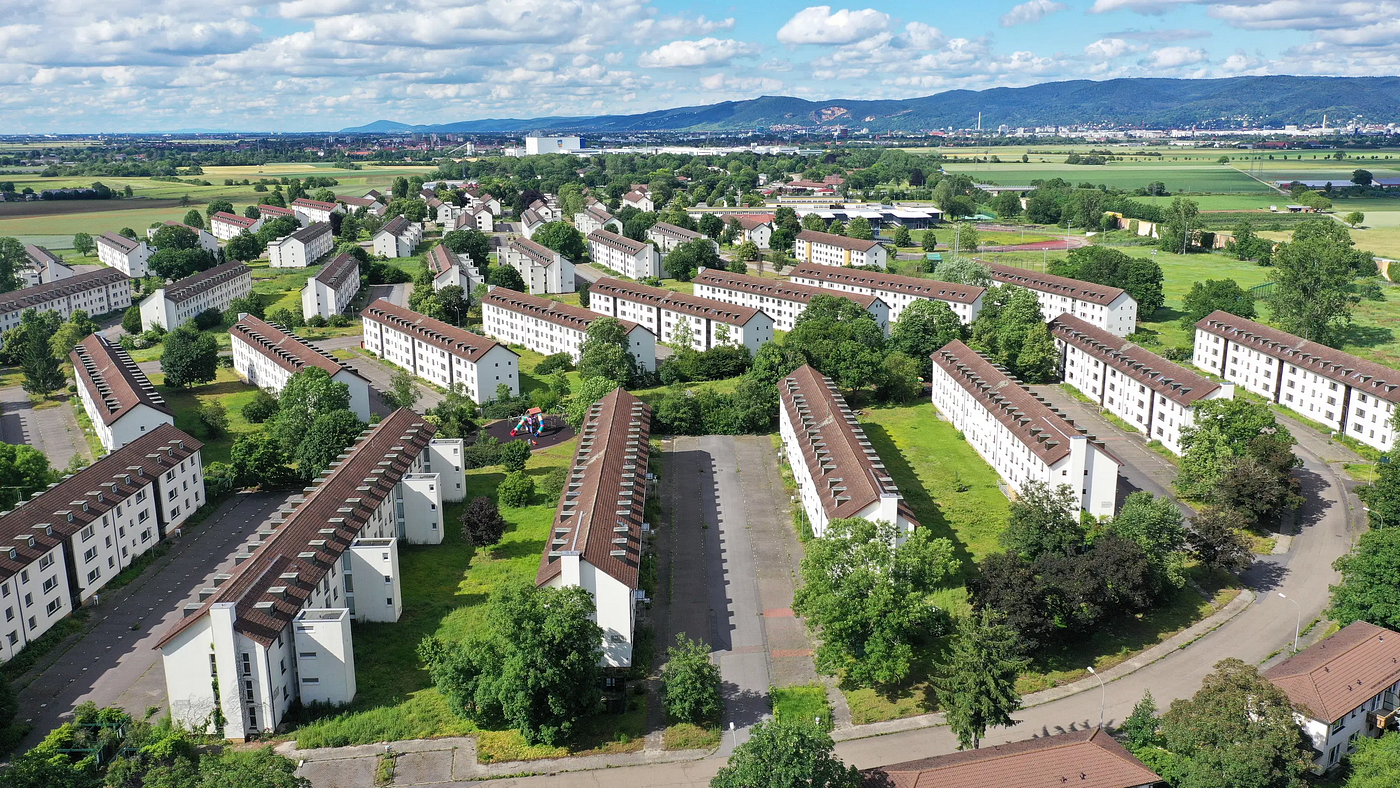
I’m telling this story not to clear my name, but to reclaim my life. To show that even in the aftermath of lies, there is still truth worth telling—and a man still worth knowing.
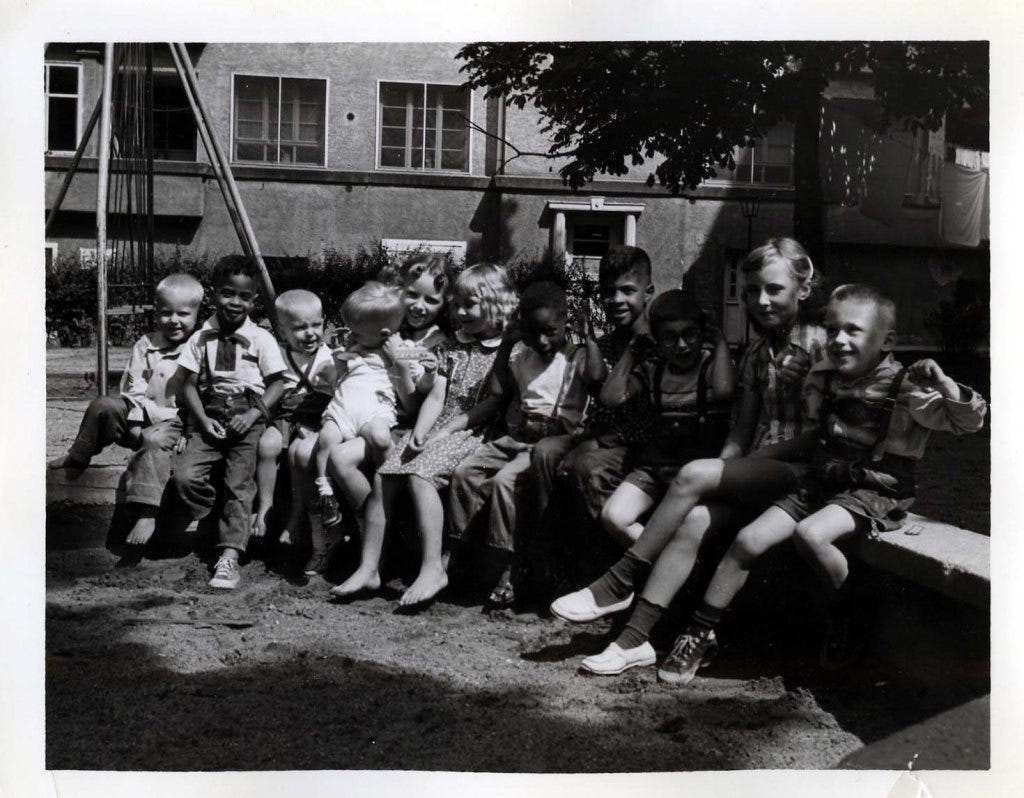
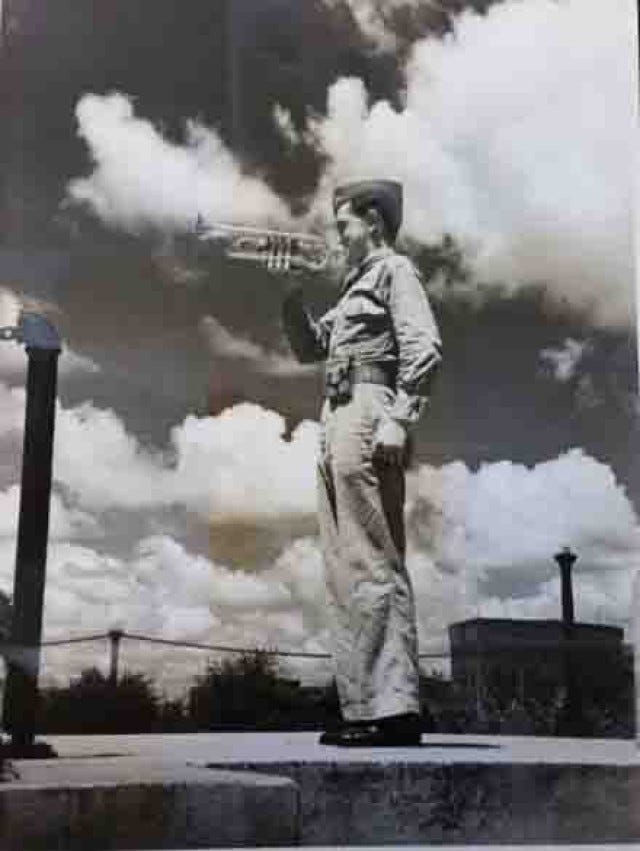
So read what follows with open eyes. And remember what my father said.

Home Page: Believe Nothing You Hear, and Only Half of What You See