Chapter 20: Junior Year at Notre Dame

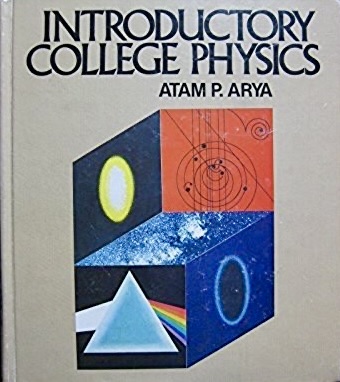
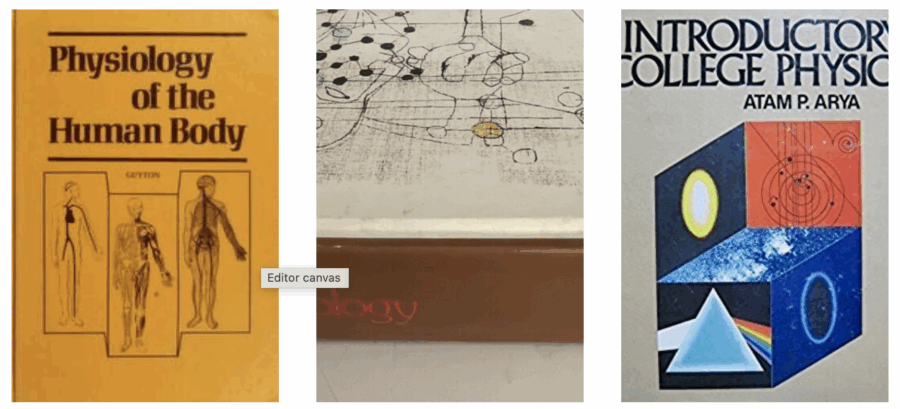
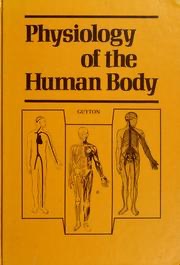
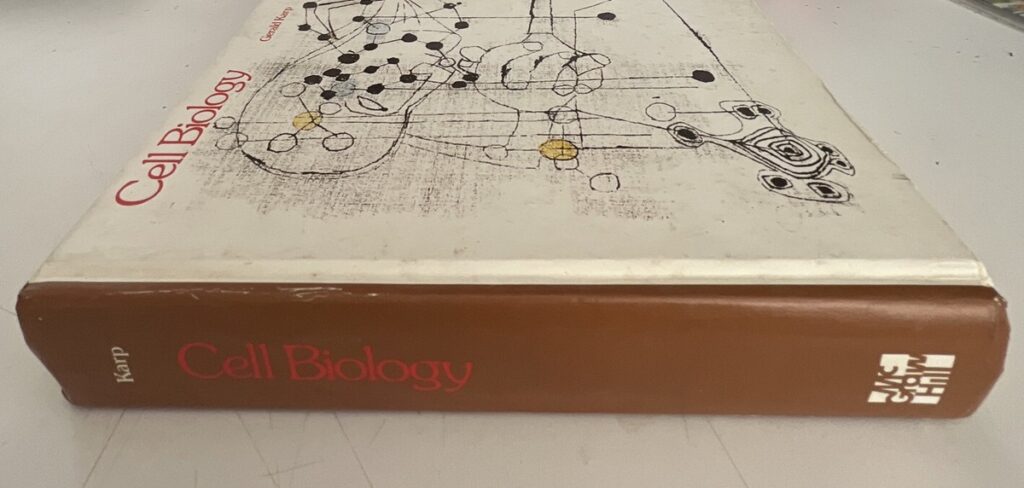
PreMed textbooks used at Notre Dame in 1979. Physiology of the Human Body. Cell Biology. Physics. Autobiography of Dr. Anthony J. Carbone

Believe Nothing You Hear, and Only Half of What You See — A memoir of Service, Shame and the Search for Truth

Return to Notre Dame

I flew back to Notre Dame on Saturday, August 25, 1979, ready to start my junior year at Notre Dame. I used to love flying into Saint Joseph County Airport [SBN] and catching a glimpse of the beautiful Notre Dame campus from the air before we landed. It was a gorgeous and peaceful home away from home.
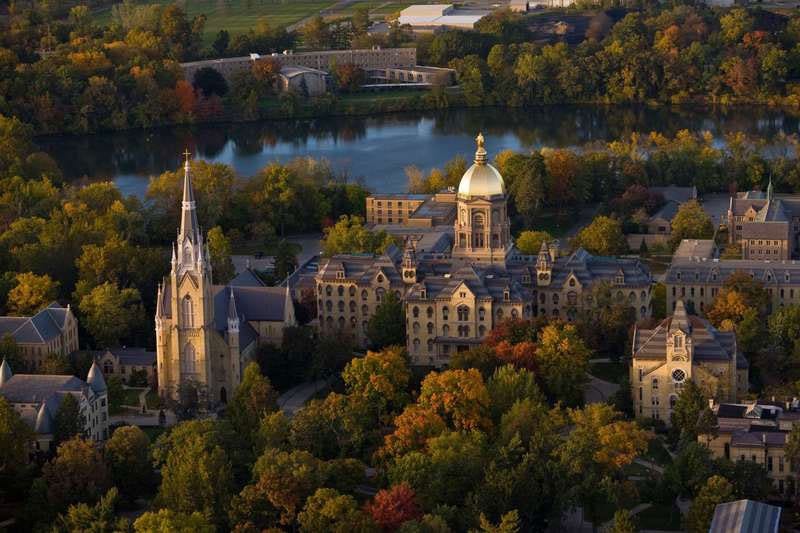
Aerial view of the University of Notre Dame du Lac campus showing the Golden Dome (Administration Building) and Sacred Heart Basilica.  Autobiography of Dr. Anthony J. Carbone.
Aerial View of the University of Notre Dame du Lac.

From the airport, I caught the shuttle into campus, the late-summer air still heavy with that Midwestern humidity. As soon as the shuttle rolled towards the familiar Golden Dome, it felt like the summer had been a quick intermission in the long play of my college life.

Back to Fisher Hall
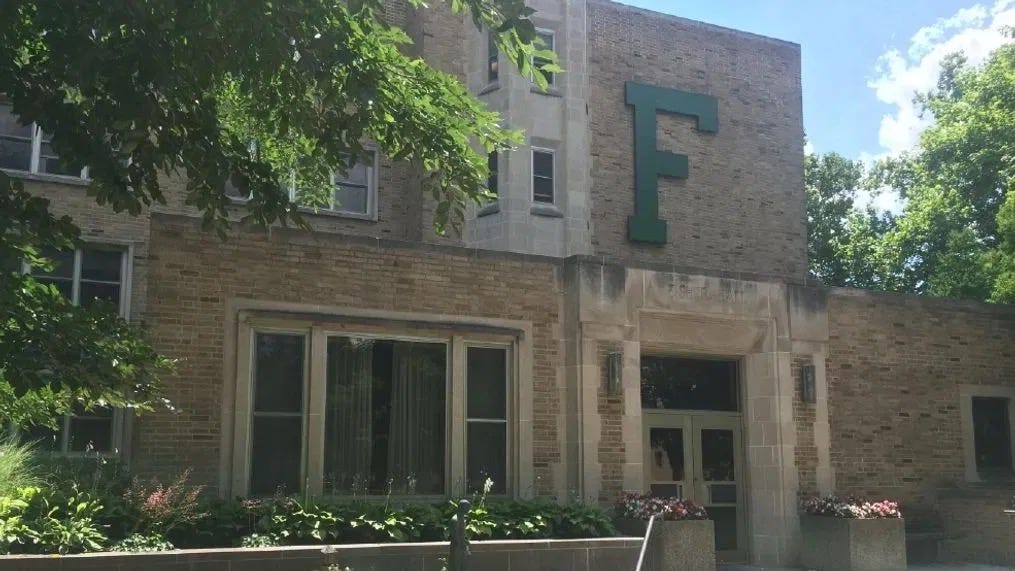
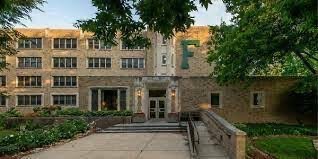
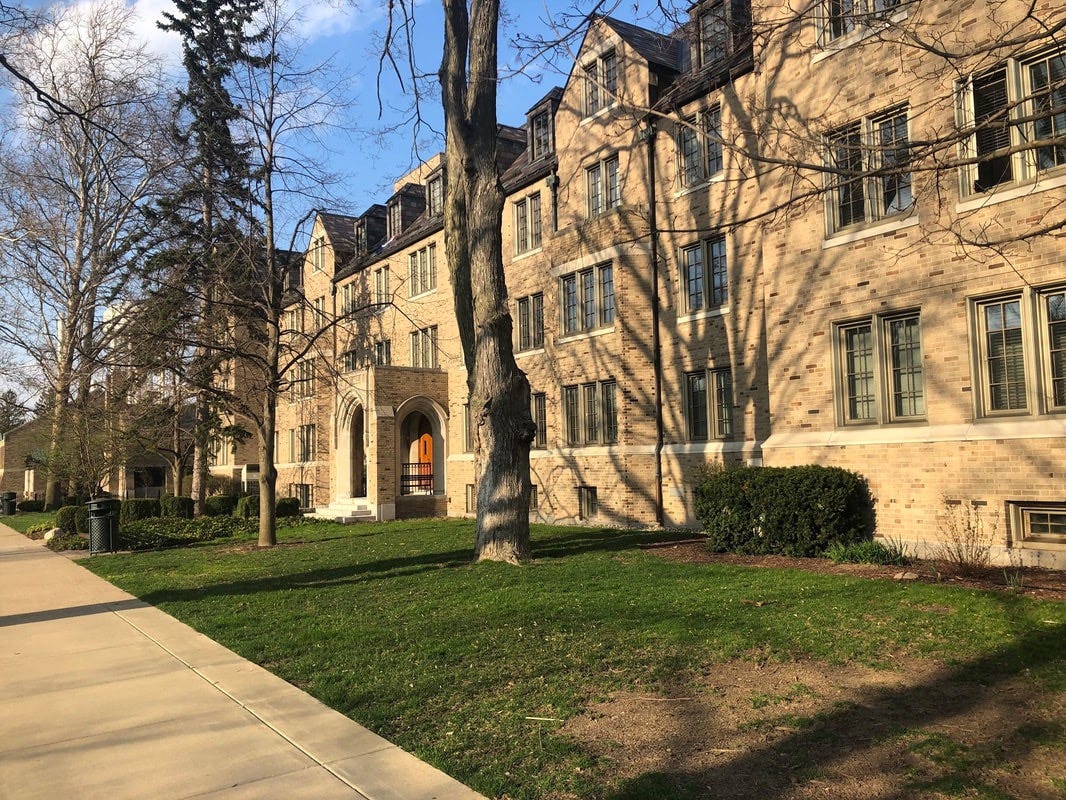
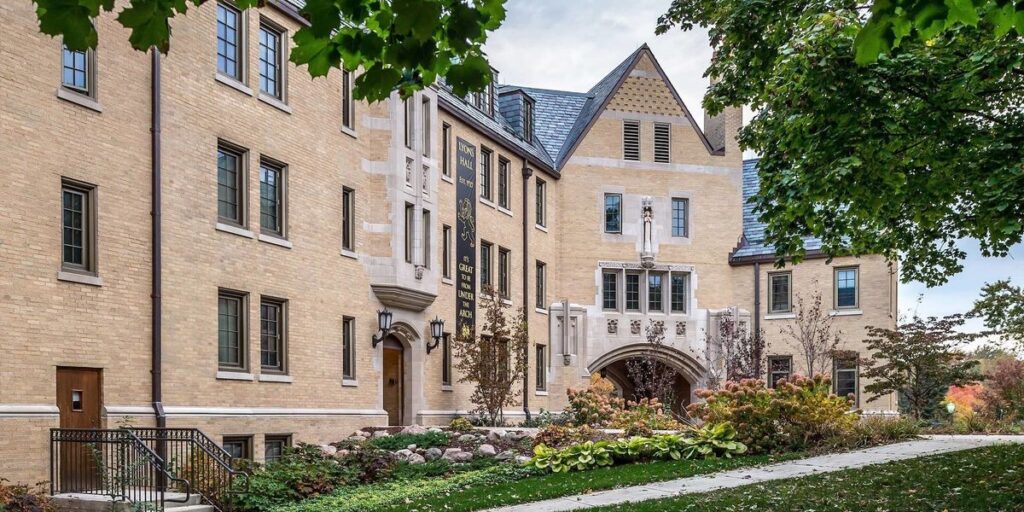
Photograph of Fisher Hall in the South Quad of the University of Notre Dame with its classic tan bricks and large green "F" for "Fisher".  Autobiography of Dr. Anthony J. Carbone.
Fisher Hall, University of Notre Dame

My stop was Fisher Hall. I hauled my bags upstairs, checked into my room, and — one by one — ran into the guys from my section. Same crew: Bob Terifay, Matt Bedics, Andy Cordes, Al Emory, Chris Kane, Scott Olds, Joe Delaney and the other cast of characters who made Fisher feel like a second home.  Voices bouncing down the hallway as everyone settled in. Doors stayed open — part welcome committee, part surveillance. B ecause you never knew who might wander by with a story from summer break.

New Fisher Section

I was curious about our new freshmen section-mates. I knew that I didn’t need to go scouting .  Bob was my go-to intel officer for dorm gossip. He already had the roster memorized. Mike Calhoun had graduated last May, so I was especially interested in meeting my next-door neighbor this year.

Before I unpacked, I made sure to find Mariann. I’d been guilty in the past of waiting too long to check in. I wasn’t about to make that mistake again. I’d wrestled for months with the idea of committing to only one girl through college, afraid it would somehow box me in. But somewhere over the summer, that resistance crumbled. I’d stopped trying to outthink it. The truth was simple: I was pretty sure I had already met — and was dating — my future wife. Knowing that was both comforting and, in a way, daunting. I could feel the weight of it even then, though in a good way.

I retrieved my belongings from storage and set up my room. There was something satisfying about putting my life back together in those four walls . Unpacking books and binders, stacking my ROTC gear in the corner, taping a few photos to the desk hutch. I was mentally gearing up for registration on Monday, August 27th, but I already knew my schedule.

First Semester 3rd Year Course Load

The first semester of junior year was shaping up to be another bruiser of a pre-med load. I had   seven classes in all. Three sciences: Physics (with yet another lab), Physiology, and Cell Biology. Military Science, this time under the daunting title “Advanced Leadership,” promised an extra layer of challenge. ROTC would be no joke this year. N ext summer I’d be heading to ROTC Advance Camp, the cadet equivalent of boot camp.
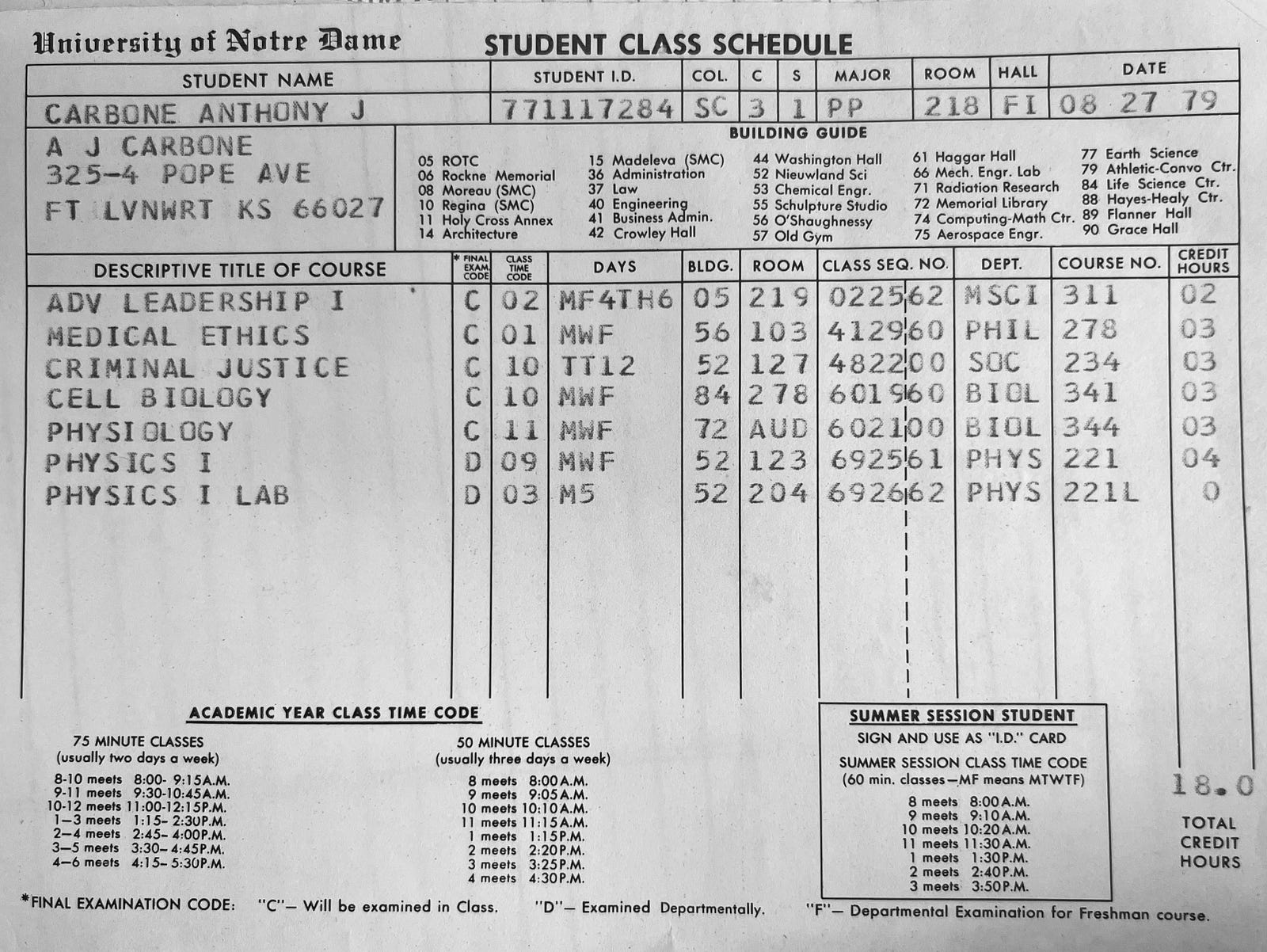
My course schedule for first semester of my Junior year at the University of Notre Dame during the 1979–1980 school season. Shows that I am signed up for Advanced Military Leadership (Military Science for ROTC), Physics I with Physics Lab, Physiology, Cell Biology, Criminal Justice and Medical Ethics.

The pressure was real. ROTC upperclassmen who had already survived Advance Camp loved to offer “helpful” tips. These were   usually in the form of horror stories about barracks life, 0430 wake-ups, daily physical training (PT), inspections, live-fire exercises, and tactical evaluations where a single mistake could tank your evaluation. I took it all in, knowing they were only half-exaggerating.

For balance, I had signed up for Medical Ethics. A philosophy course that sounded at least slightly more reflective, and Criminal Justice, which promised to be both practical and intriguing. Still, with that course list, “balance” might have been wishful thinking.

Fisher Hall had a way of keeping things light, though. In between the lectures, labs, and ROTC drills, there were late-night debates in the hallway, heading down to Food Sales. And restaurant runs into town. The girlfriends were back on campus and back at Fisher Hall. The camaraderie in our section was its own kind of fuel. We knew everyone was carrying their own load, but no one carried it alone.

Registration Day — Monday, August 27th

The South Dining Hall parking lot was already jammed when I got there. Inside, the long registration tables stretched down both sides of the hall like some kind of academic assembly line. Freshmen clutched schedules with deer-in-the-headlights expressions, upperclassmen darted from table to table, trying to swap a dreaded 0800 class for something more humane. But I was stuck with the standard Premedicine coure load. Army ROTC cadets like me had an extra layer of complexity — our schedules had to match drill times, leadership labs, and the occasional “voluntary” weekend field exercise that wasn’t voluntary at all.

I inched my way down the line, collecting my packet, verifying labs, and making sure my classes didn’t overlap with ROTC. It was chaotic, loud, and full of small reunions as friends spotted each other across the crowd. By the time I handed in my final card, I felt like the year had officially begun. The clock had started ticking, and the only way forward was head-on.

The year ahead felt big. Between the academics, ROTC, and my growing certainty about Mariann, I had the sense that the choices I made this year would echo far beyond South Bend.

Life with Mariann

Mari Moves Into Lyons Hall

Mariann and I saw each other every single day. She had moved into a new dorm, Lyons Hall, just across South Quad from Fisher, so we were practically neighbors. Most meals we ate together, drifting easily between the dining hall and the occasional off-campus bite. In the evenings, she’d come over to my room in Fisher to study, unless we decided on a change of scenery and headed to the library.
The guys in Fisher loved Mariann. She fit right in — kind, mellow, affable. She had a way of making everyone feel at ease, no games, no pretenses. Just honest and straightforward, with a sharp sense of humor that could disarm even the most sarcastic guy in the hall. My family already loved her, and I knew why. Being with her felt natural, effortless, like we’d been part of each other’s lives much longer than we actually had.

Fisher Food Sales & Oak Room

At night, we’d pool whatever cash we had and head down to Food Sales in the basement for something sweet or salty. That year, South Dining Hall opened a little late-night diner, called the Oak Room, a simple counter-service place that sold hamburgers, pizza slices and grilled cheese until closing. It became one of our go-to spots when studying had fried our brains and we needed a break.
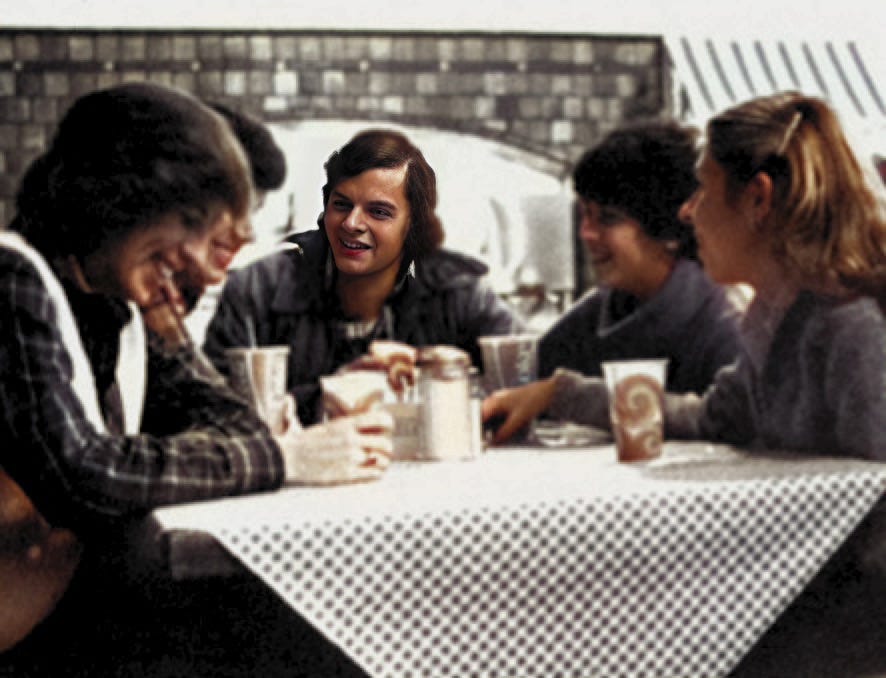
5 Notre Dame students sitting at a table drinking coffee and soda at the Oak Cafe in the South Dining Hall at night. University of Notre Dame. Autobiography of Dr. Anthony J. Carbone.
The Oak Room in South Dining Hall at Notre Dame

Jouneys Off Campus

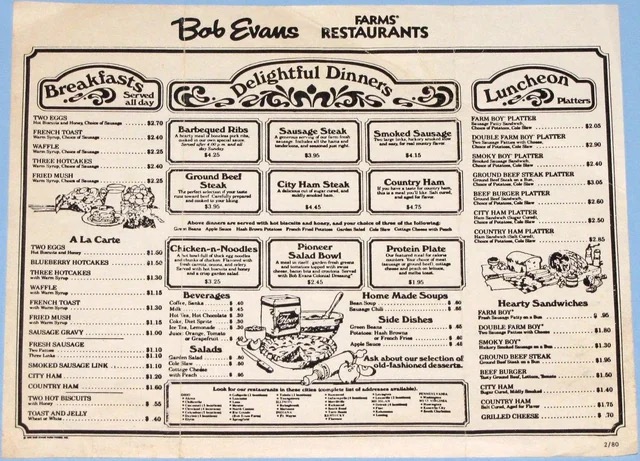
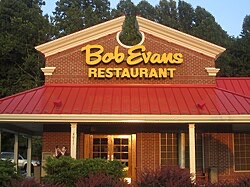
Weekends were for group outings. Our whole section would head off campus together, walking to one of the usual affordable restaurants that could handle a small mob of college students. One of our favortie stopping places was Bob Evans — it was a 3 mile walk from campus to the restaurant in Mishawaka, Indiana. It wasn’t fancy, but it didn’t need to be — those nights were more about the company than the menu.
Our Catholic Life

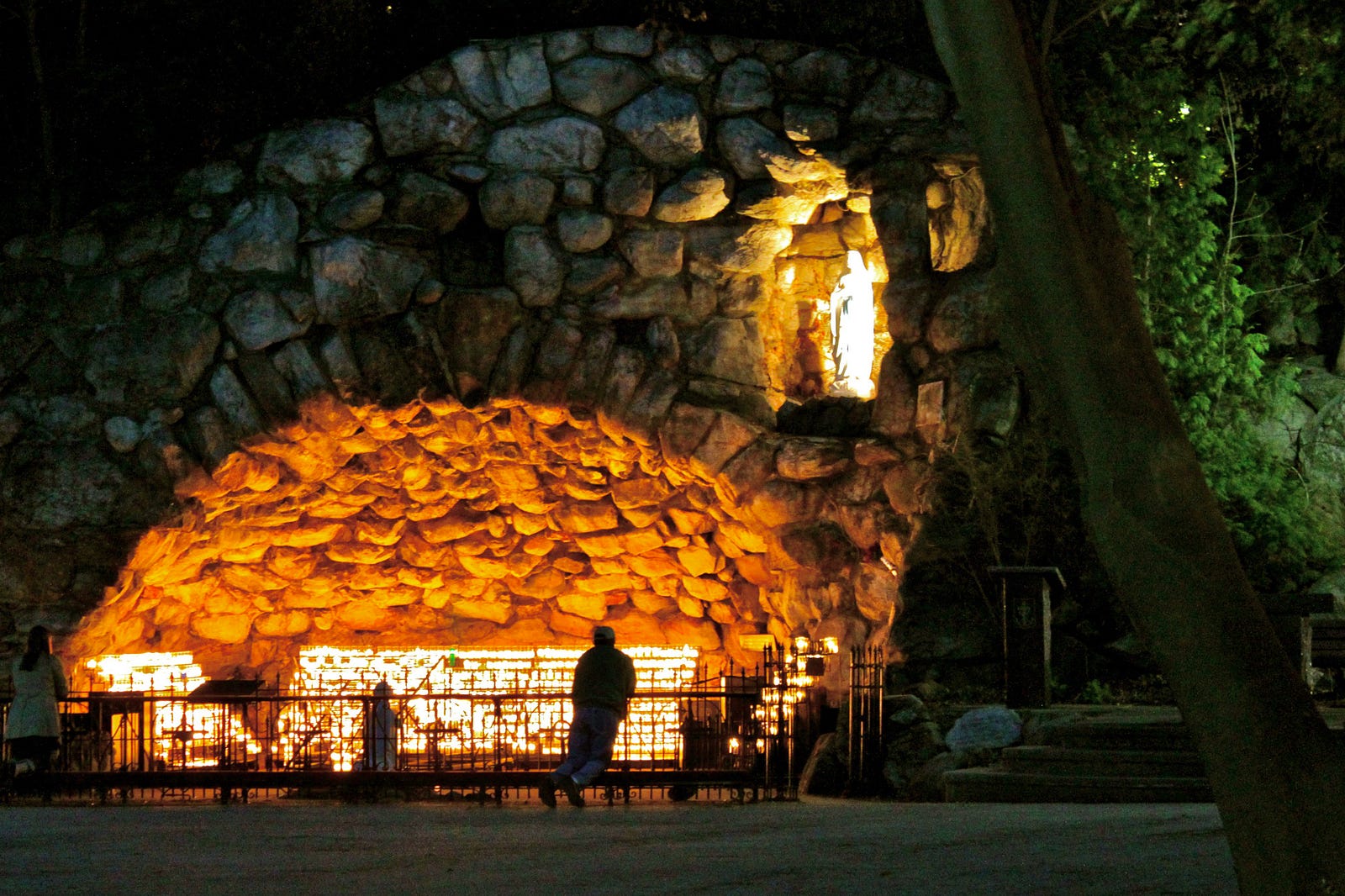
Mariann and I attended mass together nearly daily, since Fisher Hall had its own chapel and our rector was a priest. But we made the walk over to the grotto most nights to light a candle and pray. I was always begging God to help me with a test, a final grade, and eventually to get into medical school.
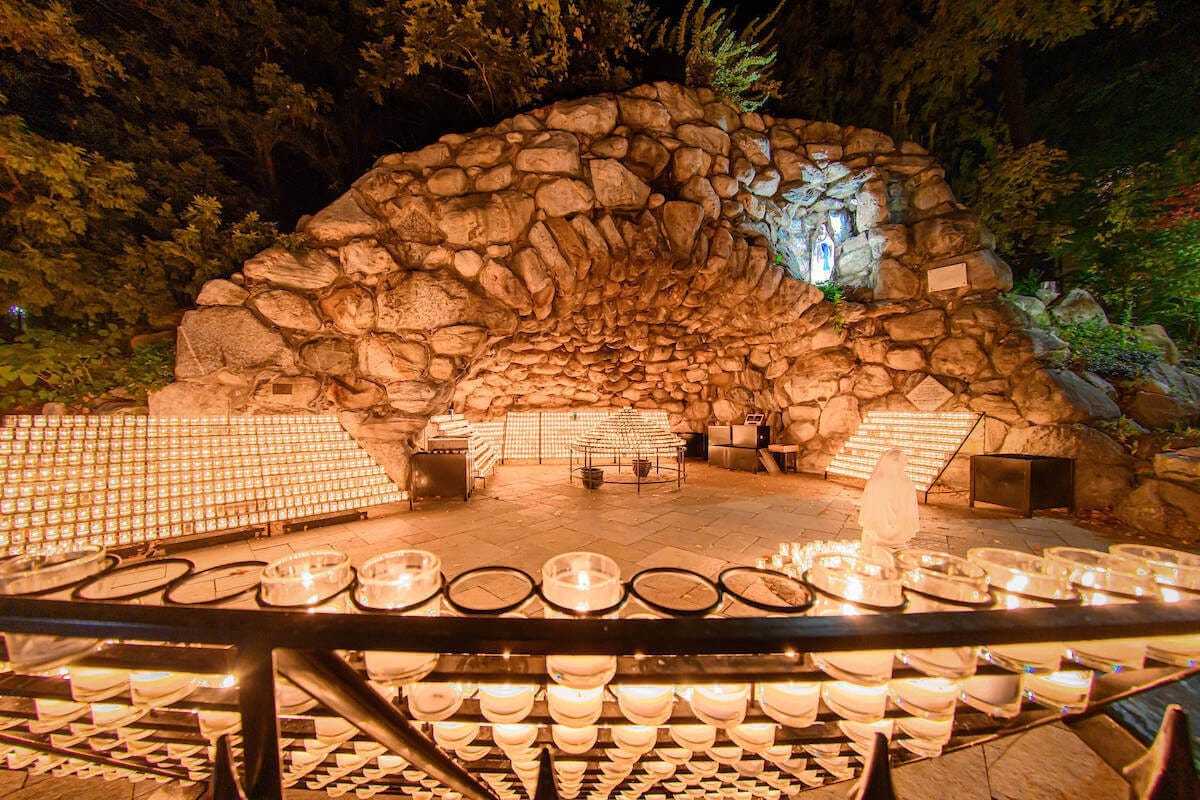
Photograph of the famous Grotto at the University of Notre Dame. Taken at night with all of the candles in the grotto lit. Autobiography of Dr. Anthony J. Carbone.
The Grotto at Night, University of Notre Dame

Fighting Irish Football Season

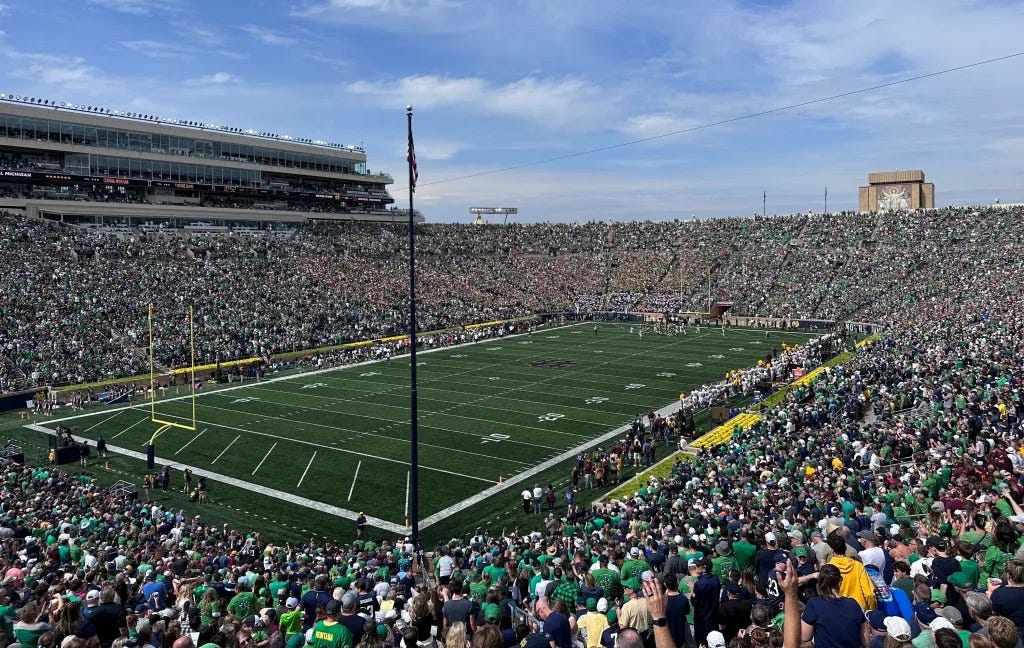
Then football season arrived. Game days transformed campus into a sea of blue and gold, with tailgates, marching band parades, and the buzz of 59,000 people heading toward Notre Dame Stadium. One of our favorite routines was watchng the Notre Dame Marching Band outside the stadium entertaining fans before the game.
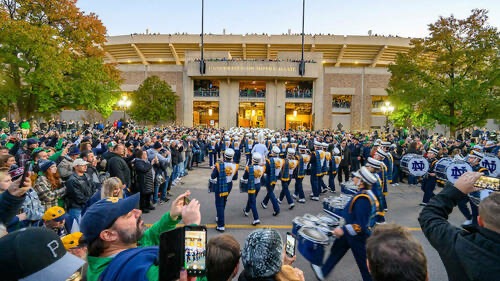
Photograph of Notre Dame Stadium with Notre Dame Marching Band and surrounding students.  Autobiography of Dr. Anthony J. Carbone.
Notre Dame Marching Band Heading into the Stadium
Notre Dame Stadium on Fighting Irish Football Game Day. Stands are packed with tens of thousands of students and fans. The libray with the mural of “Touchdown Jesus” can be seen in the distance. Autobiography of Dr. Anthony J. Carbone.
Notre Dame Stadium from the Freshmen Section View

My Fisher Hall Room

Life with Mariann gave me an anchor that fall, but I also needed a space of my own — a place where I could study, recharge, and make campus life feel more like home. By junior year, I had figured out how to do just that in Fisher Hall.
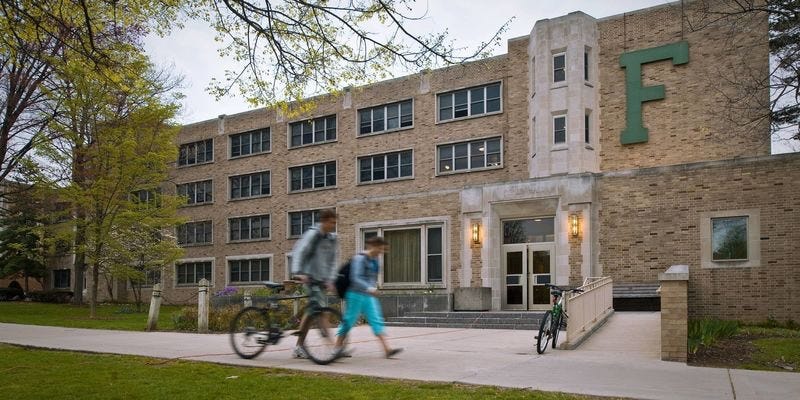
Photograph of Fisher Hall on the South Quad campus of the University of Notre Dame. With the famous big green “F” for Fisher on the front. Two students walking by, one holding onto his bicycle as they walk past the dorm. Autobiography of Dr. Anthony J. Carbone.


By the time I moved into Fisher as a junior, I felt like a seasoned pro at turning a bare dorm room into something that actually felt like home. I had a little extra money from working at the Boston law firm over the summer, so I invested in a few touches that made a big difference.

The first thing you noticed when you stepped inside was the wall-to-wall dark brown carpeting, which gave the whole room warmth. Dark wood shelves floated above my desk, stacked with books, binders, candles, photographs, and a few German beer steins I had kept from my time overseas. On the walls, I hung prints that carried me back to Germany — a sweeping scene of Rötenburg, a smaller one of the Bridge Houses in Bad Kreuznach — along with our old USA license plate from when we lived there.

In my Army ROTC fatigue uniform in my room at Fisher Hall, University of Notre Dame. Autobiography of Dr. Anthony J. Carbone. [Young Army ROTC cadet wearing olive drab fatigue uniform. In his college dormitory room. Floating shelves on wall filled with text books, notebooks, candles and souvenirs from Germany.]
In my Army ROTC uniform in my Fisher Hall room.

A few live plants and some dried eucalyptus gave off a scent that instantly reminded me of home. At the foot of my bed sat the television — the very same one Joe Montana once used to watch Johnny Carson and Saturday Night Live, usually with a plate of Toll House cookies my sisters had sent. It wasn’t just a dorm room; it was my retreat, and I spent long hours there studying late into the night.

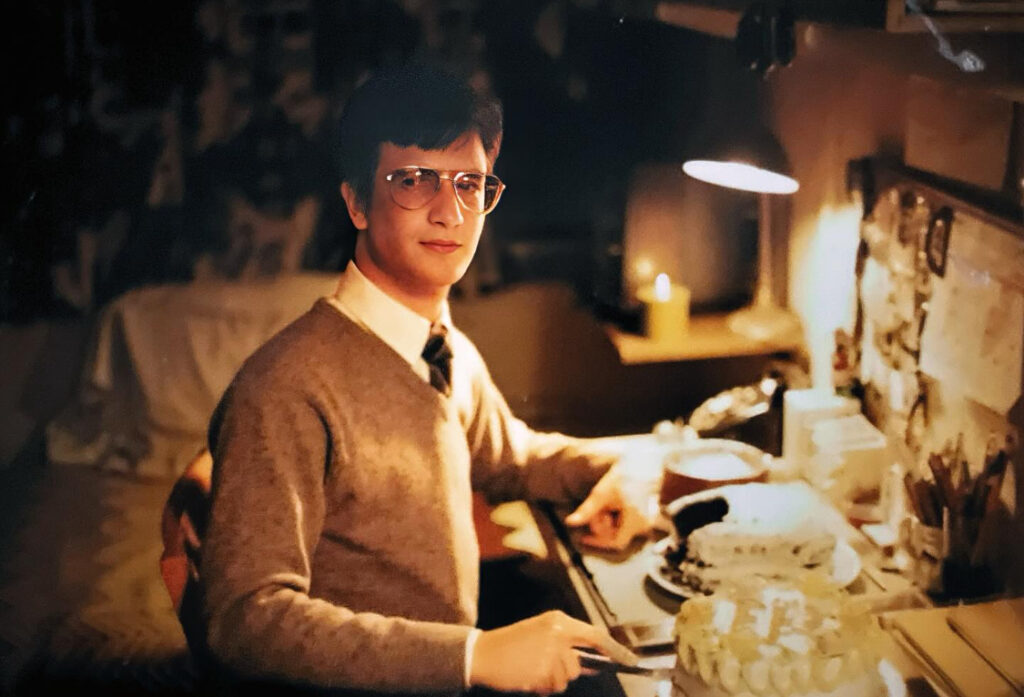
My dorm room at Fisher Hall on my birthday. University of Notre Dame. Autobiography of Dr. Anthony J. Carbone. [Student wearing glasses in white shirt and necktie wearing a grey V-neck sweater with two birthday cakes in front of him. Dormitory room with desk, lamp, bed, and small tv.]
At my study desk with my bed television at foot of bed.

Fisher Hall’s Interesting Residents

That little corner of Fisher became more than just a place to crash — it was where I read, studied, and let the stress of Notre Dame life fade away. It also became a private space for Mariann and me. She couldn’t spend the night there because of Notre Dame’s parietals, but we spent countless hours side by side studying, sometimes taking a break to watch television or heading down to Fisher Hall’s Food Sales in the basement for something to eat. Those moments made the room feel less like a dorm and more like the center of my life that year.

Our Amateur Announcer

Our section of Fisher Hall was full of colorful characters. There was a freshman who would hide in his room and narrate his life like a Notre Dame football game, and whenever the Irish scored, he’d turn on his sink faucet so the spray sounded like a cheering crowd.

Pickna

Then there was our resident druggie, Pickna. Pickna always wore a goatee and slim rectangular sunglasses indoors, probably to hide his perpetually bloodshot eyes. The stench of marijuana smoke always seaping ouf of his room. I have no clue what Pickna was studying at Notre Dame, but if I had to guess, he would be a philosophy major. If not, probably Abnormal Psych. It was difficult to ask him anything because his paranoia was out of control. 

Spiderman

I suppose others might have considered me “interesting” too, because I liked to climb up the brick façade of Fisher Hall like Spiderman. Looking back, it was incredibly dangerous, but at the time, I was young, reckless, and felt invincible. One night, I decided to take things up a notch. I climbed the back of Fisher Hall all the way to our second-floor level — which, to be clear, was three stories above the hard ground below. Then I edged sideways along the outside of the building from my window over to Pickna’s.

Inside, Pickna was smoking something in a glass pipe, an electric fan blowing out the window to mask the smell. I leaned toward the fan and spoke, letting my voice reverberate eerily: “Pickna, this is the Lord. Stop doing drugs!”
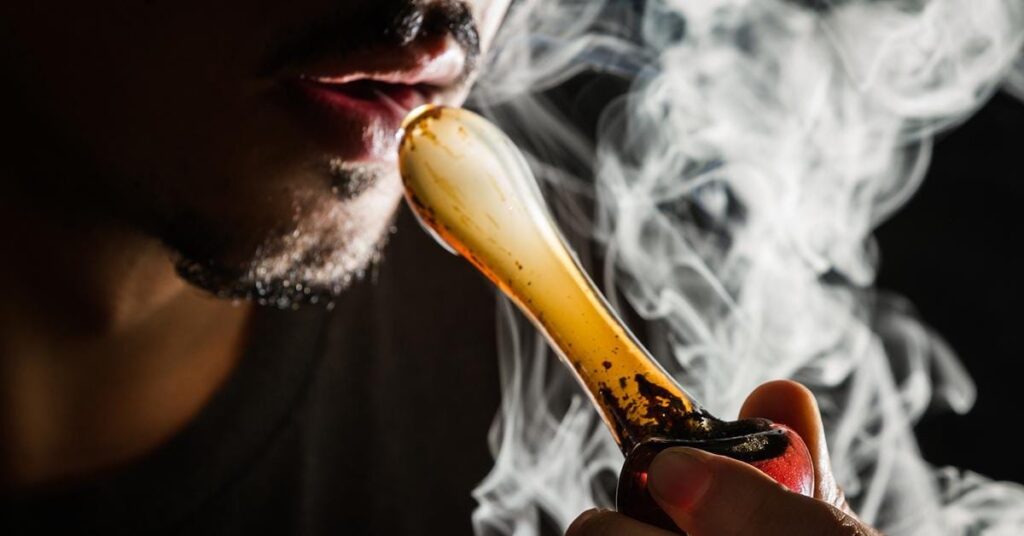
Photograph of man with goatee with a glass pipe smoking drug with smoke eminating from pipe. Autobiography of Notre Dame.

What happened next was instantaneous chaos. Pickna screamed, tossed his pipe into the closet, and bolted to the fan, trying to see what was happening. I climbed down the building as fast as I could and slipped back to our section just in time to watch Pickna running frantically up and down the hallway, still completely freaked out.

It was a reckless stunt, yes, but it was also a reminder that life at Notre Dame during those years could be equal parts absurd and unforgettable.

Third Year Pre-Medicine

As entertaining as life in Fisher Hall could be, it was time to turn our attention to the real work of junior year. Pre-med courses waited for no one, and our schedule was packed with Physiology, Cell Biology, and Physics, each with its own demanding laboratory. The labs were intense — long hours analyzing data, and running experiments that sometimes felt more like puzzles than science — but they were also thrilling, a glimpse into the kind of work that would shape our future careers.
Criminal Justice — or So I Thought

One of the electives I took that semester was listed as Sociology 234: Criminal Justice. I thought it would be a straightforward look at law enforcement, courts, and corrections — something I could connect to both medicine and ROTC. Instead, the course quickly turned into something else entirely.

From day one, it was clear Dr. J. Scott had an agenda. The required text, The Black Revolts, was his own work. The class wasn’t so much about the criminal justice system as it was a platform for his passionate lectures on race, restitution, and the Black liberation movement.
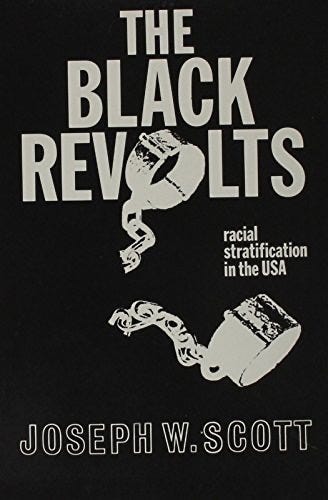
Photograph of the textbook, The Black Revolt, by Joseph W. Scott.  Textbook used by Notre Dame Criminal Justice Course in 1979,  Autobiography of Dr. Anthony J. Carbone.

He’d stride into the lecture hall and, without even a greeting, launch into fiery declarations about “the Black Revolt” and the moral obligation of America to make restitution to African Americans. I didn’t disagree with the need to address injustice, but I expected a sociology course — not a political rally.

One day, I decided to speak up. I raised my hand and asked, “Dr. Scott, when are we going to start learning about Criminal Justice?” That was all it took. He erupted: “You want to learn about Criminal Justice? I’ll tell you about Justice!!” What followed was an intense, almost shouted, explanation of systemic oppression, the legacy of slavery, and the absolute necessity of restitution.

What About our Native Americans?

I pushed back — not to be disrespectful, but because I believed in honesty and fairness. In front of nearly a hundred classmates, I said, “If the United States government really paid restitution to all African Americans, the U.S. Treasury would go bankrupt. And if you feel so strongly about restitution, shouldn’t we start with Native Americans? That alone would break the Treasury.”

The room went silent. What followed was an uncomfortable standoff of ideas — his voice loud, mine steady. I suppose I was lucky to walk away with a “C” for the semester.

Army ROTC

After a full day in lecture halls and labs, it was straight to Army ROTC — Advanced Leadership. The work there was equally demanding, a mix of classroom instruction, leadership exercises, and tactical problem-solving designed to prepare us for Advanced Camp that summer. The thought of that cadet “boot camp” hung over us like a shadow; we trained and planned constantly, testing ourselves physically and mentally, knowing the summer would be both exhausting and transformative.
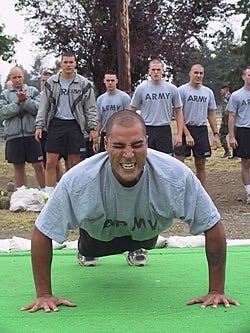
Photograph of an Army ROTC cadet doing pushups while a group of cadets watch.  Autobiography of Dr. Anthony J. Carbone.

Fighting Irish Football

Even with academics and ROTC dominating my days, Notre Dame’s heartbeat — the Fighting Irish football season — remained impossible to ignore. The campus would erupt every Saturday, and it seemed no matter how intense our schedules became, we always found a way to follow the games. Whether listening in dorm rooms, sprinting to the radio, or braving the crowds at the stadium, football tied us together. It offered a rhythm to the chaos, a chance to cheer, to celebrate, and occasionally to commiserate — all part of the full Notre Dame experience.
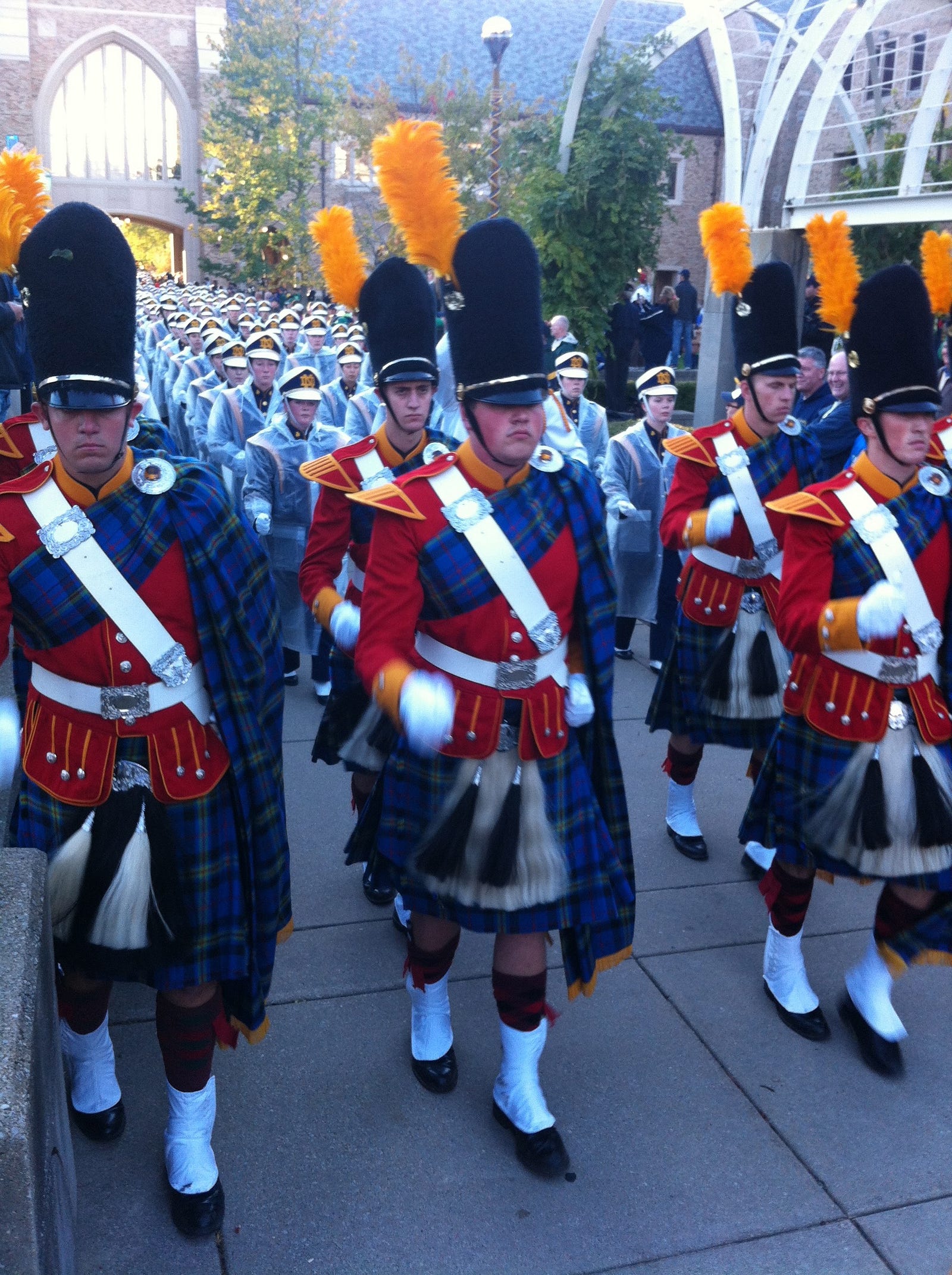
University of Notre Dame Irish Guard in red jackets and plaid kilts leading the Notre Dame Marching Band to the Stadium on Game Day. Autobiography of Dr. Anthony J. Carbone

Game days in were a ritual of tradition. Mariann and I always started with the pre-game festivities — meeting up with the Fisher Hall gang to watch the Fighting Irish Marching Band thunder across campus, brass gleaming in the afternoon sun, drums rattling through the crowd. The energy was contagious as the whole campus seemed to sway toward Notre Dame Stadium. We were always on the lookout for our Fisher Hall underclassman who made the Irish Guard squad.

From there, Mariann and I would walk hand in hand through the sea of blue and gold until we reached the gates, where we had to split for our assigned student sections. I sat with the junior section from Fisher Hall — Bob Terifay, Matt Bedics, Andy Cordes, and Al Emory right by my side — while Mariann headed into the Lyons Hall seats.
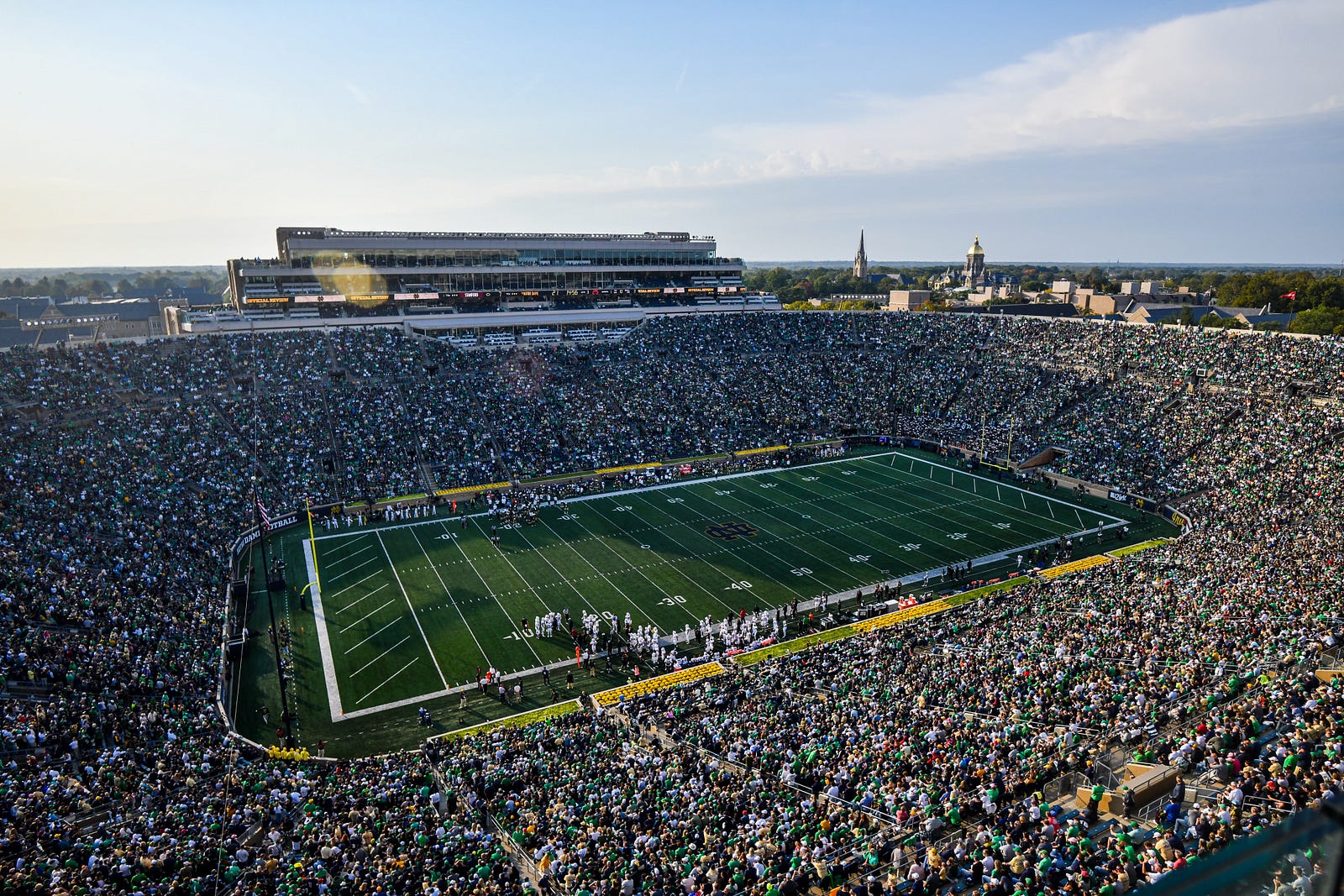
Notre Dame Stadium packed with students and fans.  Football on the sidelines.  Golden Dome in the distance.  Autobiography of Dr. Anthony J. Carbone.

After Game Meeting

Hooking back up after the games wasn’t simple in those days before mobile phones and texting. We had to plan our rendezvous ahead of time — picking a specific spot and hoping the crowds didn’t swallow us up. Sometimes it took longer than expected, but we always found each other eventually, usually with a mixture of relief and laughter.
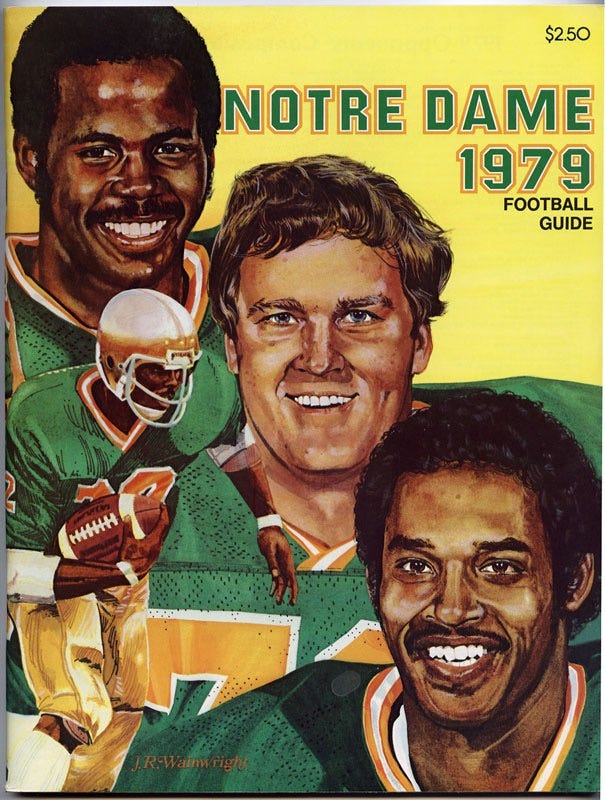
Notre Dame 1979 Football Guide.  Autobiography of Dr. Anthony J. Carbone.

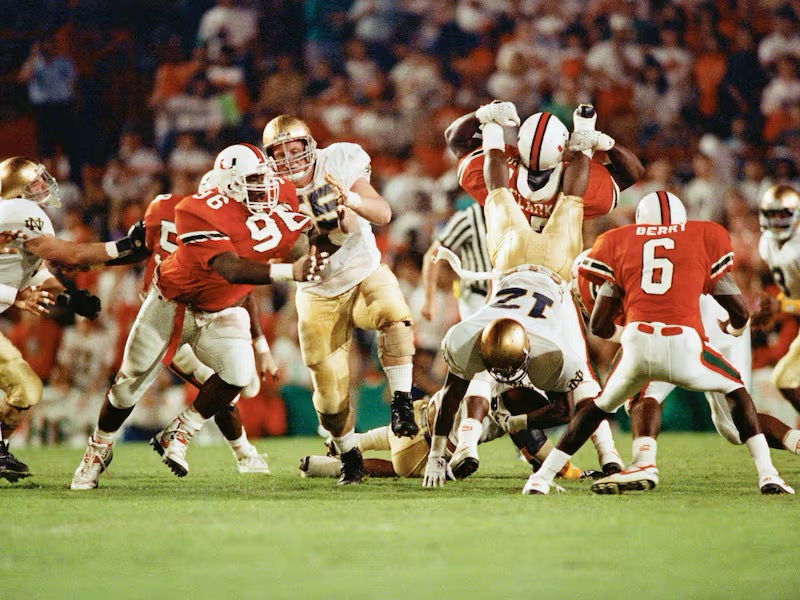
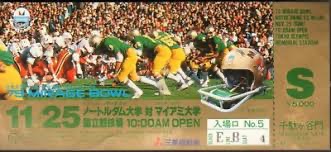
On the field, the Irish finished 7–4 under Coach Dan Devine. Highlights included the 12–10 upset at Michigan, sealed when Bob Crable leaped high to block a last-second field-goal attempt, and home wins over Michigan State (27–3), Georgia Tech (21–13), South Carolina (18–17), and Navy (14–0). But tough losses to Purdue, USC, Tennessee, and Clemson kept Notre Dame out of the bowls that year. The season ended on a brighter note with a trip to Tokyo for the Mirage Bowl, where the Irish defeated Miami, 40–15, closing out the season on a high.
Fall Final Examinations and Christmas Break

Once again, fall final examinations came before I was ready. Finals stretched from December 15th through the 20th, and, as seemed to happen every semester, I drew one on the very last day. When I finally walked out of the exam hall, drained and foggy, I caught a flight straight to Boston to meet my family for Christmas at Nana and Papa’s house in Medford.

Like the previous two years, I can’t remember much about Christmas Day itself — I was still in that post-final haze, too worn out to soak in the holiday. What I do remember vividly is that Papa Pietrantoni had been admitted to the hospital with pneumonia. Each day, I made the trip to see him, sitting by his bedside in the sterile, antiseptic ward that seemed so out of place for someone so full of life.

On January 2nd, our family packed into the car and drove from Boston down to Carlisle Barracks, Pennsylvania, where my father was attending the U.S. Army War College.
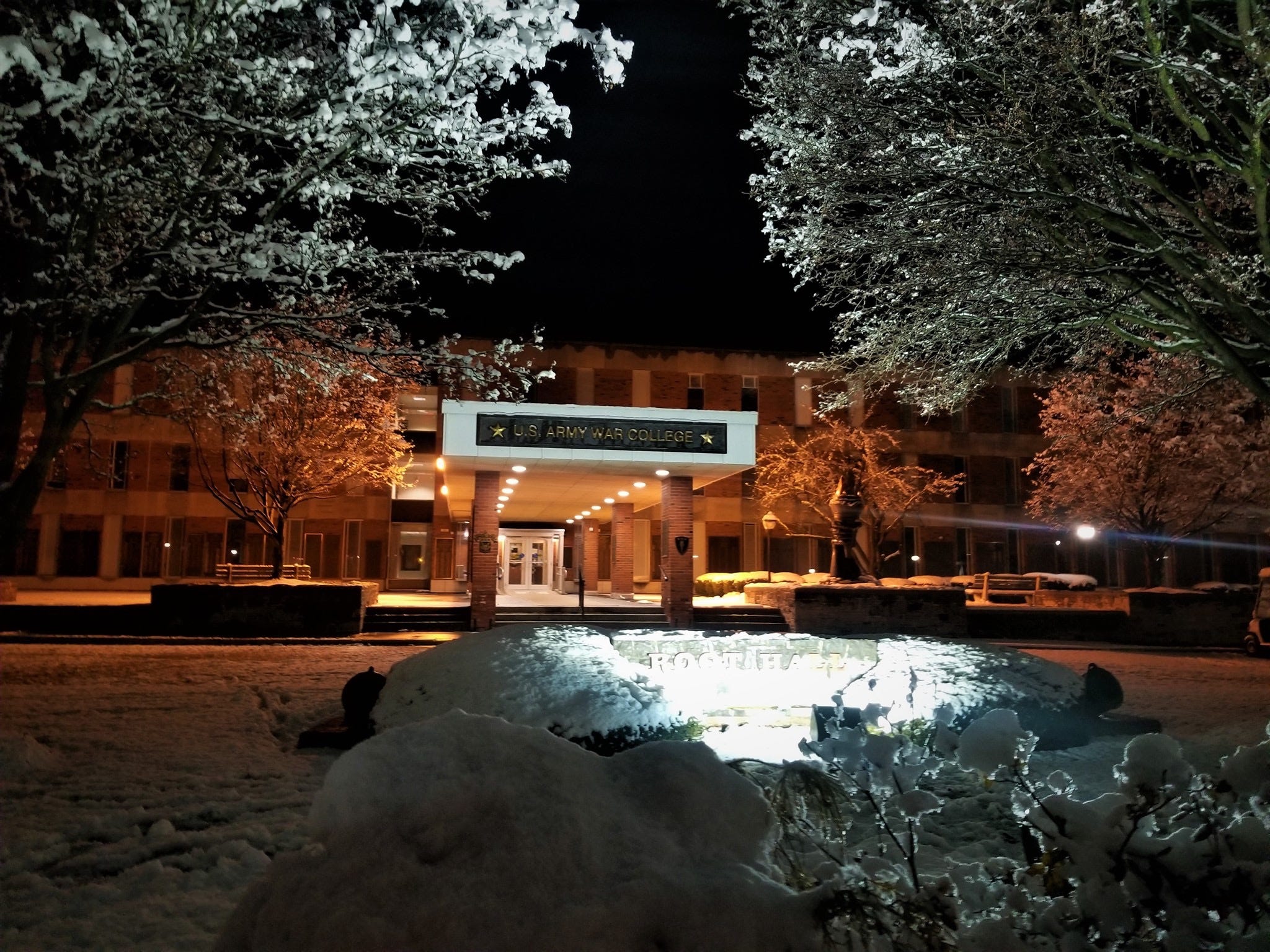
U.S. Army War College at Carlise Barracks, Pennsylvania in winter.  Autobiography of Dr. Anthony J. Carbone.

A week later, on January 9th, 1980, Papa Pietrantoni passed away. We returned immediately to Medford for his funeral, the weight of grief mixing with the cold New England winter. Before long, it was time to make the return trip to Carlisle Barracks, just in time for me to gather myself and head back out to Notre Dame.

Travel from Carlisle to Notre Dame — January 1980

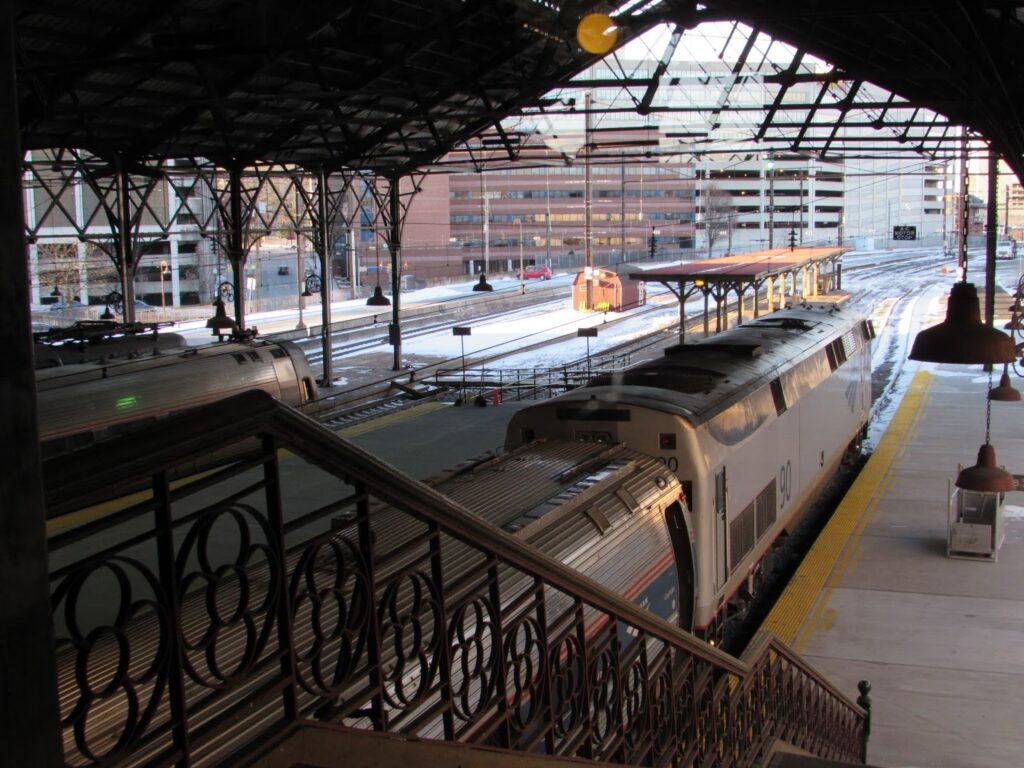
I think it was January 13, 1980, when it came time to return to Notre Dame for the spring semester. My parents and sisters drove me to the Amtrak station. Just before I boarded, I hugged them goodbye, and my mother pressed a five-dollar bill into my hand “for the trip.” Even in 1980, five bucks didn’t stretch far on a cross-country journey, but I took it gratefully.
Amtrak to Chicago

Though I had taken plenty of train rides in Europe, this was my first trip on an American Amtrak. It felt different — bigger, looser, more unpredictable. I found my assigned seat, a wide recliner by the window, and settled in. A few minutes later, an attractive woman — early 30s, with light red hair, blue eyes, and a lilting Irish accent — sat down beside me. She introduced herself as “Miss Brianna,” a schoolteacher on her way to Chicago. When I mentioned I was a student at Notre Dame, she seemed to know more about the place than I did.
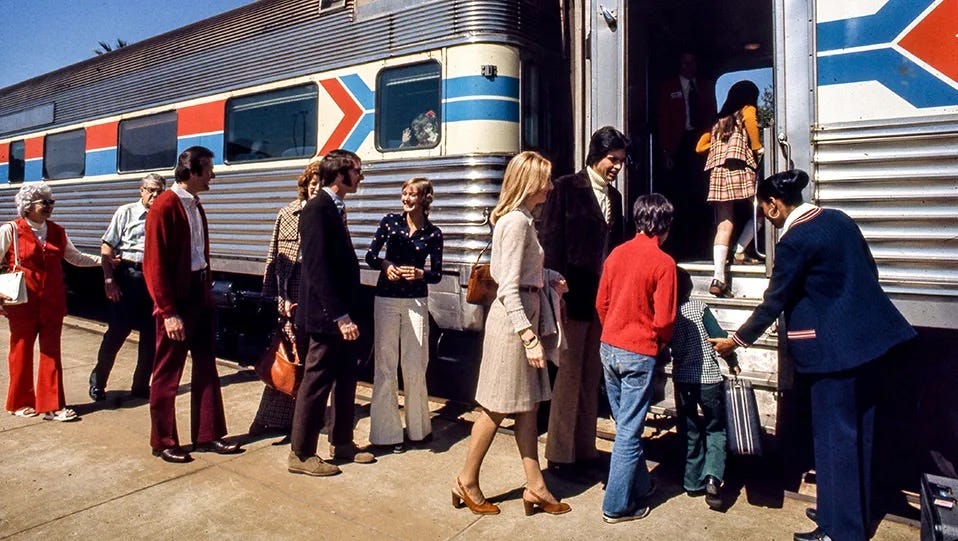
Photograph of passengers boarding an Amtrak passenger train circa 1980.  Autobiography of Dr. Anthony J. Carbone.

I asked how long the ride would take. She laughed. “Oh, American trains aren’t as reliable as they are in Europe. Expect anywhere from 19 to 24 hours, especially with snow in the forecast.” I groaned. “I don’t think I can sit here for 24 hours straight.” Her laugh was musical. “Silly boy! These are only our assigned seats. We won’t be spending much time here.”
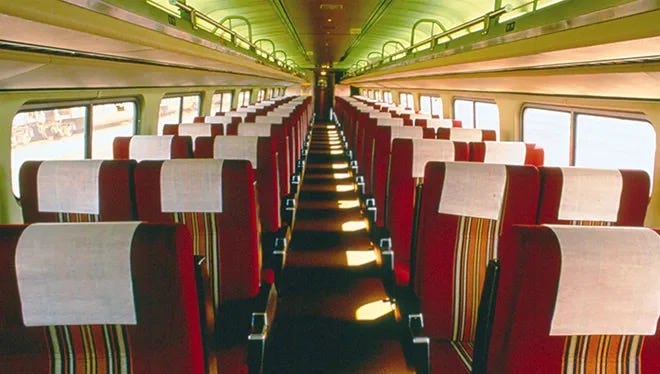
Photograph of an empty Amtrak passenger car (2x2) circa 1980.  Autobiography of Dr. Anthony J. Cabone.

The Observation Car

After the conductor punched our tickets, she led me to the Observation Car, where we sat among the floor-to-ceiling windows and watched the winter landscape glide by in snowy silence. Soon, she asked if I was hungry. I admitted I was, but sheepishly confessed my mom had only given me five dollars. That made her laugh even harder. “Well, that won’t get you far on the rails. Dinner’s on me.”

The Diner Car
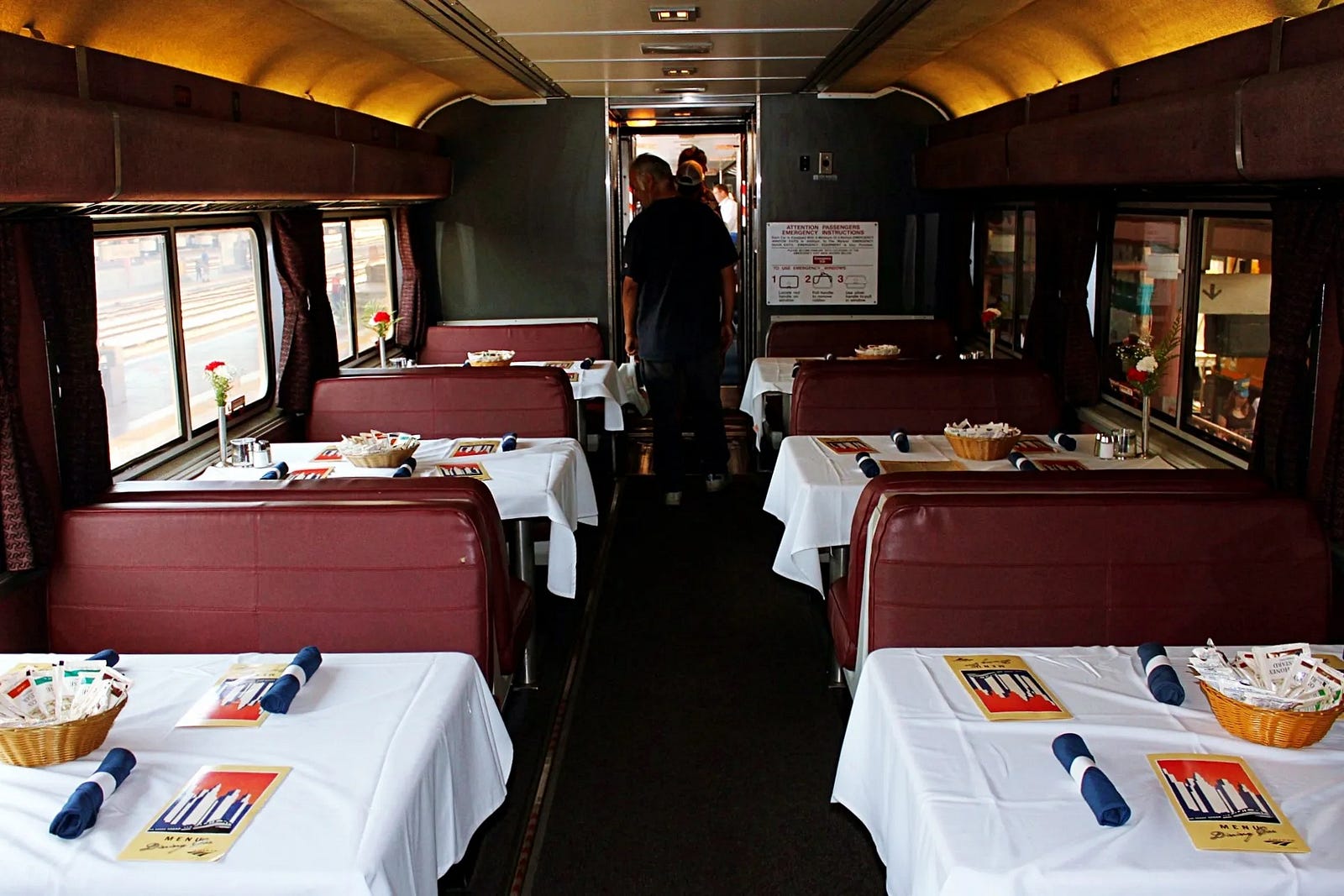
Photograph of an Amtrak diner car circa 1980.  Autobiography of Dr. Anthony J. Carbone.

The Dining Car was charming — white tablecloths, real silverware, waiters in uniform. We sat at a booth, soon joined by a man and then a striking young blonde woman. Conversation began politely enough, until the man suddenly asked her, “Are you married?”
She smiled. “Yes, but we have an open relationship.”
Without hesitation he asked, “Do you have a sleeper car?”
She nodded. “I do.”
“Would you like to show it to me?”
She giggled. The two of them stood up and walked out without another word. I sat there, stunned.

Miss Brianna elbowed me. “You, Spanner! You missed your chance to sleep with her! You’re too slow!” I was completely floored. Still a virgin and utterly naive about “swinger” culture, I could barely process what had just happened.

The Lounge Car

But I wasn’t disappointed. Dinner with Miss Brianna was more than enough for me— she was witty, warm, and full of charm. Afterward, she led me to the Lounge Car, where we joined a group of older men playing cards. She asked if I knew Pinochle. I didn’t. “No worries,” she said. “Just sit, Lad, and watch me.” She played brilliantly, bantering easily with the men, while I sat there wishing she were younger — or I were older.
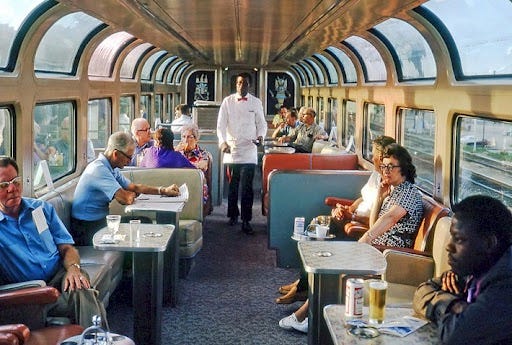
Photograph of a filled Amtrak Lounge Car with a waiter in white.  Autobiography of Dr. Anthony J. Carbone.

$5 to Travel

At one point, snow stopped the train cold. We were stranded. Miss Brianna stood and, with mock drama, introduced me to everyone in the Lounge Car: “This is Anthony. He’s on his way back to Notre Dame to study. His poor mother only gave him five dollars for the whole trip! Can you believe that?!” The men roared with laughter — and then began buying me beers, sodas, and hot dogs. I ended up with a small feast and the warm cheer of newfound friends.

Arrival at Union Station

Hours later, Miss Brianna announced, “Mr. Anthony, it’s time we return to our seats for a little rest.” We curled up under a shared blanket, sleeping in our chairs until the train finally pulled into Chicago Union Station. When it came time to part ways, she gave me a hug and a kiss on the cheek, then pointed me toward my connection to South Bend.
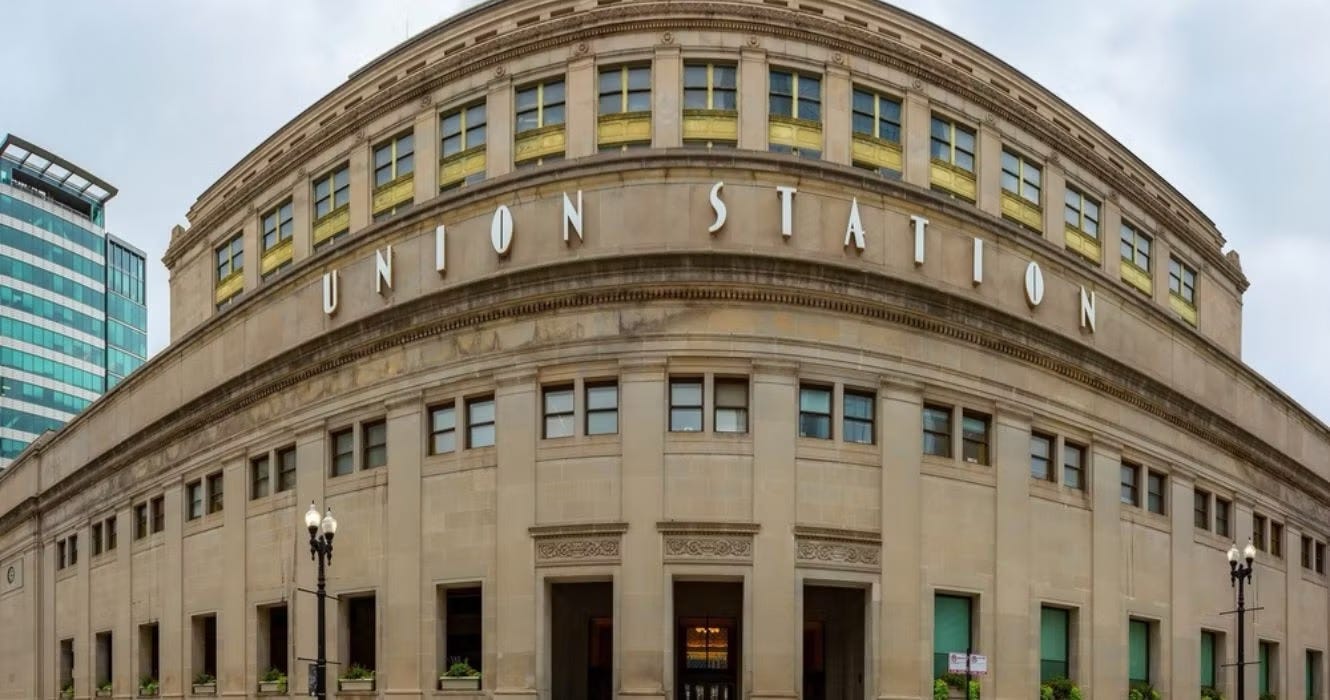
Photograph of Union Station in Chicago circa 1980.  Autography of Dr. Anthony J. Carbone.

South Bend Railroad

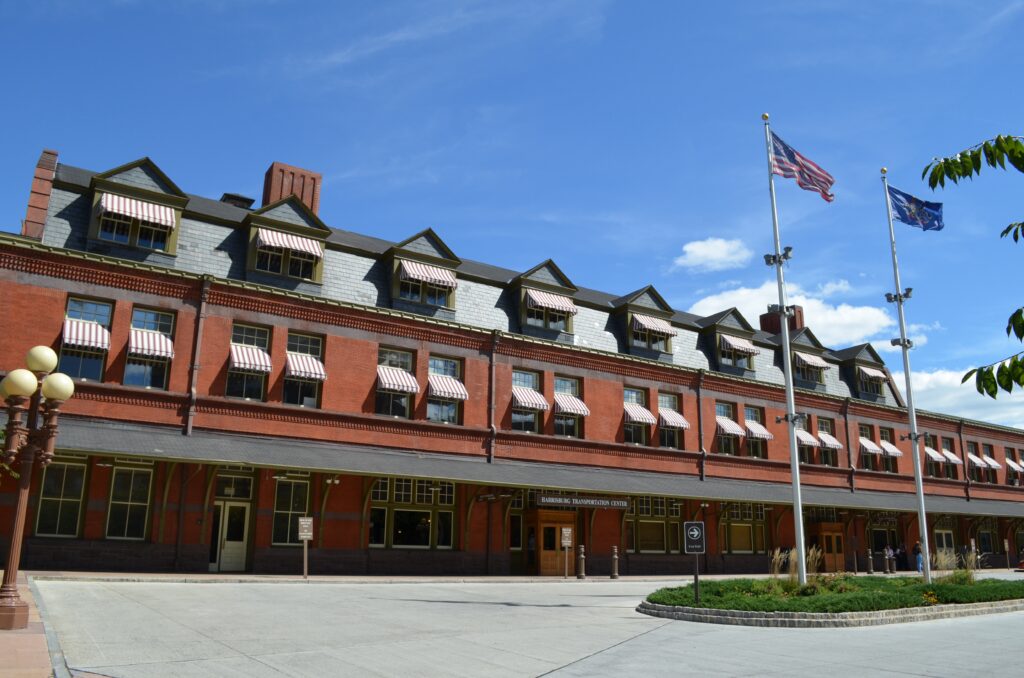
I transferred to the Chicago, South Shore and South Bend Railroad (CSS&SB) back to South Bend. And then rode a taxi back to the Notre Dame campus. The Amtrak trip from Harrisburg to Chicago remains the most memorable train ride of my life.
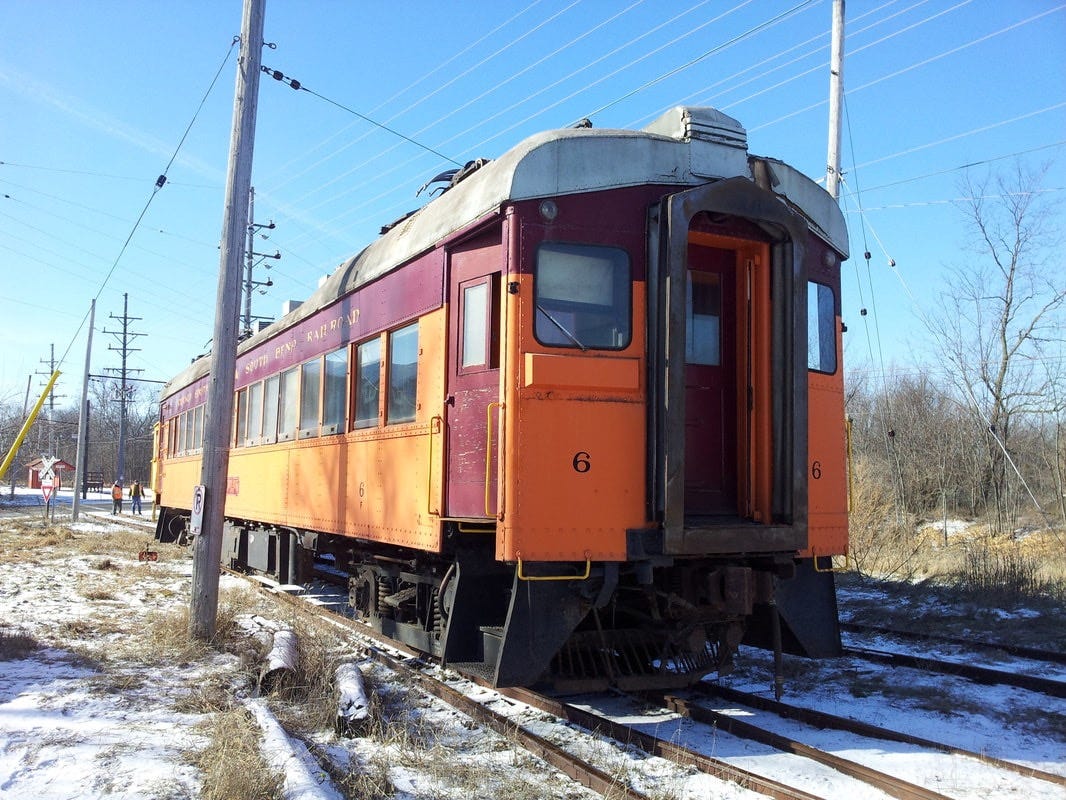
South Shore and South Bend Railroad (CSS&SB) passenger train car.  Autobiography of Dr. Anthony J. Carbone.

Return to Fisher Hall

When I returned to Fisher Hall for the spring semester, the first thing I did was look for Mariann. In the meantime, I ran into the Fisher Hall gang and we caught up on Christmas break. Everyone had stories about their favorite Christmas gift, while I shared the sad news of my grandfather’s passing and the unusual Amtrak ride I had taken back to Chicago.

Spring Semester Registration

Registration day came on January 15, 1980, and with it, the realization that this semester was going to be another uphill climb. The load was slightly lighter than in the fall — only two heavy science courses — but Biochemistry and Physics II with lab were no joke. They dominated my study time.
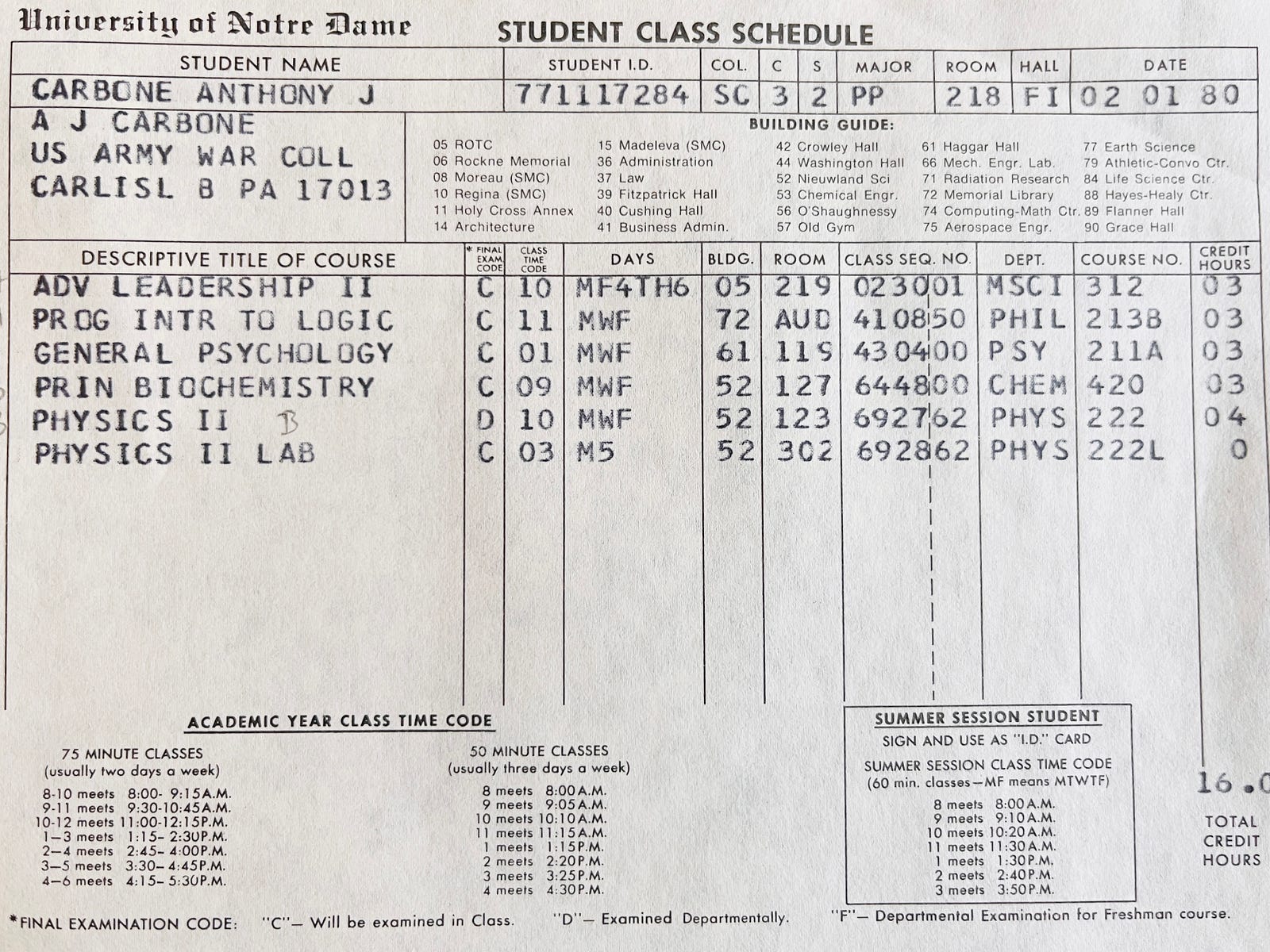
University of Notre Dame Student Class Schedule from Spring 1980 (my Junior year) listing Physics II with Lab, Biochemistry, General Psychology, Intro to Logic and ROTC Advanced Leadership.  Autobiography of Dr. Anthony J. Carbone.

My Electives

To balance them out, I had two electives: Philosophy 213B — Introduction to Logic, and General Psychology. I took Logic with Mariann, and she was a natural at what was then called “Symbolic Logic.” She could take a word problem and effortlessly break it down into letters and symbols to solve it mathematically. I had to work harder at it, but I managed an A in the course too.

Army ROTC

Of course, Military Science 312 — Advanced Leadership II — was always in the background. ROTC drill was as demanding as ever, with our instructors preparing us relentlessly for ROTC Advanced Camp that summer. It was clear that the semester would be split between my growing relationship with Mariann, the Fisher Hall camaraderie, long hours in the library, and the serious business of becoming Army officers.

Fighting Irish Basketball — Spring 1980

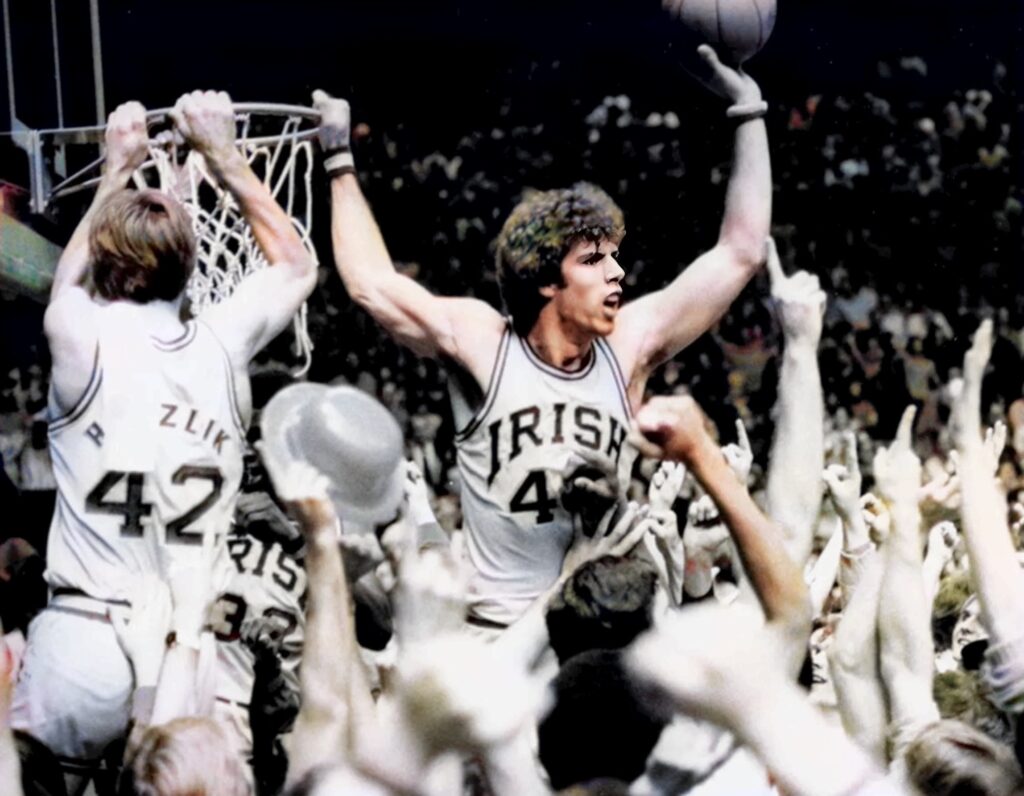
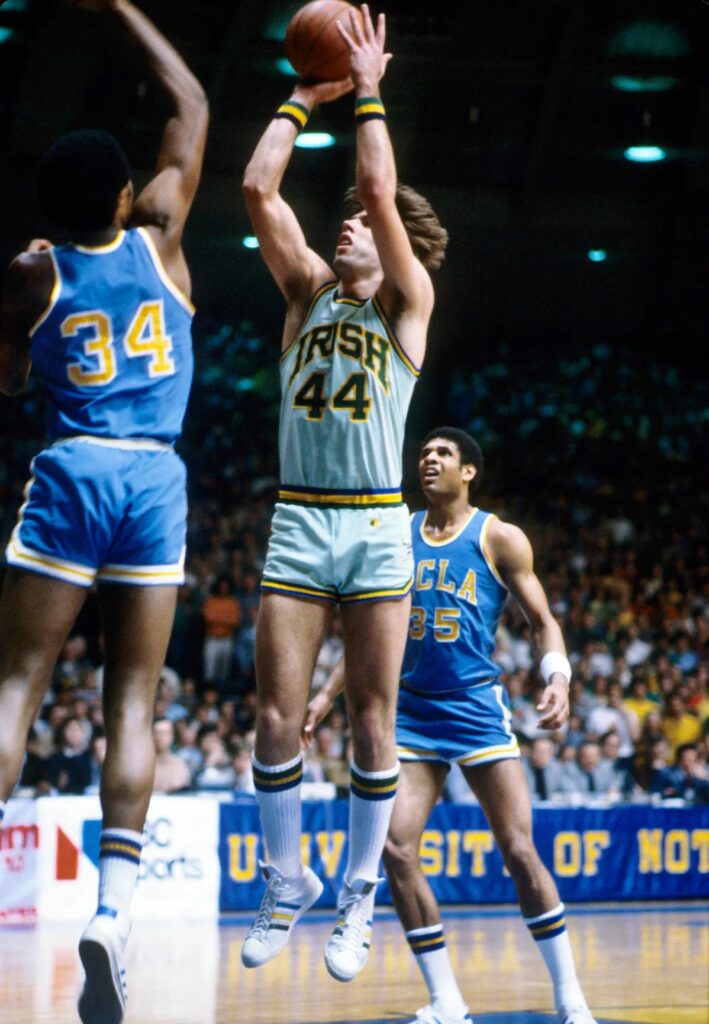
The other major highlight of that spring semester was Notre Dame basketball. The Fighting Irish, under Digger Phelps, were a national powerhouse again. That year, the team finished with a stellar 22–6 record, and ranked 9th in the final AP Poll.
Photograph of Fighting Irish Basketball Digger Phelps in 1979-1980 season.  Autobiography of Dr. Anthony J. Carbone.

Game nights at the ACC (Joyce Center) were electric. I squeezed into my assigned junior section with Bob Terifay, Matt Bedics, Andy Cordes, and Al Emory. We arrived early, the student section alive with cheers and fight-song chants, the band jumping into full swing as the team warmed up. Watching Kelly Tripucka, Orlando Woolridge, Bill Hanzlik, and Tracy Jackson dominate the court was a living reminder that spring had its own brand of Notre Dame pageantry.
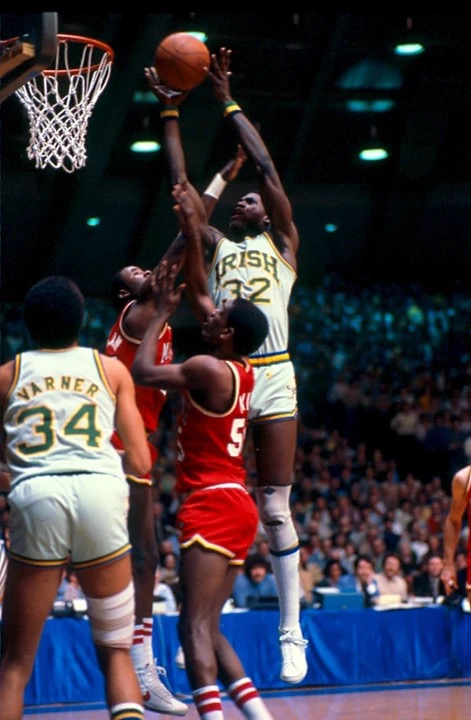
The season had standout moments that still raise my pulse in memory. Early on, we upset UCLA at home, riding the momentum to a 6–0 start. A tough loss to second-ranked Kentucky in Louisville stung, but it didn’t derail us. Maybe the highlight was that unforgettable 2-point, double-overtime win over #1 DePaul (76–74) — Kelly Tripucka scored 28, and Orlando Woolridge iced it with two free throws.

Then came the NCAA Tournament. Notre Dame earned a #4 seed in the Midwest Region — but lost in the second round to #5 Missouri, 87–84 in OT. Disappointing, yes — but that season had already delivered more than its share of thrill.

Junior Parents Weekend

Junior Parents Weekend took place February 22–24, 1980, and I was genuinely surprised that both of my parents made the long trip from Carlisle Barracks, Pennsylvania, to South Bend. At the time, my father was in the thick of his studies at the U.S. Army War College and simultaneously working toward his Master of Public Administration at Penn State. Yet, they carved out the time, staying at the Morris Inn for the weekend. True to form, my father spent much of the trip editing his thesis, with my mother faithfully retyping draft after draft. 

Still, they joined me for meals in the South Dining Hall and for dinner out at a local restaurant, and most importantly, they finally met Mariann and the gang from Fisher Hall. I could sense immediately how much they approved of Mariann, which meant a great deal to me. 

The tradition of Junior Parents Weekend — first launched in 1953 as Parents-Son Day — was created to help parents better understand the lives their sons (and, since 1972, daughters) led on campus. By the time my parents arrived, it had become a full weekend of connection and celebration. For me, it was also a rare moment where the worlds of Notre Dame and my family came together in a way that felt both special and lasting.

Spring Break, MCAT and Med School Applications

Spring Break ran from March 28 through April 7, 1980. I spent the entire break studying for the Medical College Admissions Test (MCAT) and filling out my American Medical College Application Service (AMCAS) application. I sat for the MCAT right after Spring Break. t was one of the most stressful weekends of my life. Months of preparation all came down to a single day, a single test that could make or break my medical school ambitions. I also had to fill out my AMCAS and supplemental medical school application packets before reporting to Army ROTC Advanced Camp. It was extremely stressful, but it was a relief to have it behind me. Unfortunately, I knew the hard part was still ahead: waiting for responses from the medical schools.
Final Examinations

Final examinations were held May 7–12th. When the dust settled, I finished with three A’s and two B’s — not horrible at all, considering the difficulty of my schedule. My junior year was over, and now it was time to go home and prepare for Advance Camp. I packed up my suitcase and cleared out my room for the summer, but saying goodbye to Mariann was the hardest part. This goodbye hurt more than any before, because I knew that once I was at Fort Riley, Kansas, for ROTC Advance Camp, it would be nearly impossible to communicate with her. I was going to miss her terribly.

Flight Home to Carlisle Barracks

I flew home to Carlisle Barracks just in time to help with yet another family move.
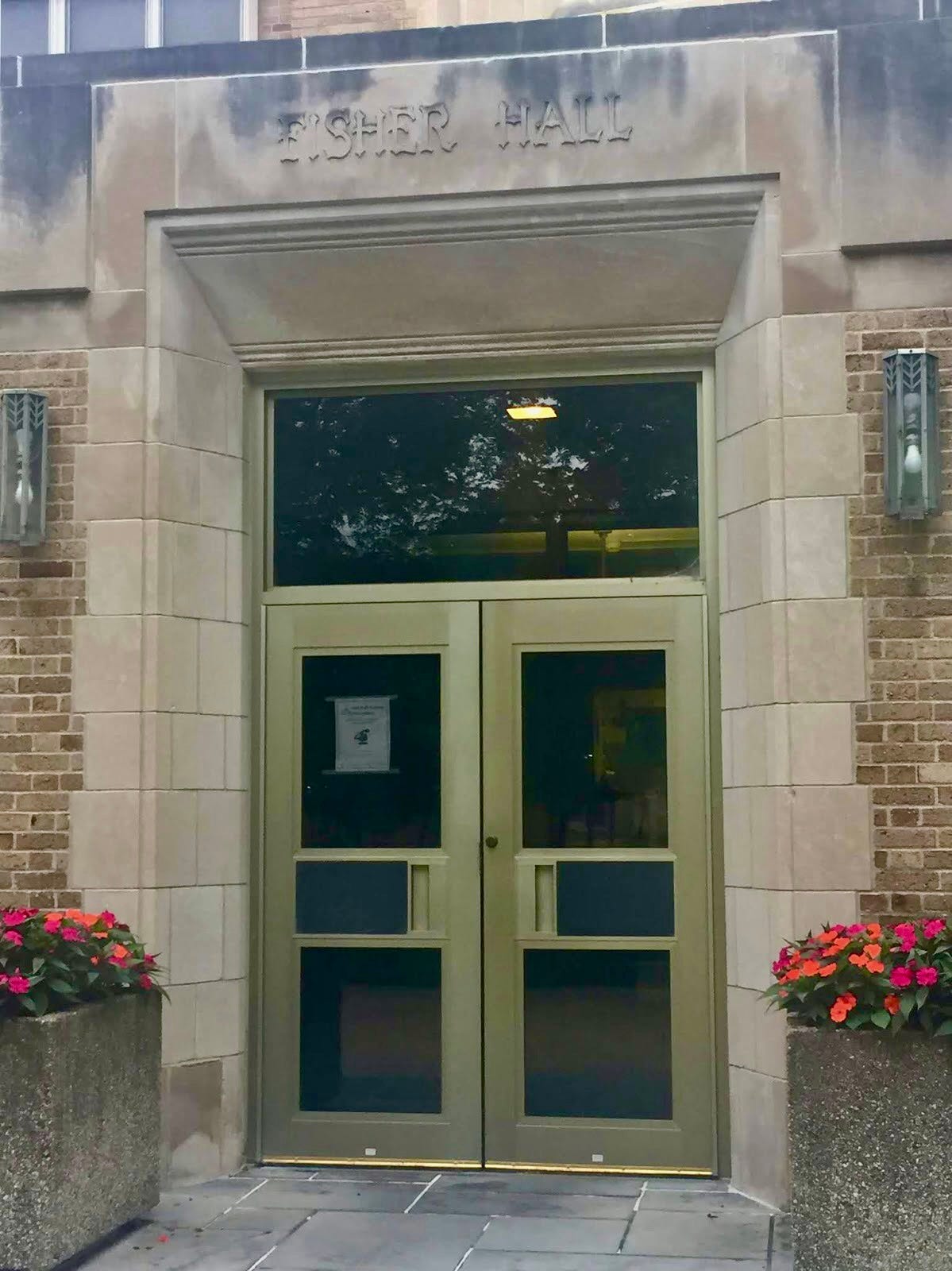
Side entrance to Fisher Hall at the University of Notre Dame.  Autobiography of Dr. Anthony J. Carbone.

Home Page

Chapter 18: Sophomore Year at Notre Dame

My only girlfriend at Notre Dame, Mariann. Autobiography of Dr. Anthony J. Carbone.

Believe Nothing You Hear, and Only Half of What You See — A memoir of Service, Shame and the Search for Truth

Return to South Bend for 2nd Year

After a much-needed Christmas break with my family at Fort Leavenworth, it was time to return to South Bend and face another grueling semester. This would by my sophomore year at Notre Dame. I said my goodbyes to my parents, my sisters Cynthia and Pamela, and the Morrison girls — then boarded a flight back to Indiana with a suitcase full of clothes and some money from summer work. From the airport, I caught the shuttle to campus and was dropped off in front of Fisher Hall, bracing myself for what I knew would be a brutal pre-med workload.

It felt good to be back with my sophomore section-mates — Bob Terifay, Matt Bedics, Al Emery, and the rest of the gang. Our group had started to feel like a true brotherhood. Joe Montana had graduated and was off to begin his legendary career with the San Francisco 49ers. In his place, Notre Dame football star Mike Calhoun moved into the room next door to mine. Mike was no Joe. Where Joe had been quiet and low-profile, Mike had an active nightlife that often made it hard to get any sleep. Let’s just say, I heard more than I wanted to.

Al Returns with his 1950 DeSoto

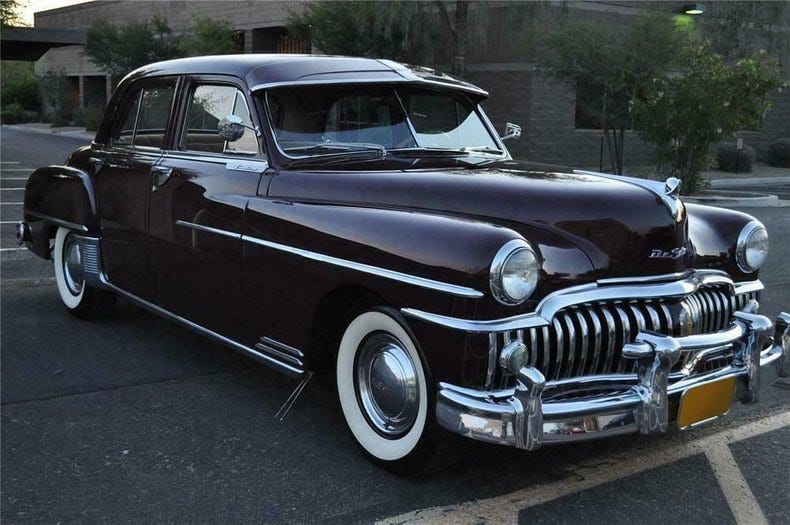
One of the great surprises that spring was that Al Emory returned to campus with his car — a 1950 DeSoto sedan. It was a beauty, a true classic, with that big rounded body style that looked like it had rolled right out of another era. Best of all, it still had its ah-oo-ga horn, which Al loved to blast whenever the mood struck him. The car quickly became a favorite of our group, because it meant freedom. We could pile the entire gang inside — crammed shoulder to shoulder, knees pressed against the seatbacks — and head off campus for a restaurant run. I never minded because I always got Mariann on my lap. Those rides in Al’s DeSoto were as much a part of our memories as the meals themselves.

Photograph of a beautifully maintained 1950 DeSoto Custom sedan covered in chrome and with whitewall tires. Biography of Dr. Anthony J. Carbone.
1950 DeSoto Custom Sedan

Pope John Paul I Elected

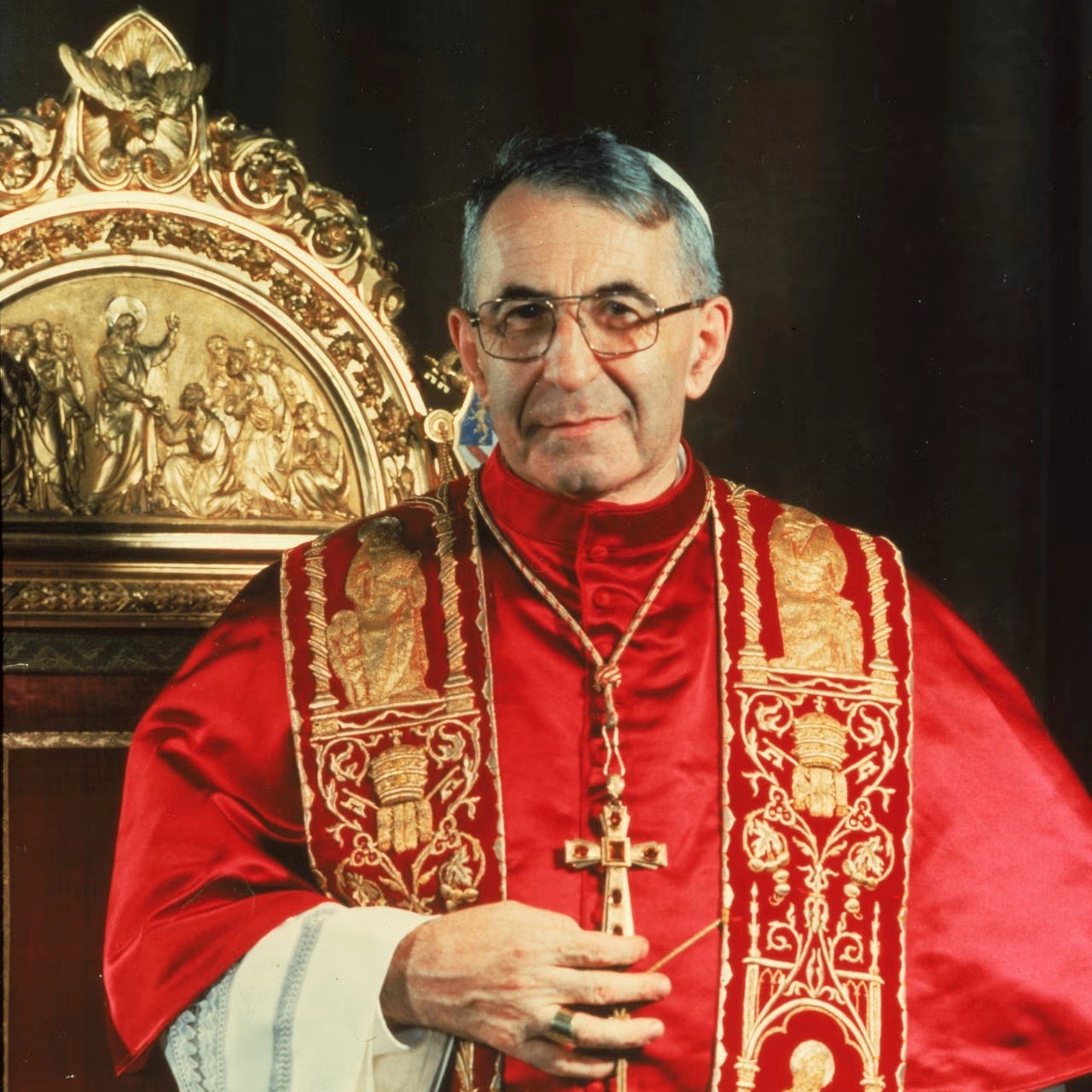
On the very day I arrived back on campus, Saturday, August 26, 1978, the Vatican’s College of Cardinals elected 65 year old Italian Cardinal Albino Luciani as Pope Paul VI’s successor. The campus was celebrating our new pope. The bells of the Basilica of the Sacred Heart were ringing loudly. Little did we know that our newly elected pope would mysteriously die in 33 days.

Pope John Paul I. Autobiography of Dr. Anthony J. Carbone.
Pope John Paul I

Our New Freshmen & New Girlfriends

We did welcome one notable freshman into our section — Joe Delaney, who would quickly become a key part of our Fisher clique. Joe had a great sense of humor, fit in easily, and before long, he had found a girlfriend too — Bernadette from Hawaii. Turns out, the second semester of sophomore year at Fisher was something of a love story for three of us. We started dating freshmen from the Class of 1982. Joe Delaney met Bernadette Young, Andy Cordes met Ginger Miklausen, and I met Mariann Schmitz. All three of us would be married within a year of graduation.

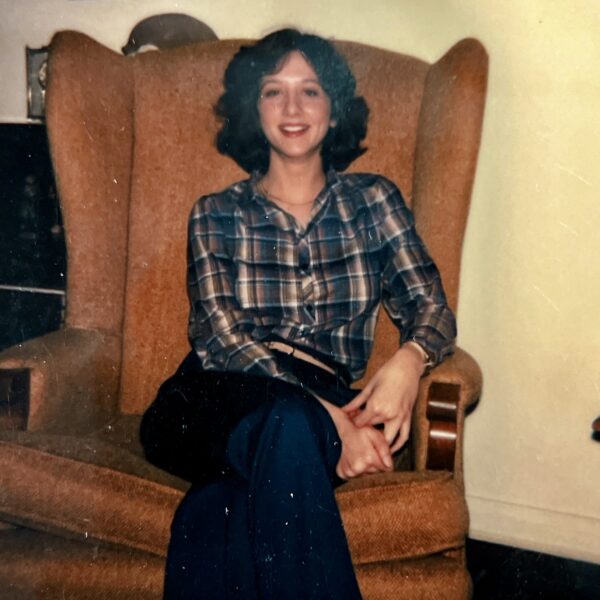
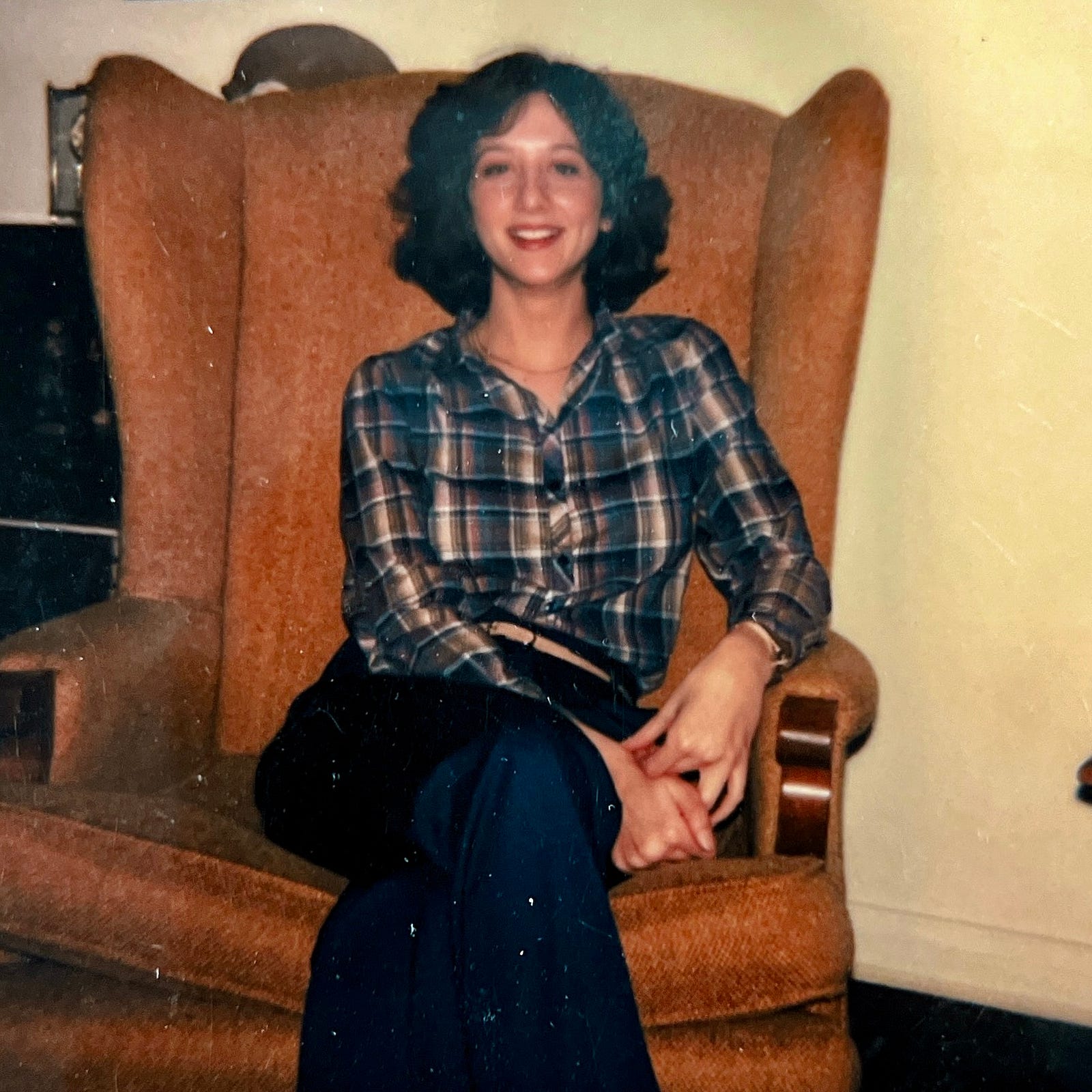
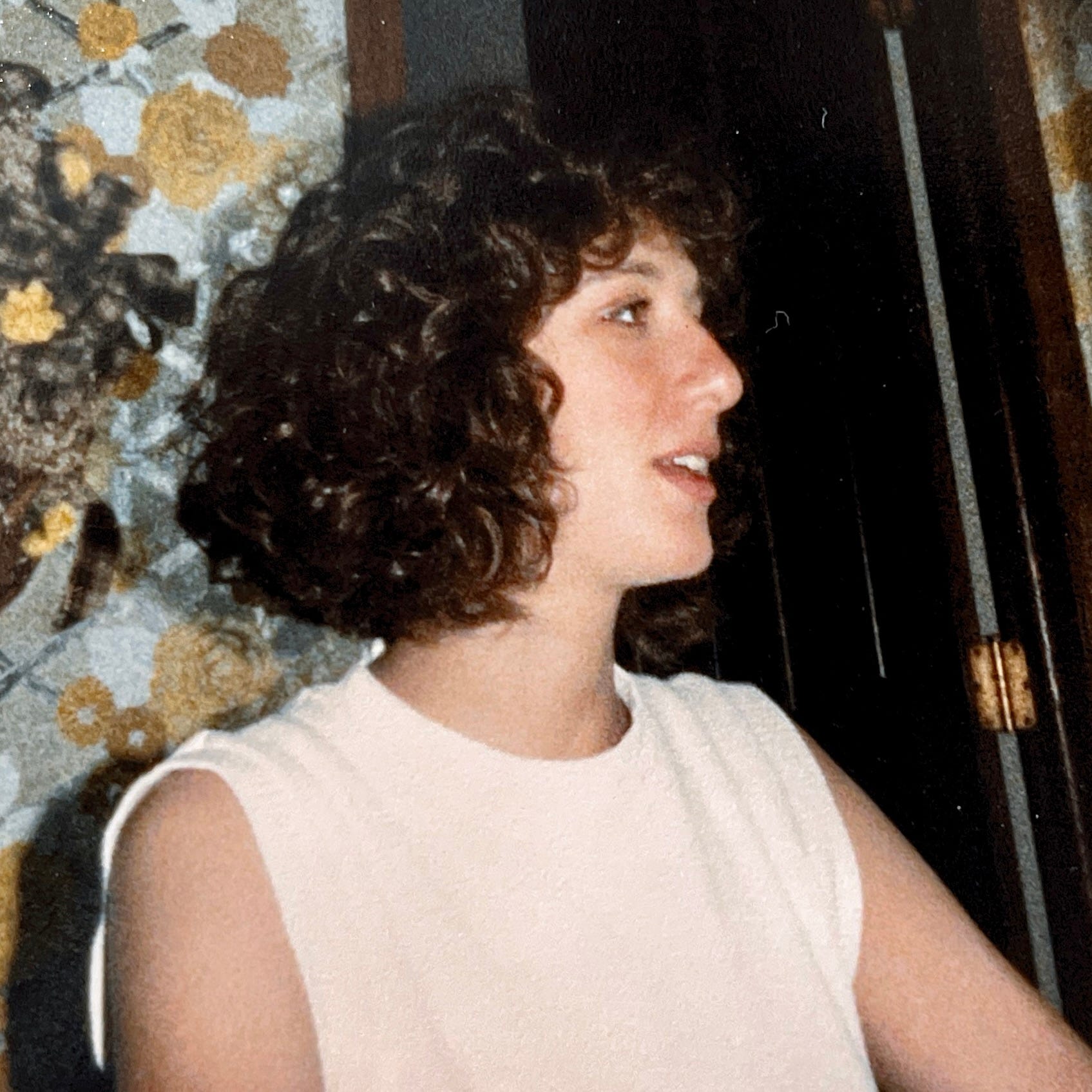
Mariann Schmitz Carbone. University of Notre Dame Class of 1982. Autobiography of Dr. Anthony J. Carbone.
Mariann “No Middle Name” Schmitz

My New Neighbor — Mike Calhoun

Next door to me lived Mike Calhoun, a huge defensive tackle on the Fighting Irish football team. He had taken over the room Joe Montana had occupied the previous year. Mike’s social life was a world apart from Joe’s. Joe never dated at Notre Dame — at least, I never heard of him with a girl until he met his wife on a flight to Hawaii for the Hula Bowl, where she was a flight attendant. Mike, on the other hand, had a beautiful Saint Mary’s College girlfriend, and he liked her terribly. Even though we had cinder-block walls between our rooms, I could often hear her thank him loudly.

Mike wasn’t your average college football jock. I think he was a pre-med major too, and he was genuinely nice and funny. One late night, I was buried in my books, having just walked Mariann back to her dorm for the evening. Mike poked his head into my room. “Tony, you study too hard. You need to relax a little. Come next door,” he said. I couldn’t say no.

I walked into Mike’s room to find three other football players sitting around a table, each with a submarine sandwich in front of them. Mike turned to me and asked, “Tony, are you hungry?” I mumbled, “A little.” Without hesitation, he grabbed one of the sandwiches from another player, shoved it into my hands, and barked, “Tony’s hungry. Eat!” I sank down into a chair, afraid to look up, and shyly ate the submarine sandwich that had been yanked from one of the other players. It was the strangest, most hilarious study break I had ever had, and for a moment, I felt like I was part of their world — even if only for a night.

Another difficult academic year

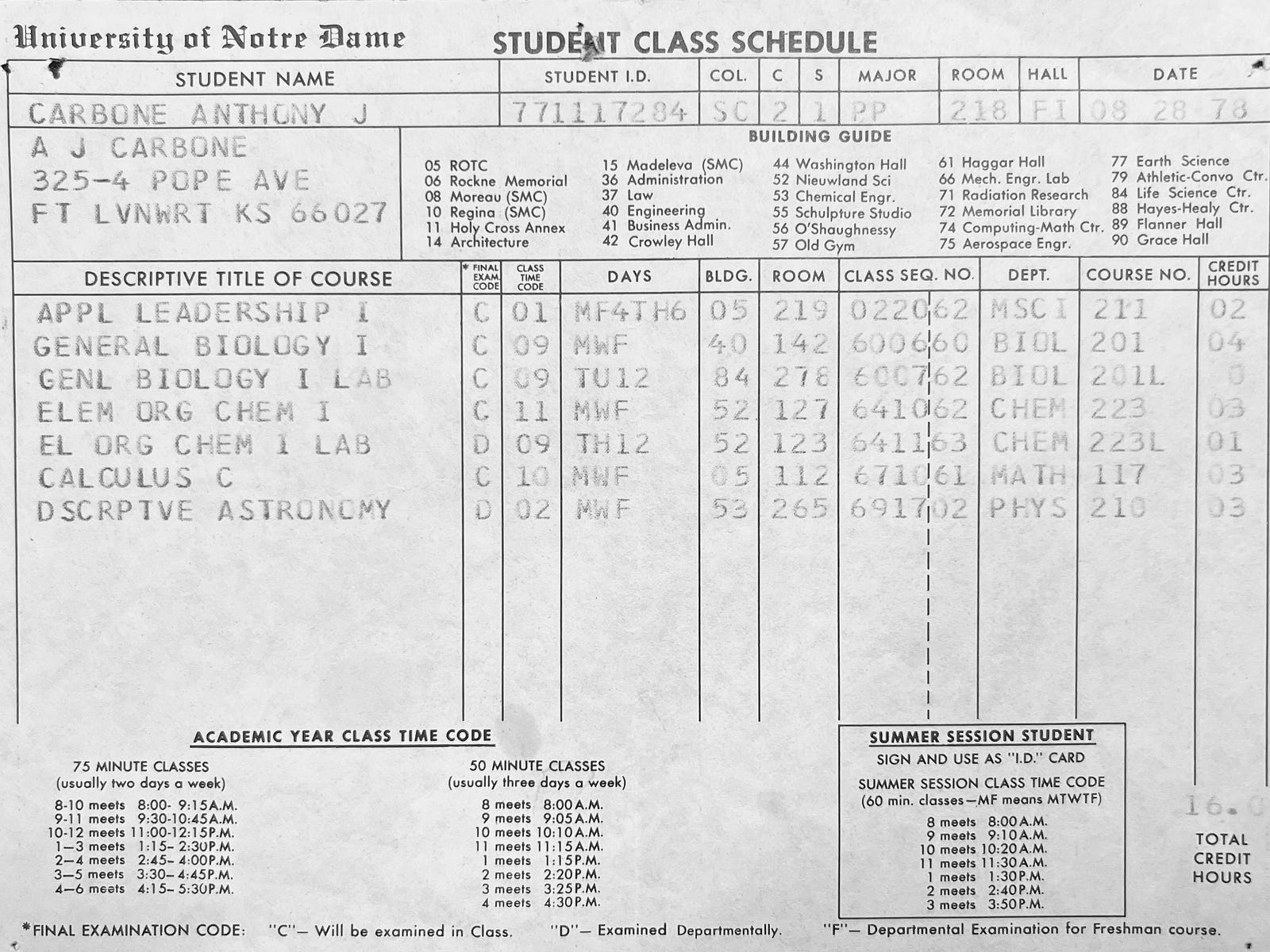
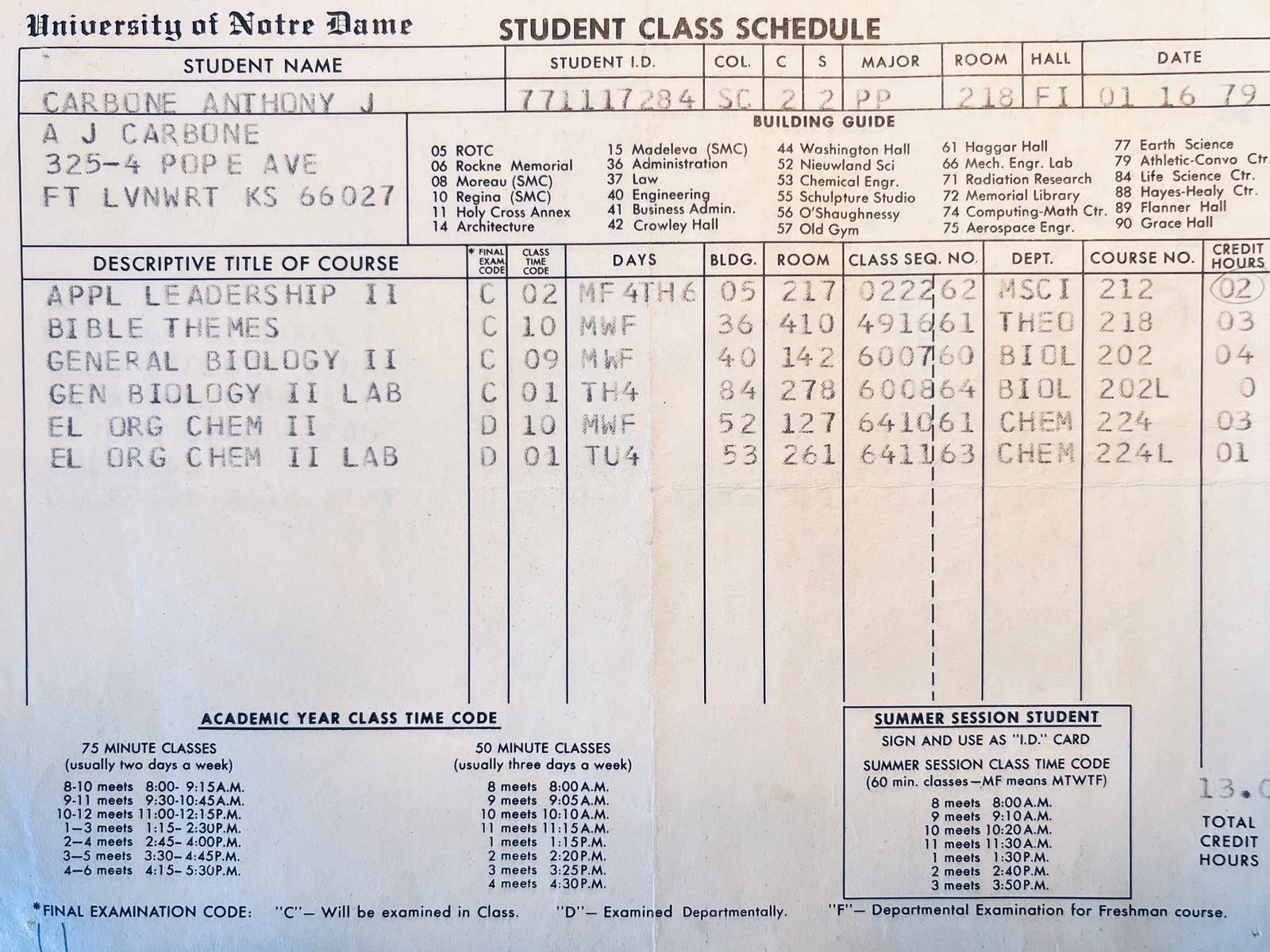
I wish I could remember more about sophomore year, but the truth is, it was so academically demanding that I barely recall most of it. My course load was a perfect storm of misery: Organic Chemistry I, Organic Chemistry Lab I, Biology I, Biology Lab I, Calculus C (third semester Calculus), Astronomy (a deceptively difficult 200-level Physics course) and Applied Leadership (Army ROTC), with weekly Drill and Physical Training (PT).

Anthony Carbone’s Sophomore Fall Schedule at the University of Notre Dame. August 1978. Autobiography of Dr. Anthony J. Carbone.

It was a rigorous semester academically, with a greuling workload. Organic Chemistry alone weeded out half the pre-med students. Calculus C made the earlier semesters feel like a warm-up. And those half-day science labs ate up time for just a single credit. Astronomy wasn’t about gazing at stars — it was math-heavy, abstract, and anything but relaxing.

Army ROTC — Military Science

And then there was ROTC — Military Science with drill afternoons and Physical Training (PT), which took up every spare minute I didn’t have.

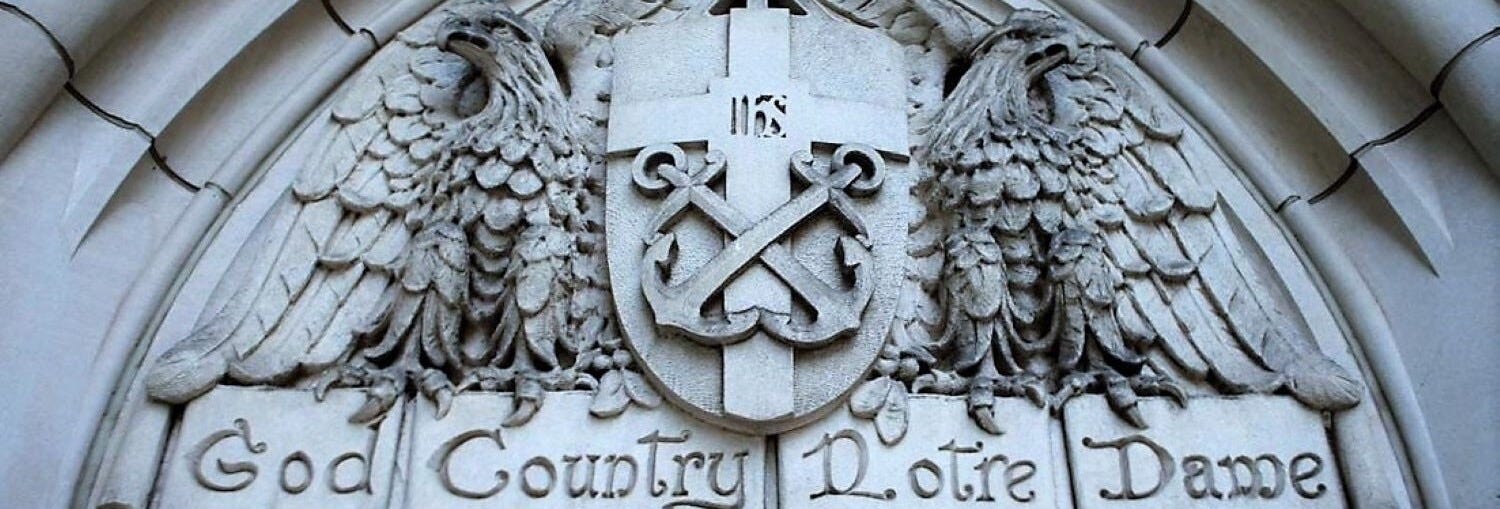
Entrance to building at the University of Notre Dame with "God, Country, Notre Dame" slogan.  Autobiography of Dr. Anthony J. Carbone.

Sophomore year in Army ROTC is where it begins to get real. We dove into leadership developmentmilitary tactics, and officer responsibilities. We learned how to give and follow orders, how to think tactically, and how to lead under pressure.

There were classroom lectures, weekly Leadership Labs, and three mornings of physical training (PT) each week, rain or shine. Each semester ended with a Field Training Exercise (FTX), complete with land navigation, rappelling, and cold nights under the stars. It was exhausting — and it left little time for anything else.

I Meet Mariann Schmitz

And yet, right in the middle of all that chaos, something extraordinary happened. Somewhere out on the quad — I don’t remember where, or even exactly when — I met Mariann “No Middle Name” Schmitz, the girl I would someday marry. That I can’t recall the exact moment bothers me a little, but it also makes sense. I was overworked, underslept, and socially anxious — especially around girls. But something about Mari caught me off guard.

Mariann Schmitz Carbone. University of Notre Dame. Autobiography of Dr. Anthony J. Carbone.

Not My Usual Type

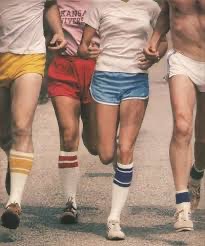
Mariann wasn’t my “type” at all — not the girly-girl in a miniskirt and flowing, silky hair I usually noticed. Mari was wearing running shorts, a sweatshirt, tube socks, tennis shoes, and her hair was tied back in a sweaty ponytail. She had just finished jogging with some upperclassman jock. And yet, there was something about her — her eyes, her smirk of a smile, her calm presence — that made me stop.

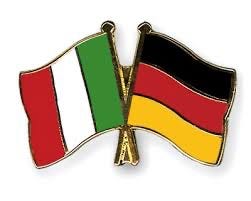
What possessed me to talk to her, I’ll never know. I had nothing to offer — no helpful tips about the campus, no shared major (she was an Economics major), I didn’t play basketball, and no cool social clout. But thank God, she was Catholicand intelligent. That gave us common ground. Then I found out her mom was full-blooded Italian, her dad German. Now we were talking. At least I’d met my cultural match.

Italian and German crossed flags pin.  Autobiography of Dr. Anthony J. Carbone.

Schmitz Family in Wheaton, Illinois

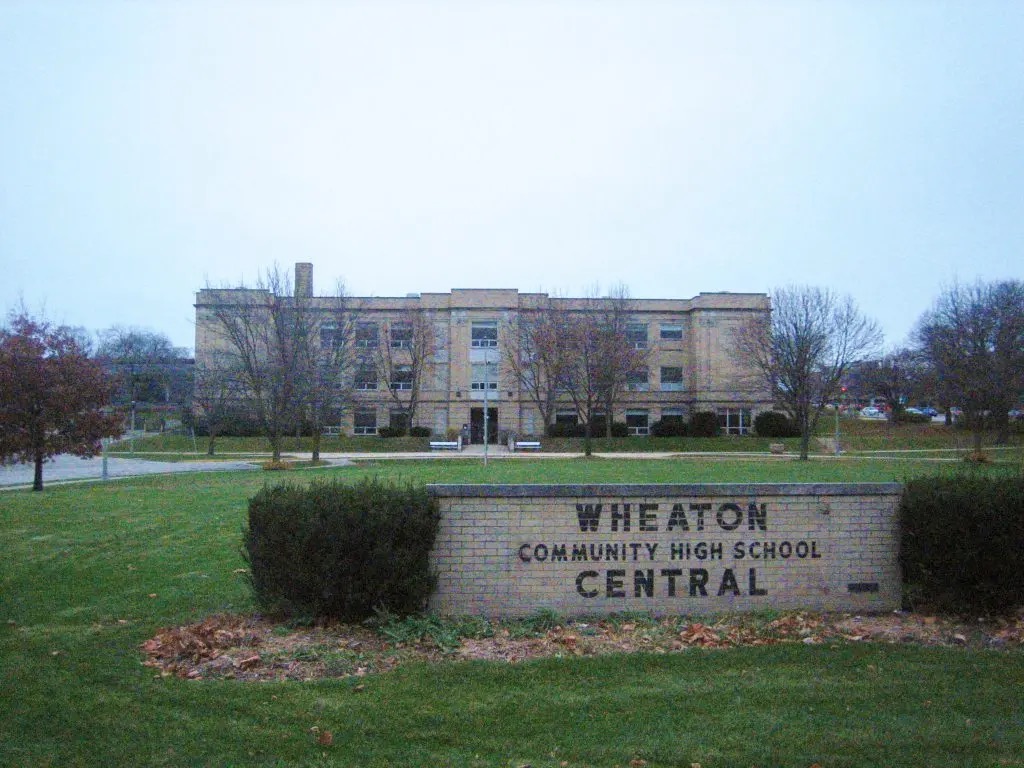
Mariann came from Wheaton, Illinois, part of a big, devout Catholic family. Her father, John Henry Schmitz, was German-American and worked as Executive Vice President at Hollister Corporation. Her mother, Sara Gene Crivello Schmitz, was a powerhouse in her own right — President of the DuPage County Bar Association. Mariann was a graduate of Wheaton Central Class of 1978.

Together, Mr. & Mrs. Schmitz raised seven children: John Jr., Susan, Margaret, Kathryn, Mariann, James, and Jacqueline. Mr. Schmitz had just passed away in March 2025 at age 94 — after 73 years of marriage. That tells you everything you need to know about their values. They were the real deal.

Mariann–a Scholar-Athlete

Mari was brilliant — a Notre Dame Scholar, likely a National Merit finalist. She was also athletic, having played on her varsity basketball team back in Wheaton. A true Notre Dame scholar-athlete. But what struck me most wasn’t her résumé — it was how comfortable I felt around her. She had a sharp wit, a quick mind, and those sleepy eyes that made me lose my train of thought. She just made me laugh and feel comfortable. I don’t remember how it all unfolded from there. I just know that we started spending more time together. And before long, we were spending every day together.

Our First Date?

There was no official “first date.” We just ended up together. I still remember one quiet evening, walking with her around Saint Mary’s Lake at twilight. She was talking — about what, I have no idea — and I was suddenly overcome with dread. “Oh my God… I’m going to marry this girl.”

I knew it. That was it. No more dorm parties, or panty raids, or sampling the brilliant Saint Mary’s coeds. All those college fantasies I’d picked up from TV and movies evaporated. Because I had just met my future wife.

Did Mari think the same thing? Probably not. More likely she was thinking, “This guy is short and definitely can’t play basketball.” But somehow, we clicked. And I knew how lucky I was.

Forty-seven years later, I still can’t think of a single flaw in her. She was — and is — smart, kind, holy, funny, and the most grounded person I’ve ever met. For someone who was half Italian and half German, Mariann never fought or gave me the silent treatment. Mari is that rare girl — pure, strong, sweet, and serious about life, studies, faith and family.

Looking back, meeting Mariann was the most important part of my Notre Dame experience. It wasn’t just the professors, labs, the tests, or the military drills that shaped me — it was her. She changed the course of my life. And in the chaos of it all, I found something I never expected: love.
Animal House, Food Fights & Toga Parties

Not long after we met, the campus atmosphere shifted into a different kind of chaos — thanks to Hollywood.

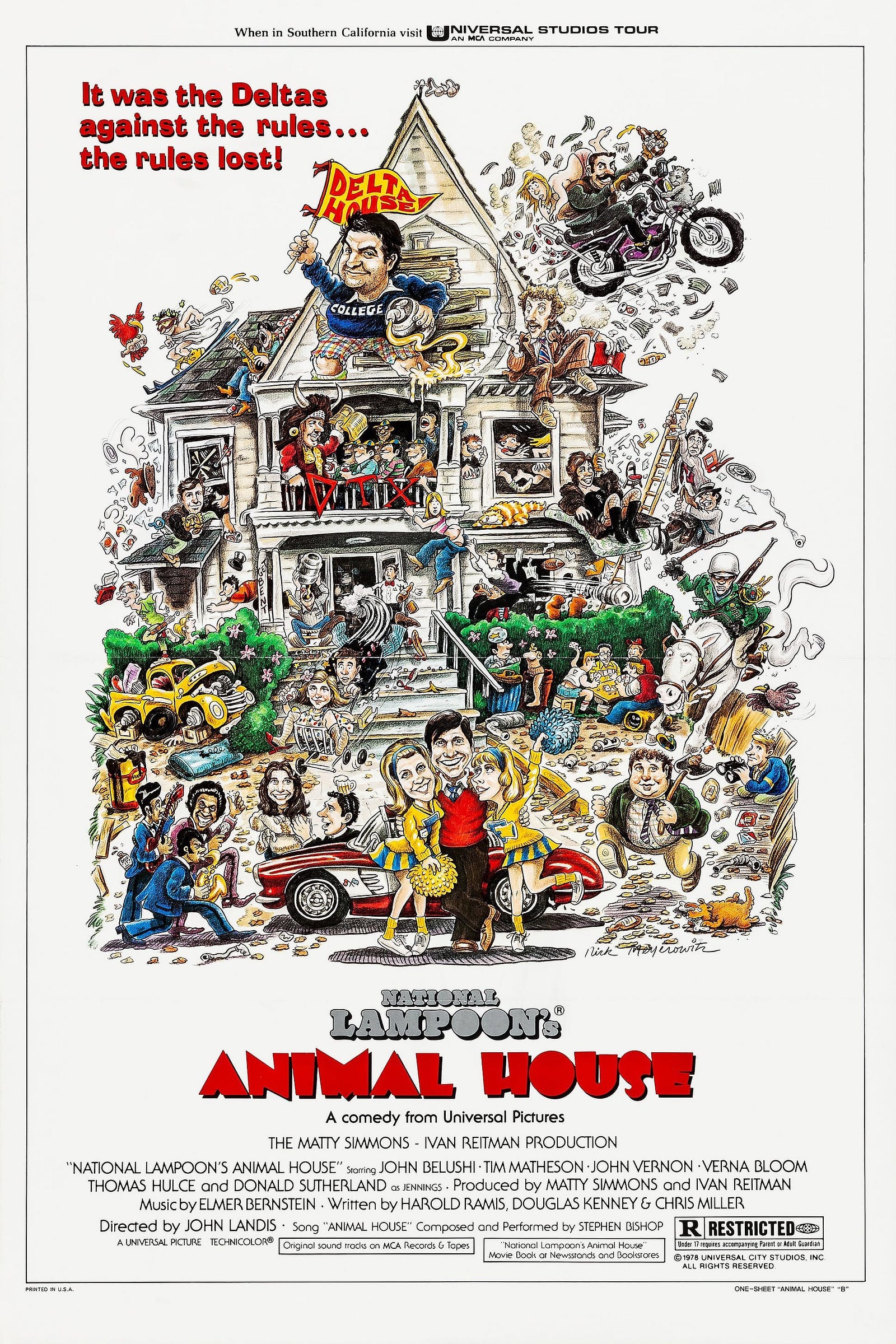
Movie Poster for National Lampoon’s movie “Animal House” that debuted July 28, 1978 right before my sophomore year at University of Notre Dame. Autobiography of Dr. Anthony J. Carbone.

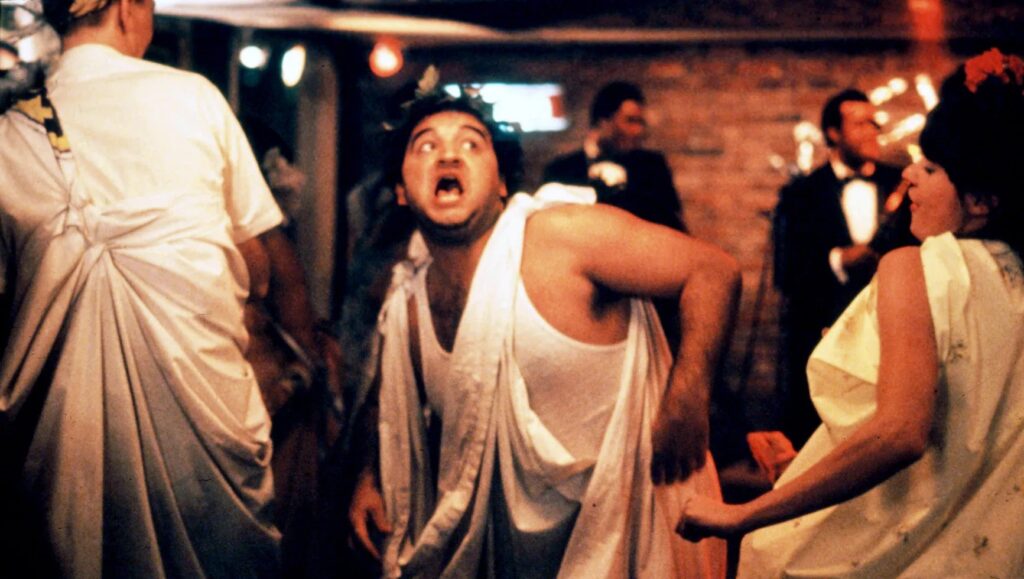
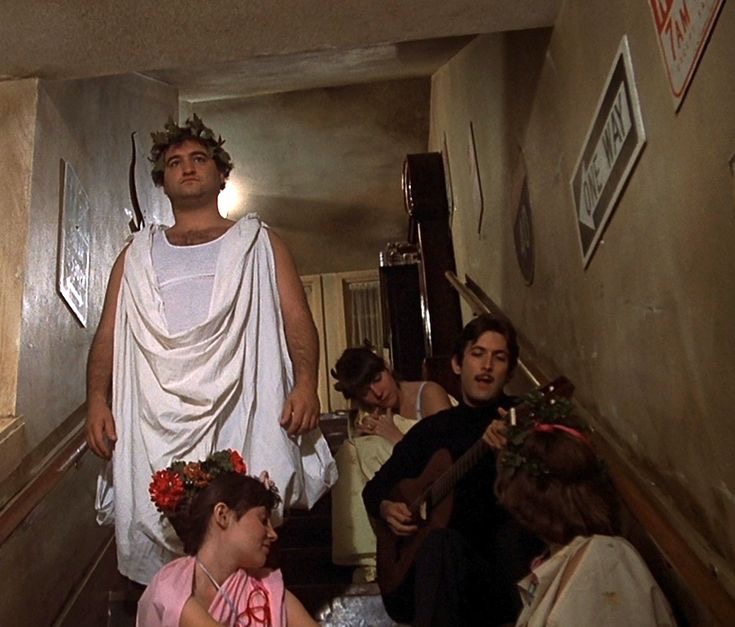
Toga Parties

That fall, the movie Animal House had just debuted on July 28, 1978, right before school started. It became an instant cultural phenomenon. The film’s irreverent, chaotic fraternity spirit swept across campuses like wildfire — and Notre Dame was no exception. Residence halls across campus threw Animal House-inspired toga parties in those early weeks of the semester. Even the usually reserved Fisher Hall got in on the fun.

Food Fights in South Dining Hall

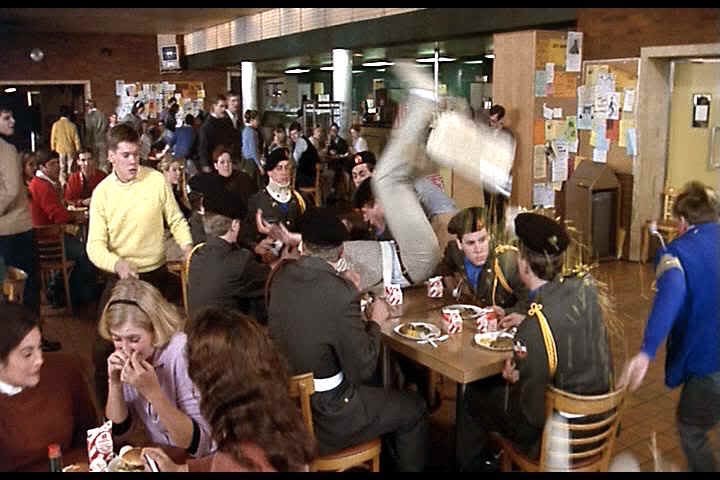
I remember walking into the South Dining Hall and watching spontaneous food fights erupt without warning. Someone would shout a battle cry — usually something absurd like “TOGA!” or “FOOD FIGHT!” — and trays of mashed potatoes, carrots, and Jell-O would go flying. Most of the students would duck under the long oak tables for cover, but a few brave or foolish souls stood their ground, hurling dinner rolls like grenades. It was madness — hilarious, stupid, and strangely exhilarating.

Animal House Attitude

That Animal House attitude — carefree, rebellious, and loud — lingered across campus for nearly the entire school year. And yet, amid all that absurdity, I had found Mariann. My world had become more grounded and more joyful, even as food flew through the air.

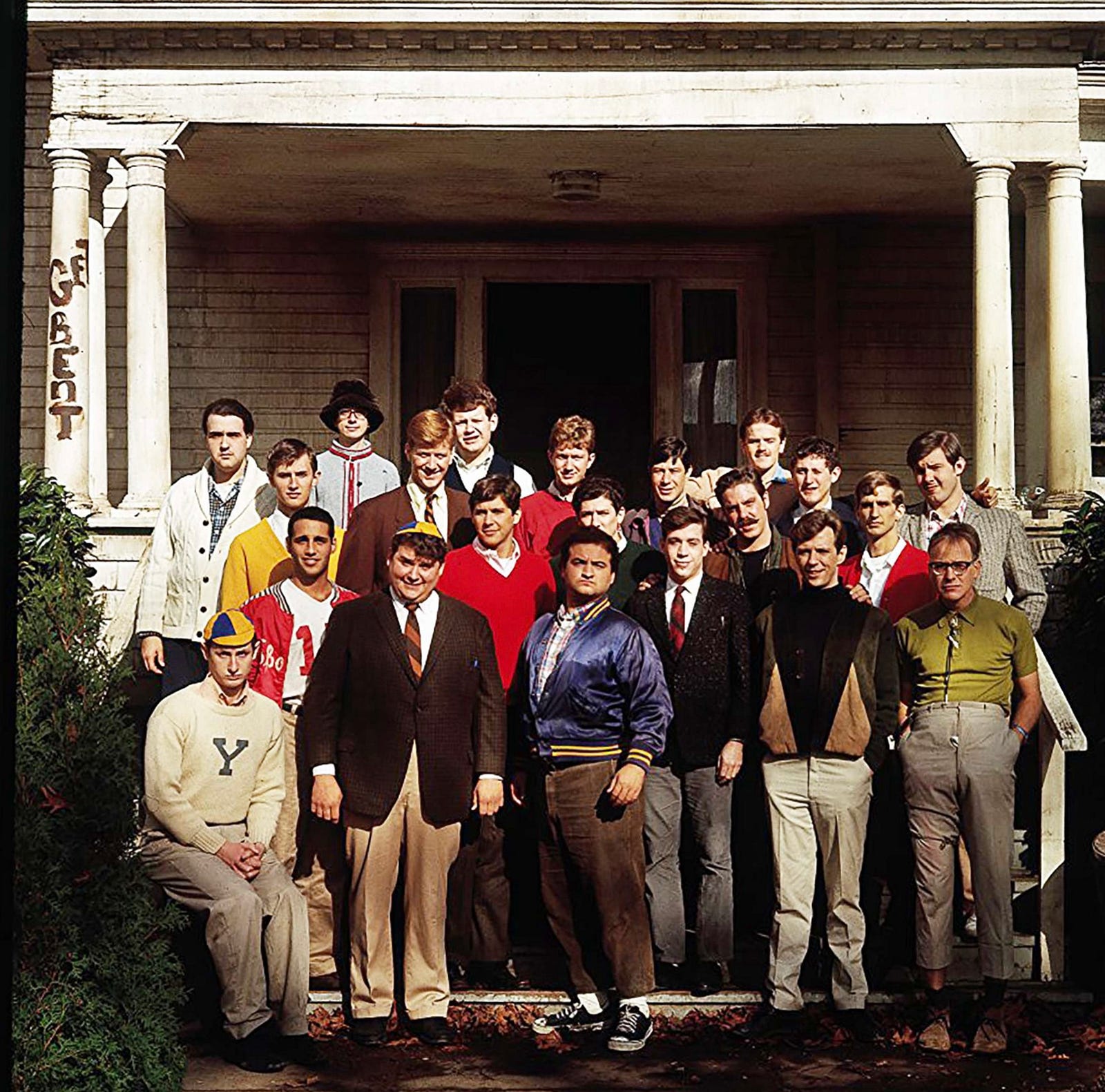
Photo of the cast of National Lampoon’s “Animal House” from July 1978. Autobiography of Dr. Anthony J. Carbone.

My Academic Load Sophomore Year

When I reminisce about my sophomore year at Notre Dame, all I can think about are the hours and hours I spent buried in Organic Chemistry, Biology, and their respective laboratories — plus third semester Calculus. It was a brutal academic year.

My first semester of my sophomore year at the University of Notre Dame in 1978 schedule of courses. Autobiography of Dr. Anthony J. Carbone.

Pope John Paul II Elected

On October 16, 1978, the Vatican’s College of Cardinals elected 58 year old Cardinal Karol Józef Wojtyła of Wodowice, Poland, the first non-Italian Pope in over 400 years. His election inspired hope and resistance against the communist regime in his home country. And his work with United States President Ronald Reagan is believed to have facilitated the decline and eventual fall of the Soviet Union years later.

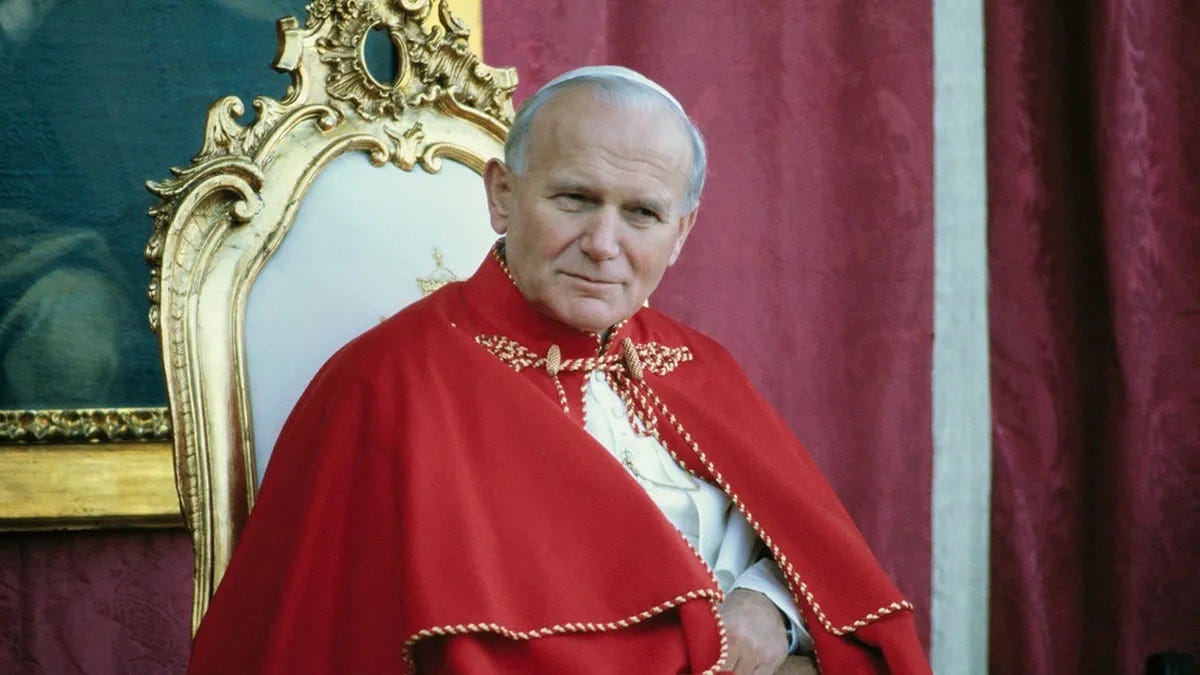
Pope John Paul II. Vatican City. Autobiography of Dr. Anthony J. Carbone.
Pope John Paul II

19th Birthday at Notre Dame

My 19th birthday on December 3, 1978 felt completely different from the year before — quieter in some ways, but more meaningful. This time, I had Mariann by my side. She surprised me with a homemade cake, and, as if by tradition, my mother’s cake arrived in the mail the very same day. I suddenly had two birthday cakes again, and somehow that made me feel doubly blessed.

My 19th birthday at University of Notre Dame.  Two birthday cakes in my dormitory room at Fisher Hall.  Autobiography of Dr. Anthony J. Carbone.

Birthday Dinner at Bob Evans

That evening, our little Fisher Hall crew — me, the guys, and the new girlfriends, Ginger, Bernadette, and Mariann — bundled up and walked a mile or so off campus to Bob Evans. The winter air was crisp, our laughter drifting into the night as we crunched along the sidewalk. Bob Evans was one of our favorite spots because of homecooked meals, especially on cold, winter evenings. Over steaming plates of comfort food, we celebrated like only college kids can — loudly, joyfully, without a care in the world.

When we returned to campus, Mariann took the birthday cakes out in my Fisher Hall room, candles glowing in the dim light. Friends gathered close, the room filled with the sound of voices, the scent of frosting and coffee. Looking across at Mariann, with her smile soft and warm in the candlelight, I realized this birthday wasn’t just perfect — it was the kind you carry with you forever. I felt, in that moment, incredibly lucky.

Fall Final Examinations

The fall was coming to a close before I knew it once again. Final exams were held December 13th through 21st, and of course my pre-med final examinations went until the very last day. I wasn’t back home at Fort Leavenworth until December 22nd. 

Just like last year, I can’t remember much about this Christmas either — other than the fact that all four of my sisters were home from college for the holidays with me. The weeks leading up to finals, followed by the rigorous examinations themselves, alwasy left me in a fog for several days. And by the time I rested, Christmas was over.

I do remember calling Mariann in Wheaton, Illinois every evening. In those days, long-distance telephone calls were expensive, with rates dropping 35% after 5 PM and 60% after 11 PM. To save money — and stay out of trouble — I would wait until 11 PM to call her.

New Year’s Eve at the Morrison’s Again

I visited the Morrison girls after Christmas, and once again we rang in the New Year together at their house — a warm, lively evening filled with laughter, music, and the comfort of familiar friendship. Yet beneath the cheerful surface, I was caught in a quiet tug-of-war. I found myself drawn to one of the Morrison girls, while at the same time thinking constantly about Mariann. Deep down, I already knew Mariann was the woman I would one day marry. 

Still, part of me wanted to experience a bit of college dating before settling into something so serious. The Catholic boy in me wrestled with guilt over such thoughts; the mix of emotions made for a season of both soaring highs and quiet lows.

Time to Return to Notre Dame

Drive Back to Campus

January 15th arrived far more quickly than I wanted. I loved being home with my four sisters, and of course, seeing the Morrison girls. This year, my parents encouraged me to catch a ride from Kansas City to South Bend with fellow Notre Damers. I remember sitting in the front bench seat of a guy’s car with a female student between us. Didn’t know either one of them, so initially, the trip was a bit awkward for me. I recall that the trip took up about 9 hours or so. We arrived after dinner, so I had only a little time to unpack and chat before Spring Semester Registration the following morning. 

Second Semester was as bad as First

The second semester course load was nearly identical in workload to fall semester. The only change in my schedule was that Astronomy (Physics 210) had wrapped up after first semester, and I replaced it with Bible Themes (Theology 218) in the spring. Every day was an academic gauntlet, and spare time was nearly nonexistent.

My second semester of my sophomore year at the University of Notre Dame in 1979. Autobiography of Dr. Anthony J. Carbone.

Spending More Time with Mariann

Despite the heavy course load, I happily shared all of my limited free time with Mariann. While I maintained my friendships with my Fisher Hall section mates, Mari quickly became the center of my world. We ate together, studied together, attended daily Mass together, and prayed together at the Grotto nearly every evening.

Mariann and I prayed at the Grotto nearly every night while at the University of Notre Dame. Autobiography of Dr. Anthony J. Carbone.

Our nights often ended with a late snack from “Food Sales” in the basement of Fisher Hall — usually something like a microwaved sandwich or vending machine chips and a Coca-Cola — before I walked Mariann back to her dormitory in the North Quad.

Marinn at Farley Hall

Mariann lived in Farley Hall that year, one of the all-female dorms on campus. After dropping her off, I’d head back to Fisher to study or collapse from exhaustion.

Farley Hall, one of the all-female dormitories, at the University of Notre Dame. Where Mariann Schmitz lived her first year at Notre Dame. Autobiography of Dr. Anthony J. Carbone.

My First Dance with Mariann

I can still remember my very first dance at Notre Dame — my first real date. Fisher Hall was hosting its Fall Dance, and of course, I was taking Mariann. She looked absolutely stunning in her dress, and though the night held many small moments, one that still lingers in my memory is dancing with her to “Three Times a Lady” by the Commodores.

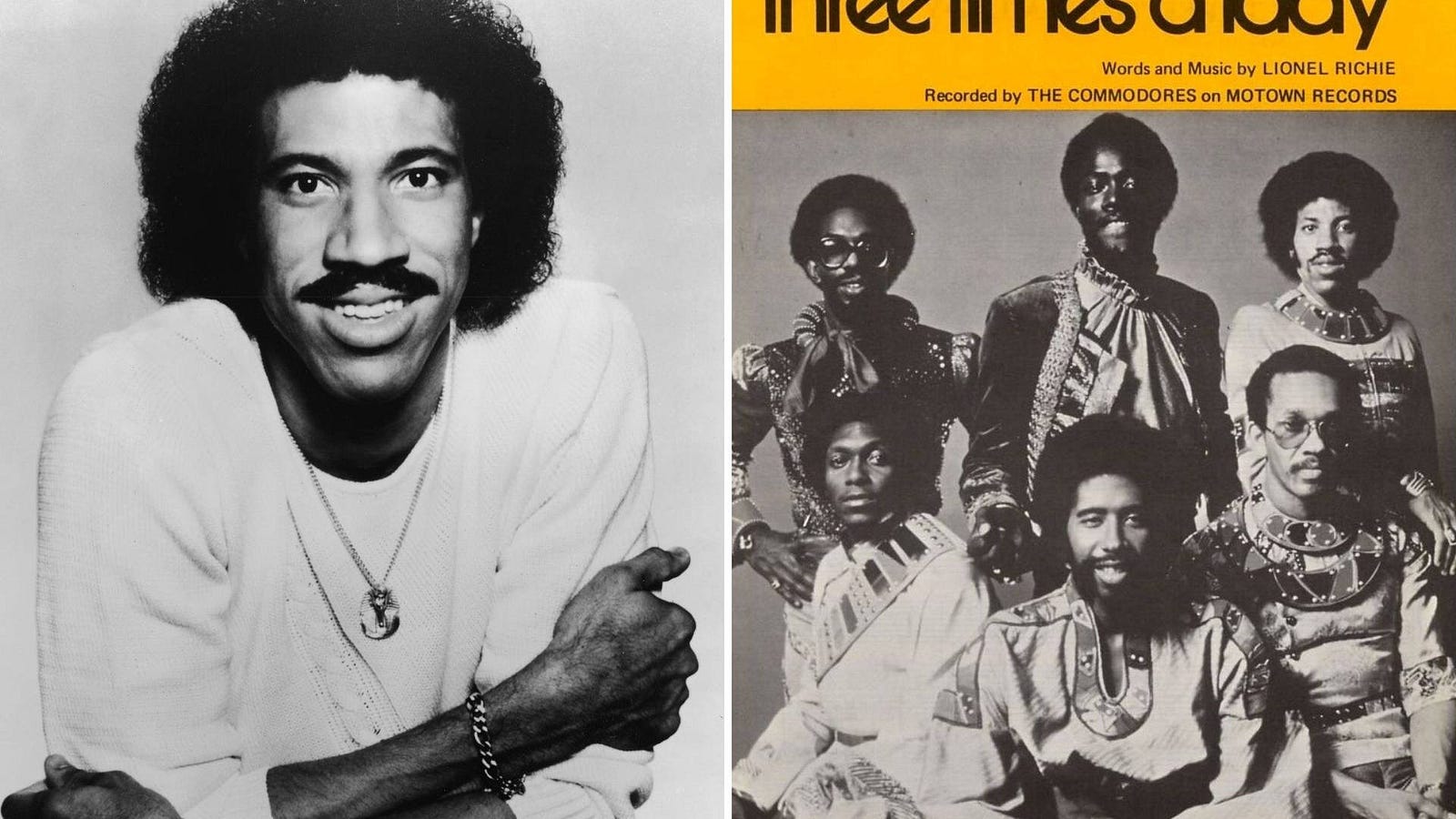
Lionel Ritchie’s hit with the Commodores in 1978 “Three Times a Lady”. Autobiography of Dr. Anthony J. Carbone.

Lionel Richie and “Three Times a Lady”

The 1978 ballad, written by Lionel Richie, had just become the group’s first #1 hit on the Billboard Hot 100 and also topped the soul chart. As we swayed to its slow, romantic rhythm, I already knew — somehow — that Mariann and I were meant to be. Even then, I wondered whether “Three Times a Lady” might someday be our First Dance song at our wedding.

Mari’s Brother John Visits Us at Notre Dame

Over time, I began to meet Mariann’s family. Her oldest brother, John, came to visit us at Notre Dame, and on one occasion, he took us out to dinner so he could get to know me. It was a nice restaurant — nicer than anything Mari and I could afford. At the end of the meal, John said, “I’ll pay for dinner; you two can leave the tip.” He put down cash for the check and stood up to leave. Mari and I looked at each other in panic. We checked our wallets and, between us, had just one dollar. As we were sneaking out, we left the crumpled bill on the table and followed John out the door, mortified but unsure what else to do.
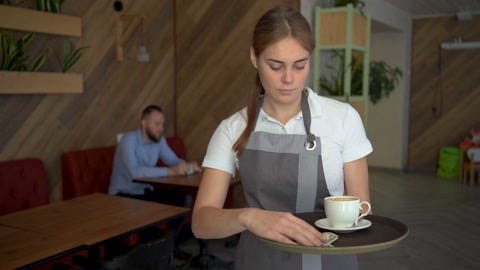
Waitress with tiny tip Mariann and I left her. Autobiography of Dr. Anthony J. Carbone

We didn’t make it far. Just outside the restaurant, John realized he had forgotten his car keys and ran back in to retrieve them. When he returned, he was holding his keys in one hand and, in the other, the waitress’s outstretched hand with our sad little $1 tip still sitting in her palm. We were completely embarrassed — but we were broke.
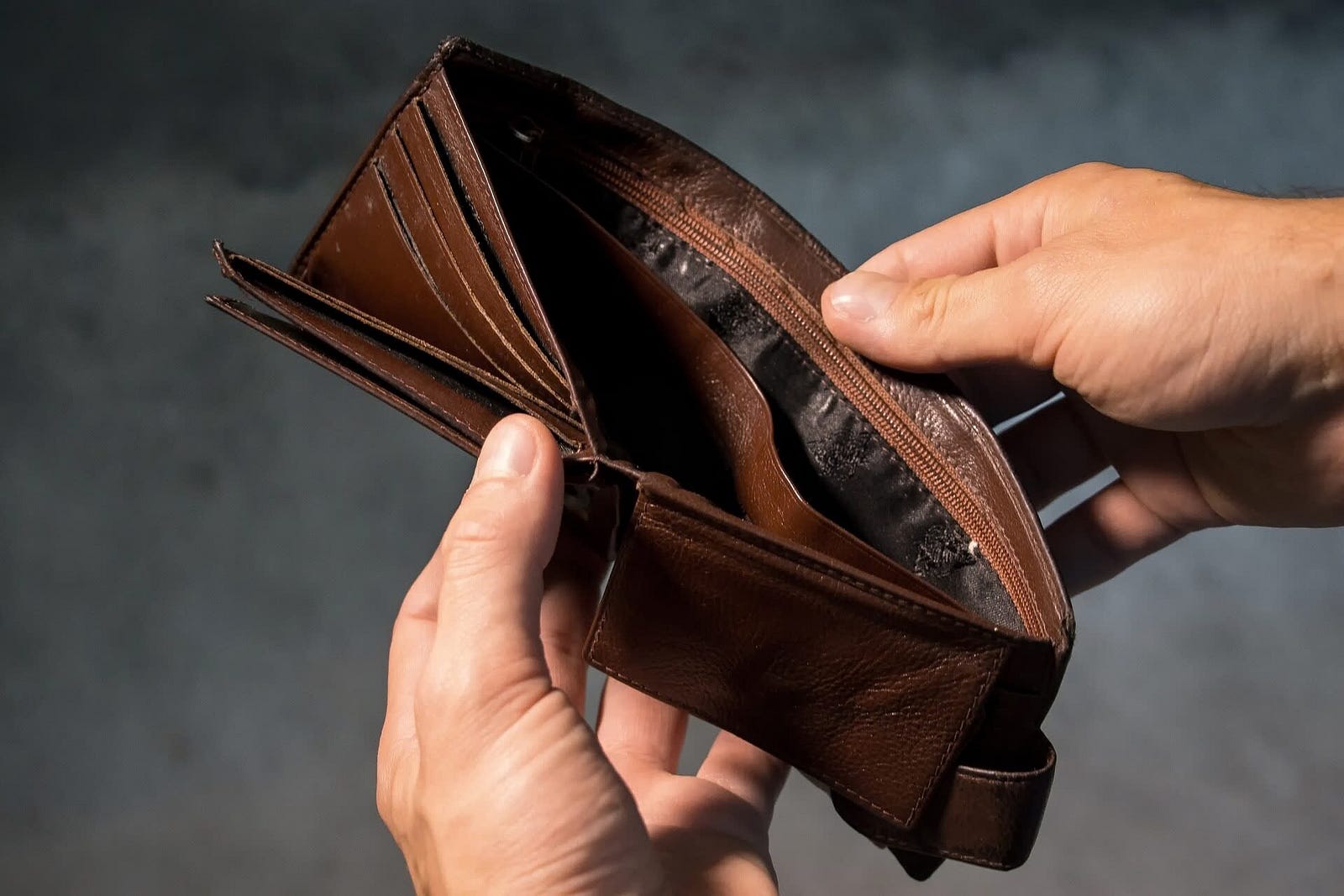
Mari and I were Both Broke at School

Even though Mari came from a wealthy family, she didn’t receive a stipend or spending allowance. I was earning $100 a month from ROTC, but my father required me to send $50 of it home for my personal expenses. That left Mari and me living on about $50 a month combined — and even in the late 1970s, that didn’t go very far for two hungry, busy college students.
Empty wallet while attending University of Notre Dame. Autobiography of Dr. Anthony J. Carbone.

Another Exciting Year of Sports for the Fighting Irish

Thank God that tickets to all Fighting Irish home games was part of our tuition. Mari and I attended football and basketball games together, although we always had to sit in different sections due to the fact I was a sophomore and she was a freshman. Notre Dame sports teams continued to have a great year during my sophomore year.

University of Notre Dame athletic ND Logo. Autobiography of Dr. Anthony J. Carbone.

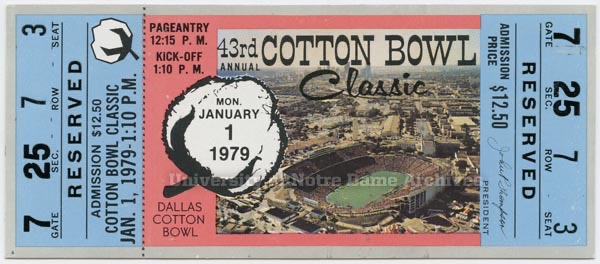
Fighting Irish Football Squad Wins at the 1979 Cotton Bowl

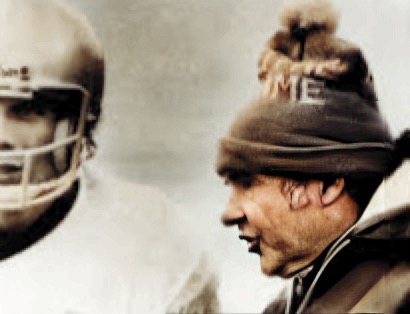
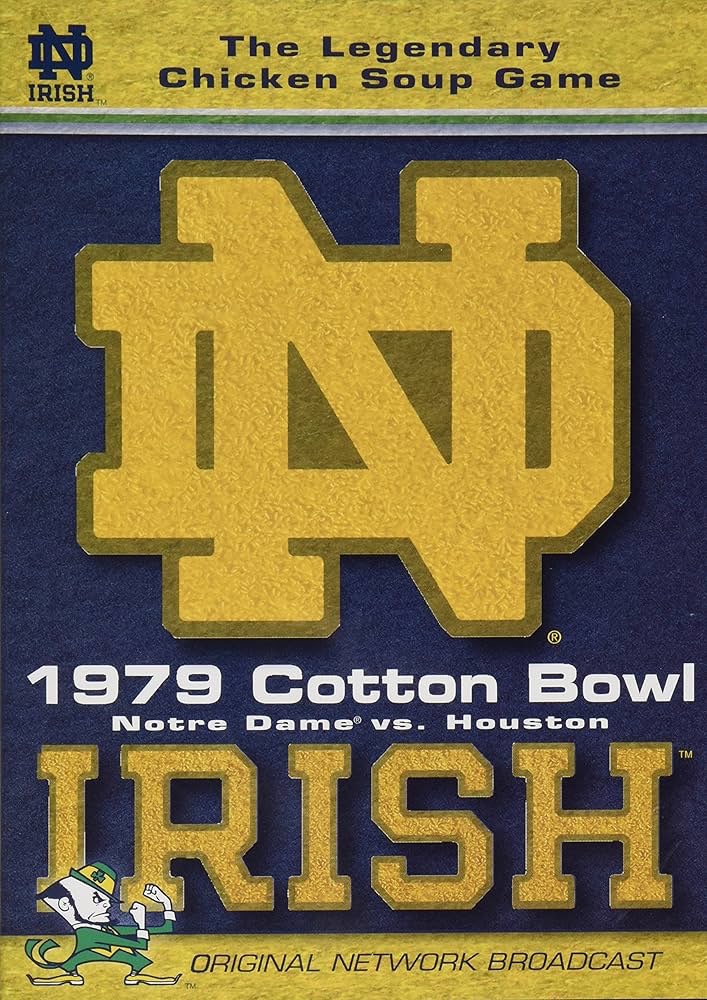
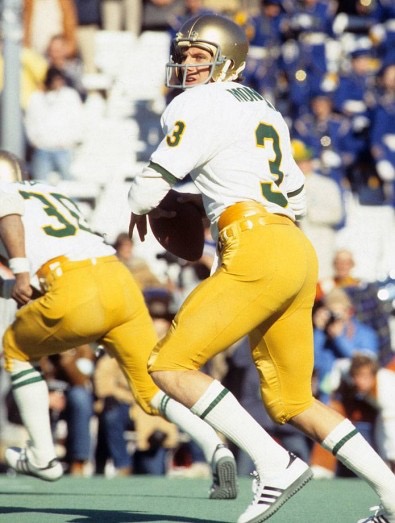
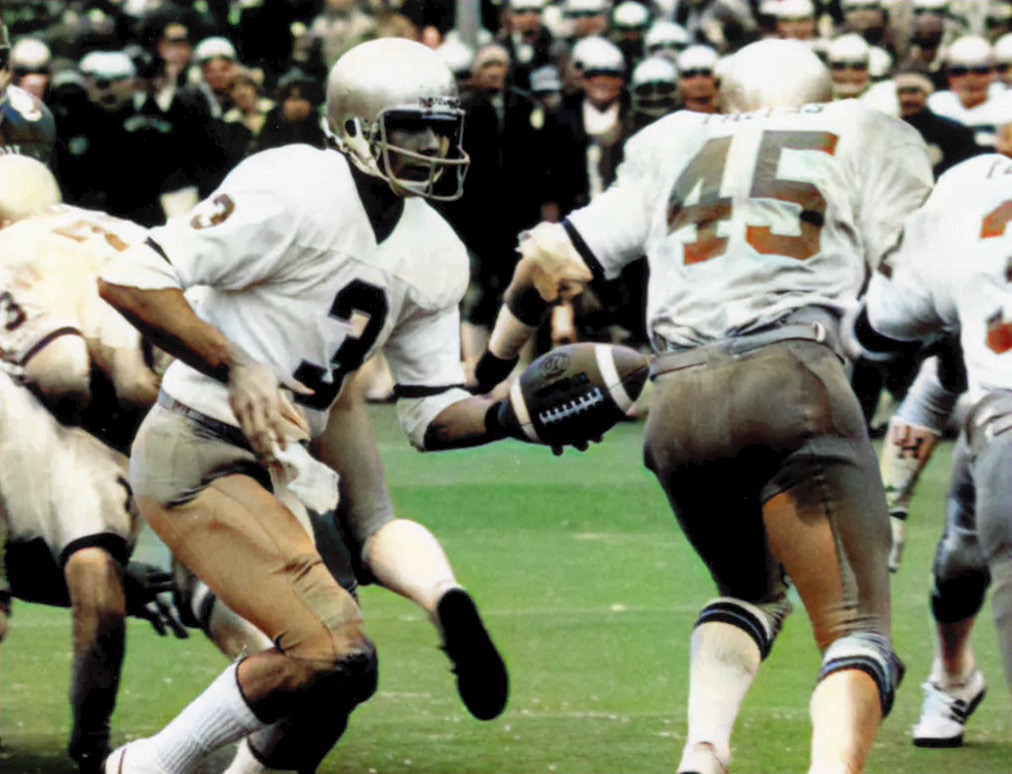
The Fighting Irish football team, led by legendary quarterback Joe Montana, delivered one of the most unforgettable comebacks in college football history. Despite a disappointing regular season that left them out of national title contention, Notre Dame finished strong with a trip to the Cotton Bowl on January 1, 1979, to face the Houston Cougars.

That day in Dallas was bitterly cold, with wind chills dipping below zero, and Montana — already battling the flu — suffered from hypothermia and had to be taken to the locker room. Trainers wrapped him in blankets and fed him warm chicken soup to bring his body temperature back up.

The Chicken Soup Game

Miraculously, Montana returned to the field in the fourth quarter with the Irish trailing 34–12. What followed was pure magic. Montana led three late scoring drives, capped by a last-second touchdown pass and a two-point conversion to win the game 35–34. The comeback sealed Joe’s reputation as “The Comeback Kid” and helped propel Notre Dame to a №6 national ranking by the end of the season. And the game has since been affectionately refered to as “The Chicken Soup Game.”

Fighting Irish Men’s Basketball

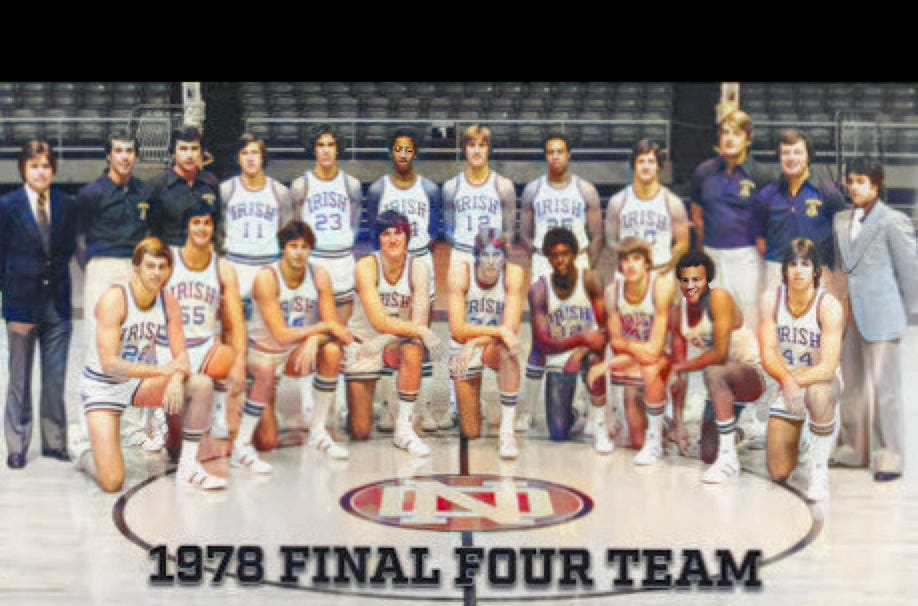
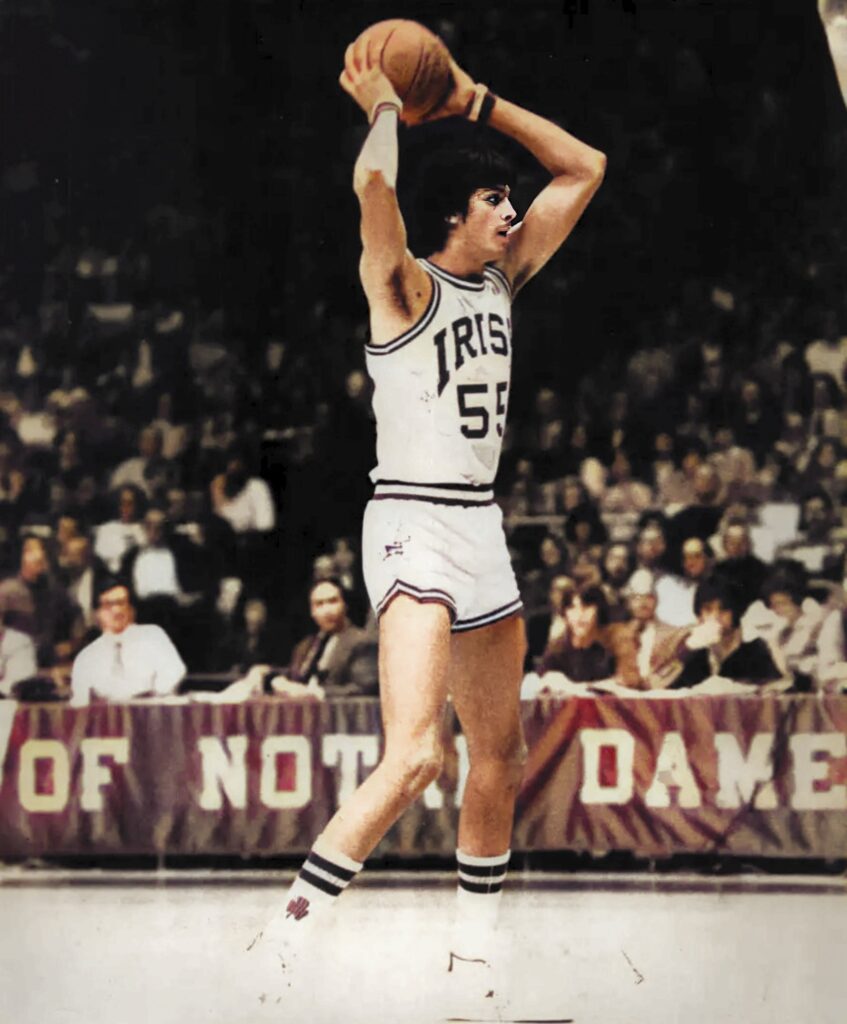
The basketball team also made headlines that year. The Notre Dame men’s basketball team, coached by Digger Phelps, posted a stellar 24–6 record and finished the season ranked #4 in the nation. With a dynamic roster that included sharp-shooter Kelly Tripuka and 6-foot-11-inch center Gill Salinas, the team played with speed, skill, and strength.

University of Notre Dame Fighting Irish Mens Basketball Team. Final 4 1978. Autobiography of Dr. Anthony J. Carbone.

Classmates Kelly Tripuka and Gil Salinas

It was a thrill for me to sit in class with both Kelly Tripuka and Gill Salinas, knowing they would later take the court in nationally televised games. The energy on campus during basketball season was electric, with high expectations and intense pride in our Fighting Irish.

Fighting Irish Scholar-Athletes

Notre Dame prides itself on being home to true scholar-athletes, where academic excellence is expected of every student — regardless of how many touchdowns they score or rebounds they grab. The Irish have had more Academic All-Americans than any other school in baseball and women’s soccer, while also cracking the top-10 in football (third), men’s at-large (third), softball (eighth), men’s basketball (ninth) and men’s track/cross country (tenth).

Banner that reads, "Notre Dame's Academic All-Americans--A Legacy of Athletic and Academic Success". Autobiography of Dr. Anthony J. Carbone.

Before every football game, when the public address announcer introduced each Fighting Irish starter, he also announced their academic major — and I was humbled by how many of them were Pre-MedEngineering, or other tough majors. I was barely surviving my own academic load, and here were these guys playing top-tier NCAA football while preparing for med school.

I remember one day in Theology class with Gil Salinas, our star basketball center, when the professor asked him to stand and explain why he wasn’t traveling with the team. Gill quietly admitted that his GPA had slipped below the required standard, and he’d been benched until he brought it back up. Thank God he did — quickly.

Easter Holiday 1979

Easter Holiday was April 13–16 this year, and it was too close to summer break to afford another trip home. So Mariann invited me home to Wheaton, Illinois to meet the rest of the family. I think we traveled by train from South Bend to Chicago and then took the commuter rail from downtown to Wheaton.

I was nervous as hell meeting Mr. John Schmitz. He was a large framed, grey haired gentleman. I remember that he grilled me like fathers do when they meet the new boyfriend the first time. He had that no-nonsense German way about him, wearing a tweed jacket and smoking a pipe. Mariann’s mother, Sara(fina), was a beautiful Italian-American lady. She was very kind to me. 

Mariann came from a huge family. Only her sister Sue was married and not living home. Everyone else was still living at home, including her older brother John. I was suprised that John was still living at home at his age, but I learned that John had been in a terrible automobile accident and I think someone died, and he was living at home to save money to repay his father.

I think the Mrs. Schmitz gave me John Jr’s bedroom. He lived in the basement and had a dark, wood-paneled bedroom with a king-size waterbed. I had never slept on a waterbed prior to that, and I never wanted one afterwards. I remember Mariann coming downstairs to visit me and I was scared to death that Mr. Schmitz would pop in with a shotgun.

Back to Campus

Mari and I returned to Notre Dame on Easter Monday, with spring final exams just three weeks away. The last stretch of the semester was a blur of long nights in the library, cram sessions, and that familiar, gnawing anxiety that came final examinations. I especially hated courses with papers and blue-book exams like Theology. When the last test was turned in, the relief was immediate — and quickly replaced by the bittersweet reality of saying goodbye for the summer.

Packing Up Dorm Rooms & Saying Goodbye

I surprised myself with how sad I felt saying goodbye to Mariann for the summer. I was still unsettled that I had fallen for someone this much, this soon — it wasn’t the carefree college experience I had imagined for myself. But it was too late. I had already met my other half, and anyone who knew us both would have agreed without hesitation that she was my “better half.”

I packed up both of our dorm rooms, carefully stacking boxes and making sure everything went into the storage the university provided — though I’m sure they charged us some fee for it. Then Mari’s brother, John, arrived to pick her up and take her home to Wheaton. He offered me a ride to the airport. Saying goodbye in front of him felt awkward, so I kept it short, but I already missed her before she was even out of sight.

Flight to Kansas City

As I boarded my flight home, I knew it was going to be a long summer. And judging by how much we were already talking about calling each other, I also knew it was going to come with some very expensive phone bills.

Home Page