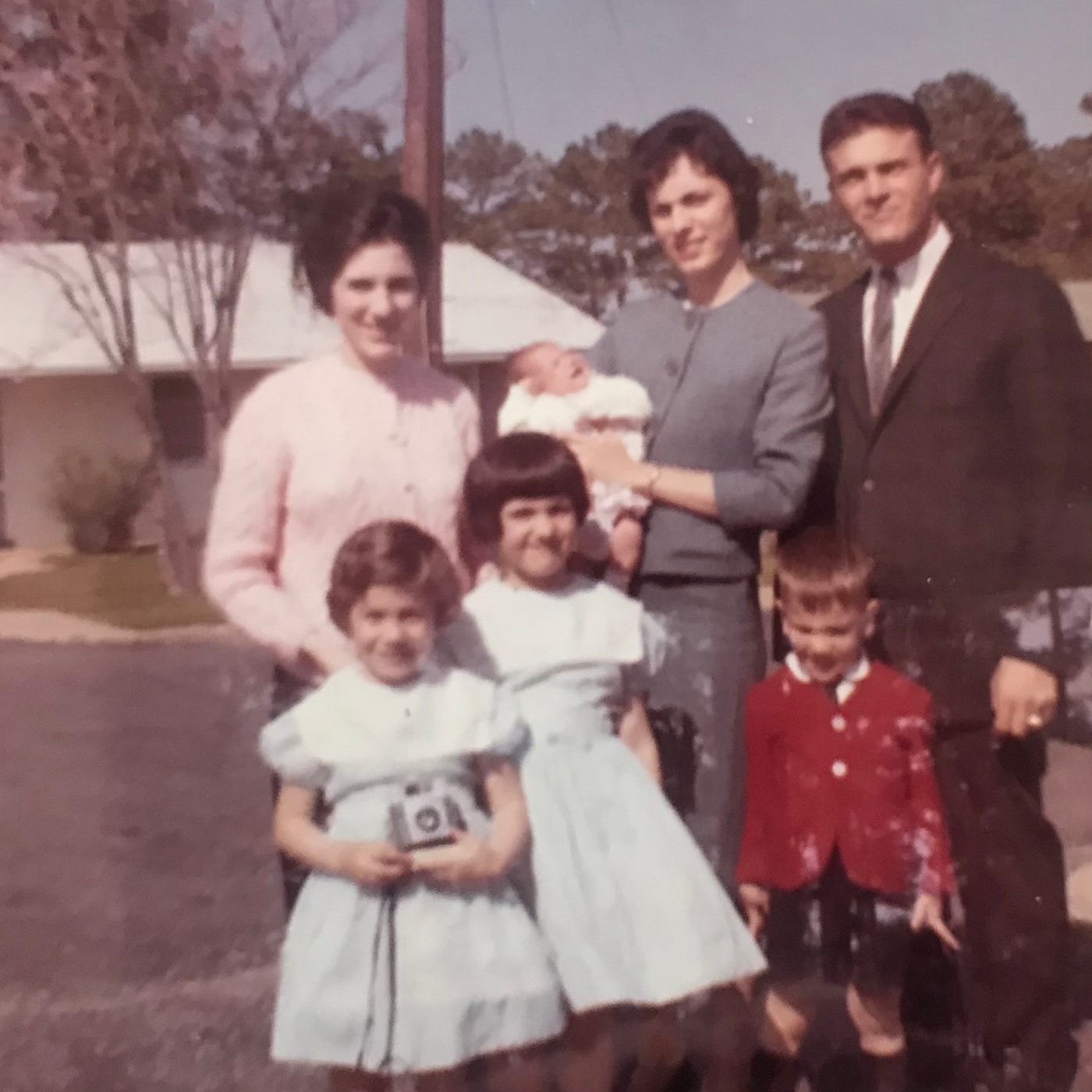
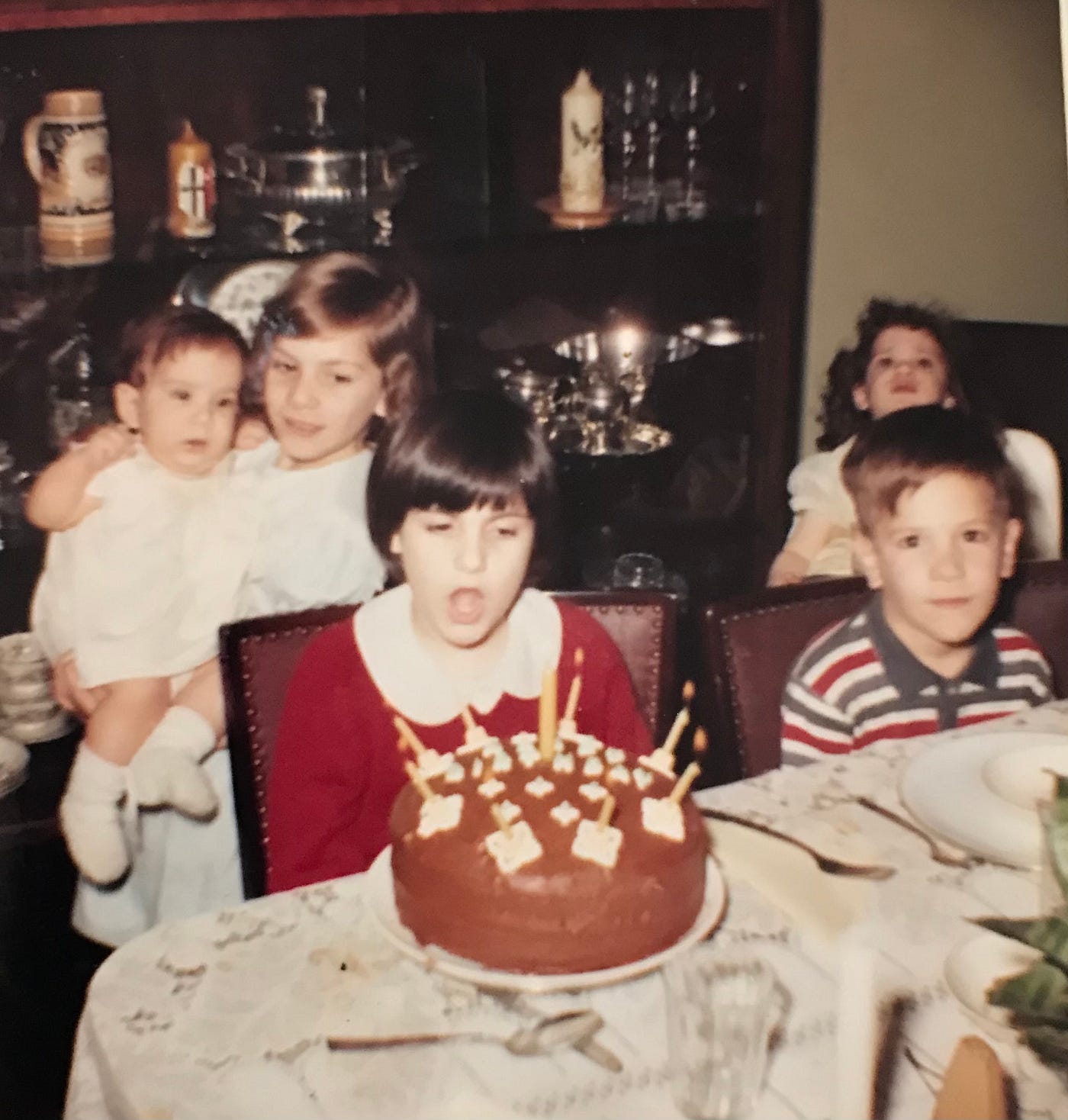
Believe Nothing You Hear, and Only Half of What You See—A Memoir of Service, Shame, and the Search for Truth
Return to Norwich University
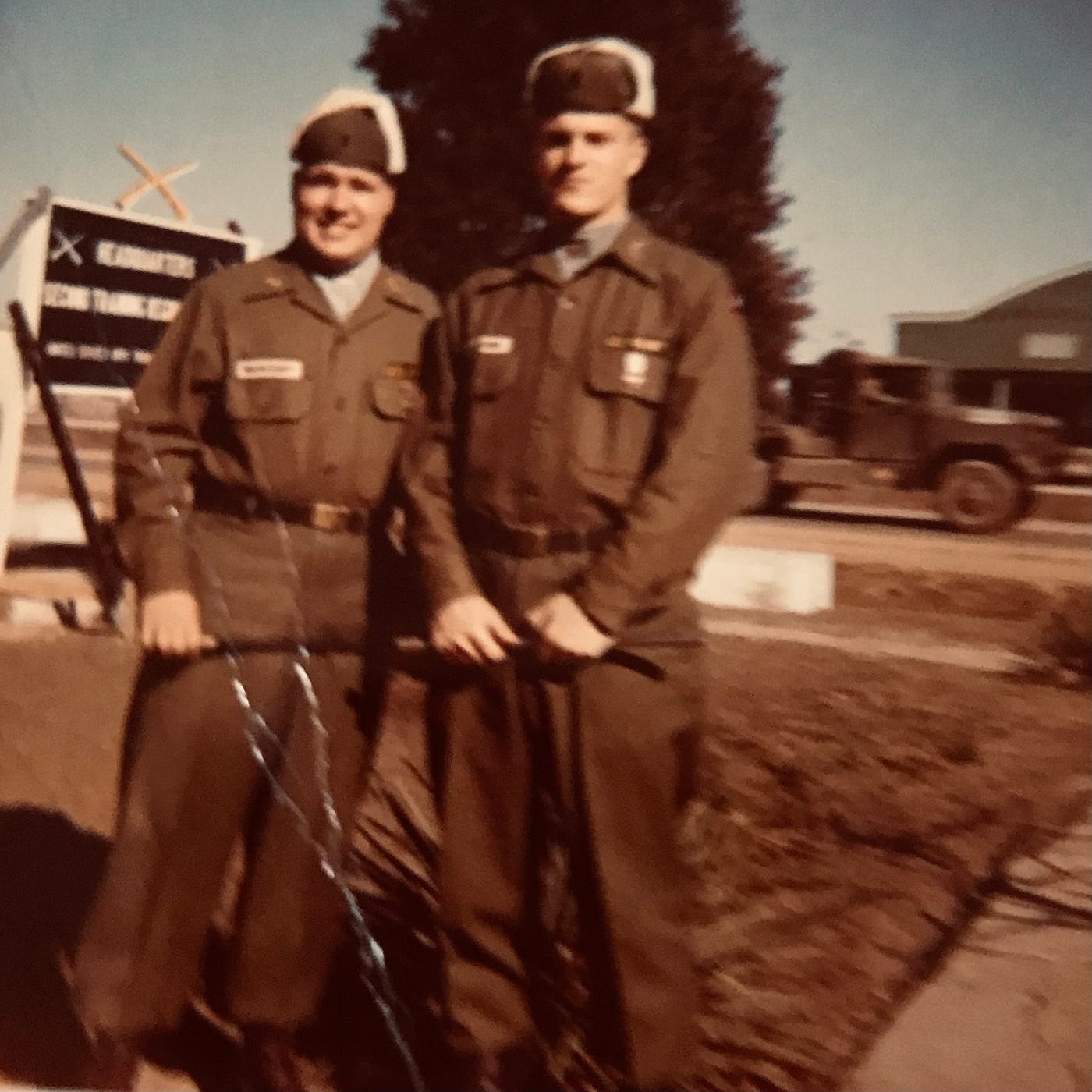
After completing his tour of duty in Korea, my father received new orders that must have filled him with pride: he was to return to his alma mater, Norwich University — the Military College of Vermont — as an Assistant Professor of Military Science. For him, it was more than just a job; it was a return to the place that had shaped him as a young man and launched his military career. For our family, it became a unique and vivid chapter — one filled with snowy landscapes, small-town charm, and a few lessons we never forgot.
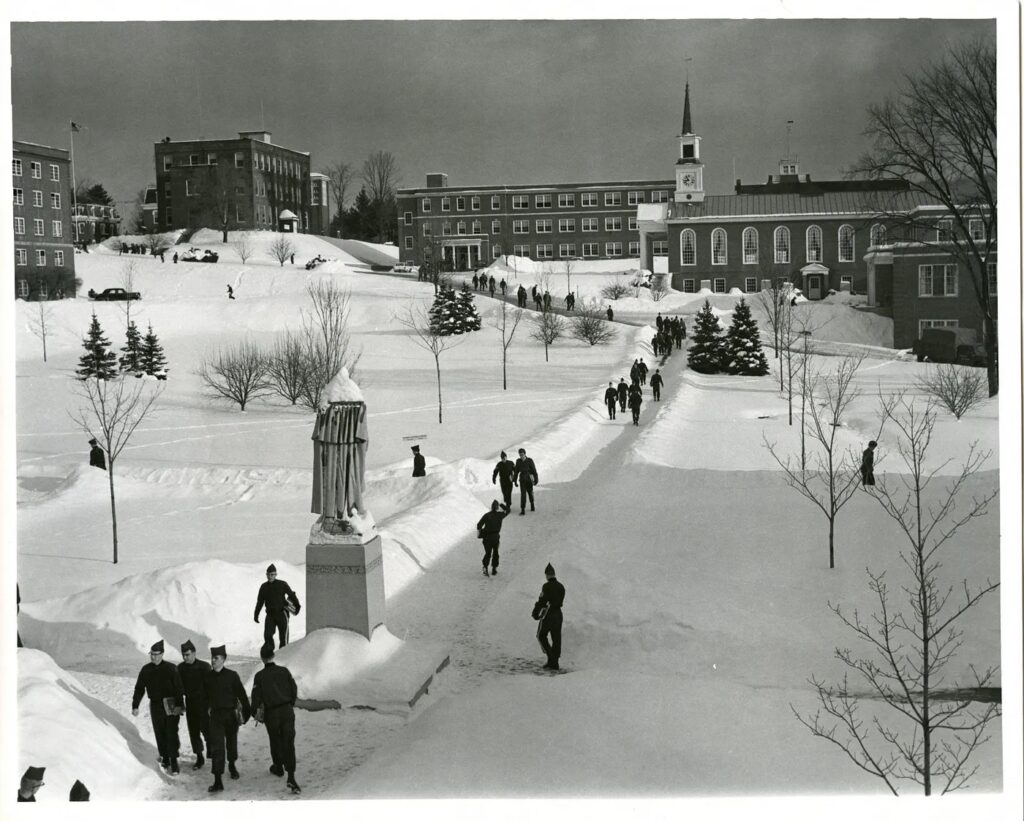
Cadets walking on snow-covered campus of Norwich University.
We move to off-campus house in Northfield, Vermont
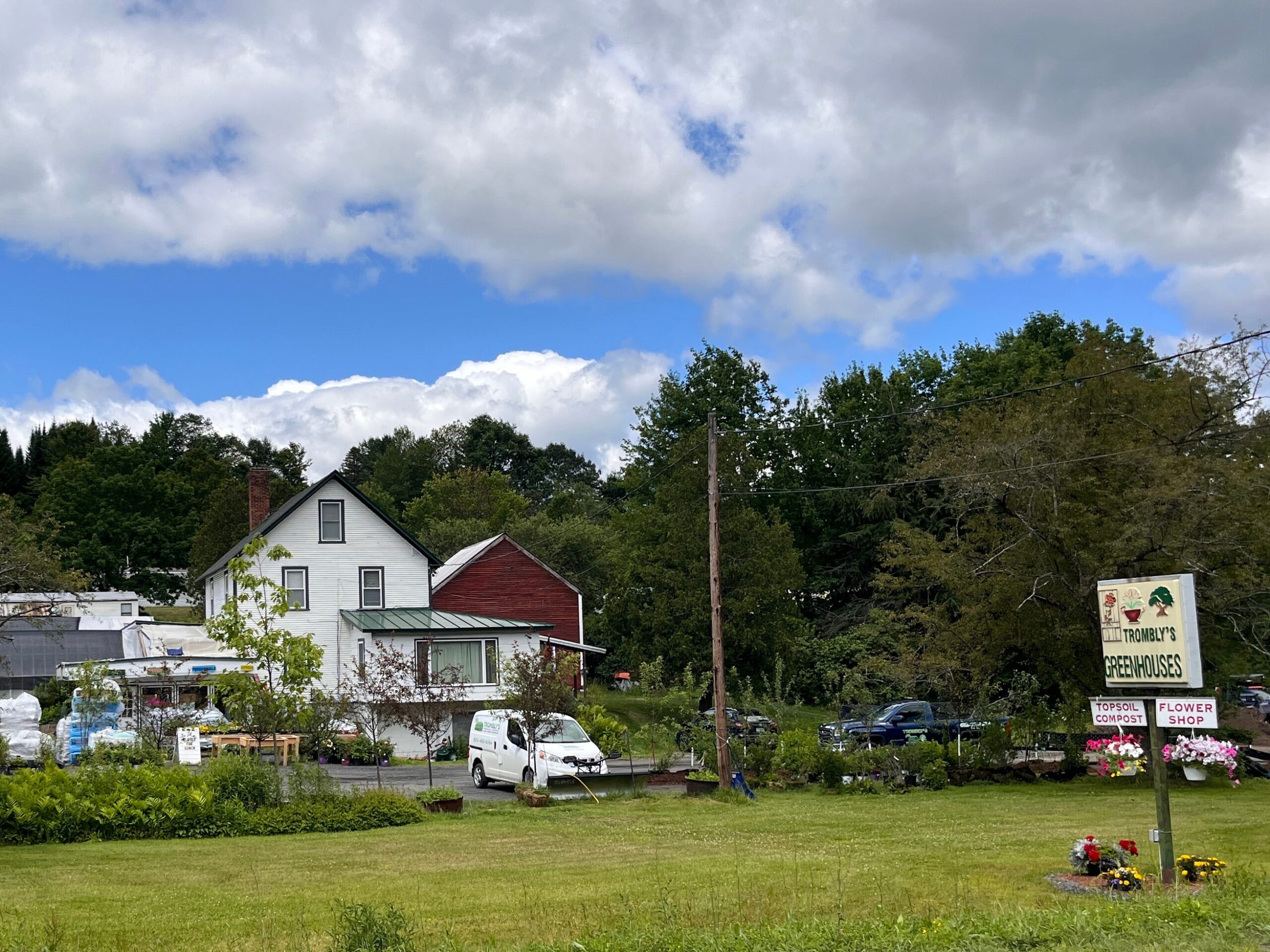
We moved into a modest white ranch house at the foot of the Norwich ski slope, within easy walking distance of the campus. The house was small but cozy, and the setting was pure Vermont. Behind us sat Trombley’s greenhouse, where we could buy ears of corn and other fresh vegetables. It was one of those places where the seasons announced themselves through what was available at the roadside stand.
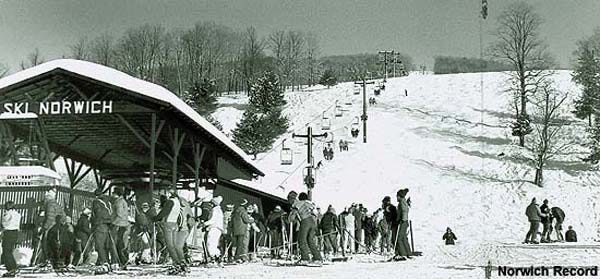
Norwich University Ski Slope & Lift across the street from our home in Northfield.
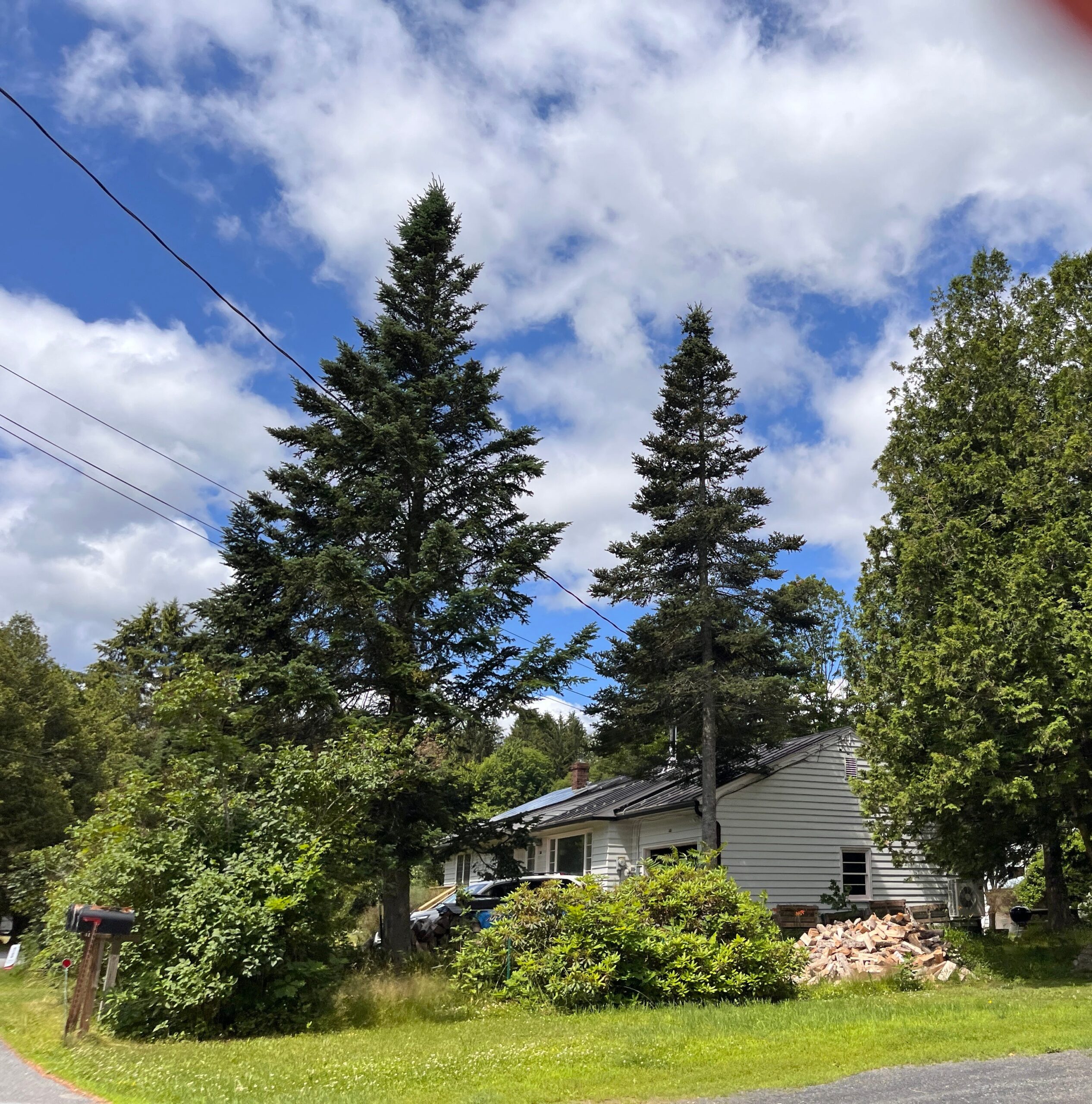
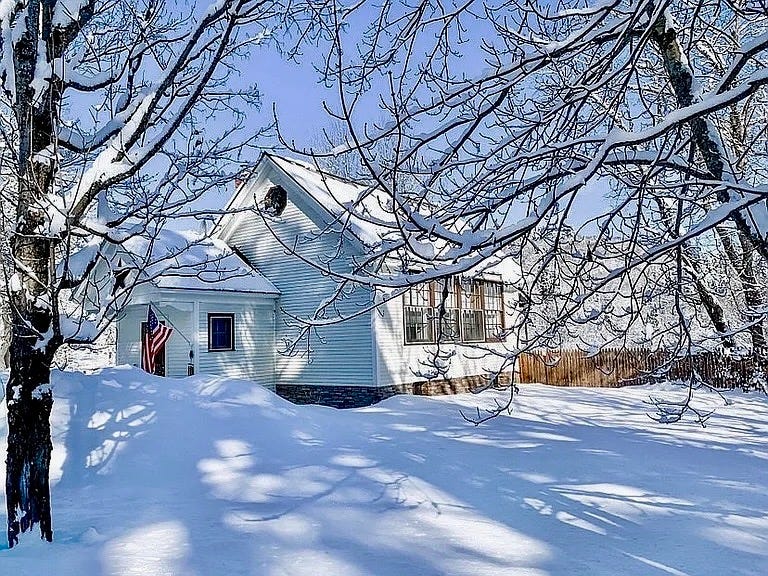
Our home on Terrace Place in Northfield, Vermont where we lived while my father was working at Norwich University (his alma mater) as the Assistant Professor of Military Science (PMS).
Trombly’s Greenhouse near our home in Northfield, Vermont where we bought fresh corn and eggs.
Lynne goes to 5th Grade in One-Room Schoolhouse
My oldest sister, Lynne, went to fifth grade in a tiny white, one-room schoolhouse located in Rabbit Hollow. The school was so small that it only served fifth graders.
One-Room Schoolhouse at Rabbit Hollow where my sister Lynne attended 5th Grade while we lived in Northfield, Vermont.
Diana and I attend 4th & 3rd Grade Together
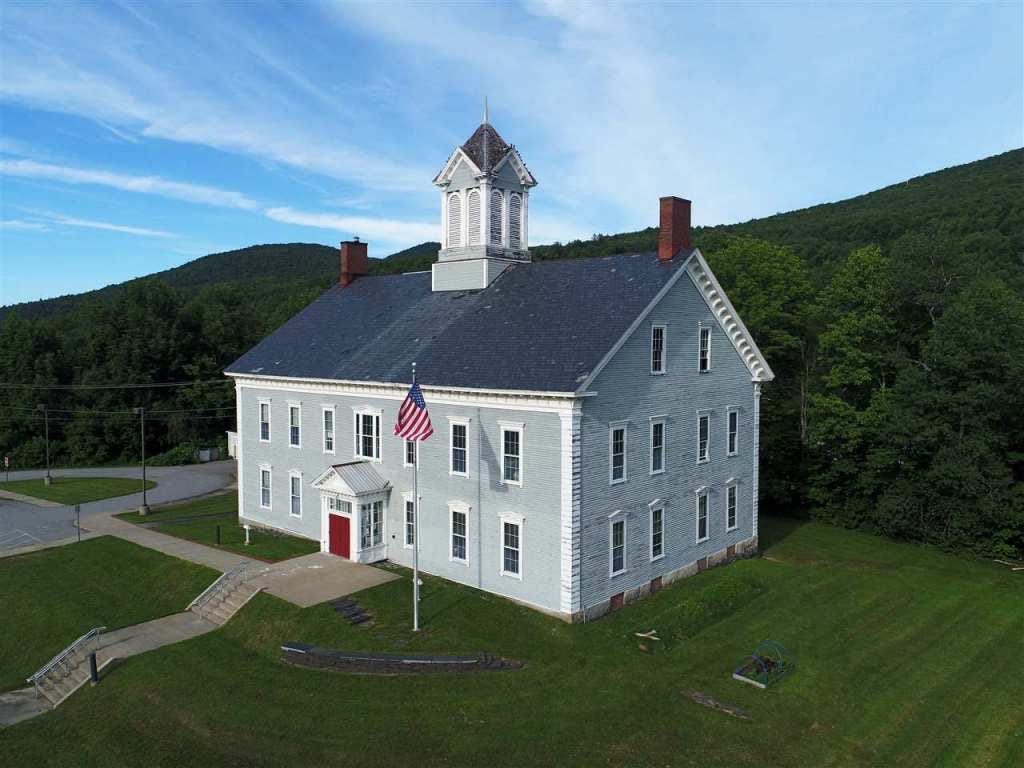
Meanwhile, Diana and I were enrolled in a two-story gray schoolhouse in Northfield that taught only third and fourth grades. She was in fourth, I was in third — and I loved knowing she was just a floor away. We rode the bus together each morning and afternoon, and often shared lunch in the cafeteria tucked down in the basement.
Northfield Grade School in the Gray Building in Northfield, Vermont where Diana and I attended 3rd and 4th grade while my father worked at Norwich University.
My favorite school cafeteria
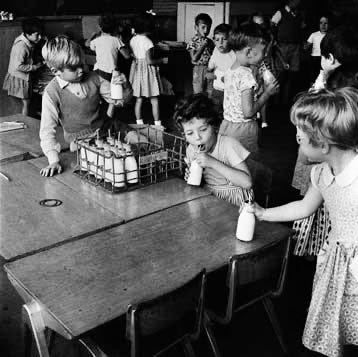
That basement cafeteria remains one of my warmest memories — especially on bitter Vermont winter days. The meals were like no other school lunches I’ve ever had. A typical menu might include a warm biscuit smothered in Chicken à la King, served alongside milk that came in small glass bottles sealed with silver foil tops. At least once a day, someone would drop a bottle, and it would shatter spectacularly on the floor. The room would erupt into clapping and cheers, as if we had just witnessed a performance.
Cold, fresh milk in tiny glass bottles
Drinking milk from small glass bottles in cafeteria.
Missed out on learning cursive penmanship
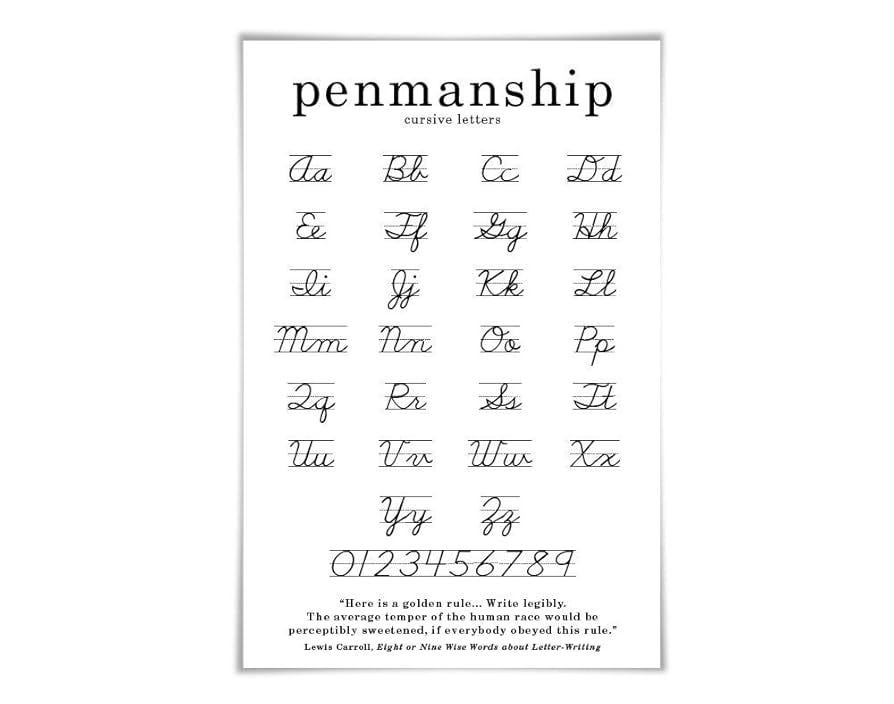
School life had its challenges, though. In Vermont, students were taught cursive writing with ink pens in the second grade. But I had just come from the German school system, where cursive wasn’t introduced until third grade. My new teacher seemed annoyed that I hadn’t learned it yet, and I remember feeling confused and even a little ashamed. It struck me as strange — even as an eight-year-old — that in a town with a military college, someone wouldn’t expect a student from out of state, or even another country. Eventually, my teacher allowed me to keep printing with a pencil, and I wouldn’t truly learn cursive until years later, when my college girlfriend Marianne patiently taught me proper penmanship. To this day, I still write in clear block letters and rarely use cursive.
Penmanship Poster similar to the one hanging up in my 3rd Grade classroom.
While we were adjusting to Vermont life, my father was thriving. As the Assistant Professor of Military Science (PMS), he helped lead the Army ROTC program, teaching courses in close-order drill, map reading, and land navigation. I know he took real pride in shaping young cadets on the same campus where he had once marched across the quad himself. It must have felt like coming full circle.
Norwich University Cadet Handbook
Winter and Hockey in Vermont
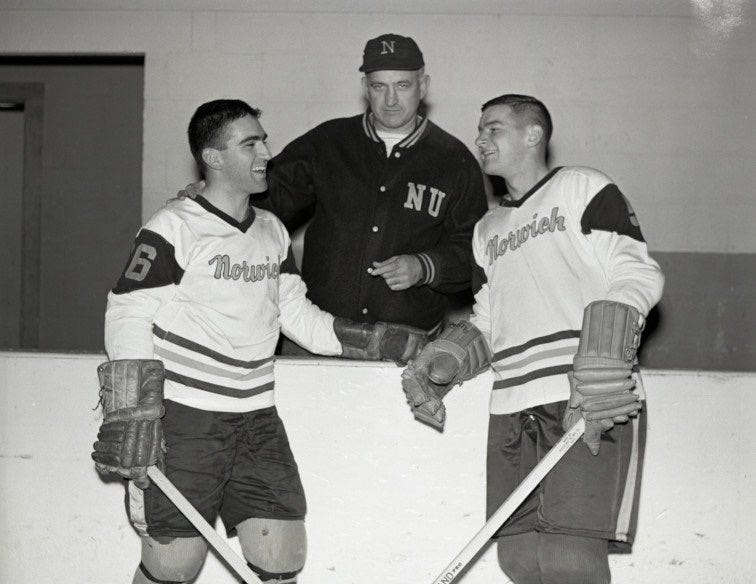
As you might expect, winters in Vermont were long, dark, and cold — but the locals seemed to thrive on it. Skiing and hockey weren’t just hobbies — they were part of the culture. Hoping I might assimilate, my father signed me up for hockey lessons offered by the Norwich University hockey coach. I gave it my best, but most of the kids had been skating since they could walk. On the other hand, I was stumbling around in skates that felt at least two sizes too small. I spent more time falling than skating, and one hard fall even chipped my front teeth. That was pretty much the beginning and end of my hockey career.
Norwich University Cadet Hockey Players and the Hockey Coach
Northfield Townies
Northfield was a tiny town — just over 3,400 residents in 1960. By 1967, Norwich had about 1,200 cadets, meaning they made up nearly a quarter of the town’s population. But despite that, there was always a strange tension between the college and the townspeople. For whatever reason, the locals didn’t seem particularly fond of the institution that helped sustain their town. The only time that changed was during hockey season — if the Norwich Cadets were winning, the townsfolk would turn out to cheer. Otherwise, the university and the town existed on mostly separate tracks.
Close to the Pietrantonis in Medford
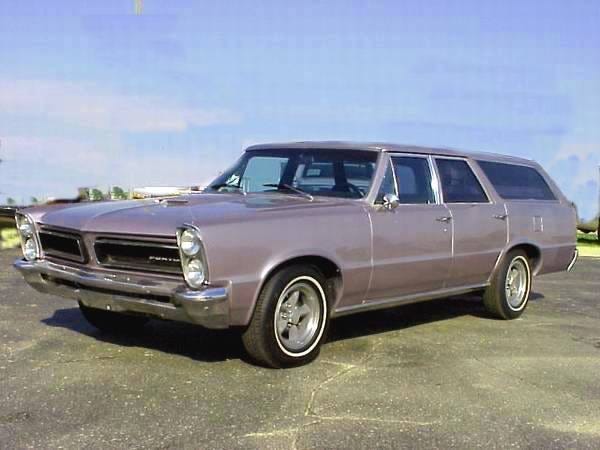
One of the real blessings of that year in Vermont was our proximity to family. Northfield is less than three hours north of Boston, which meant we were finally living close to my mother’s side of the family in Medford. We visited my grandparents’ house often, and my aunts would come up to Vermont when they could. After years of being stationed far from home, it was special to have holidays, birthdays, or even just weekend visits that didn’t require a cross-country drive or plane ride. That closeness was a quiet comfort that made the cold winters feel warmer.
We drove in a 1967 Pontiac Tempest Stationwagon
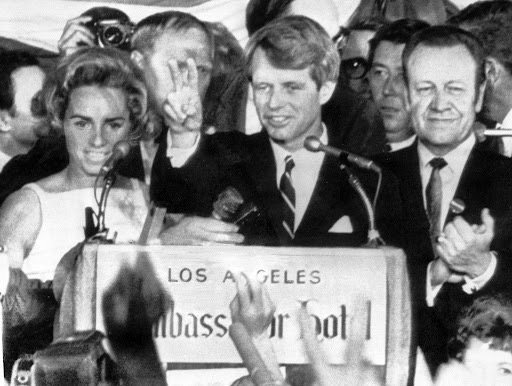
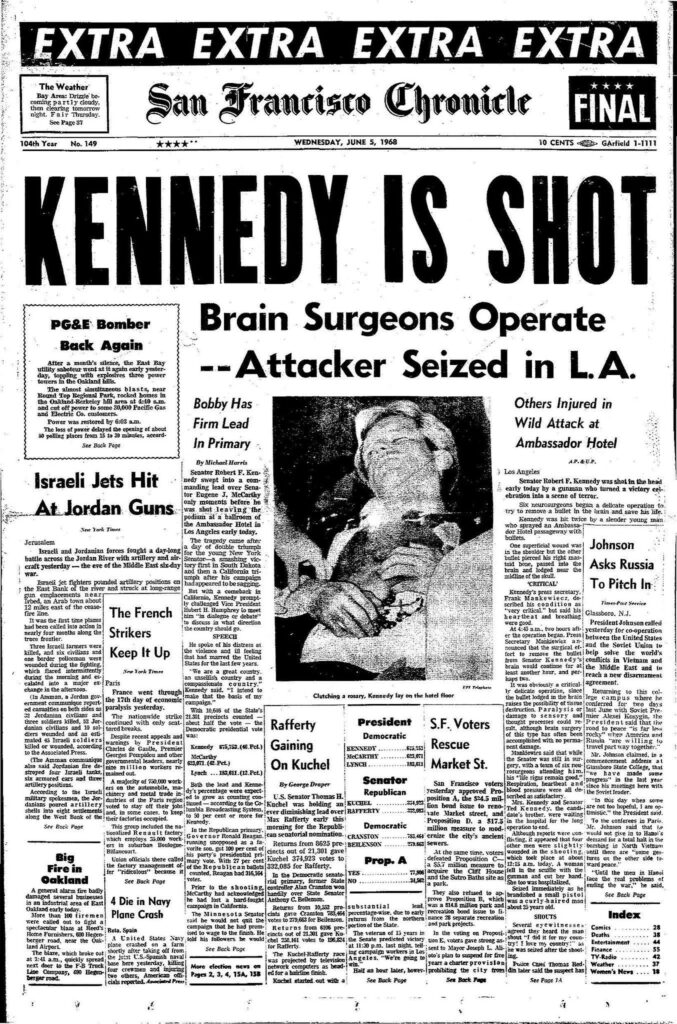
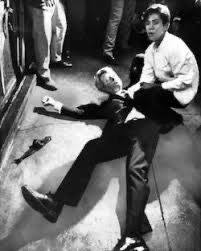
Assassination of Senator Robert Kennedy (June 6, 1968)
It was the morning of June 6, 1968, and my mother had sent me over to Trombley’s Greenhouse to pick up some milk and eggs. The day was bright and beautiful, and I remember stopping in a field along the way to admire a robin’s nest with four perfect blue eggs inside. That simple sight filled me with joy. But when I returned home, the mood was completely different. I could sense immediately that something was wrong. My mother told me that Senator Robert Kennedy had been shot by an assassin. I was still too young to fully understand the concepts of evil and murder, but I knew it was something terrible.
Only a few years earlier, I had sat in front of the television as a very small boy when President John F. Kennedy was assassinated. Now, it was his younger brother. Just eight weeks earlier, on April 4, 1968, Martin Luther King Jr. had also been assassinated. As a young boy, I struggled to process it all — the war in Vietnam that I only partly understood, and these assassinations of leaders I heard my parents speak about with respect and admiration. It felt like the world was unraveling. I remember being deeply confused, wondering why so many good men were being taken away, and why violence seemed to surround everything I was trying to make sense of.
Time to Move Again
Our year in Vermont was brief, but it stands out in memory as something rare and quietly golden. There was a steadiness to life that year — a rhythm built on snow, school buses, cafeteria clatter, and my father’s cadets drilling in neat formation. It was a pause between larger, louder chapters. And though we didn’t know it at the time, those moments would stay with us longer than many others.
Believe Nothing You Hear, and Only Half of What You See—A Memoir of Service, Shame, and the Search for Truth
Assignment to MACV as Cavalry Tactical Advisor in Vietnam
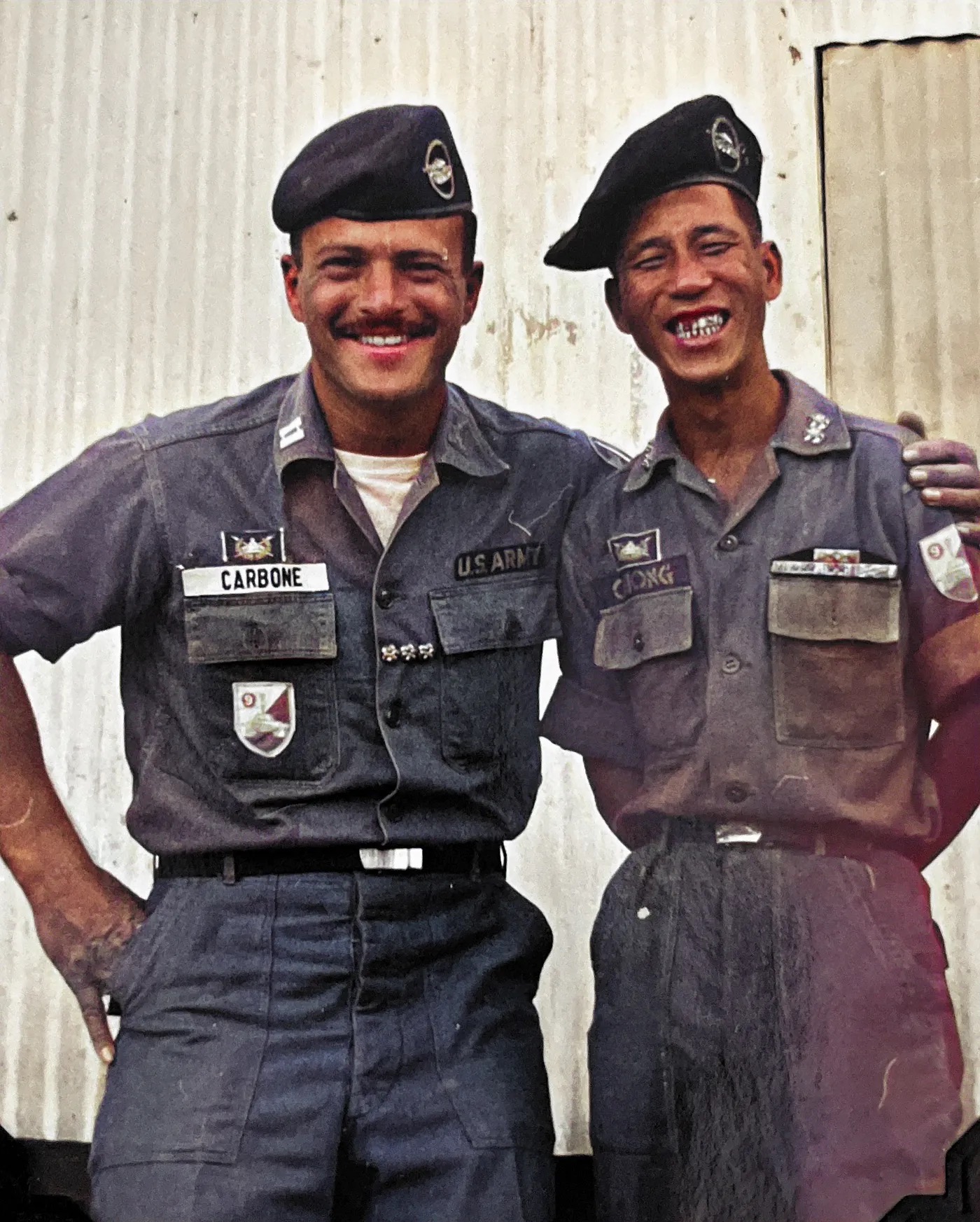
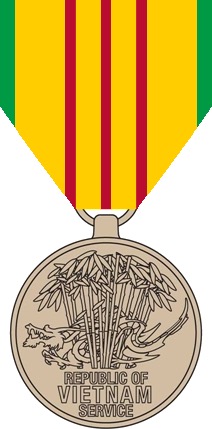
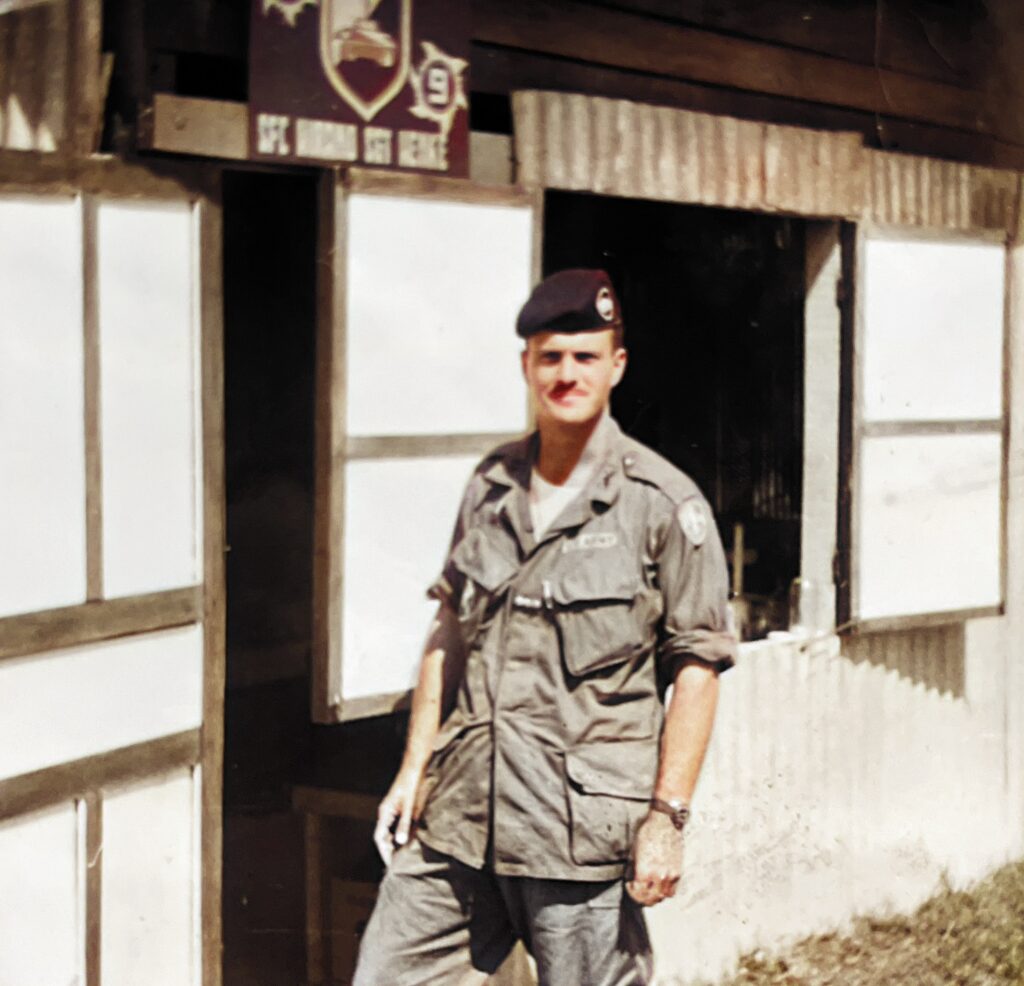
In 1966, the war in Vietnam escalated, and our family felt its reach personally. My father received orders from the Pentagon to deploy to the Republic of Vietnam, assigned to the Military Assistance Command, Vietnam — MACV — as a U.S. Army advisor. It was his first tour, and he would spend the next year embedded with Army of the Republic of Vietnam (ARVN) cavalry and armored units in the Mekong Delta, particularly near Bac Lieu, Tan An, and Soc Trang. His mission was to help train, advise, and support the South Vietnamese military as they fought to reclaim and secure their homeland from the Viet Cong insurgency and the growing threat of the North Vietnamese Army.
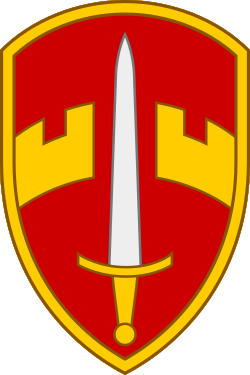
U.S. Military Assistance Command Vietnam (MACV) Patch
Dad Enjoyed His First Tour in Vietnam as a Tactical Advisor to an ARVN Cavalry Unit
My father seemed to genuinely enjoy this first tour, especially compared to the more grueling Special Operations tour he would undertake later. He fell in love with the Vietnamese people — their resilience, their warmth, and especially their children. His photo albums from this era are full of beautiful, candid photographs of everyday life in the Mekong Delta: women carrying baskets at the market, children waving at the camera, families riding bicycles, soldiers resting between patrols. He always had a camera slung over his shoulder and took great pride in arranging these moments into carefully assembled albums that told his story. His affection for the people and the land of Vietnam is evident in every image.
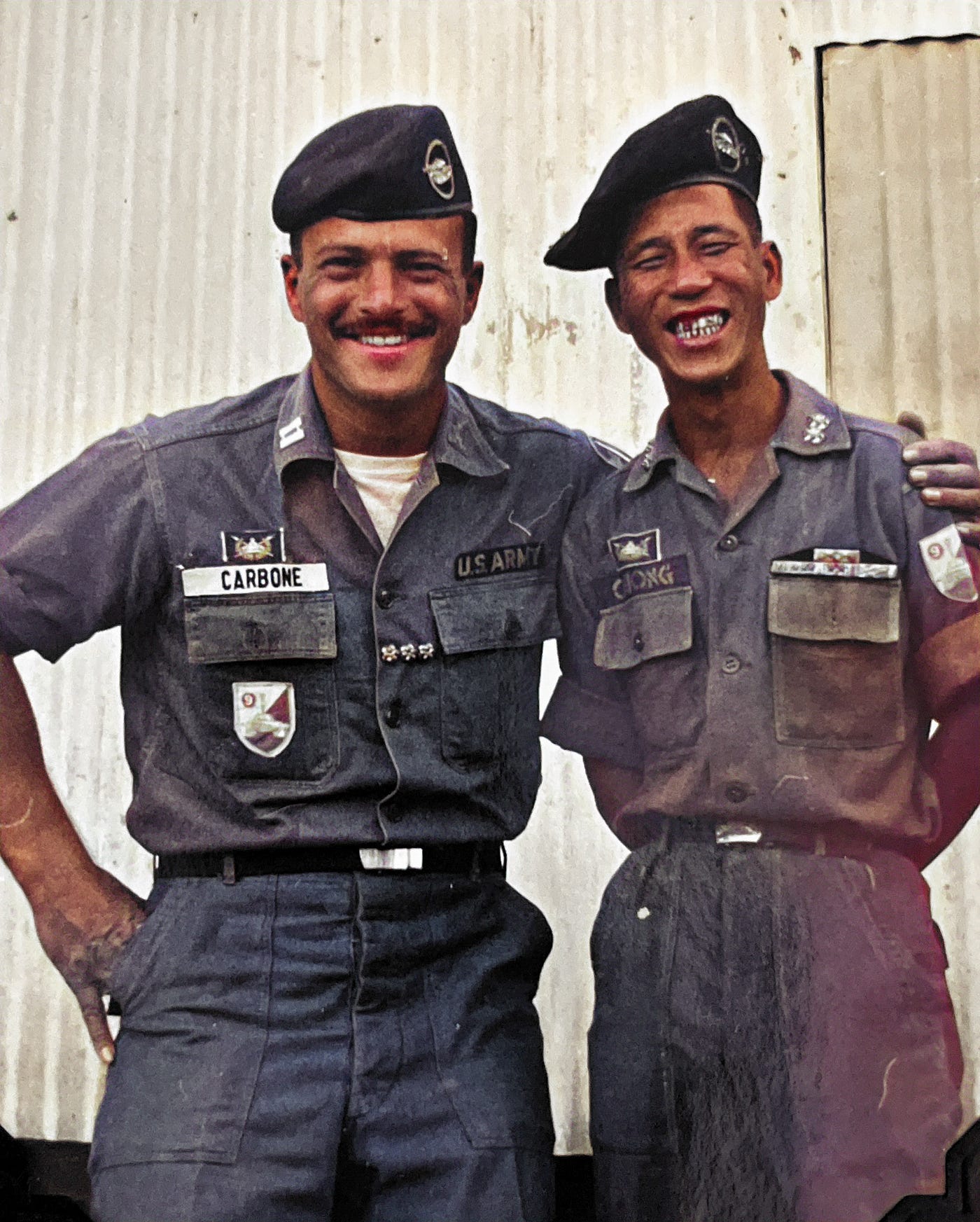
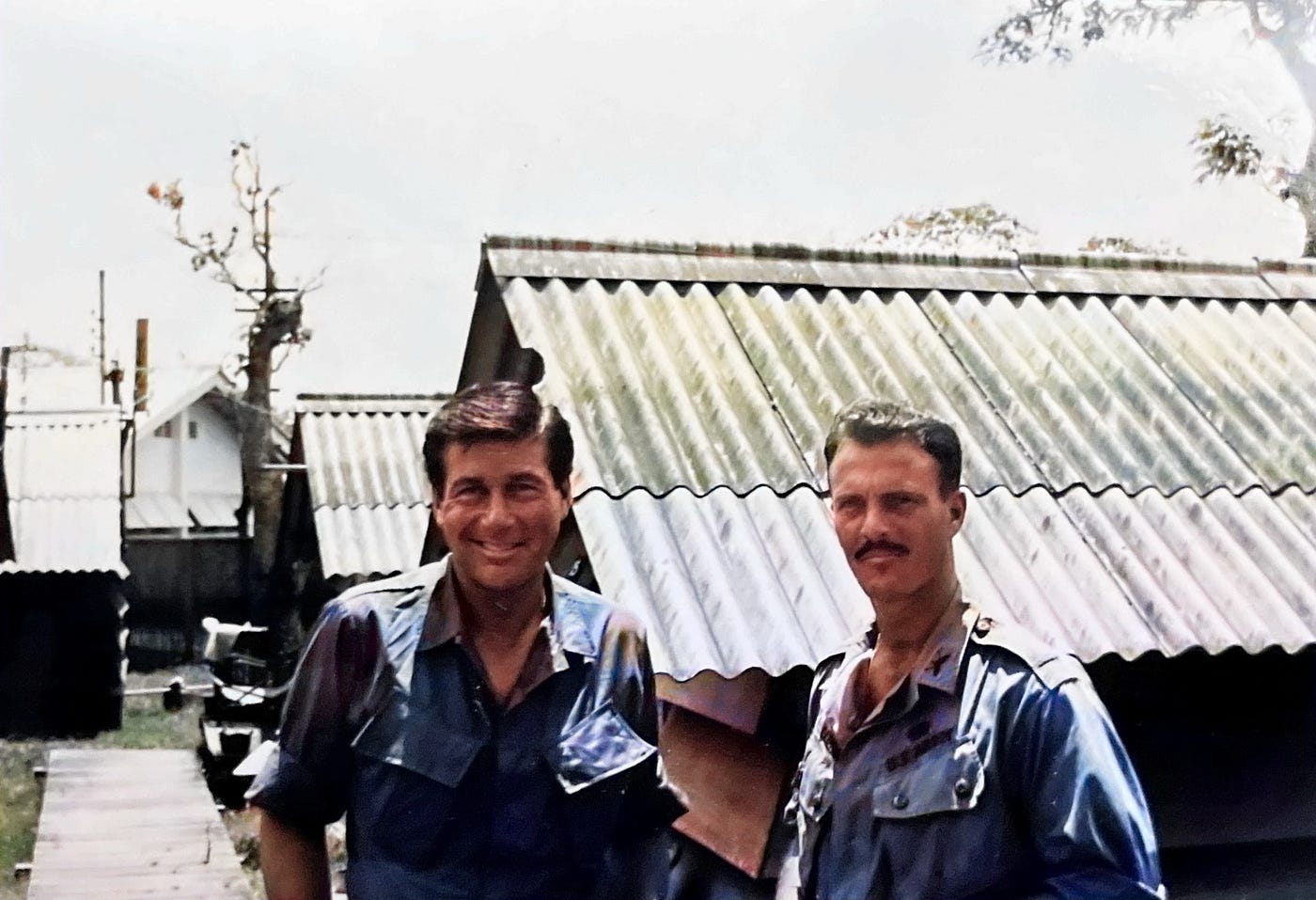
Captain Carbone with one of the many South Vietname officers that he advised.
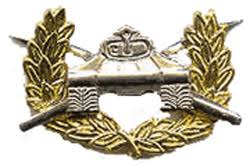
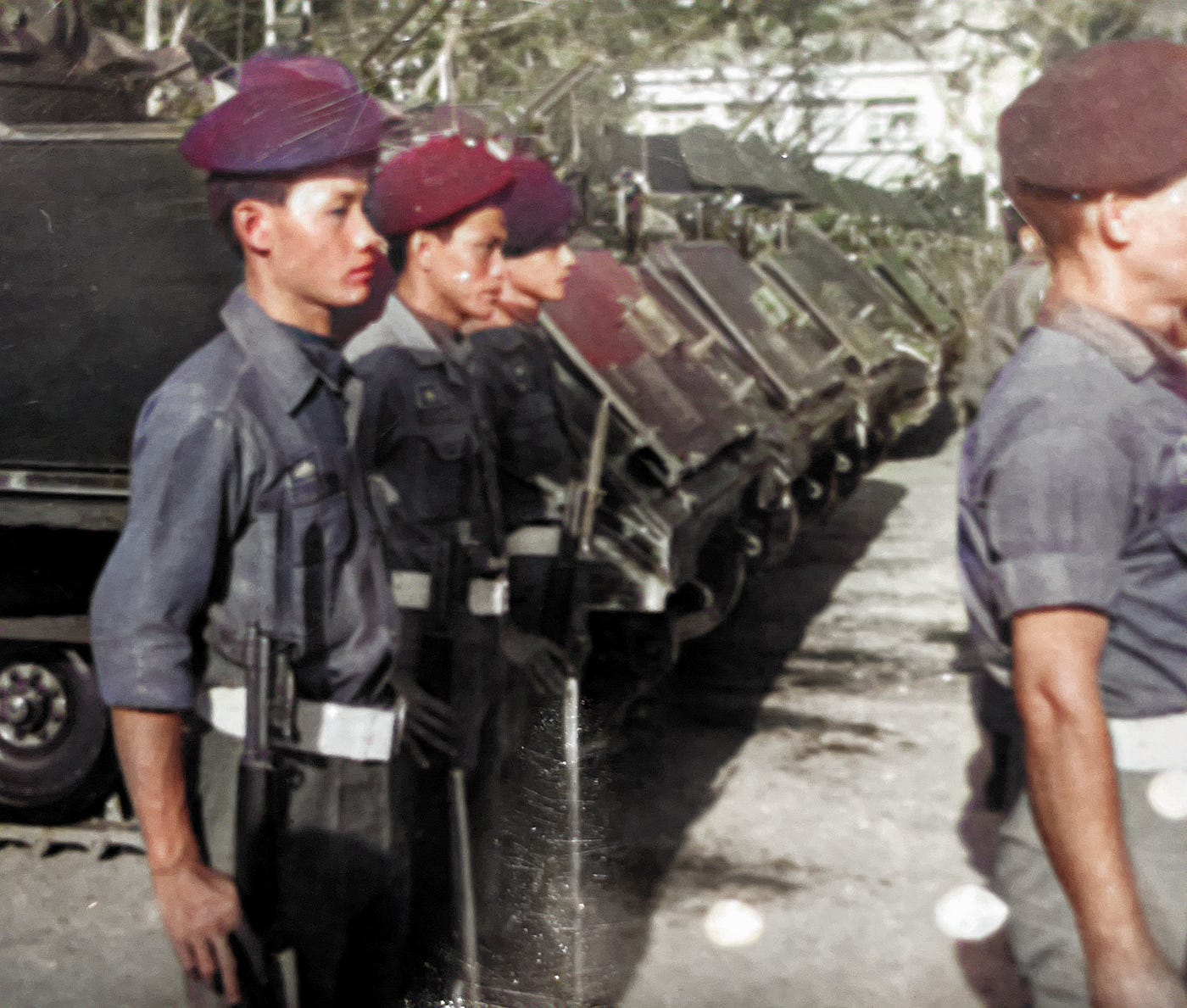
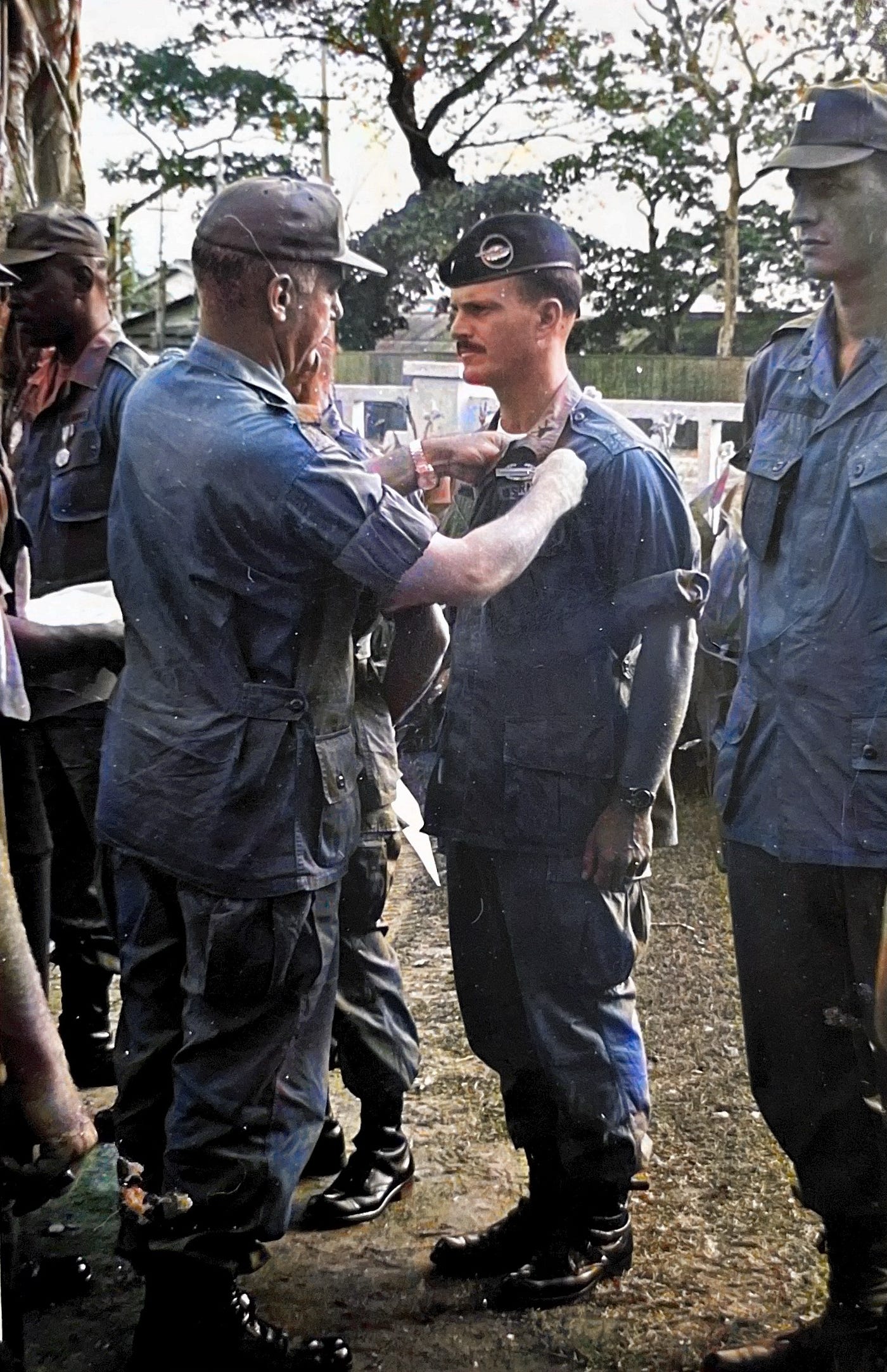
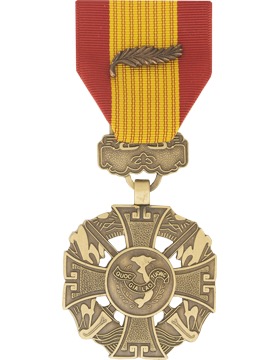
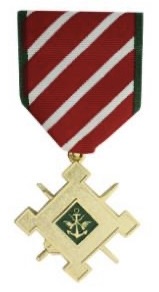
Dad is Awarded the ARVN Armor Officer Black Beret & Tankers Badge
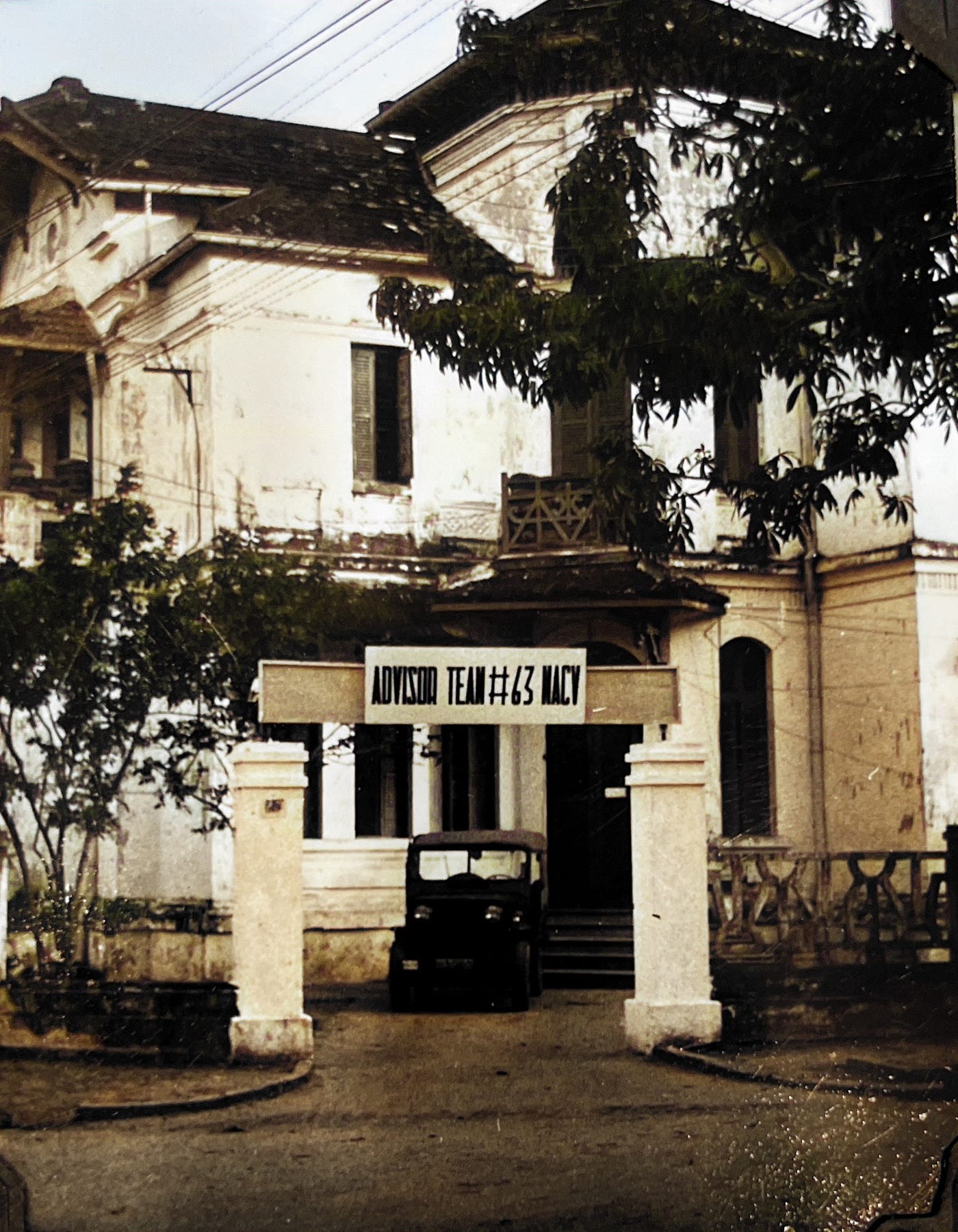
Dad was member of MACV Advisor Team #63 in Sóc Trăng
MACV Advisory Team #63 in Sóc Trăng
Army of Republic of Vietnam (ARVN) 17th Cavalry ready for inspection.
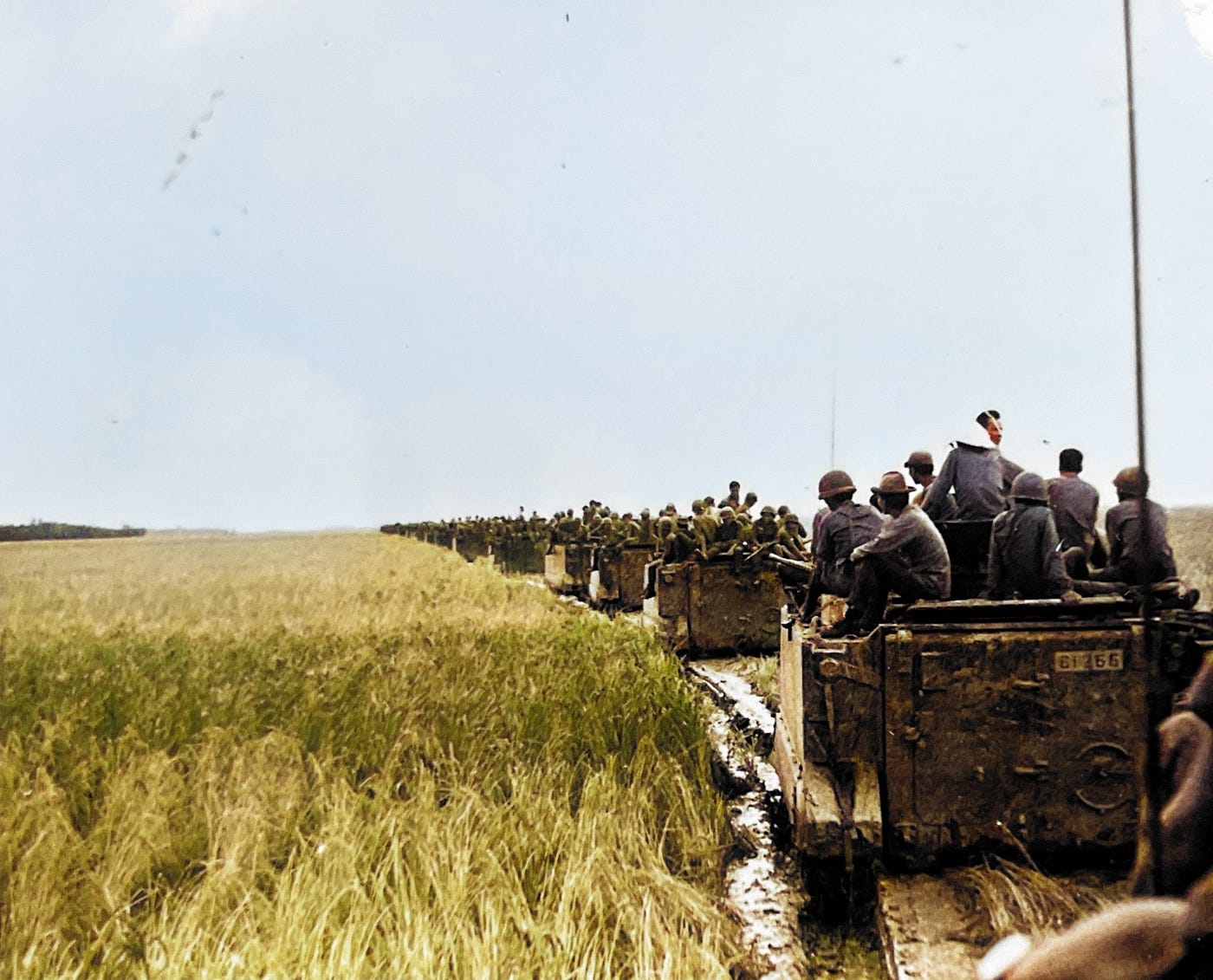
Republic of Vietnam Armored Unit on Patrol in Mekong Delta
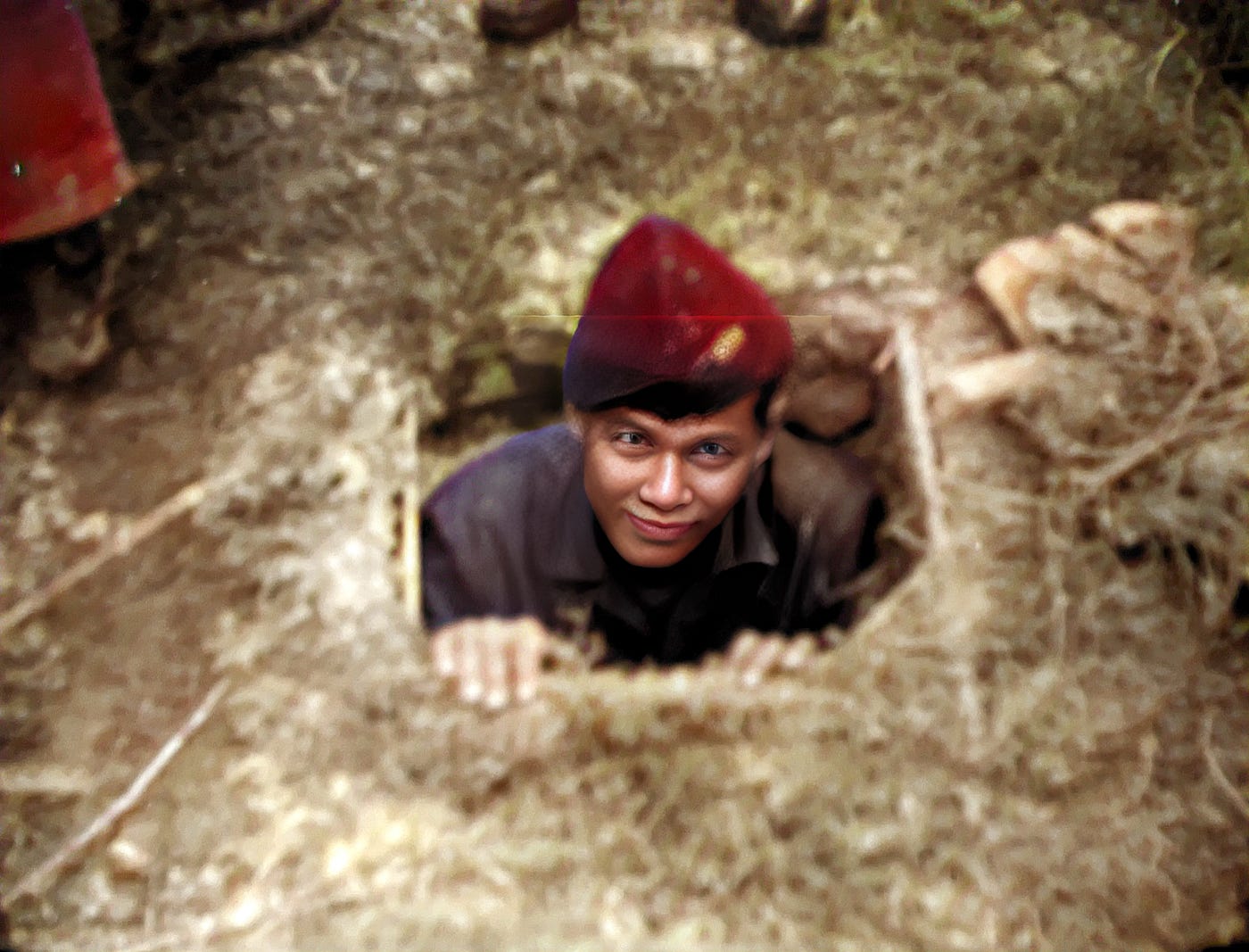
The unenviable dangerous job of Tunnel Rat in Vietnam
Entrance to Viet Cong tunnel system.
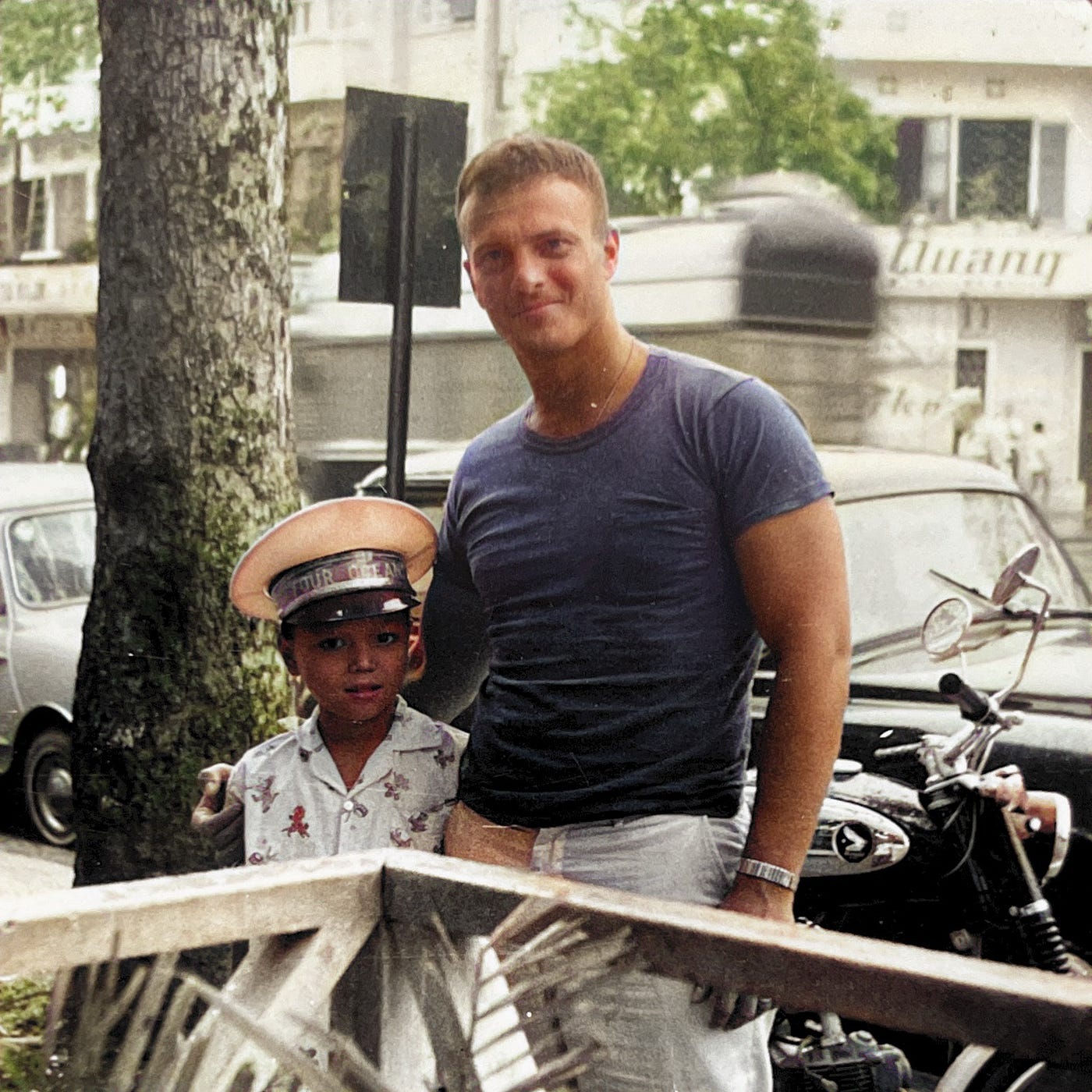
My father had a special love for the Vietnamese children
Dad with one of the many Vietnamese children he loved.
Dad met a lot of celebrities visiting the troops in Vietnam
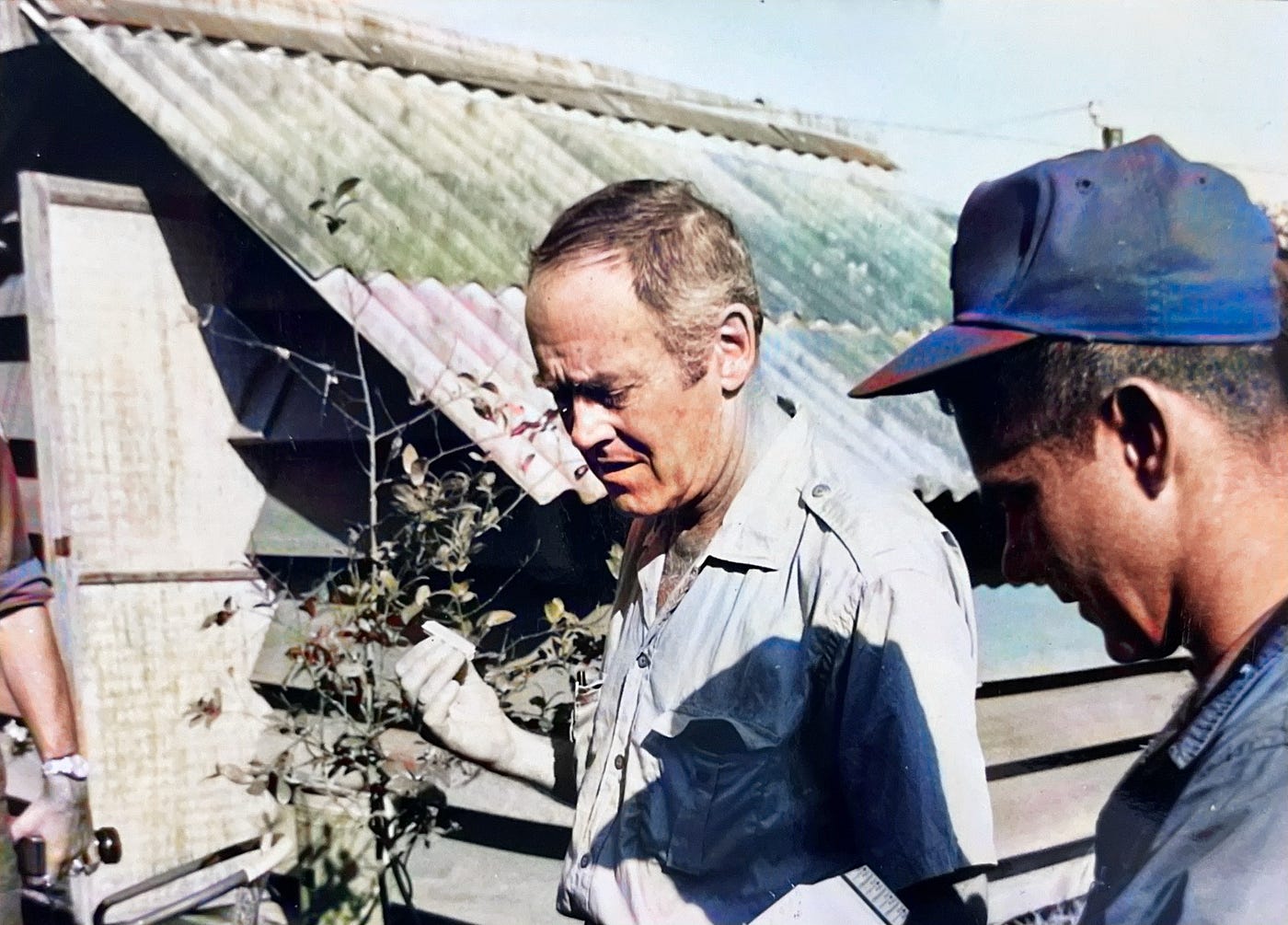
While the duties of a MACV advisor were serious — often dangerous — there were lighter moments as well. Being based closer to Saigon gave my father access to some unique opportunities. He met a number of American celebrities who visited the troops to boost morale, including Ann Margret, Chuck Connors, James Garner, Henry Fonda, Efrem Zimbalist Jr., Don DeFore, Bob Meredith of the Dallas Cowboys, Dick Bass of the L.A. Rams, and Jerry Wilson of the St. Louis Cardinals. My father always had a deep appreciation for film, sports, and storytelling, and these moments added a personal highlight to an otherwise austere and high-stakes assignment.
Actor Efrem Zimbalist Jr
Actor Henry Fonda
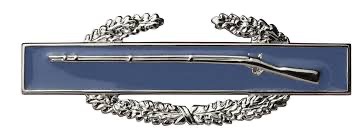
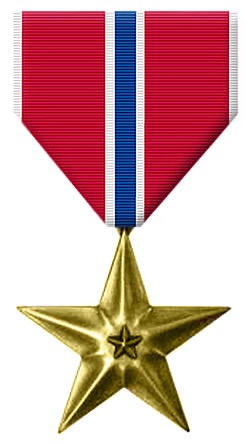
Professionally, his accomplishments during this year were significant. On February 1, 1967, he was promoted to the rank of Major. That same year, he earned two prestigious badges: the Vietnamese Armor Badge and the U.S. Combat Infantry Badge, a testament to his active engagement in combat operations alongside the Vietnamese forces he advised. He often went out with ARVN cavalry units into hostile territory, coordinating air strikes and artillery, gathering intelligence, and supporting civil pacification efforts. He used to send me letters with drawings of the elaborate Viet Cong tunnel systems he discovered — complete with false walls, hidden entrances, and escape shafts. As a young boy watching the Vietnam War unfold on our television every evening, I was both captivated and proud. His war stories made him larger than life to me.
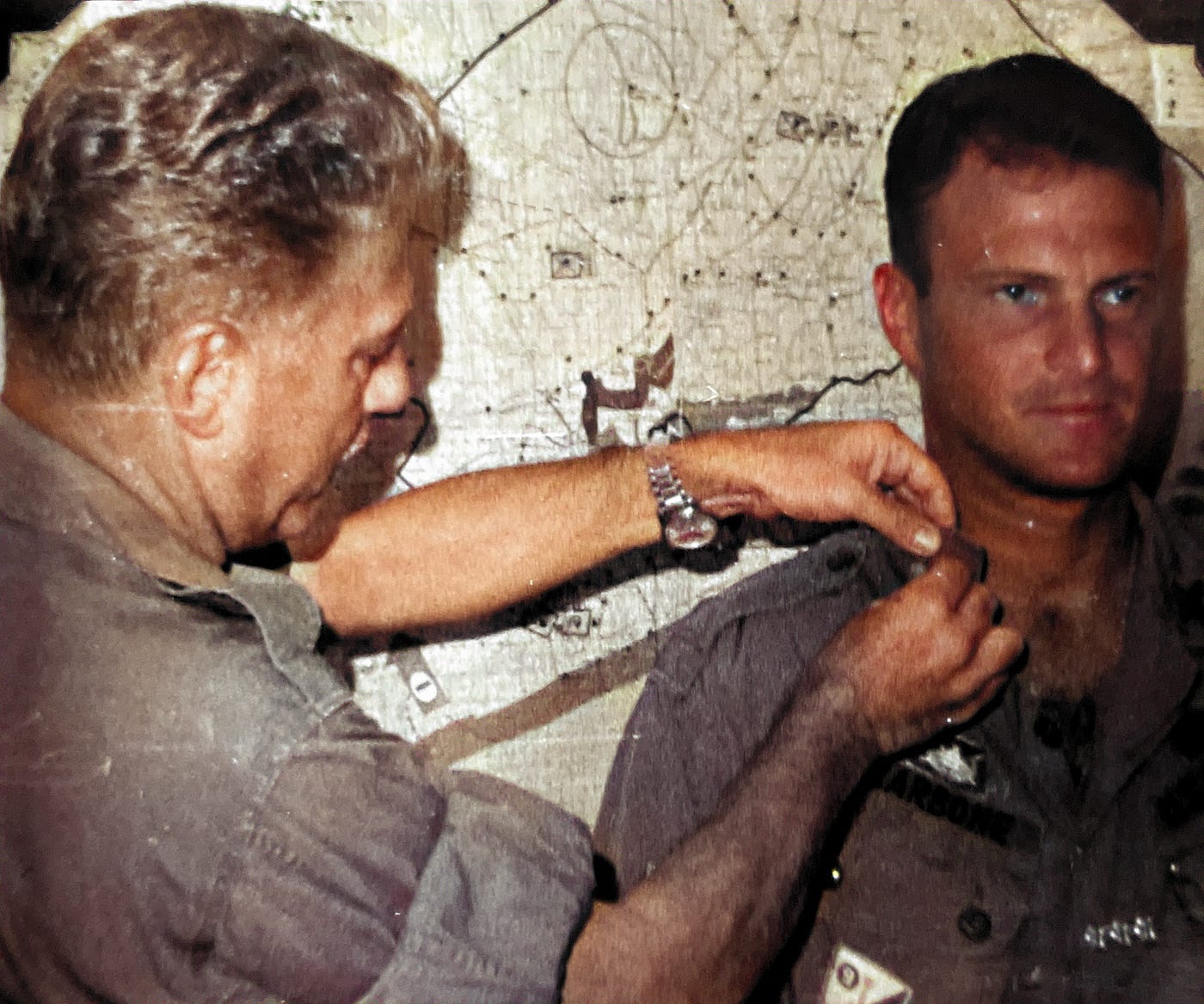
Dad awarded the Combat Infantry Badge (CIB) in Vietnam
Dad being awarded the U.S. Army Combat Infantry Badge (CIB)
U.S. Army Combat Infantry Badge (CIB)
Dad gets promoted to Major while in Vietnam
Dad being promoted to Major.
While Dad was in Vietnam, we moved back to Medford
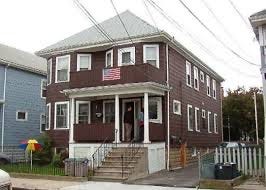
Back in the U.S., we were living in Medford, Massachusetts, on the first floor of a multi-family home at 44 Frederick Avenue. The building belonged to the parents-in-law of my godfather, Uncle George Pietrantoni, and we lived just downstairs from them. It was a warm, close-knit Italian-American neighborhood, and I saw Uncle George and Auntie Carole often.
Went to the Dame School
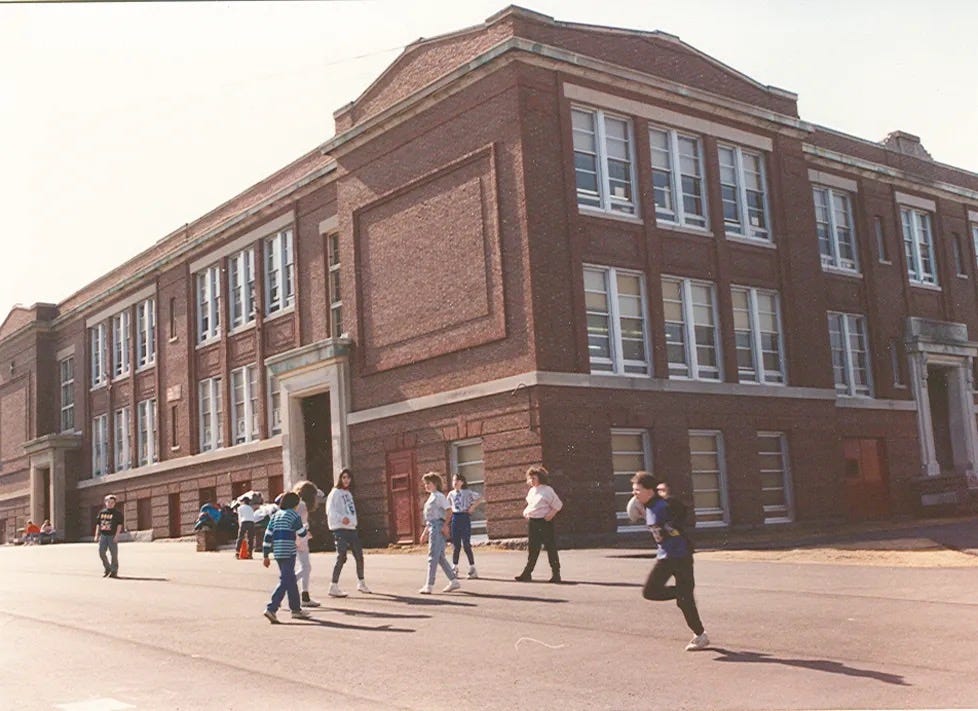
I was in second grade that year and attended the Lorin L. Dame School on George Street along with my sisters Dianaand Lynne. I had second grade with old Miss Collins.
The school was about halfway between our apartment and Nana and Papa Pietrantoni’s house on Winthrop Street, and I remember spending many weekends with my grandparents.
Nana & Papa Pietrantoni’s Home
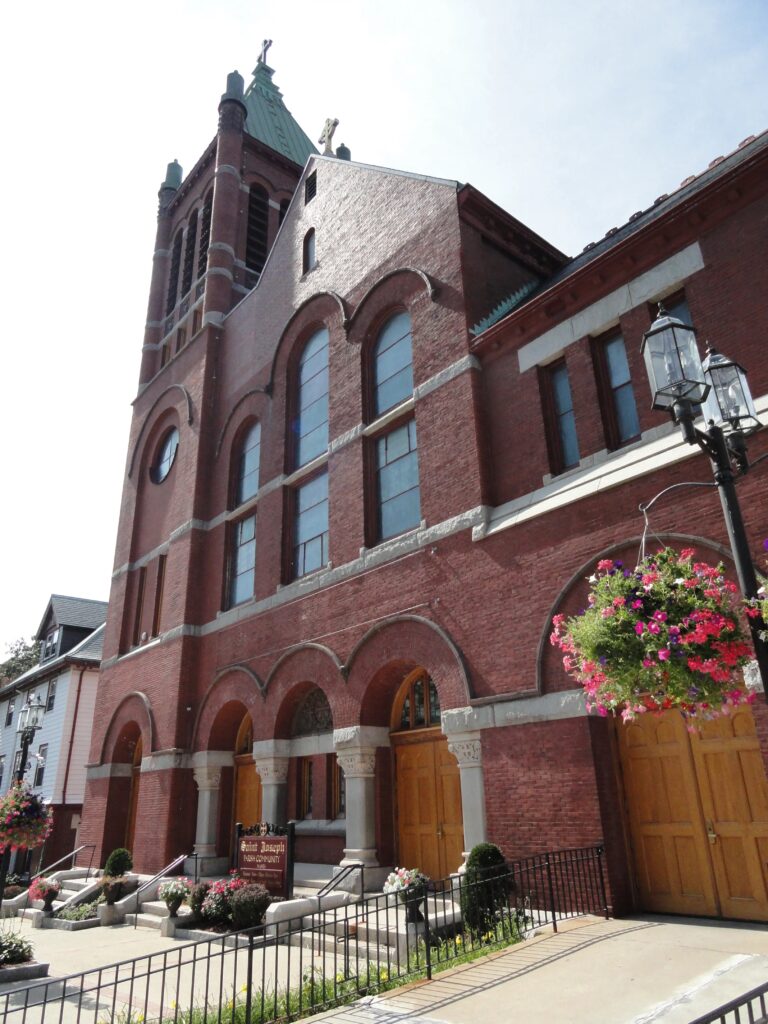
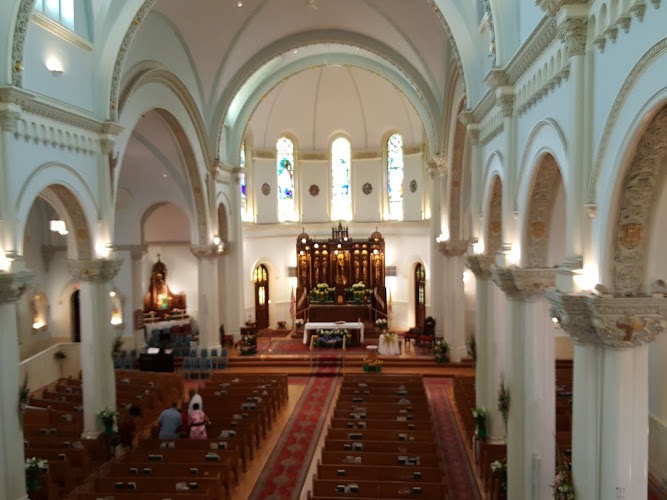
My grandfather went grocery shopping every Saturday morning and always came home with fresh Scali bread and sliced Italian cold cuts. Sunday mornings were reserved for Mass at Saint Joseph’s Catholic Church, the same church where all of us kids were baptized, where I made my First Communion, and where three of my sisters would eventually marry.
After Mass, we’d gather at Nana & Papa’s for a traditional Italian Sunday dinner of spaghetti and meatballs. Uncle Aldo would show up just long enough to eat a couple of meatballs and play a tune or two on the upright piano in the dining room. Those weekends were loud, joyful, and full of love — and food.
My Godfather, George Pietrantoni
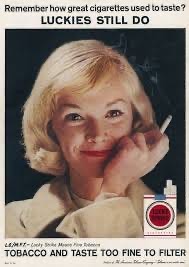
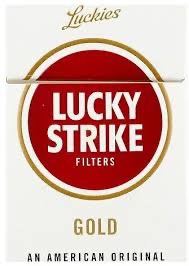
Uncle George was like a second father to me while mine was away. He’d often give me a quarter and send me down to the corner store to buy him a pack of Lucky Strikes. Back then, a six-year-old could do that without raising eyebrows.
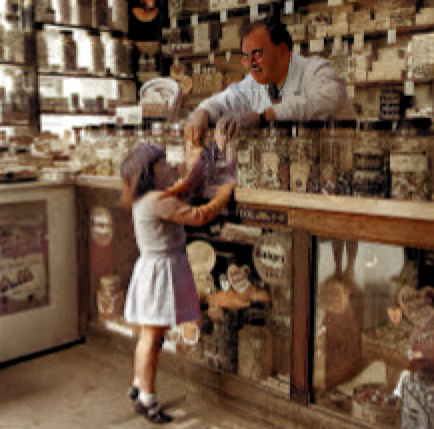
If I was lucky, he’d give me an extra nickel or dime so I could grab a few pieces of penny candy. I felt so grown up, entrusted with money and a mission.
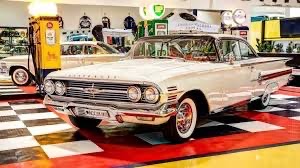
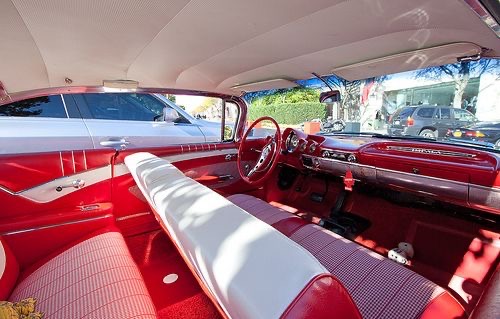
I also got to ride around with him in his stunning white 1960 Chevrolet Impala with red interior. I’d sit on his lap and “steer” the big red wheel while the windows were rolled down, the radio playing, and Lucky Strike smoke curling into the summer air. I remember those rides like they were yesterday.
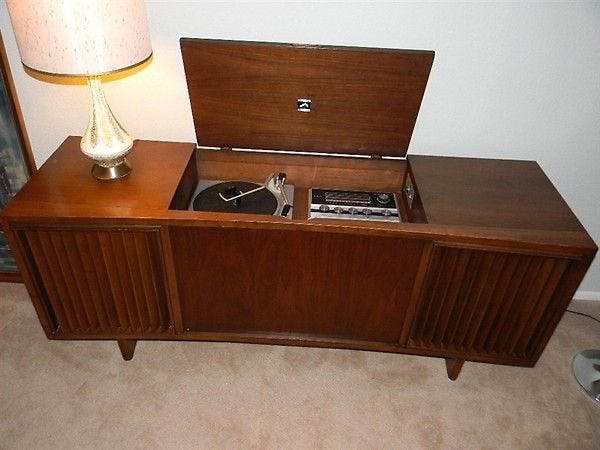
Auntie Norma, meanwhile, was working at Harvard University and still living at home with Auntie Cynthia and Yvonne. She had just bought a beautiful record RCA console that played both 45s and 33 rpm LPs.
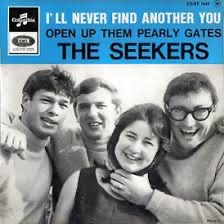
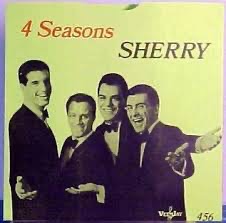
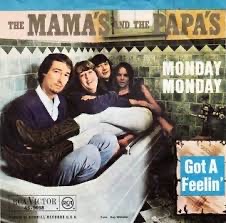
We’d all gather around to dance in the living room to songs like The Four Seasons’ “Sherry,”The Mamas and the Papas’ “Monday, Monday,”and The Seekers’ “Another You.” The music made our home feel alive and connected — even as we all missed my father terribly.
My mother wrote my father every night
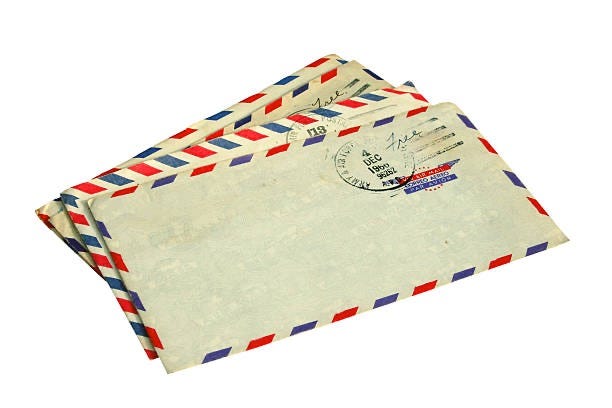
At home, my mother did everything she could to keep the family strong and grounded during his year-long absence. She wrote to him every single night. Every. Single. Night. My father, in turn, wrote back faithfully to her and to each of us. His letters weren’t just updates — they were expressions of love, encouragement, and longing. They brought him home to us in every envelope. I still have many of those letters today, yellowed with time but full of heart. I am amazed by how my parents stayed so deeply in love during such a prolonged and uncertain separation and know that their love letters helped — that steady rhythm of writing and receiving, day after day, page after page, was their emotional lifeline.
R&R in Waikiki, Hawaii
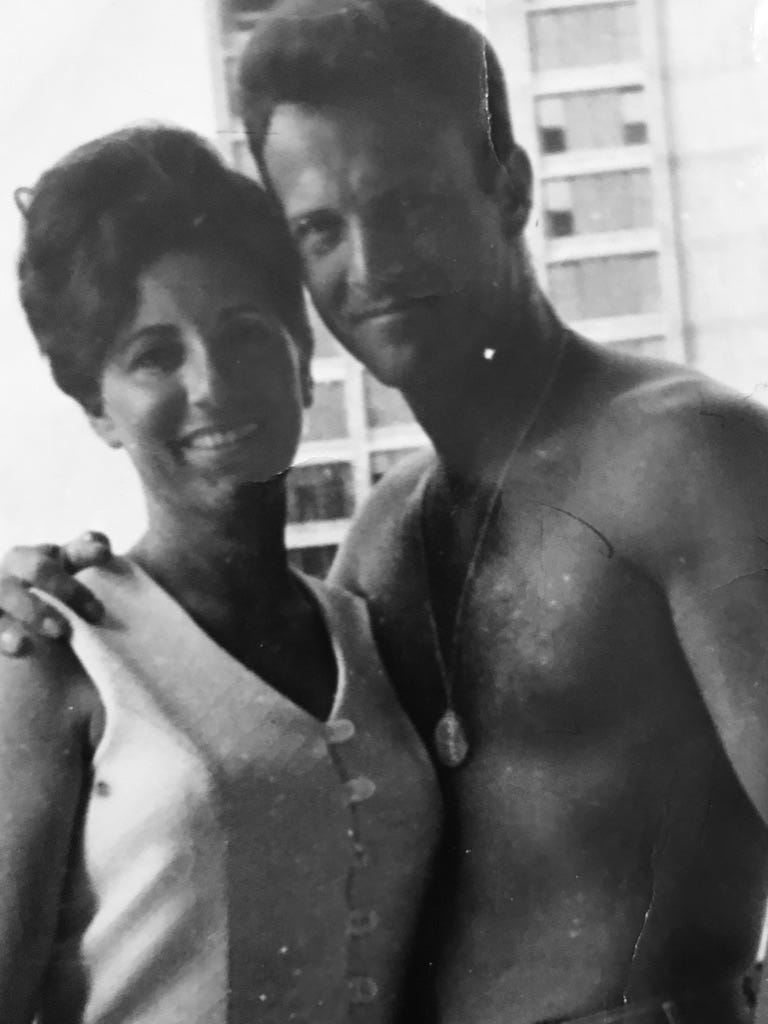
In the middle of his tour, they were reunited for a brief but beautiful week of R&R in Waikiki, Hawaii, paid for by the military. The photographs from that vacation are among my favorites. My parents looked like newlyweds again — smiling, tanned, holding hands on the beach. You can see it in their eyes: how much they missed each other, and how much they cherished every second of that week. Love, real love, endures like that.
Mom & Dad on R&R at Waikiki, Hawaii during his first tour of Vietnam.
The Apollo One Disaster (January 27, 1967)
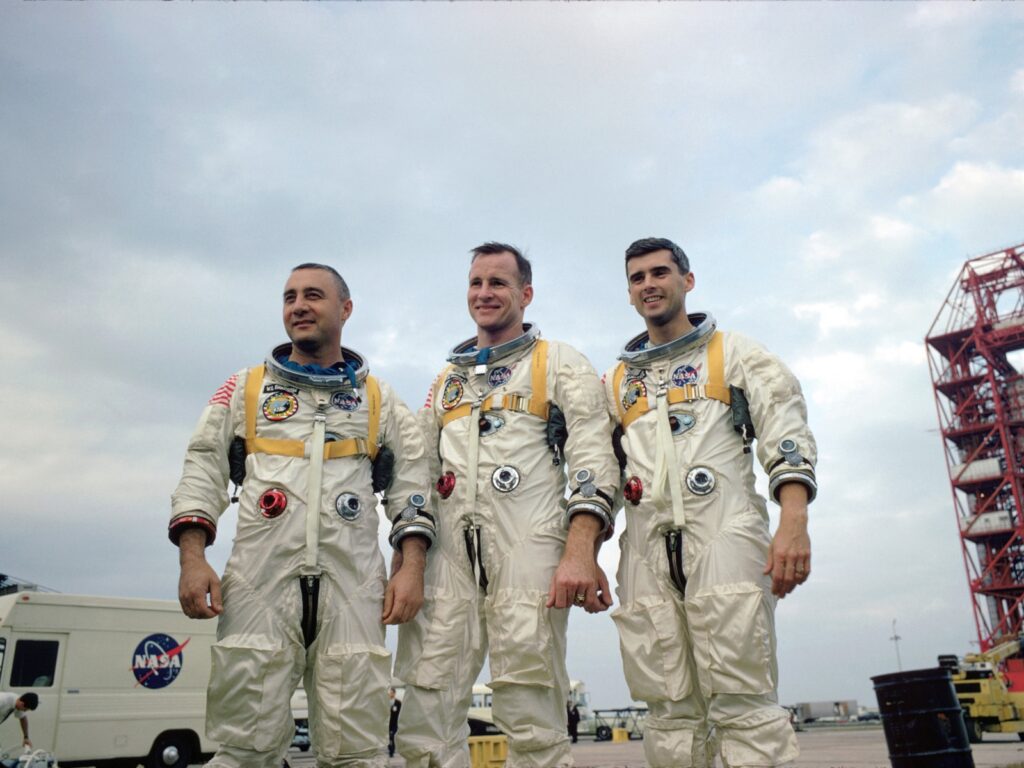
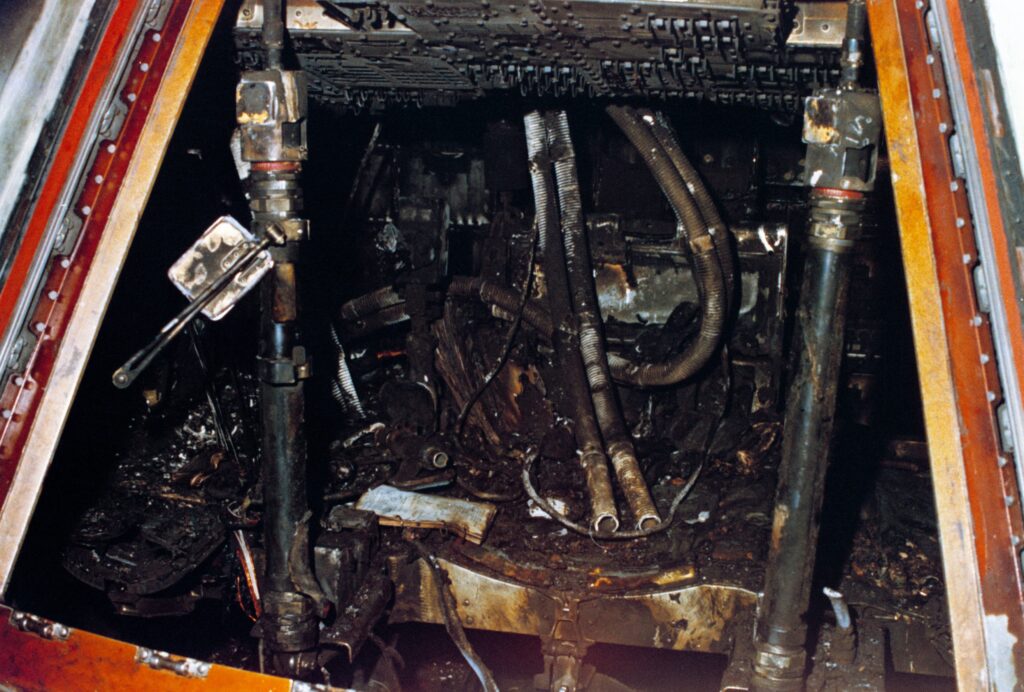
I still remember one cold evening in our apartment at 44 Frederick Avenue in Medford. It January 27, 1967 around 6:30 PM, and we were gathered around the television as the Apollo 1 spacecraft was preparing for liftoff. In those days, America was captivated by the space race, and for young boys like me, NASA was nothing short of magical. But that excitement turned to horror. A fire erupted inside the command module during a pre-launch test, killing astronauts Gus Grissom, Ed White, and Roger Chaffee. The tragedy shocked the nation and forced NASA to halt manned missions until major safety changes could be made. I was just a boy, but I never forgot that night. It was the first time I realized that even heroes could be vulnerable, and that the pursuit of exploration carried real danger.
MARS Calls from Vietnam
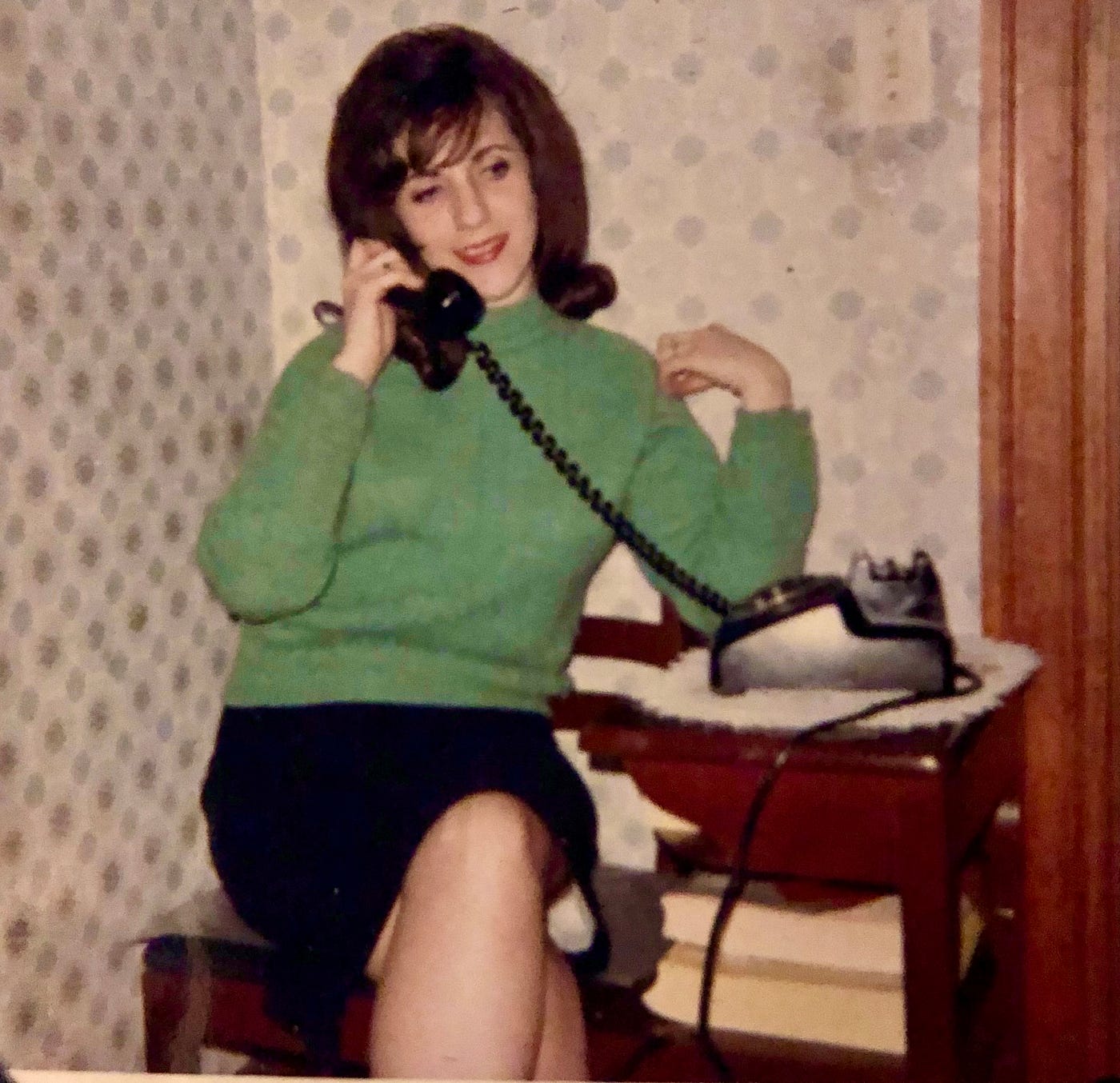
On a happier note, every few months the Army arranged MARS (Military Auxiliary Radio System) calls so that soldiers could connect with their families. These long-distance conversations, relayed through ham radios, required us to speak in military fashion — ending each phrase with “Over.” One particular call still makes me laugh to this day. My father had said, “I’m making you a tape,” referring to a new cassette recording. But my mother misheard him and replied, “You want me to send you a cake? Over.” The radio operator, patiently relaying both sides, jumped in to clarify: “Ma’am, I believe your husband said he is making you a tape, not a cake.” We all burst into laughter on both ends of the line.
My mother on the telephone with my father in Vietnam.
Cassette Tape Messages
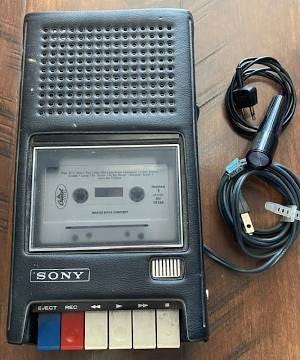
That was a time when compact cassette recorders, newly developed in Japan, allowed us to exchange audio messages across continents. We’d record ourselves talking about school, daily life, or just saying, “I love you,” and mail them across the ocean. My father would send his replies back, and we would sit together and listen to his voice on the living room floor. I wish we still had those tapes today. I would give anything to hear my parents’ voices again — those tender, hopeful, loving voices carried across time and space
This first tour in Vietnam marked a profound chapter in my father’s career — and in our family’s life. It tested our endurance, but it also revealed the depth of our bonds. While he was advising and fighting alongside his ARVN brothers in the Mekong Delta, he was still husband, father, and family man — writing letters, making tapes, taking photographs, and dreaming of home.
Believe Nothing You Hear, and Only Half of What You See — A memoir of Service, Shame and the Search for Truth
Dad Gets Orders for Fulda, Germany
In 1964, during the height of the Cold War, my father received deployment orders to Fulda, West Germany. The Berlin Wall had only recently gone up, and global tensions were at a boil. It was a serious time, and the assignment my father received reflected that gravity.
Command of C Troop, 14th Armored Cavalry
Dad was given command of C “Charlie” Troop, 14th Armored Cavalry Regiment, in Fulda, Germany — stationed at one of the most sensitive flashpoints between NATO and the Warsaw Pact.
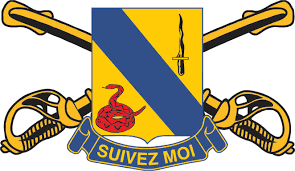
Insignia of the 14th Armored Cavalry with Crossed Cavalry Sabers and the motto, “Suivez Moi,” which is French for “Follow Me”.
The Fulda Gap
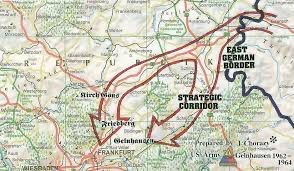
Known as the “Charging Charlies“, C-Troop (and the rest of the 14th Cavalry) was responsible for guarding the infamous Fulda Gap, the strategic corridor military planners believed the Soviets would use to launch a massive armored invasion into Western Europe.
Map of Fulda Gap Germany During Cold War
Family Prepares for a Transatlantic Transfer
My father deployed ahead of us to report for duty and secure housing, while the rest of us — my mother, my three sisters, and I — prepared for the long move overseas. The process of uprooting our lives for Germany was as complex as it was memorable. Every item we owned had to be sorted into four categories: (1) Hold Baggage — essentials that traveled by air; (2) Household Goods — the bulk of our possessions, shipped by slow-moving cargo ship; (3) Storage — items too big or unnecessary to bring; and (4) Trash or Give Away — whatever wouldn’t make the cut.
Birth of Sister #3, Cynthia
Just weeks before our departure, on January 29, 1964, my third sister Cynthia was born. Her arrival added both joy and urgency to our preparations. With a newborn in the house, the challenge of organizing an international military move became even more formidable. But as always, my mother handled everything with grace and efficiency — tending to Cynthia’s every need while managing three other young children and the complex logistics of uprooting a household. Cynthia took her very first flight as an infant in her mother’s arms, beginning a life already shaped by service, travel, and family sacrifice.
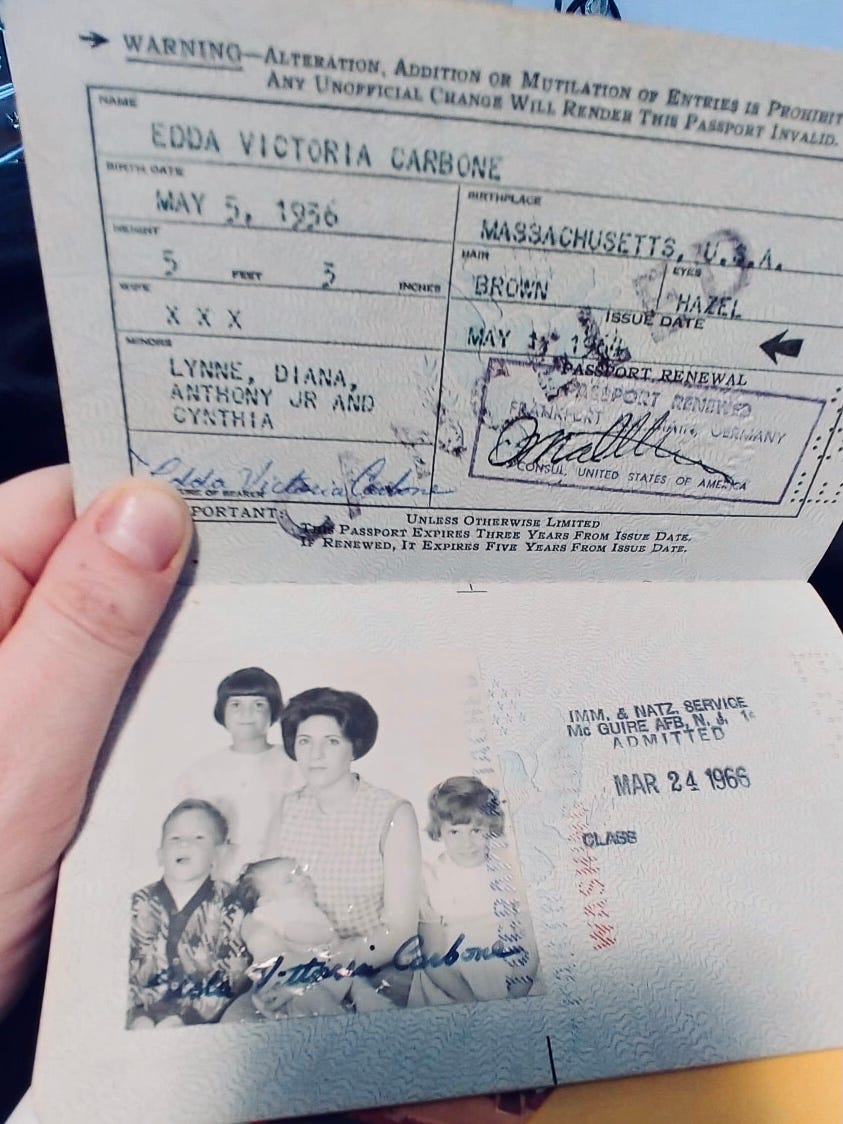
My mother’s passport with Lynne, Diana, Anthony Jr. and Cynthia.
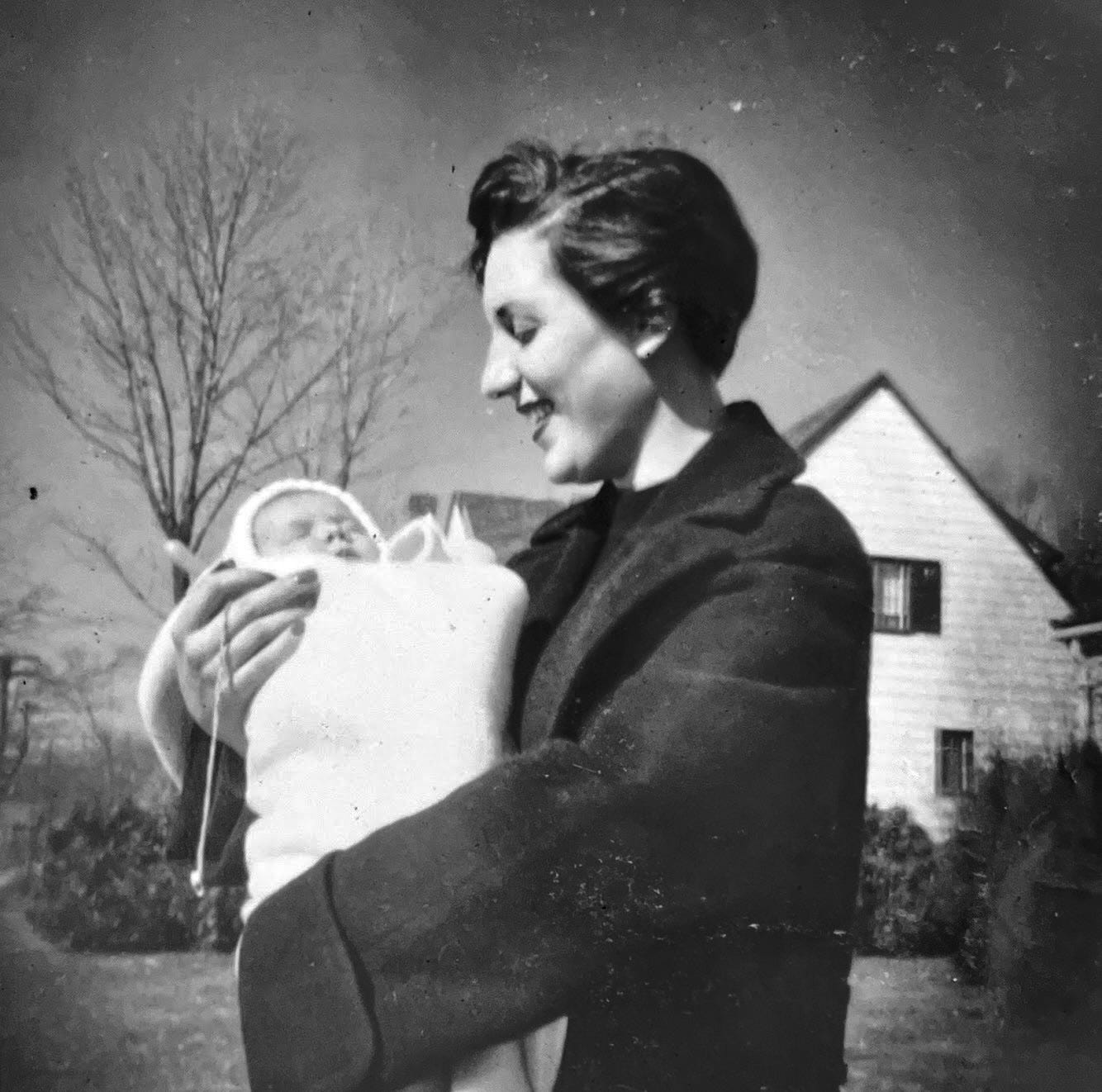
Mom with Cynthia in Medford before leaving for Germany.
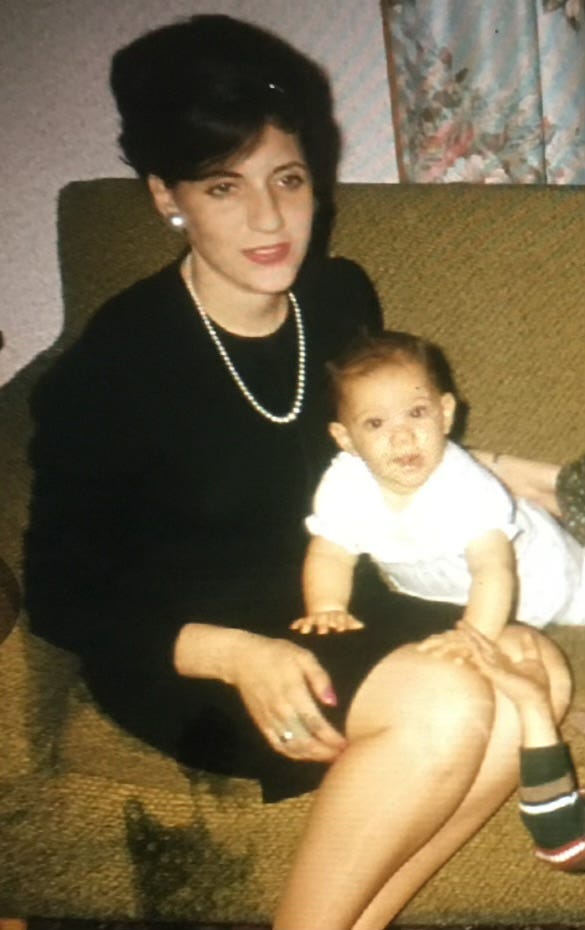
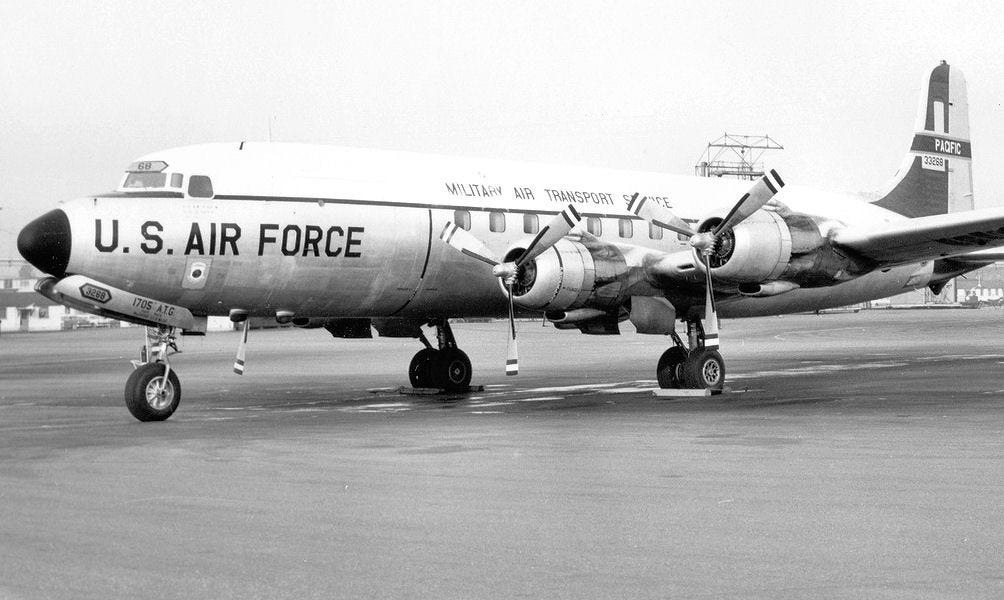
Though I was very young, that journey remains burned into my memory. We traveled to McGuire Air Force Base in New Jersey, where we boarded a sleek four-propeller Douglas C-118 Liftmaster aircraft operated by the Military Air Transport Service (MATS)— packed mostly with uniformed GIs. We were one of the few military families on board. My mother, ever composed and elegant, wore a pencil skirt and sweater, her trademark pearl necklace resting neatly at her collar as she carried my baby sister Cynthia in her arms. She handled the journey with grace, even while managing four children. I remember GIs stepping in to help — each of us was being held or entertained by a soldier at one point. It was a shared moment of kindness and connection in a time of great upheaval.
Douglas C-118 Liftmaster operated by the Military Air Transport Service (MATS) out of McGuire AFB.
Family Flies to Germany — Headed to Fulda
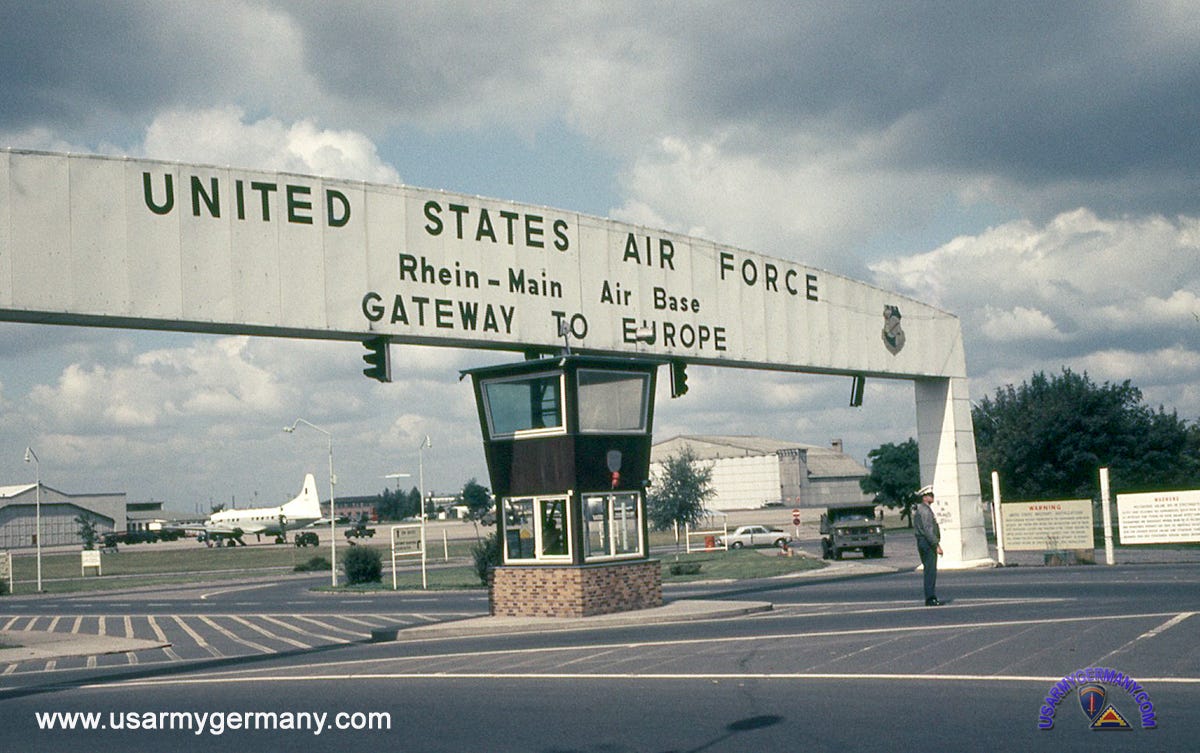
The flight took us from McGuire to Gander, Newfoundland, then across the Atlantic to Shannon, Ireland, and finally to Rhein Main Air Force Base in West Germany. It took 16 to 18 hours, and when we landed, we were met by my father and our “sponsors” — an Army family assigned to help us transition into German life.
The Famous Welcome Sign to Europe at Rhein-Main Air Base in Frankfurt, Germany.
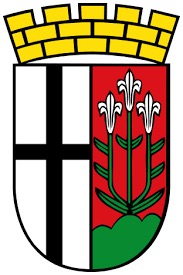
Coat of Arms for Fulda, Germany
We live on a farm on the Germany “Economy”
At that time, there were no on-post quarters available for us in Fulda, so we rented a home “on the economy,” Army-speak for off-base living. Our rented house sat on a small German farm, nestled in the hills above a Catholic school that I attended for kindergarten alongside my sisters Lynne and Diana. The nuns who taught us wore full habits and ran a tight ship. I remember the heavy wooden Brio toys we played with, the scent of peppermint tea served before naps, and the solemn atmosphere of strict German discipline.
Our landlord’s daughter, Effie, was a teenage girl with long blonde braids who lived downstairs and was mainly Lynne’s friend. Our babysitter was Marlena lived up the street from us. She spoke just enough English to make herself understood and was endlessly patient with us.
My favorite sights, sounds and smells of Germany
Some of my most vivid childhood memories are rooted in that farm — the air thick with the scent of wildflowers, blossoming trees, and the unforgettable smell of “honeywagons,” large wooden barrels filled with manure used to fertilize the fields. Coal was still the primary source of heat, and the smoky, sulfur-rich air had a strange health to it — earthy and alive, part of the rural rhythm of Fulda. Another sensory thread woven deeply into those memories is the sound of church bells. They marked the hours with gentle regularity, rang out at midday for the Angelus, and on Sundays, filled the valley almost nonstop from dawn to dusk. Even now, the tolling of bells brings me instantly back to Germany — awakening a sense of calm, nostalgia, and rootedness that no other sound quite can.
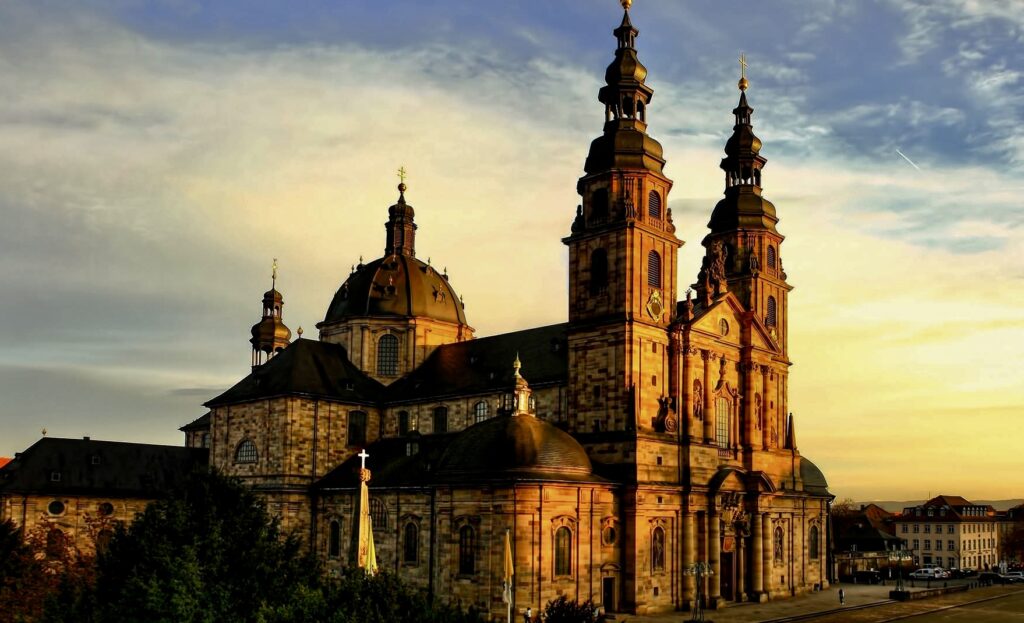
18th Century Baroque Cathedral of Saint Salvatore in Fulda, Germany
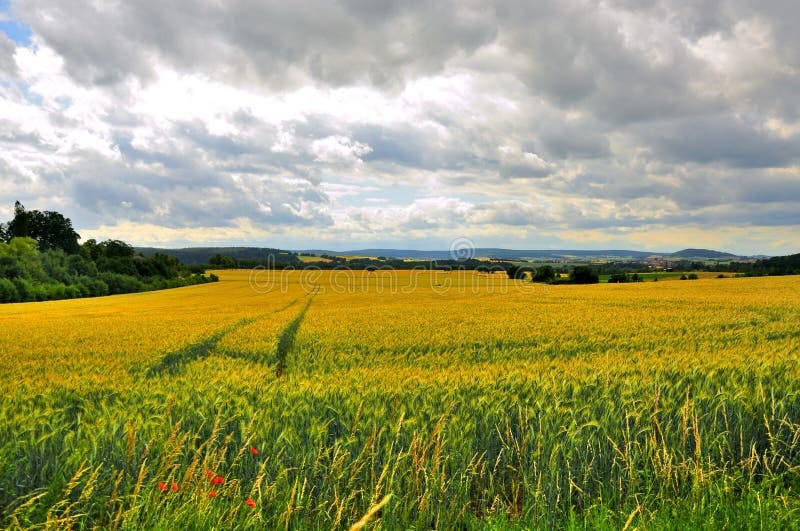
The rolling farmlands of Fulda, Germany.
Dad Commands F Troop, 14th Armored Cavalry on Soviet Border
I don’t believe we owned a car at the time, so my father was picked up daily by his jeep driver to report to the regiment. It didn’t matter to me that we didn’t have a car because we loved living on the German farm. I was utterly captivated by the world we had entered. Even then, as a small boy, I had already made up my mind: I wanted to be a cavalry officer just like my father. I watched him closely, studying how he wore his uniform, how soldiers saluted him, how he led. To me, he was a hero, and I never questioned that I would follow in his footsteps someday.
Dad with his First Sergeant and jeep driver in the background.
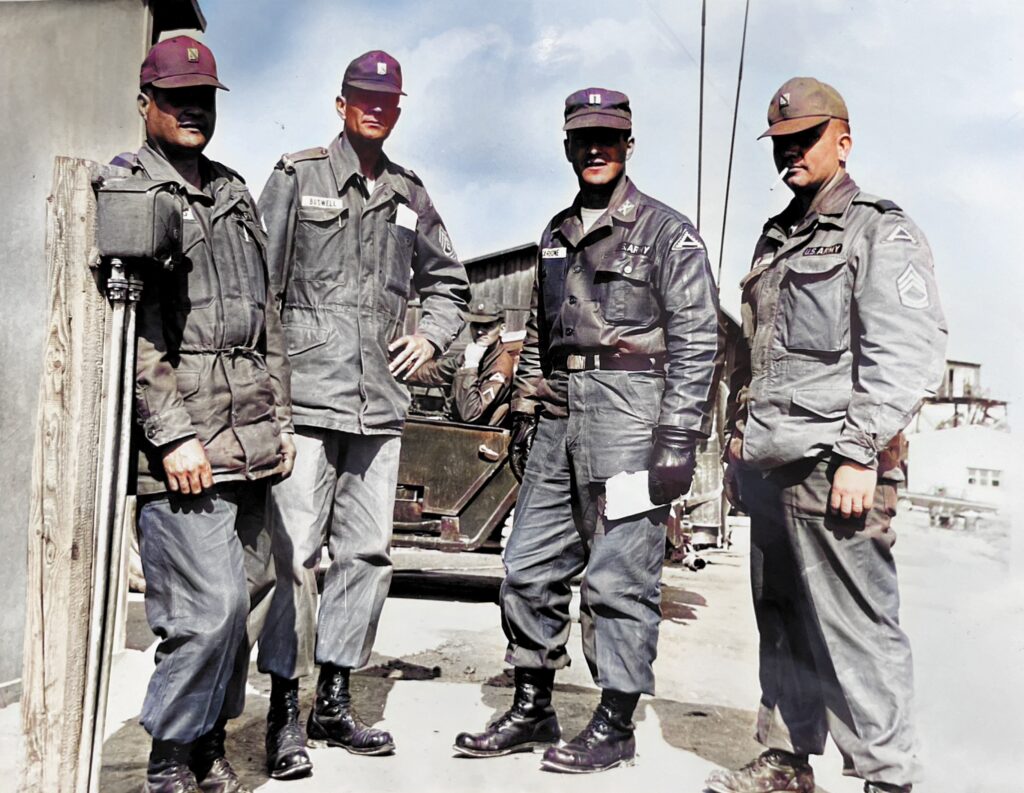
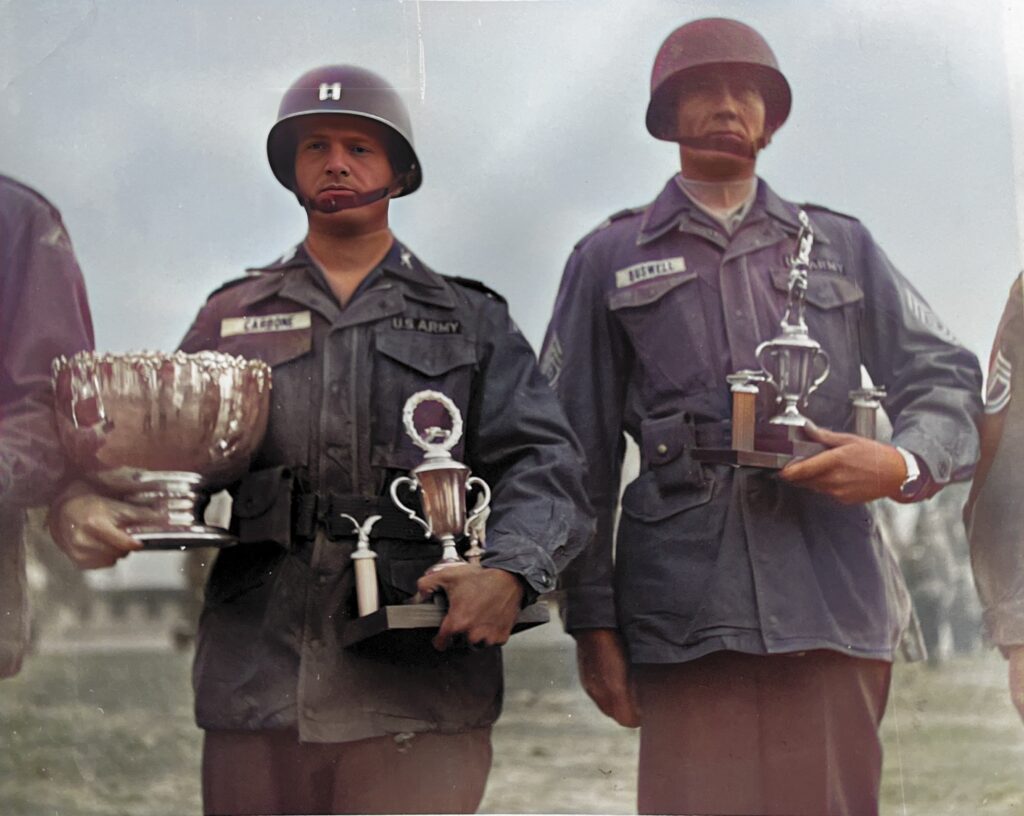
CPT Carbone received the coveted award of First In Tank Gunnery (next to Troop First Sergeant Buswell)
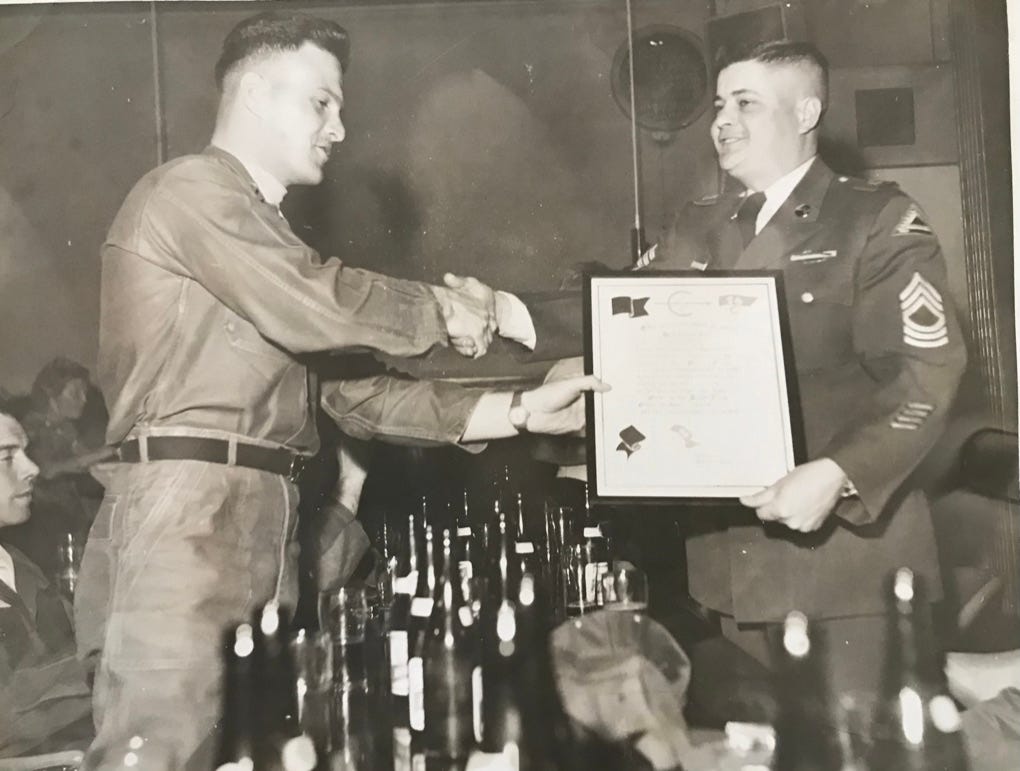
Dad receiving a certifiicate for commaning C Troop, 14th Armored Cavalry in Fulda, West Germany.
We move on post into government quarters on Rose Barracks
Eventually, our family received government quarters. We moved into a tall, gray three-story apartment building that housed twelve Army families. The fourth floor had maid’s quarters built by the Nazis decades earlier. It wa, a haunting reminder of Germany’s past tucked above American military life. From my bedroom window, I could see the military airfield nearby. At night, as I lay in bed reading comic books under the covers. The rotating airfield beacon would cast alternating flashes of green and two white lights into my room. That rhythm of light, sweeping silently across my walls and pages, felt like a lullaby — strange, comforting, and unforgettable.
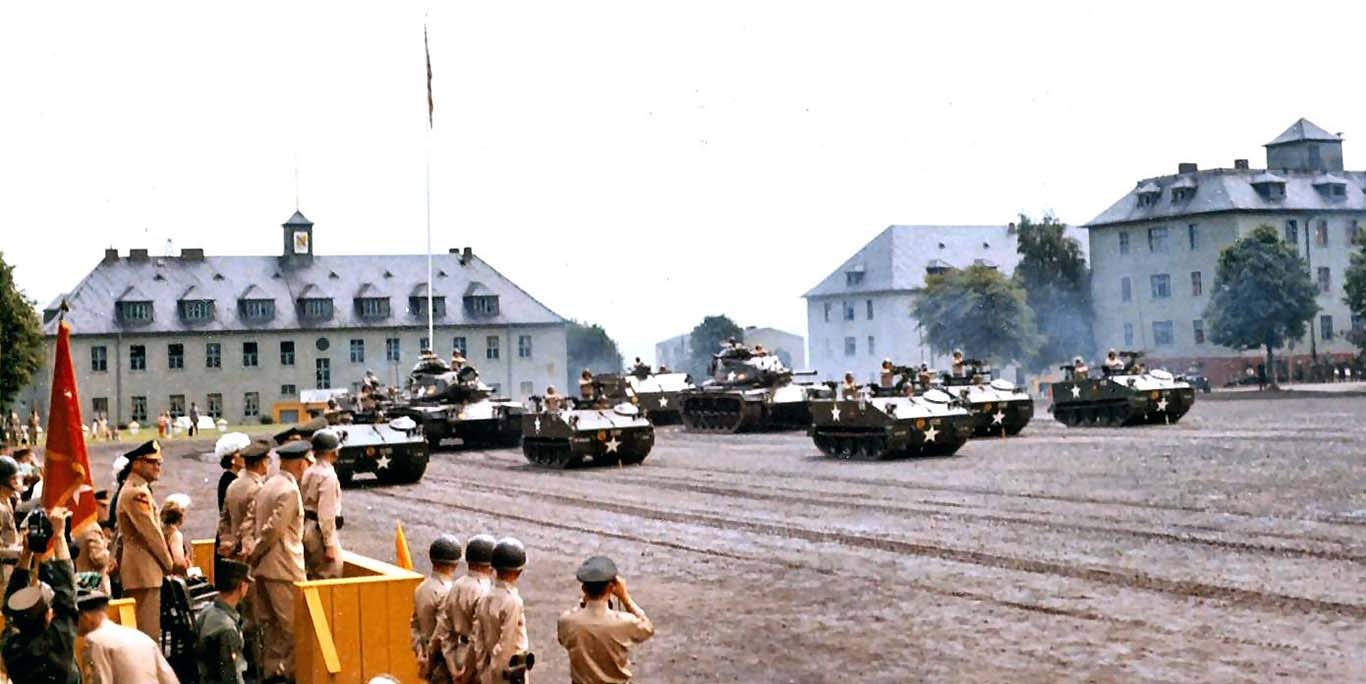
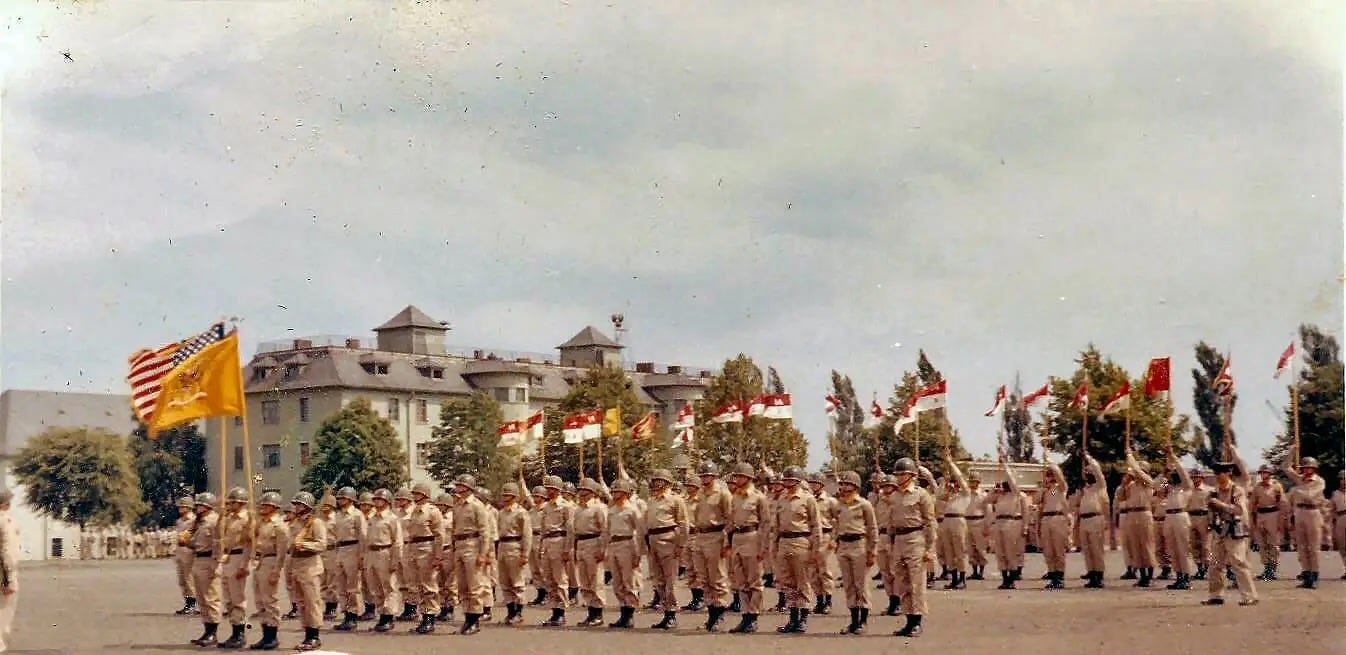
14th Armored Cavalry Regiment at Downs Barracks, Fulda, Germany
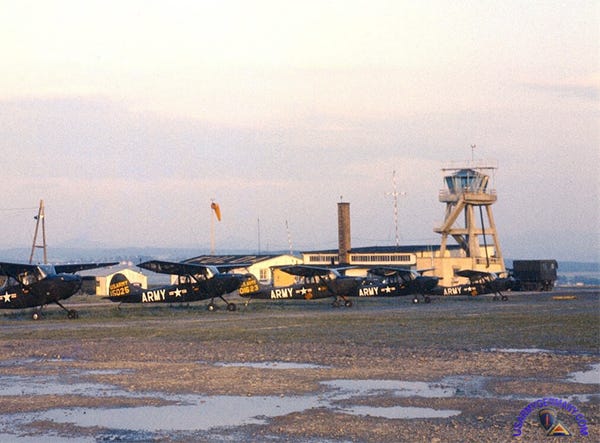
Fulda Army Airfield c.1964 showing the control tower and airfield beacon. The U.S. Army cavalry used Cessna L-19/O-1 Bird Dog aircraft were for reconnaissance.
Life on a cavalry post thrilled me. My father gave me occasional tours of the motor pool, the barracks, and the tanks. I couldn’t get enough. The Military Police (actually Unit Police–UPs) at the gate would sometimes let me stand next to them, waving in vehicles and offering salutes. The whole environment was electric to a young boy with big dreams.
Colors and Guidons of the full 14th Armored Cavalry Regiment at Downs Barracks
The Grim Reality of Guarding the Soviet Border
It wasn’t all parades and salutes for the 14th Armored Cavalry Regiment. Their mission was deadly serious. The regiment’s men actively guarded the infamous Fulda Gap, stationed at the spear’s tip.
Military planners expected that if the Soviet Union ever unleashed its armored divisions into Western Europe, the main thrust of their invasion would come roaring through this very corridor.
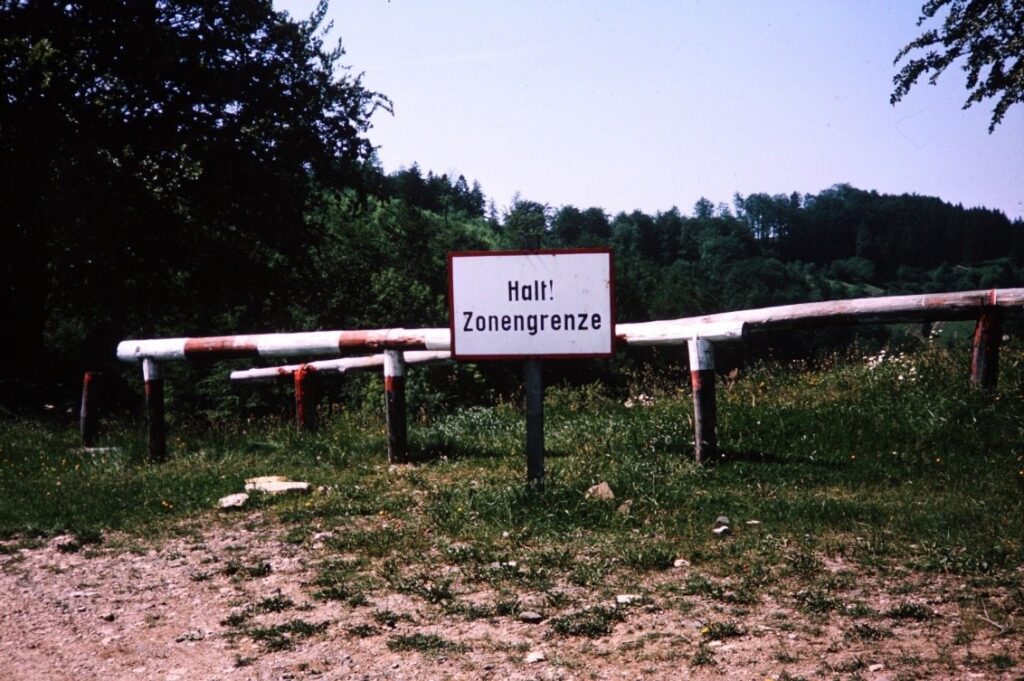
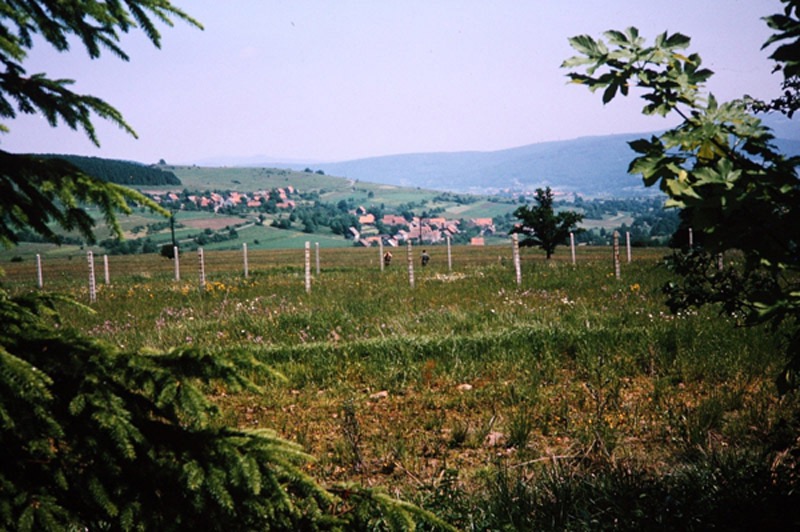
To the untrained eye, the countryside around Fulda was idyllic. Rolling hills, fertile farmland, and quiet villages created the picture of peace. The landscape gave no hint of the threat that loomed just across the line. However, the soldiers of the 14th Armored Cavalry knew better. They patrolled the NATO border daily, often within meters of East German and Soviet forces. From their observation posts, they could see the enemy through field glasses—watching them as intently as they were being watched in return.
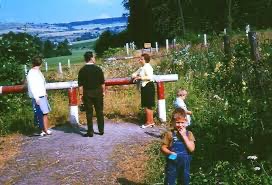
A border between East & West Germany that is just two barbed wire fences.
Families vist the border looking for the families in the East
Need for Tank Gunnery Proficiency
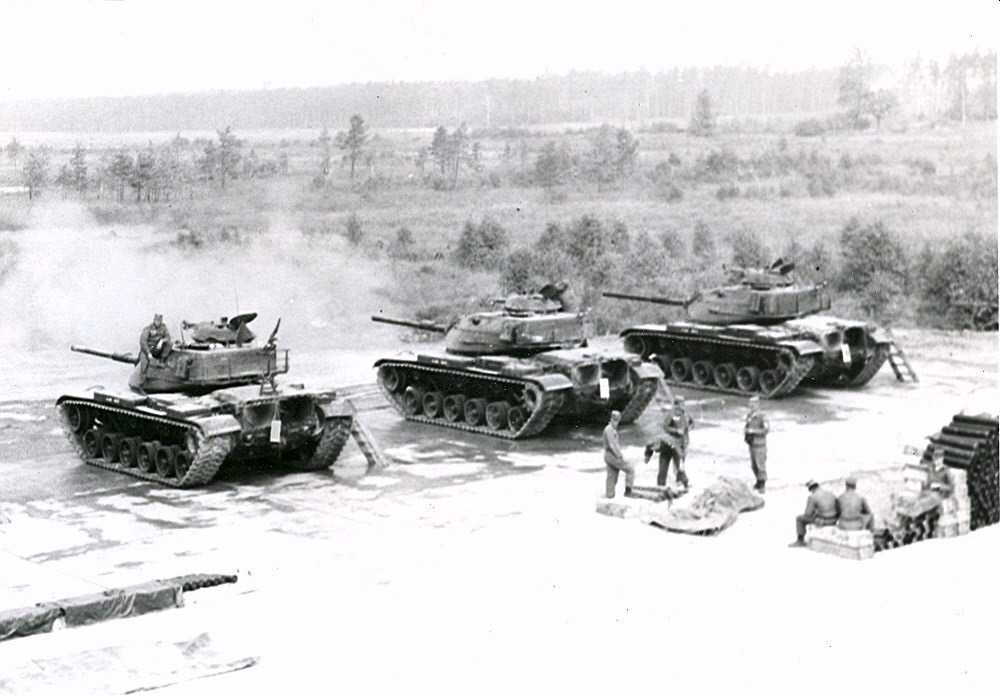
For these troopers, there was no illusion of safety. Tank gunnery, live-fire ranges, and field maneuvers weren’t training games—they were rehearsals for survival. Every round fired, every drill practiced, was preparation for the day the balloon might go up, when the border could erupt in fire and steel without warning.
The 14th Cavalry’s unspoken duty was to slow the Soviet juggernaut long enough for NATO reinforcements to mobilize. Everyone knew what that meant: if war broke out, the enemy would overrun the regiment in hours, perhaps even minutes.
It was a grim reality, but one they carried out with quiet professionalism. To a boy watching from the safety of Army quarters, the regiment looked like knights in armor. Unfortunately for the men who wore the spurs, it was a mission shadowed by constant danger.
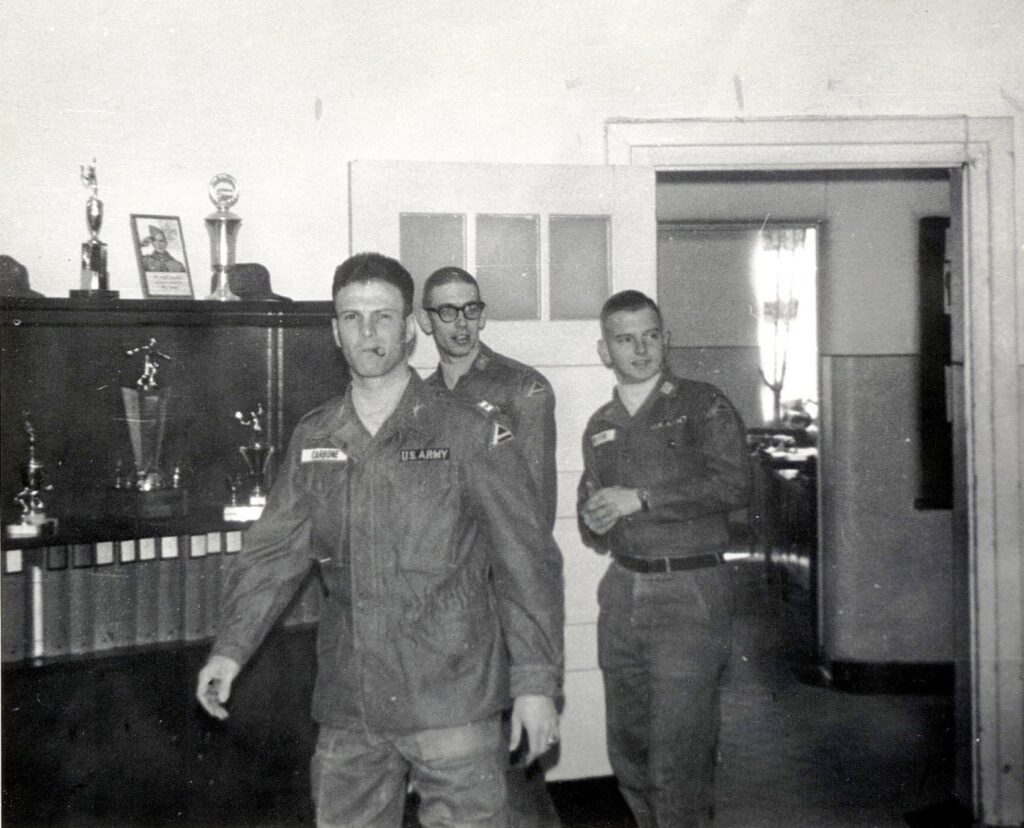
C Troop Commander, Captain Tony Carbone, with his Executive Officer (XO) Lieutenant Ron Meyers.
Baby Sister, Pamela, is born in Germany
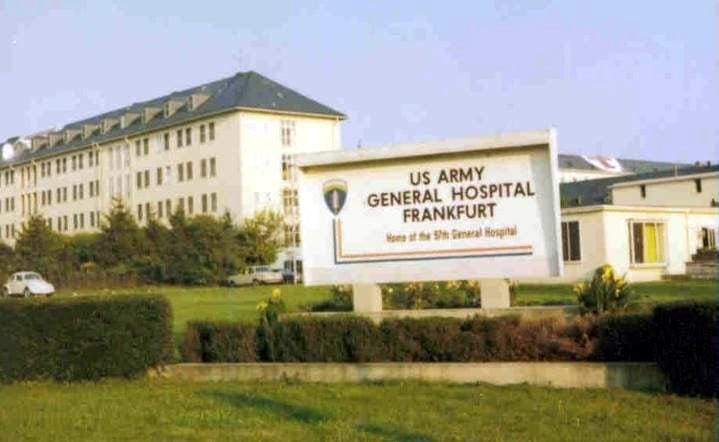
During this tour, our family grew again. My baby sister Pamela was born on September 11, 1965 at the 97th General Hospital in Frankfurt, Germany. My mother was too far along in her pregnancy to make the long trip home, so Pamela became the only one of us not born at Lawrence Memorial Hospital in Medford, Massachusetts. She even held dual American-German citizenship until she turned eighteen.
97th General Hospital in Frankfurt, Germany.
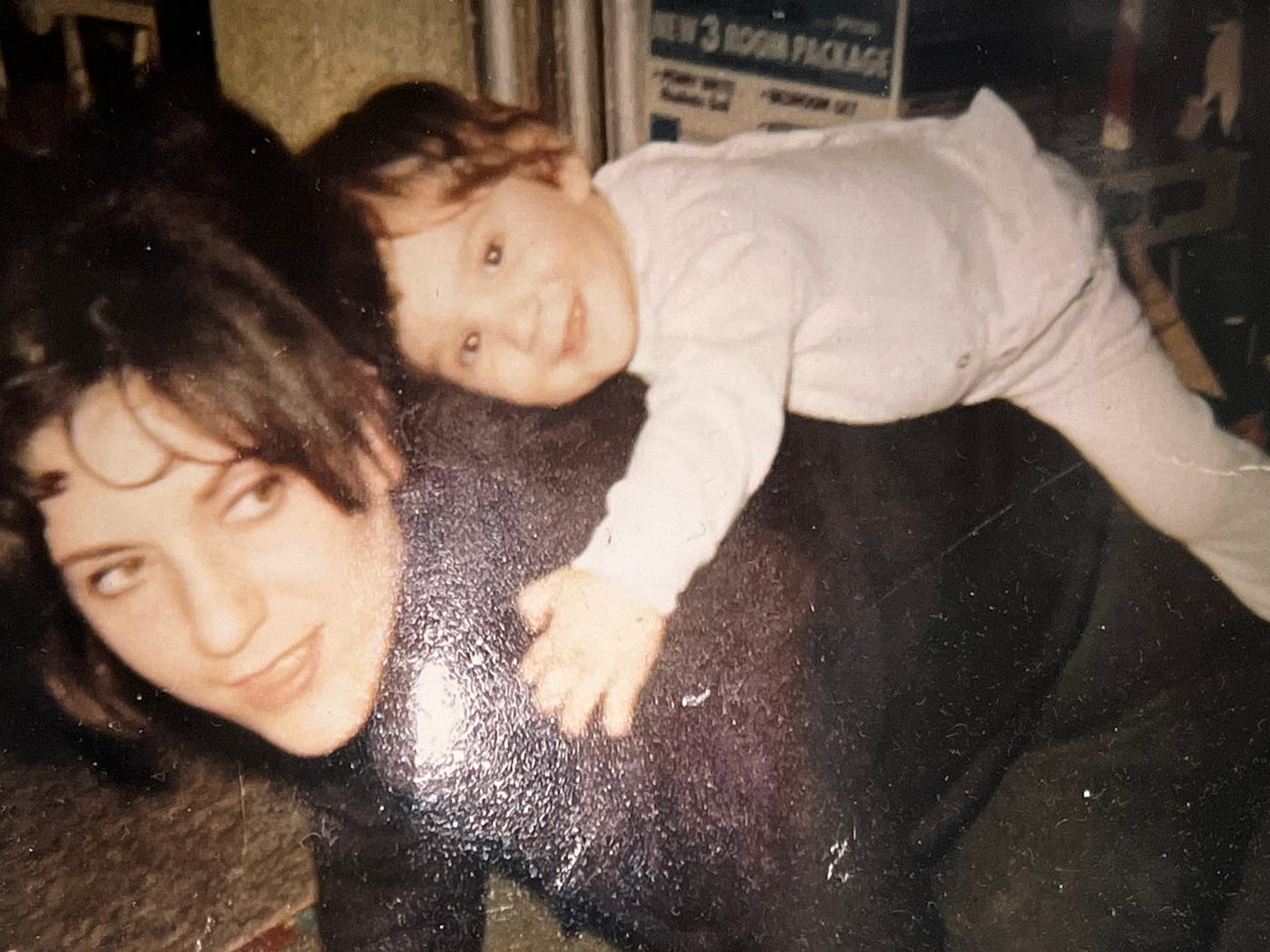
My baby sister Pamela riding on my mother in Germany
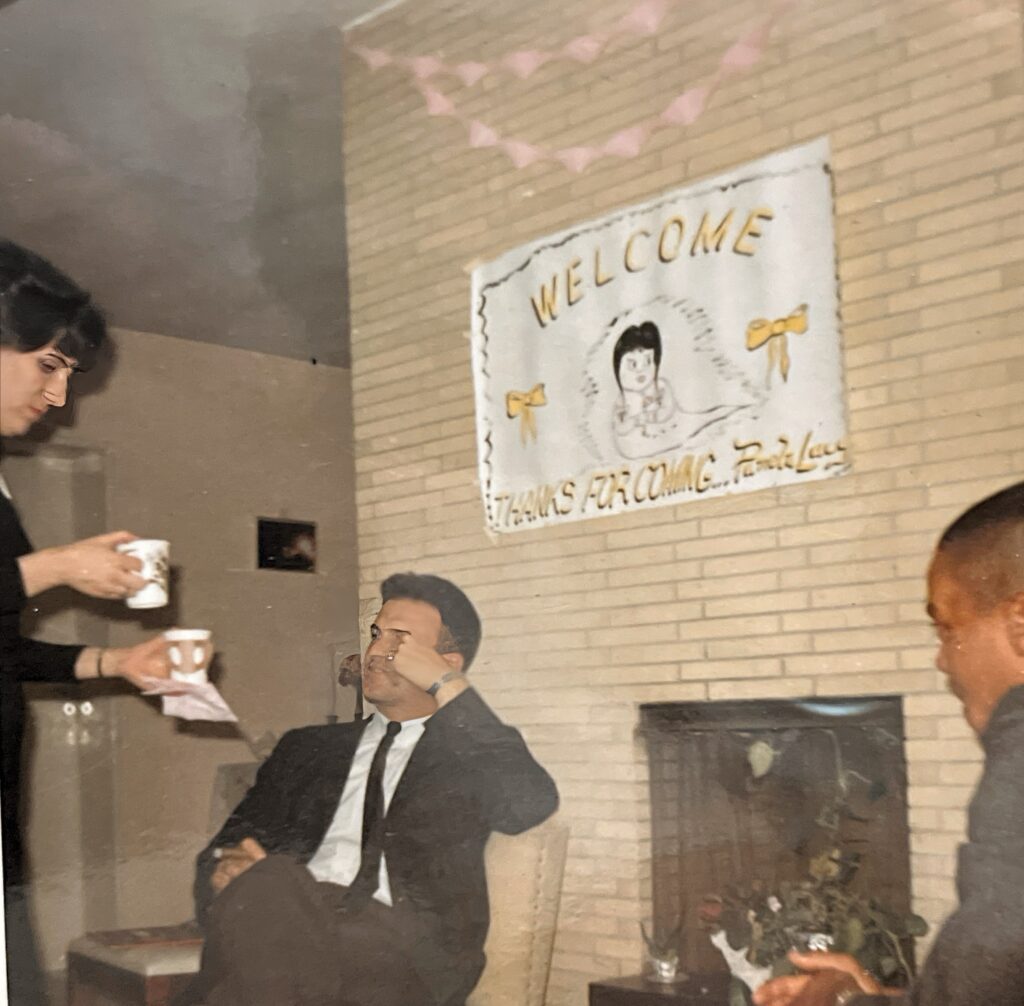
My sister, Pamela’s, baptism party in our post quarters in Fulda, Germany.
Our first deployment to Germany wasn’t just a posting — it was the beginning of my lifelong identification with the Army, with cavalry tradition, and with the kind of honorable service my father embodied. It was the chapter where I began to understand who I was becoming — and who I aspired to be.
Dad Gets Orders for HQ USAREUR in Heidelberg, Germany
As his command in Fulda came to an end, our family received new orders: a transfer to Headquarters, US Army Europe and 7th Army (HQ USAREUR) Heidelberg. This meant a new home for our family — one unlike any we had experienced before. We relocated to an American military housing area called Patrick Henry Village (PHV), located just on the outskirts of Heidelberg.
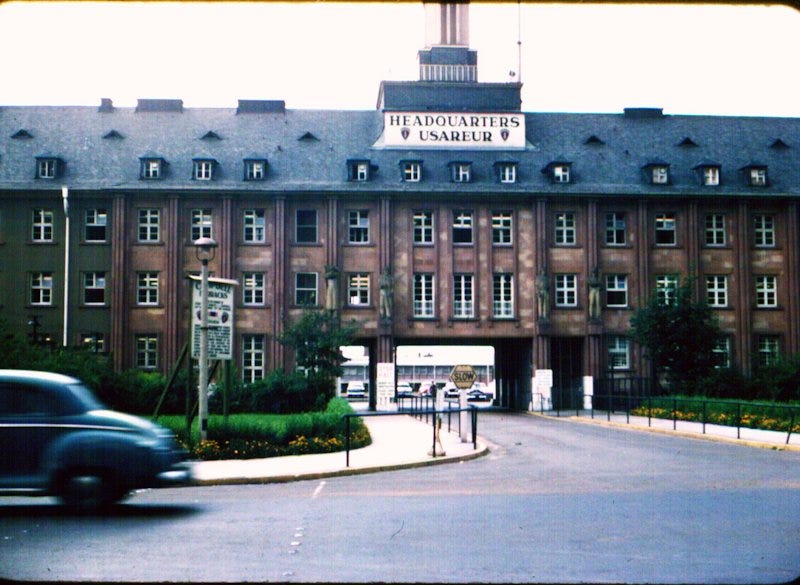
Headquarters US Army Europe (USAREUR) in Heidelberg, Germany
Our Family Moves Into Post Housing — Patrick Henry Village
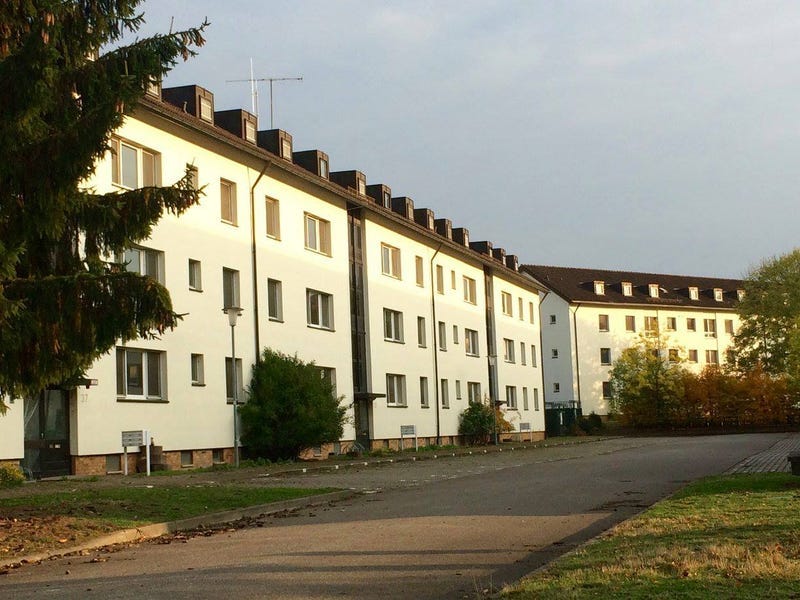
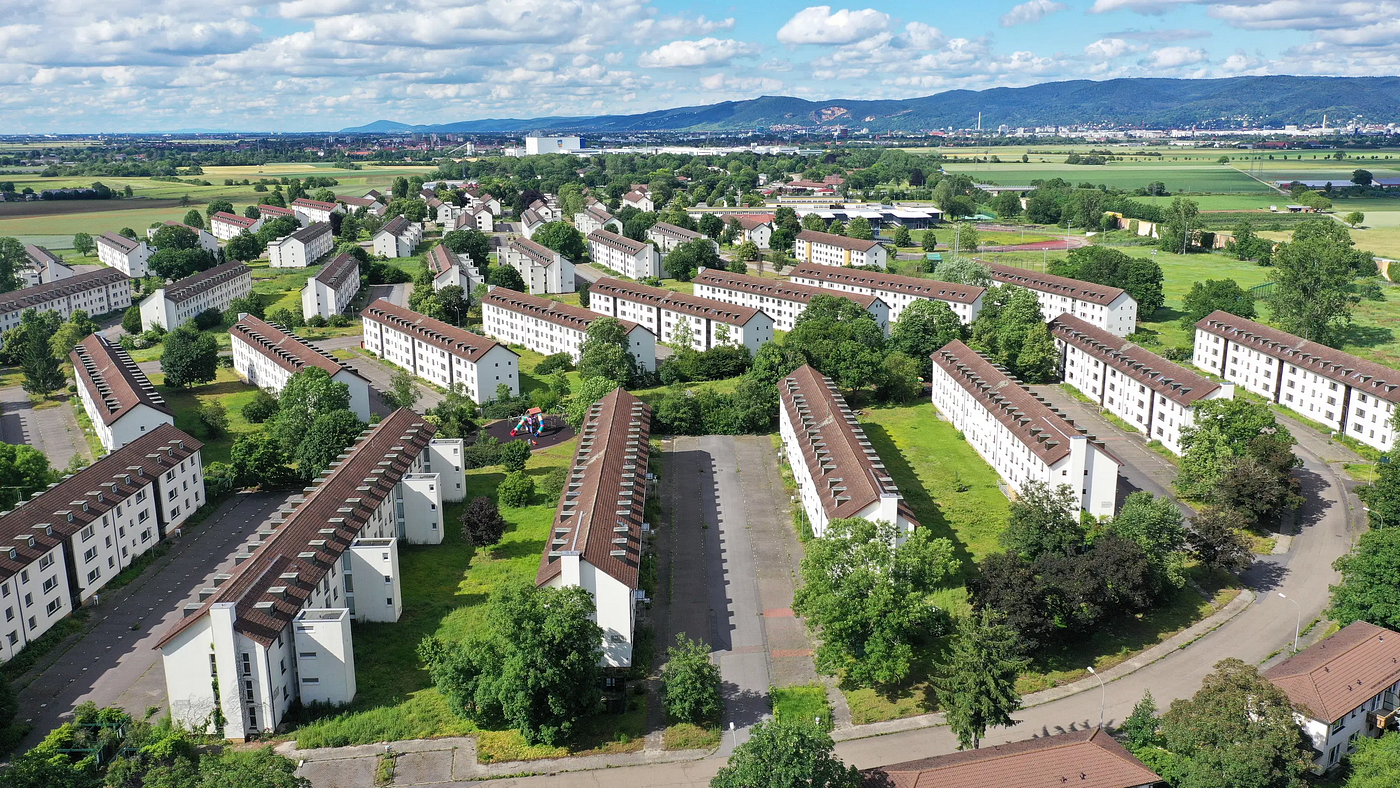
PHV was more than just a place to live; it was a self-contained American suburb transplanted into the heart of Germany. During the Cold War, it became one of the largest military family housing areas in Europe, with over 16,000 Americans living in approximately 1,500 apartment buildings. Every building looked exactly the same — white-painted concrete blocks with terra cotta roof tiles, lined up in precise rows. Each building contained three stairwells, with 18 apartments stacked over three floors.
The fourth floor usually housed maids’ quarters or temporary billeting units. From the outside, there were no distinguishing features. That fact became a nightmare on my very first day of school when I got hopelessly lost trying to find my way back home. Every building looked the same, and the playgrounds behind them all were full of noisy children. To this day, I have no idea how my mother managed to find me in that uniform maze of concrete, stairwells, and unfamiliar faces — but she did.
Apartment Buildings at Patrick Henry Village
Aerial View of PHV Shows Size and Similarity of Post Housing
Aerial view of Patrick Henry Village showing the uniform multi-family governement quarters.
Playing freely on Post Housing Area in Patrick Henry Village
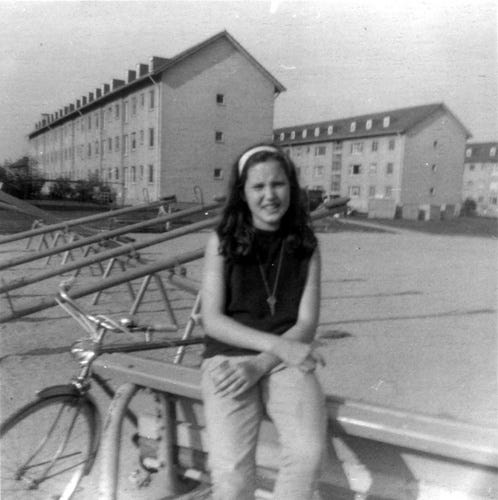
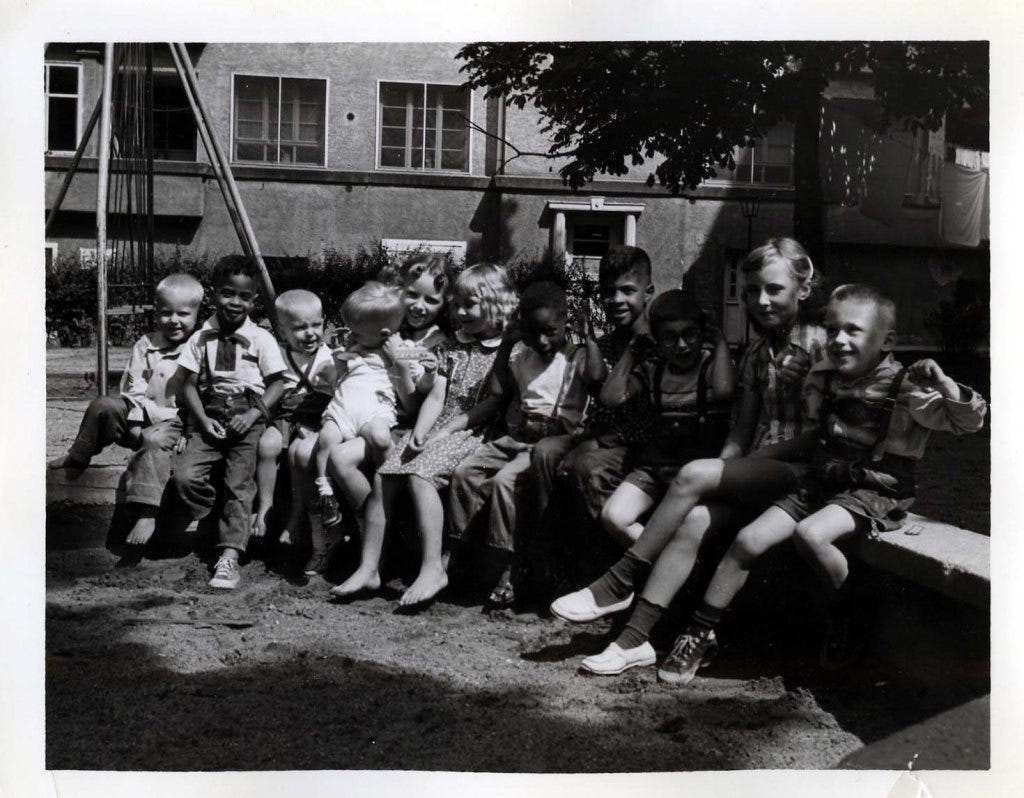
Despite that early trauma, I quickly adapted and grew to love life in Patrick Henry Village. Behind each building was a small playground, usually occupied by a noisy cluster of children from different corners of the country, brought together by the rhythm of Army life. After school and on weekends, those playgrounds became our kingdom. We ran wild until the familiar rituals of military tradition called us back to order.
Playground behind housing units in Patrick Henry Village.
Children met in the playground without the need for mothers supervising us.
Military Bugle Calls
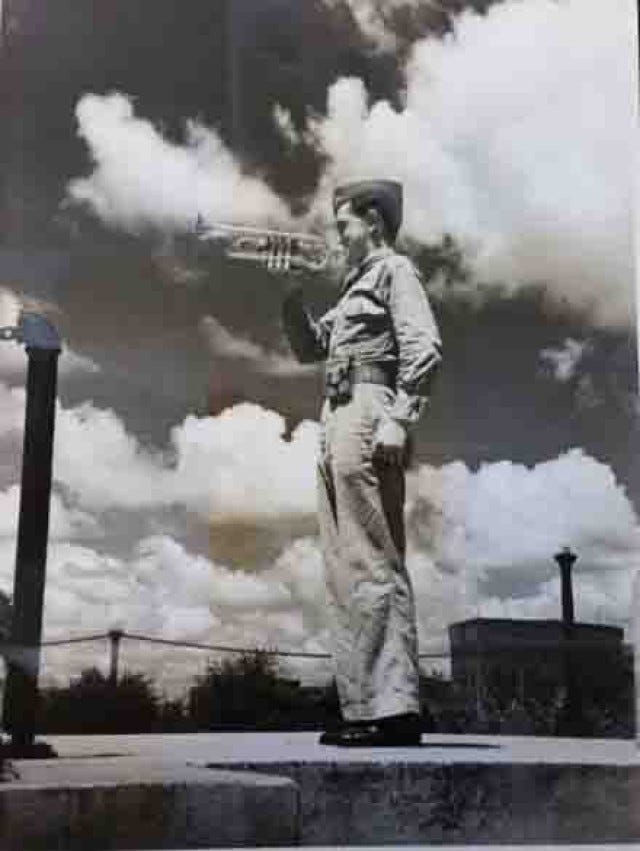
Every evening at exactly 1700 hours, a cannon blast echoed across the post, followed by the bugler’s mournful notes of “Retreat” and “To The Color.” At that moment, everything on base stopped. Cars pulled to the side of the road. Soldiers stepped out and faced the flag. Children froze in mid-play, instinctively turning toward the post colors. Everyone stood silently until the last note faded. That simple act — performed every day — instilled in me a deep and abiding sense of patriotism. Even today, the memory of it gives me goosebumps.
Bugler sounds Reville, Retreat, Tattoo, and Taps at scheduled times that can be heard post-wide.
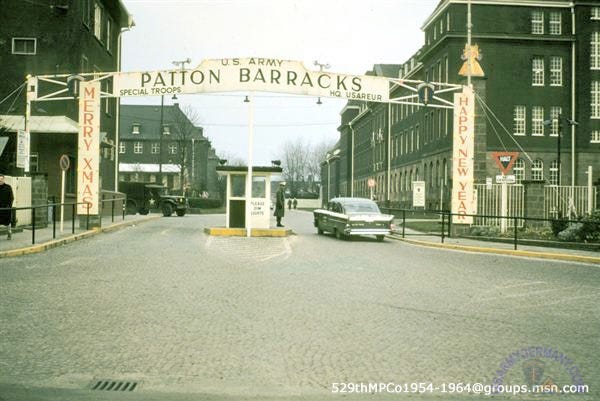
HQ USAREUR at Patton Barracks in Heidelberg
My father’s duty station was at Patton Barracks, which housed the Headquarters of United States Army Europe (USAREUR) and the 7th Army. As a boy, I didn’t fully grasp the weight of those names or the significance of the command my father now served. But I understood that he wore his uniform with pride, and that our family’s life revolved around a larger mission. We belonged to something big.
Patton Barracks, Heidelberg, Germany
We Enjoy Off-Post Visits to Altstadt Heidelberg
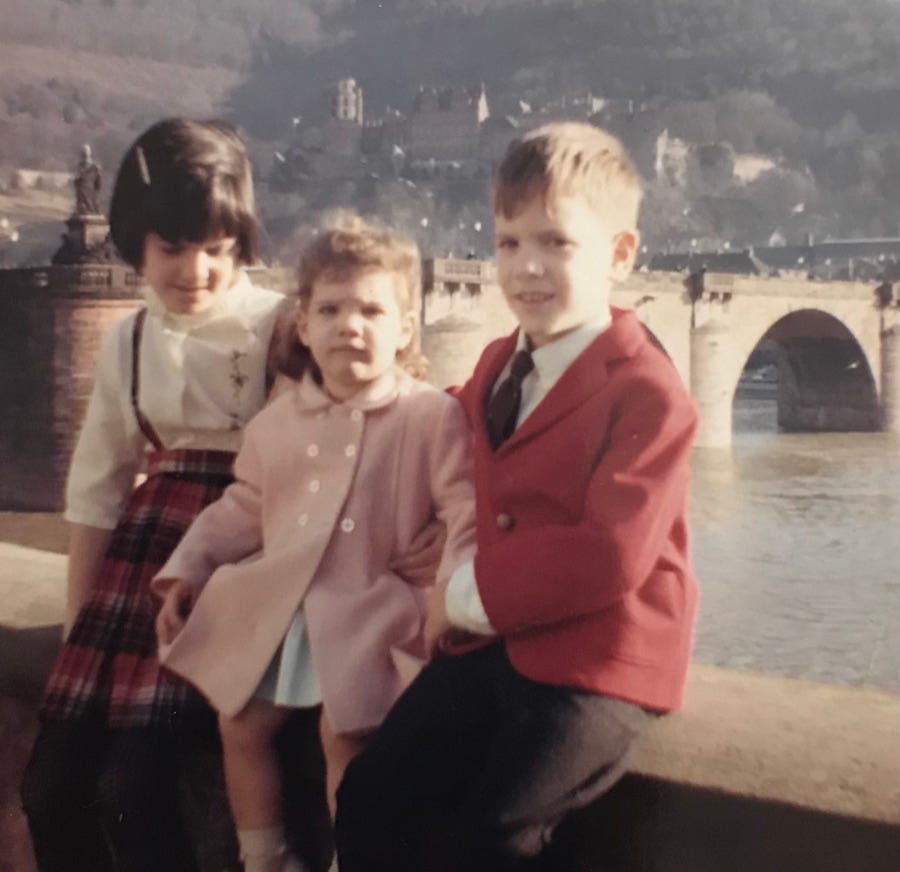
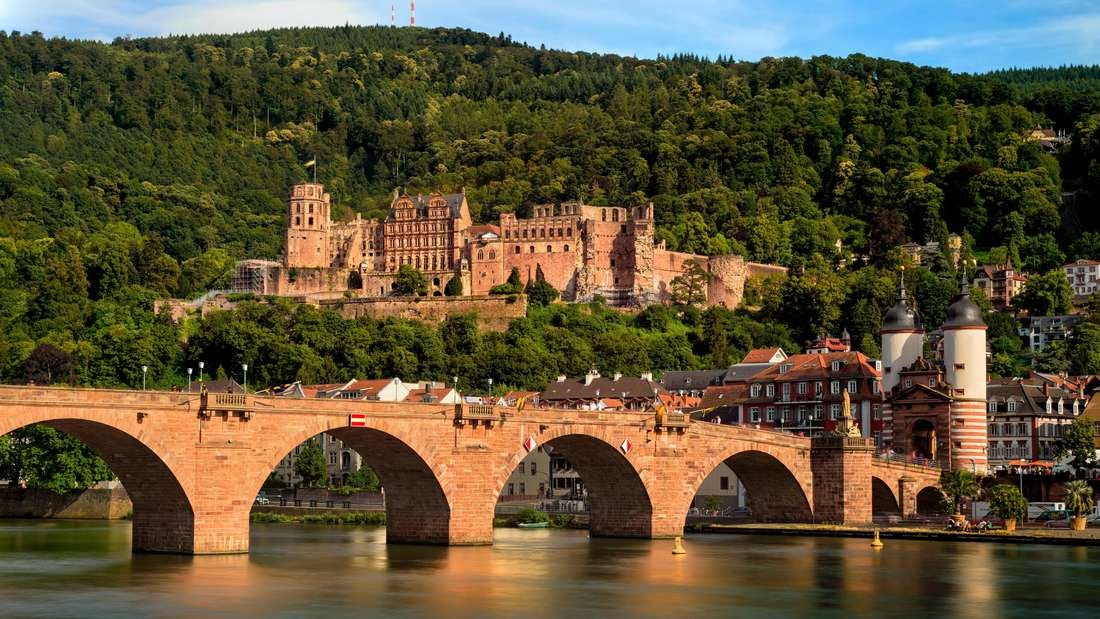
Though Patrick Henry Village was distinctly American, we were just a short ride away from one of the most beautiful cities in all of Europe — Heidelberg. Nestled on the banks of the Neckar River, Heidelberg is a city of old-world charm and deep historical roots. Dating back to the time of the Celts and Romans, it is best known for its stunning Schloss Heidelberg — a romantic, partially ruined castle perched on a hill overlooking the river and the old city.
Lynne, Cynthia and me sitting at the Necker River with the Alte Brücke and the Heidelberg Castle behind us.
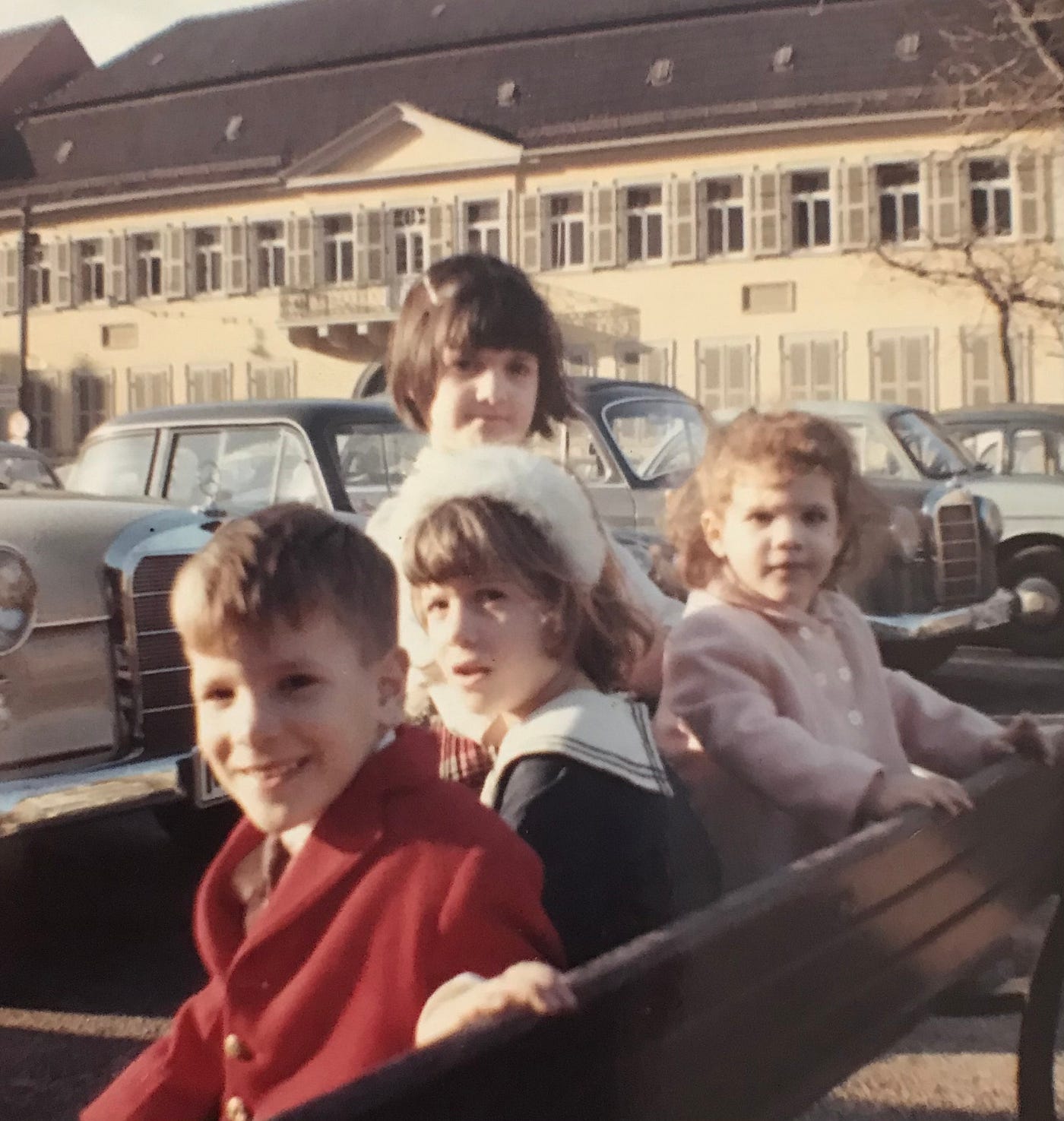
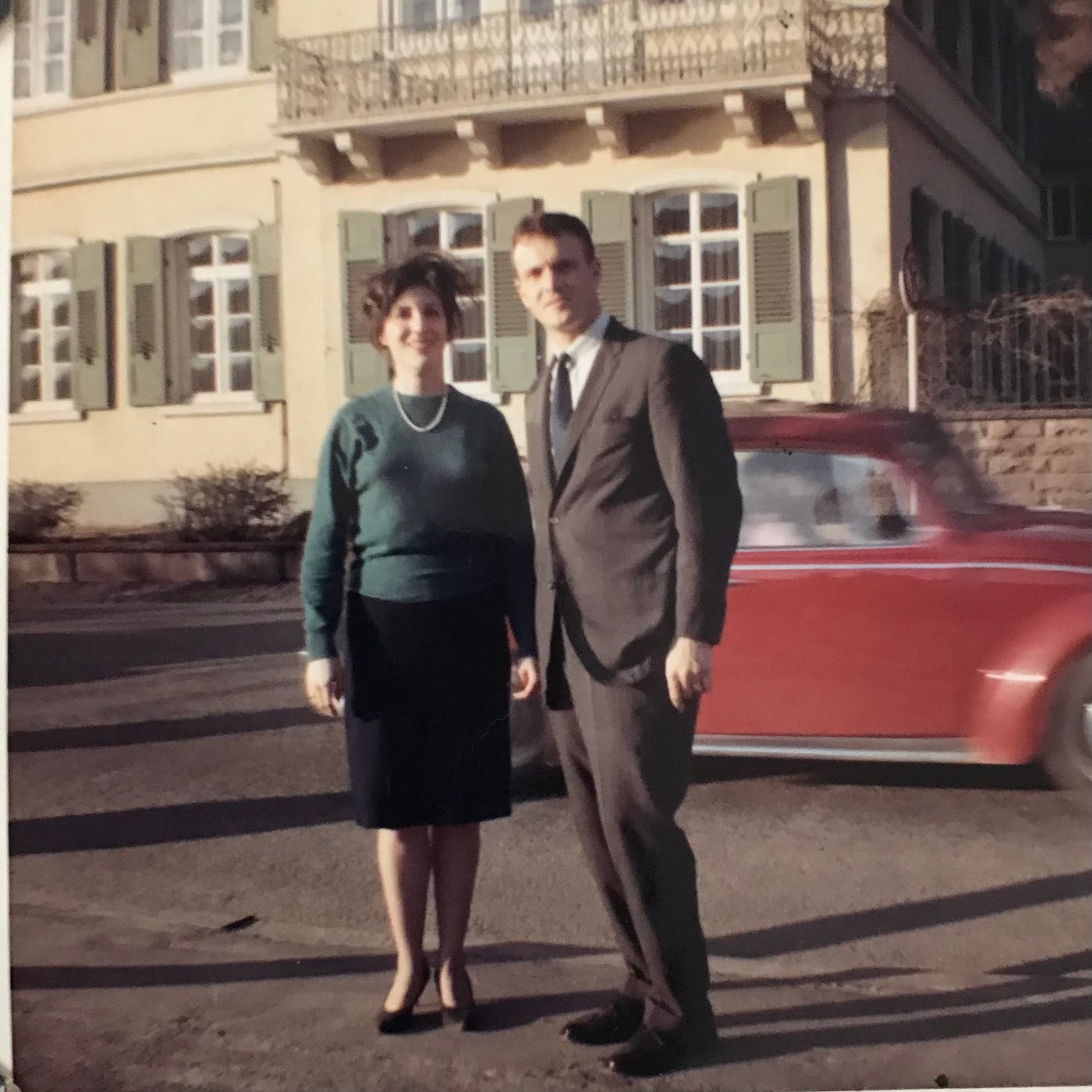
Lynne, Diana, Cynthia and me during our Sunday outing in Old Town Heidelberg. That’s our old Mercedes.
Mom & Dad in Old Heidelberg
Altstadt Heidelberg
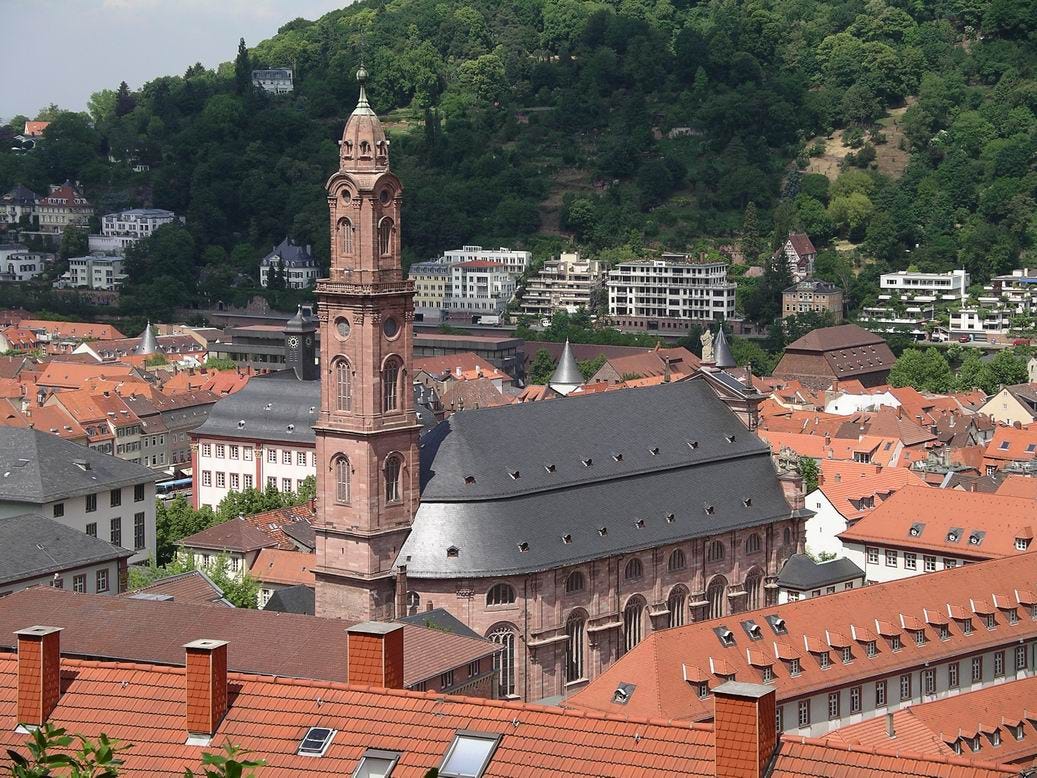
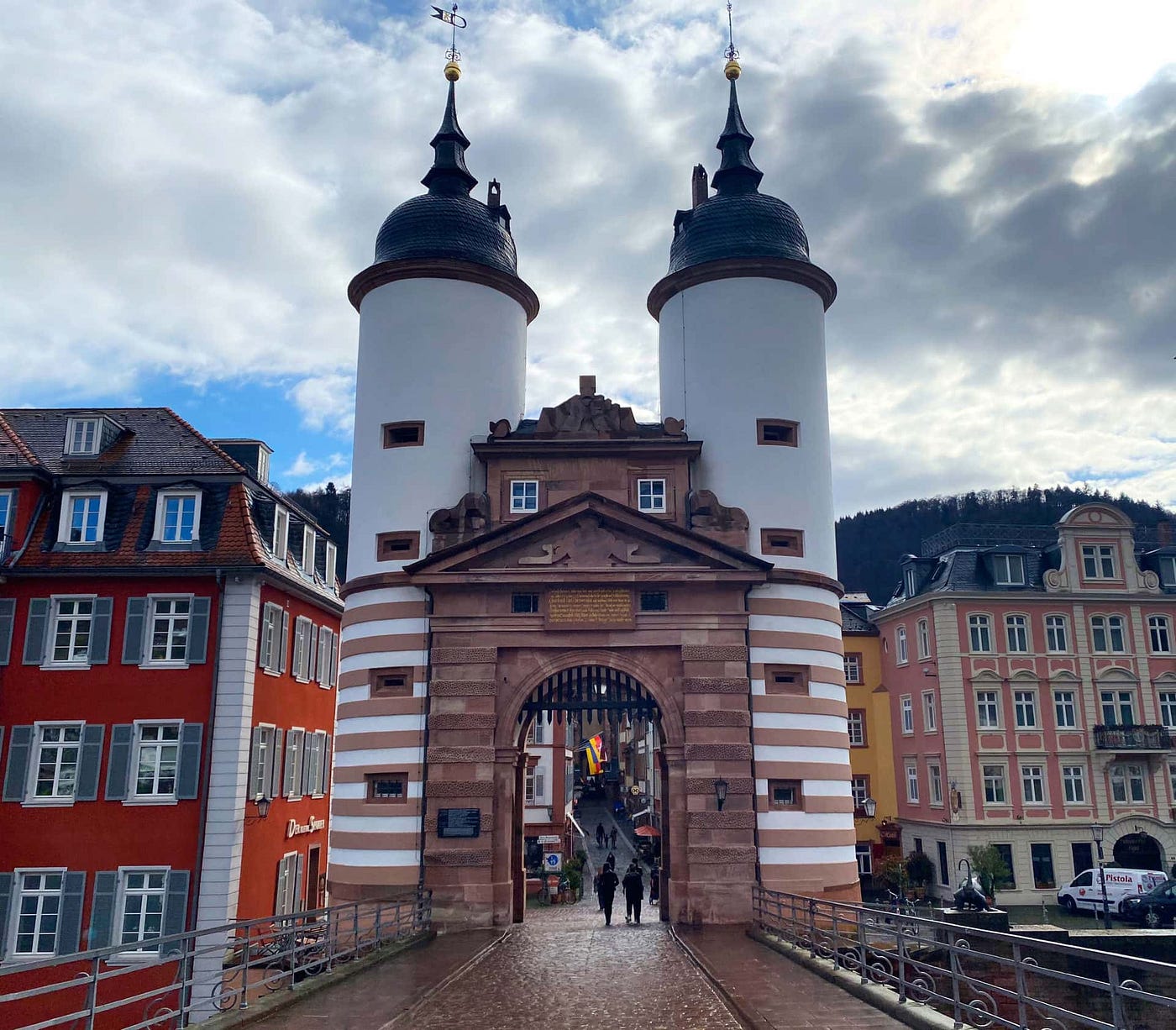
My favorite part of Heidelberg was the Altstadt — Old Heidelberg — located along the river beneath the castle. Its cobblestone streets wound past the Heiliggeistkirche (the Church of the Holy Ghost) and over the beautiful Alte Brücke, the Old Bridge. We spent many Sundays wandering those streets, exploring castle ruins and soaking in the beauty of this ancient town. On most Sundays, our family ritual began with mass at the post chapel, where I served as an altar boy. Afterward, we’d drive to the Officer’s Club for Sunday brunch — a tradition that blended sacred and social rhythms into a weekly ceremony of our own.
Heidelberg Castle with the Alte Brücke over the Necker River.
Heiliggeistkirche (the Church of the Holy Ghost) in Heidelberg.
The Entrance to Die Alte Brücke
Auntie Norma Stays with us Again
During this period, one of the most beloved figures in our family life came to stay with us — my mother’s younger sister, Norma Pietrantoni. Auntie Norma had always been a special presence in our lives, visiting us at every post we were assigned to, often stepping in as a second mother or nanny. In the 1960s, she worked as the personal secretary to the President of Harvard University. But when her boss took a sabbatical, Auntie Norma made a bold decision: she packed her suitcase and lived with us in both Fulda and later in Heidelberg for several months.
At a time when it was rare for single women to travel alone, Auntie Norma became a fearless explorer. While helping my mother care for my baby sisters, she also toured Europe — sometimes joining military-sponsored trips with soldiers, and other times venturing out entirely on her own. She was an avid photographer and the person behind most of the 16mm movie reels that captured our childhood in Germany. Thanks to Auntie Norma, so many of our memories from that magical time were not only lived but beautifully preserved.
Auntie Norma holding baby Cynthia
Lynne’s Birthday in Heidelberg
Lynne’s birthday in Heidelberg with Diana, Tony, Cynthia and baby Pamela
Heidelberg became more than just a city to me. It was a place of magic and mystery, history and reverence. The contrast between the crisp, ordered life of Patrick Henry Village and the timeless elegance of Heidelberg shaped my understanding of the world. One was duty, the other was beauty — and I was lucky enough to be raised with both.
Believe Nothing You Hear, and Only Half of What You See—A Memoir of Service, Shame, and the Search for Truth
Army Commissions Father a Cavalry Lieutenant
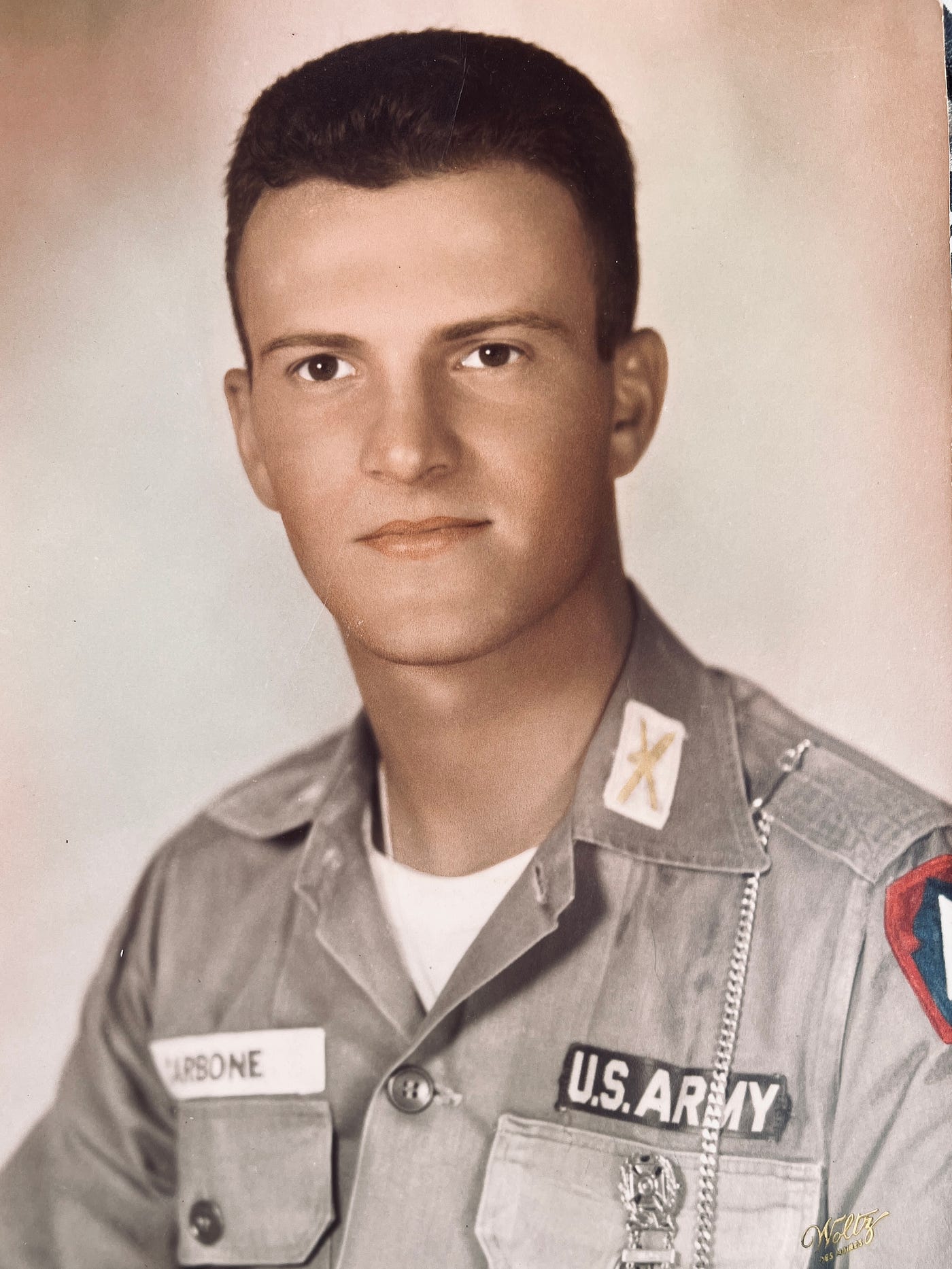
My father as a newly commissioned 2nd Lieutenant Armor Officer
Father Receives Orders for Fort Knox, Kentucky
After graduating from Norwich University on December 18, 1958, the President of the United States commissioned my father into the United States Army as a Cavalry Officer. His first assignment brought him and my mother the U.S. Army Armor Officer Basic Course at Fort Knox, Kentucky. The Army designed this several-month training program to transform him from a generalist cavalry officer into a specialist in armor and mechanized warfare.
We lived in a modest government house nestled in the company grade officer neighborhood of Fort Knox during that time. Though the housing was simple, it felt more spacious and comfortable than the trailer we had come from in Missouri. For my mother, this was a slight reprieve — finally, a bit of stability while my father threw himself into his next round of training.
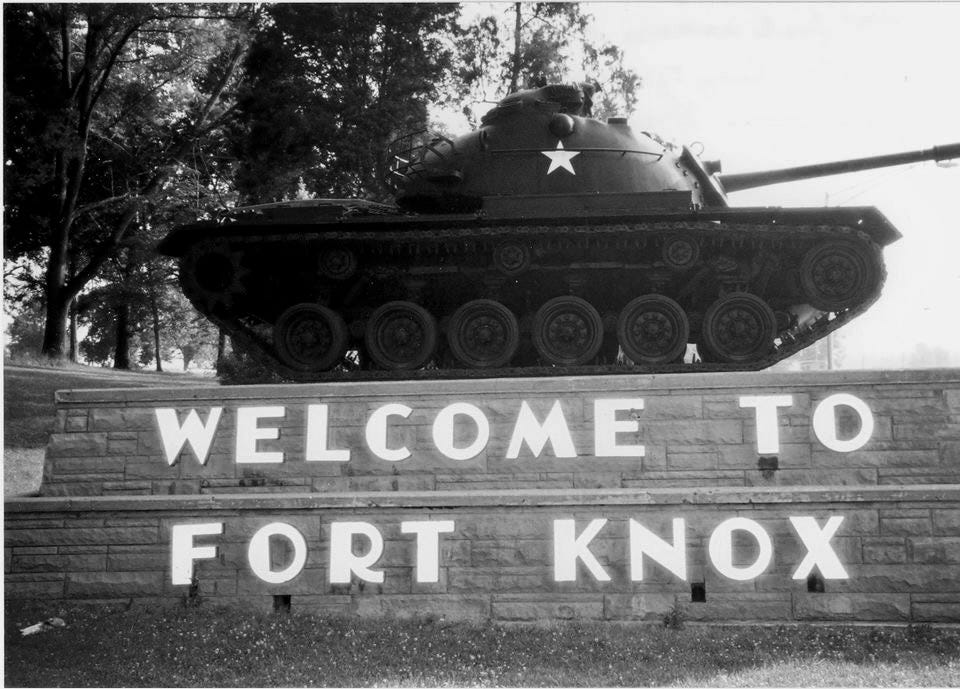
Fort Knox, Kentucky Front Gate
Father Receives Orders for Fort Leonard Wood, Missouri
After completing the Armor Officer Basic Course at Fort Knox, my father received orders to Fort Leonard Wood, Missouri in 1959, where the Army put him in charge of a training platoon. It was the beginning of his official military career — an ideal soldier stepping into the long shadow of duty, discipline, and sacrifice.
Father as a new lieutenant (with “Tiny” Minoski) at Fort Leonard Wood
Family Living Off-Post in a Tiny Trailer in Missouri
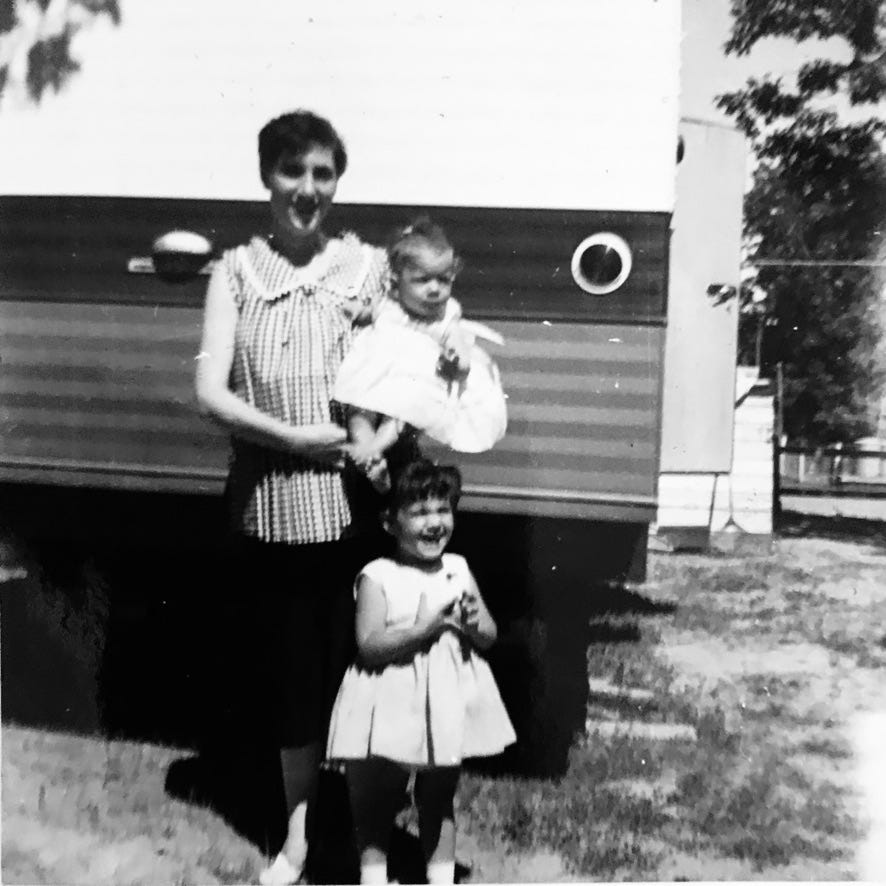
But for my mother, this period was anything but glamorous. She moved into a tiny trailer off base with my two sisters, Lynne and Diana. The trailer had no telephone, no car, and very few luxuries. Isolated in rural Missouri and far from her family in Medford, Massachusetts, my mother often described those early days as some of the most difficult in their marriage. It was a time of intense homesickness and growing pains — where she began to understand what it truly meant to be an officer’s wife.
Mother with sisters Lynne and Diana by our trailer at Fort Leonard Wood, Missouri
My Birth, December 3, 1959
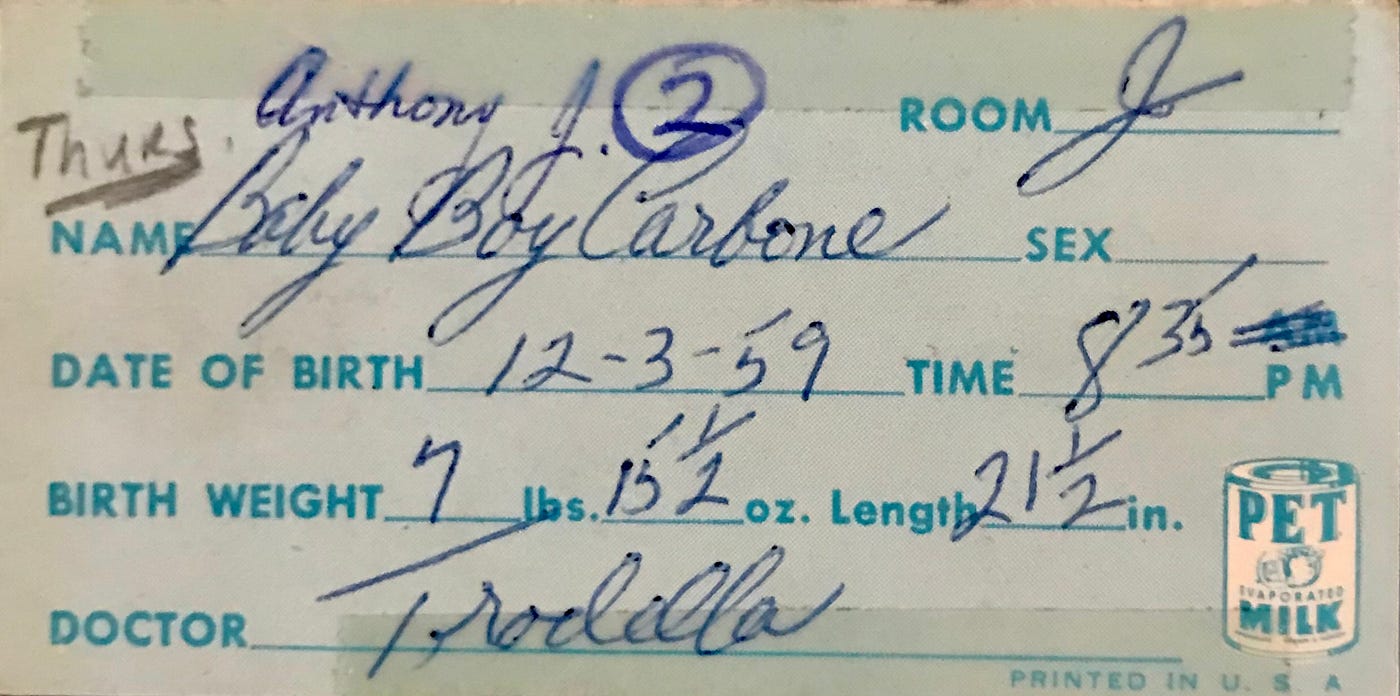
In the winter of 1959, my mother made a brave decision. Wanting to be close to her family and the familiar care of her longtime doctor, she traveled alone — with no car and no support from the Army — back to Medford, Massachusetts, to give birth to me. My father remained on duty at Fort Leonard Wood, unable to accompany her. I was born on December 3, 1959, at Lawrence Memorial Hospital, delivered by Dr. Trodella — the same physician who had brought my sisters Lynne and Diana into the world. Not long after my birth, my mother bundled up her newborn son and returned to Missouri, where our now family of five squeezed back into the same little trailer.
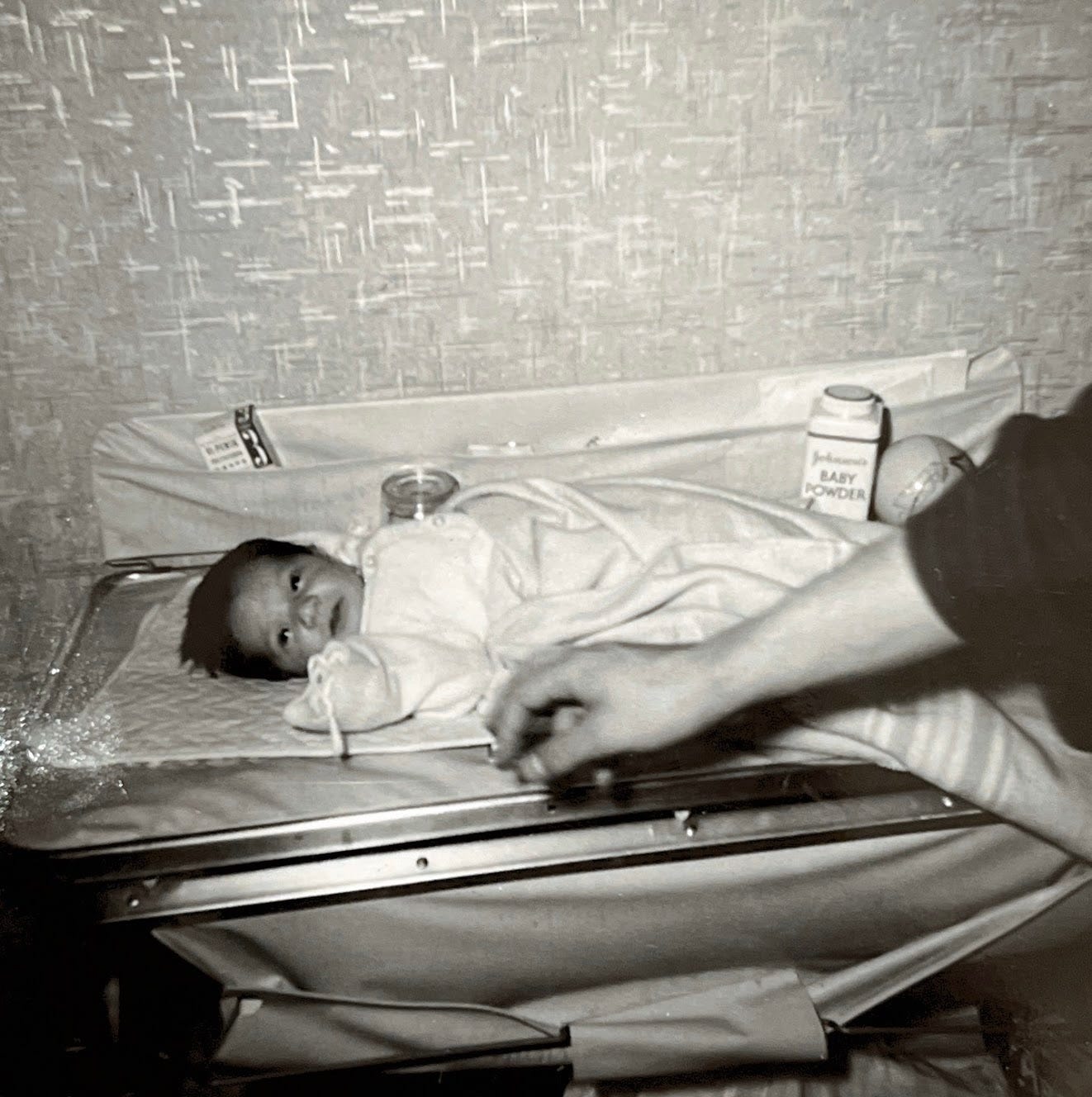
Anthony Joseph Carbone Jr born December 3, 1959.
My Mother’s Younger Sister Greyhound from Boston to Missouri Alone
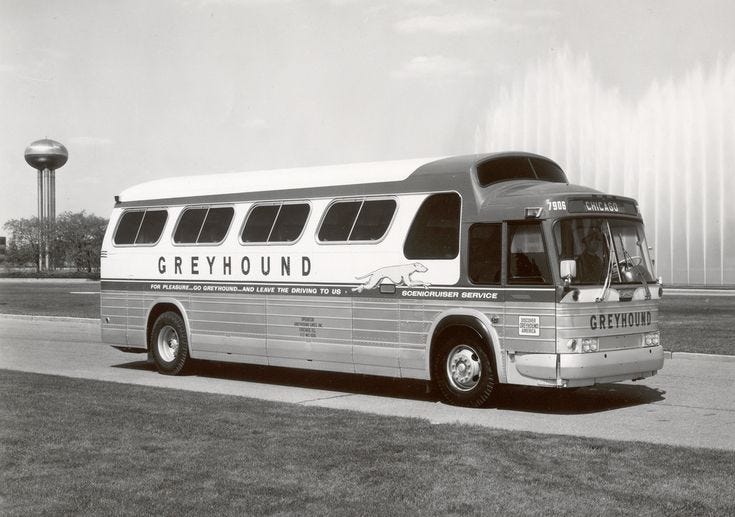
Then a story about my aunts and Fort Leonard Wood always surprised and impressed me. My mother’s younger sisters — Norma, Cynthia, and Yvonne — decided to visit her all the way from Boston. They didn’t have much money, and none of them had ever traveled so far. But they pooled what they had, boarded a Greyhound bus, and rode all the way across the country to rural Missouri.
This was long before mobile phones or even reliable landlines. When they finally arrived, they sat at the local bus station for hours, waiting patiently for my father to get off duty and pick them up. During their visit, there were now eight people living in that little trailer. My mother described it as cramped and chaotic, yet she said it was one of the most joyful and loving visits of her life. Laughter, babies, stories, and sisterhood filled that small space, reminding all of us that even in humble surroundings, family makes room for family.
Father Sent to Airborne School at Fort Benning, Georgia
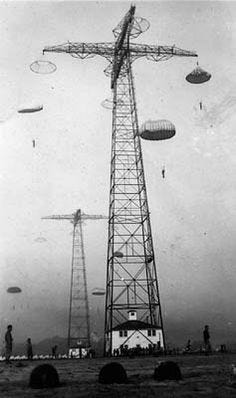
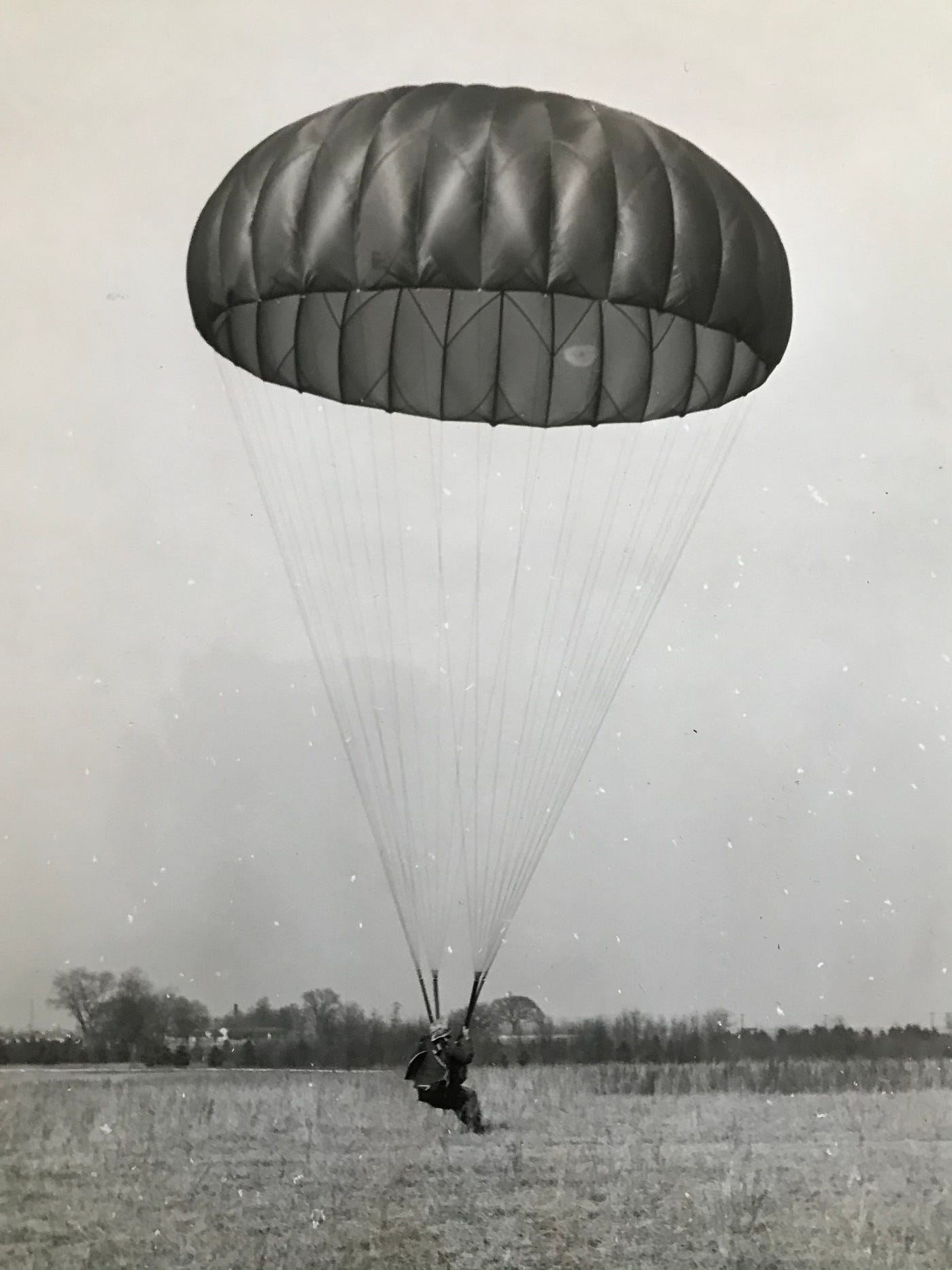
Upon completion of his assignment at Fort Leonard Wood in 1960, my father received orders to attend paratrooper training at the U.S. Army Airborne School at Fort Benning, Georgia. Over the course of three grueling weeks, he trained relentlessly to earn the coveted silver paratrooper wings. The jumps were real. The risks were real. My father stood determined and proud when he completed the course and became a paratrooper, a distinction he carried with pride for the rest of his life.
250-Foot Jump towers at Airborne School, Fort Benning, Georgia
Dad making a perfect Parachute Landing Fall (PLF) on the drop zone at Fort Benning.
Father Receives Orders for 10th Cavalry Regiment in Korea
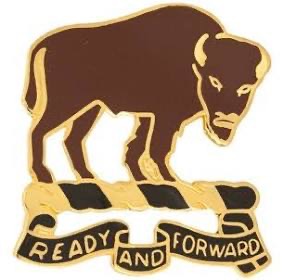
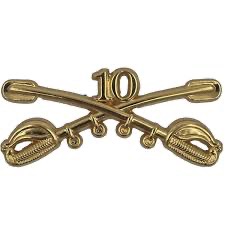
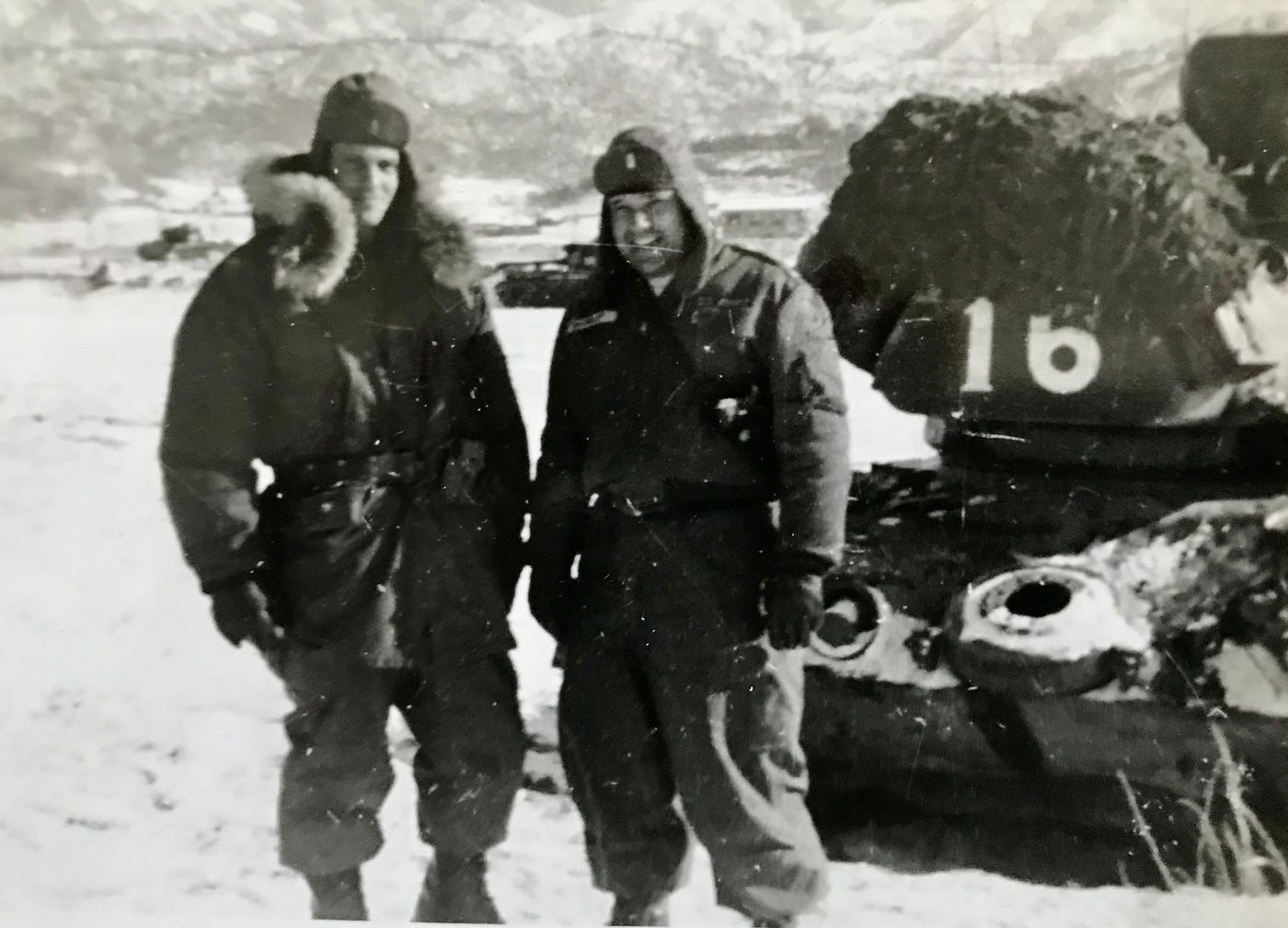
Shortly after completing his airborne training, my father actively served a year-long unaccompanied tour in South Korea from 1960–1961, leading as a Cavalry Platoon Leader and Squadron Adjutant with the 10th Cavalry Regiment.
I have photographs of him wrapped in his heavy Army-issue extreme cold weather parka and wearing those oversized insulated “Mickey Mouse” boots designed for sub-zero conditions. The images showed him standing beside tanks that had slid off icy roads and flipped completely over in the snow — gritty proof of the harsh terrain and rugged conditions he endured.
Dad and Tiny Minosky enjoying winter in Korea
Father as a Cavalry Lieutenant in South Korea
My godfather, Uncle George, stepped in to help
During that year, while my father braved the Korean winter, I was just one to two years old, too young to understand his absence but old enough to feel its impact. My godfather, Uncle GeorgePietrantoni, only about 18 at the time, stepped into the void, becoming a familiar presence in my life. But when my father returned, I had entered the “Stranger-Danger” phase of childhood, wary of unfamiliar faces — even his. My instinctive withdrawal stung him deeply, planting the seeds of an awkward tension that lingered between us for years, a quiet rift neither of us fully knew how to bridge.
We Live With Nana Pietrantoni
While my father served in Korea, my mother brought us back to our haven in Medford, Massachusetts, to live at my nana’s house. That house, a bustling three-story home, was our true home away from home. My grandparents lived on the second and third floor, along with my nana’s sister, my great aunt Concetta, three of my mother’s sisters (Aunties Norma, Cynthia and Yvonne), and eventually — my mother and her three children.
The house was always alive with movement and voices. Family members came and went in a constant stream, and my nana seemed to be cooking from sunrise to midnight. The smell of garlic and fresh tomato sauce filled every hallway. My papa was always in the backroom sewing on his vintage Singer sewing machine with a rhymthic chucka sound. It was noisy, crowded, and warm — and to me, it was the safest place on earth.
Mom, Lynne, Diana, Anthony Jr, and Auntie Yvonne at 143 Winthrop Street in Medford
Mum with my two older sisters, Lynne and Diana
Auntie Norma holding me at my grandparents’ house in Medford, Massachusetts
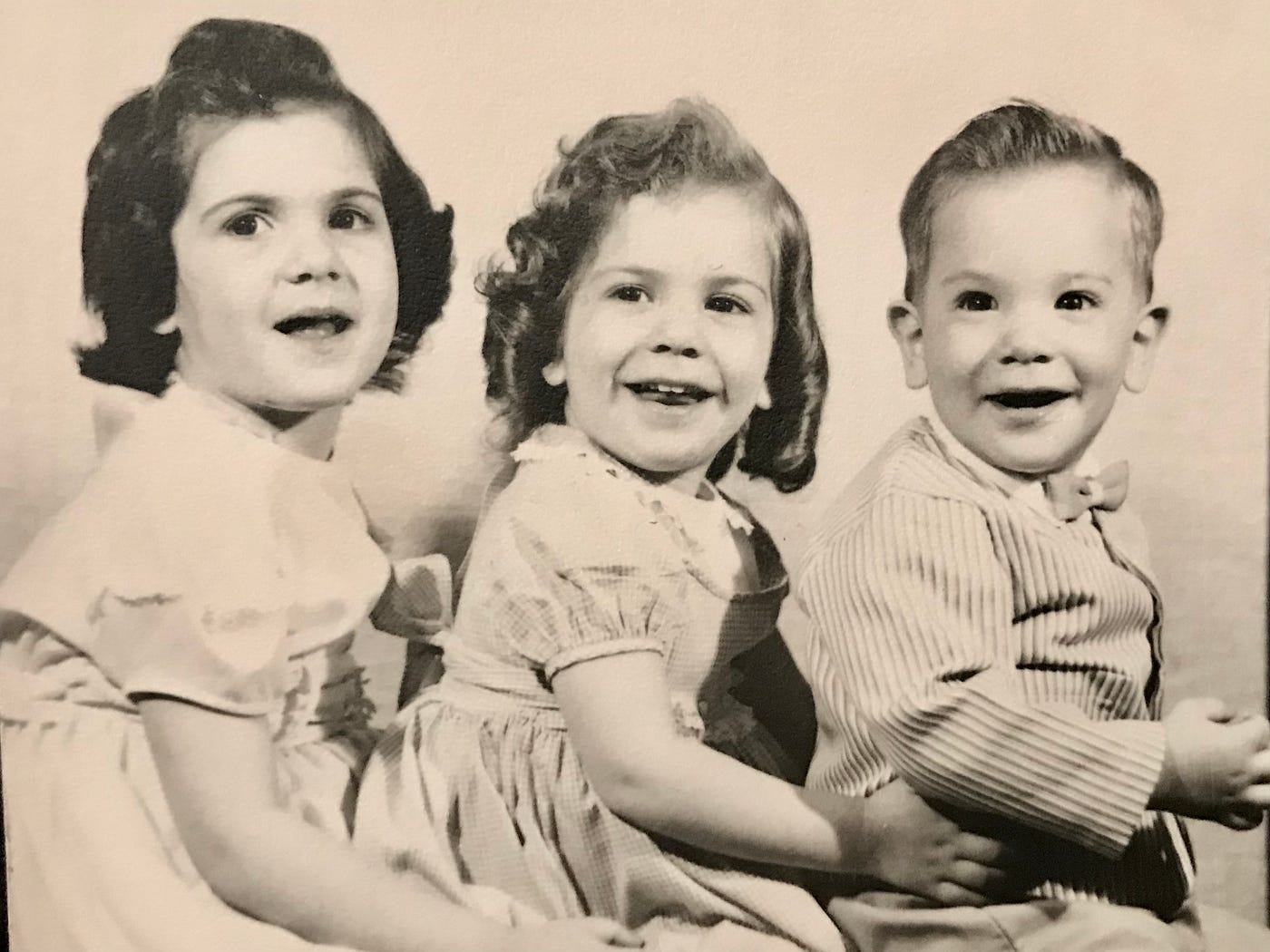
Lynne, Diana and Anthony Jr.
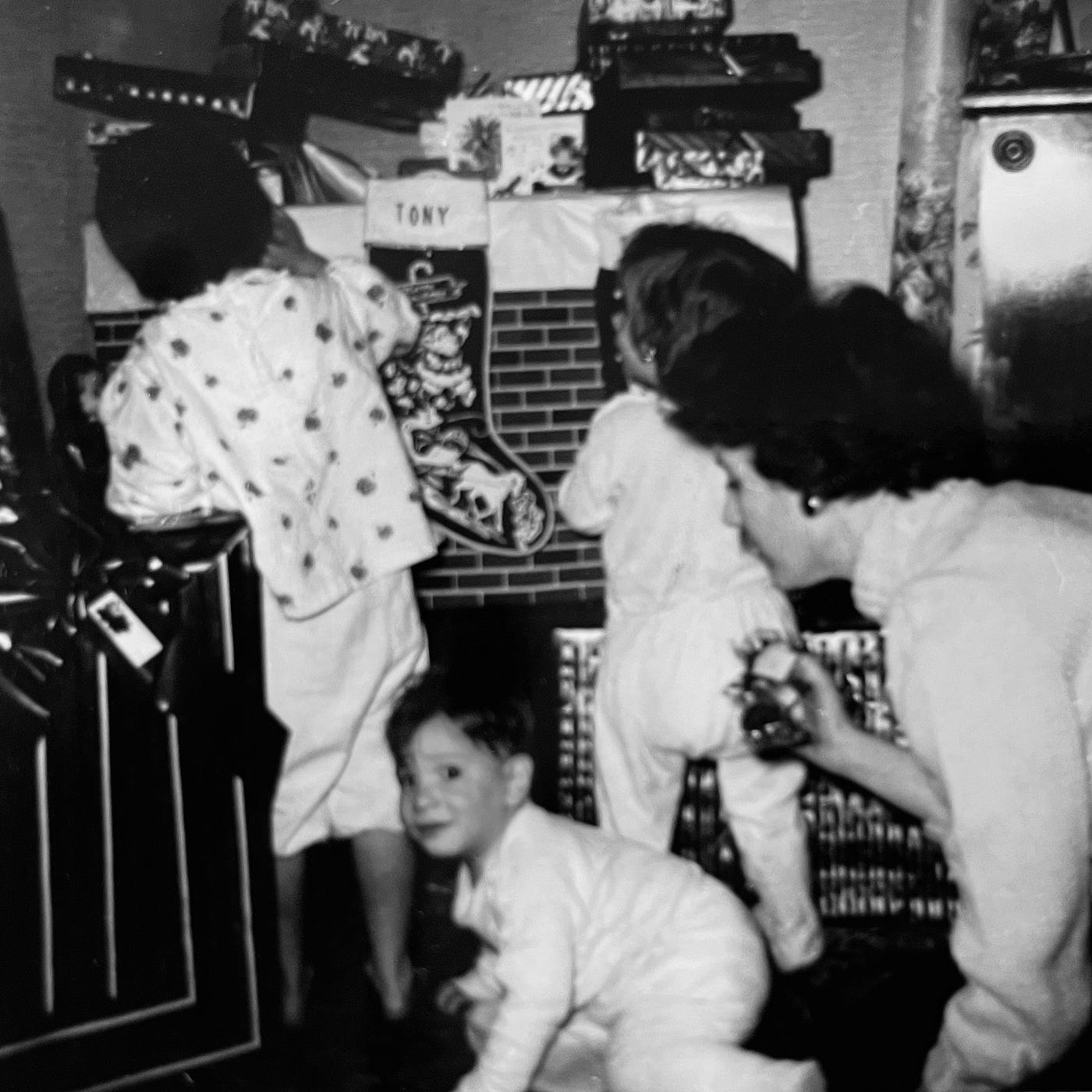
Christmas 1960 at Nana & Papa Pietrantoni’s house while my father was in Korea.
Father Receives Orders for 101st Airborne DIvision at Fort Campbell, Kentucky
After completing his tour in Korea, the Army sent my father to Fort Campbell, Kentucky, where he served from 1961 to 1963 with the prestigious 101st Airborne Division, the “Screaming Eagles.” He served as the Adjutant for the Headquarters and Headquarters Company of the division. Once again, our family lived in government quarters on post, adjusting to the routines and rituals of a new Army installation.
Dad in the living room of our post quarters at Fort Campbell, Kentucky
With my mother behind our quarters on Fort Campbell, Kentucky
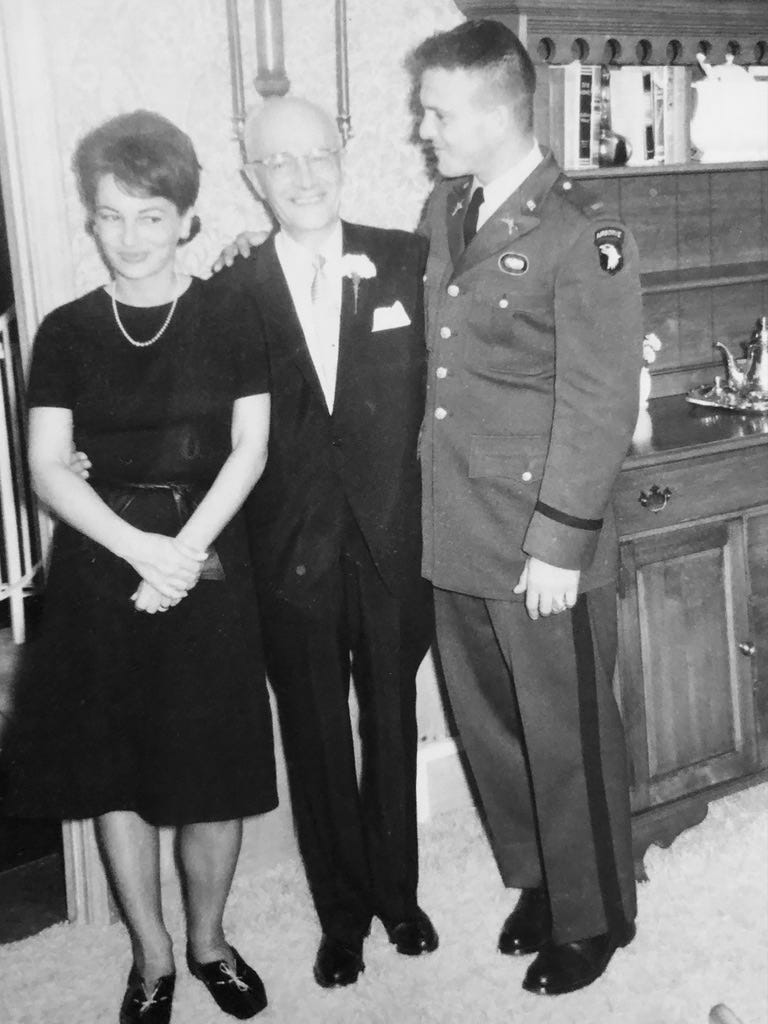
My father wearing his paratrooper wings and 101st Airborne Division patch with his father and sister, Rosemarie.
The Cuban Missile Crisis
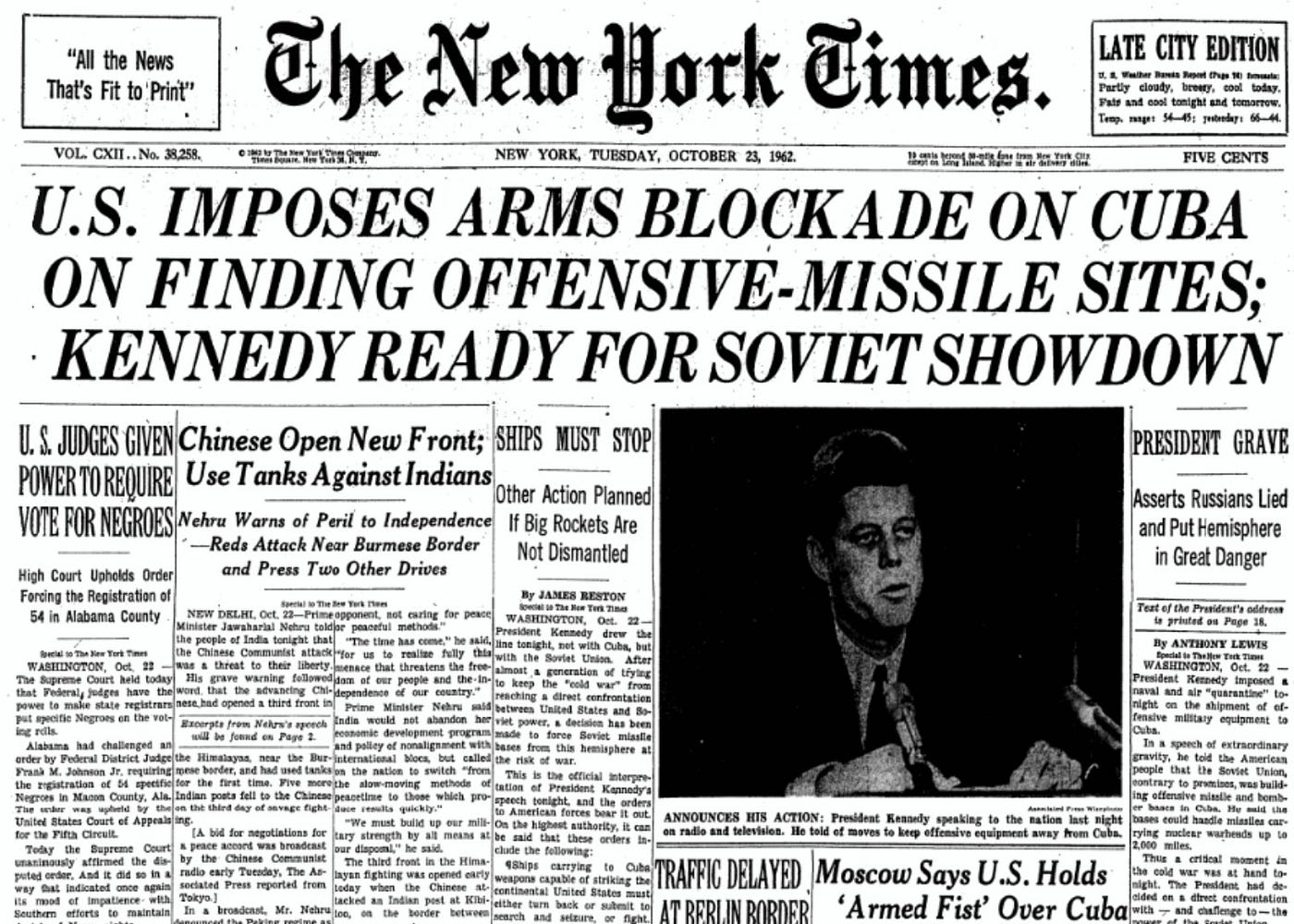
During this same period, in October of 1962, the United States faced one of the most dangerous confrontations of the Cold War — the Cuban Missile Crisis. This 13-day standoff between the United States and the Soviet Union began when American reconnaissance aircraft discovered that the Soviets were installing nuclear missiles in Cuba, just 90 miles from Florida. President John F. Kennedy responded by ordering a naval blockade of the island and demanding the immediate removal of the missiles. For nearly two weeks, the world stood on the brink of nuclear war. Thankfully, U.S. and Soviet leaders eventually resolved the crisis through diplomacy, though only after extraordinary tension and heightened military readiness.
NY Times Article from October 1962 on the Cuban Missile Crisis
Dad and the 101st Airborne Prepare to Invade Cuba
Most history books record that elite Army units, including the 101st Airborne Division, were mobilized and staged in Florida and Georgia in anticipation of a possible full-scale invasion of Cuba. However, what most people don’t know — and what I know from my own father’s account — is that he was part of a classified mission to Puerto Rico. As the Adjutant for the Command & Control Battalion of the 101st Airborne Division, he and a select group of officers were quietly deployed to Ramey Air Force Base in Aguadilla, Puerto Rico, during the height of the crisis. Their presence there was never officially acknowledged in the open-source historical record, but it’s part of our family’s private history.
I remember overhearing fragments of the story growing up — how the tension was palpable, the operation strictly need-to-know, and the mood deadly serious. My father never glorified the moment, but the fact that he was trusted to be part of such a critical, behind-the-scenes operation speaks volumes about the kind of officer he was becoming. The Cuban Missile Crisis may have been narrowly avoided through diplomacy, but my father and others in the 101st were prepared to act at a moment’s notice.
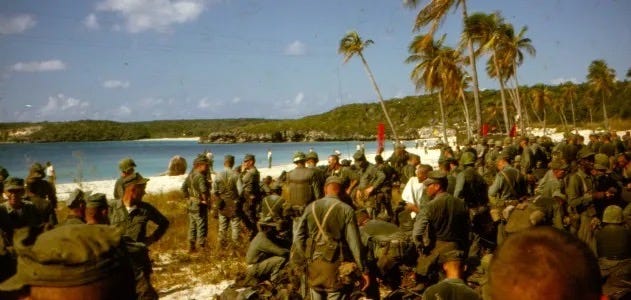
USMC Forces Preparing for Invation of Cuba on Puerto Rican Island
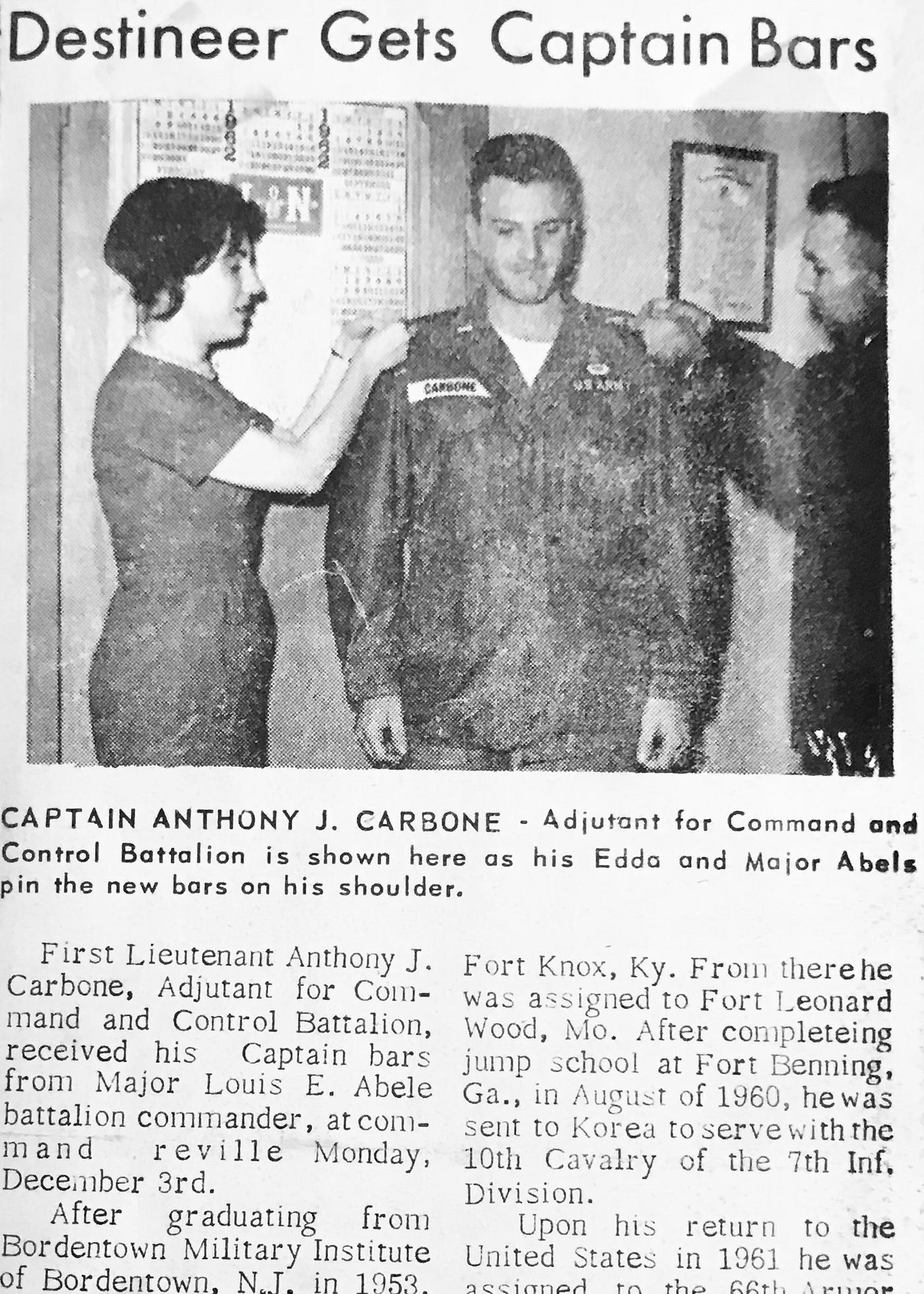
Dad Gets Promoted to Captain
My father was promoted to the rank of Captain on my third birthday. This was while serving as the Adjutant for the Command & Control Battalion of the 101st Airborne Division.
Mom pinning on Captain’s bars on my newly promoted father.
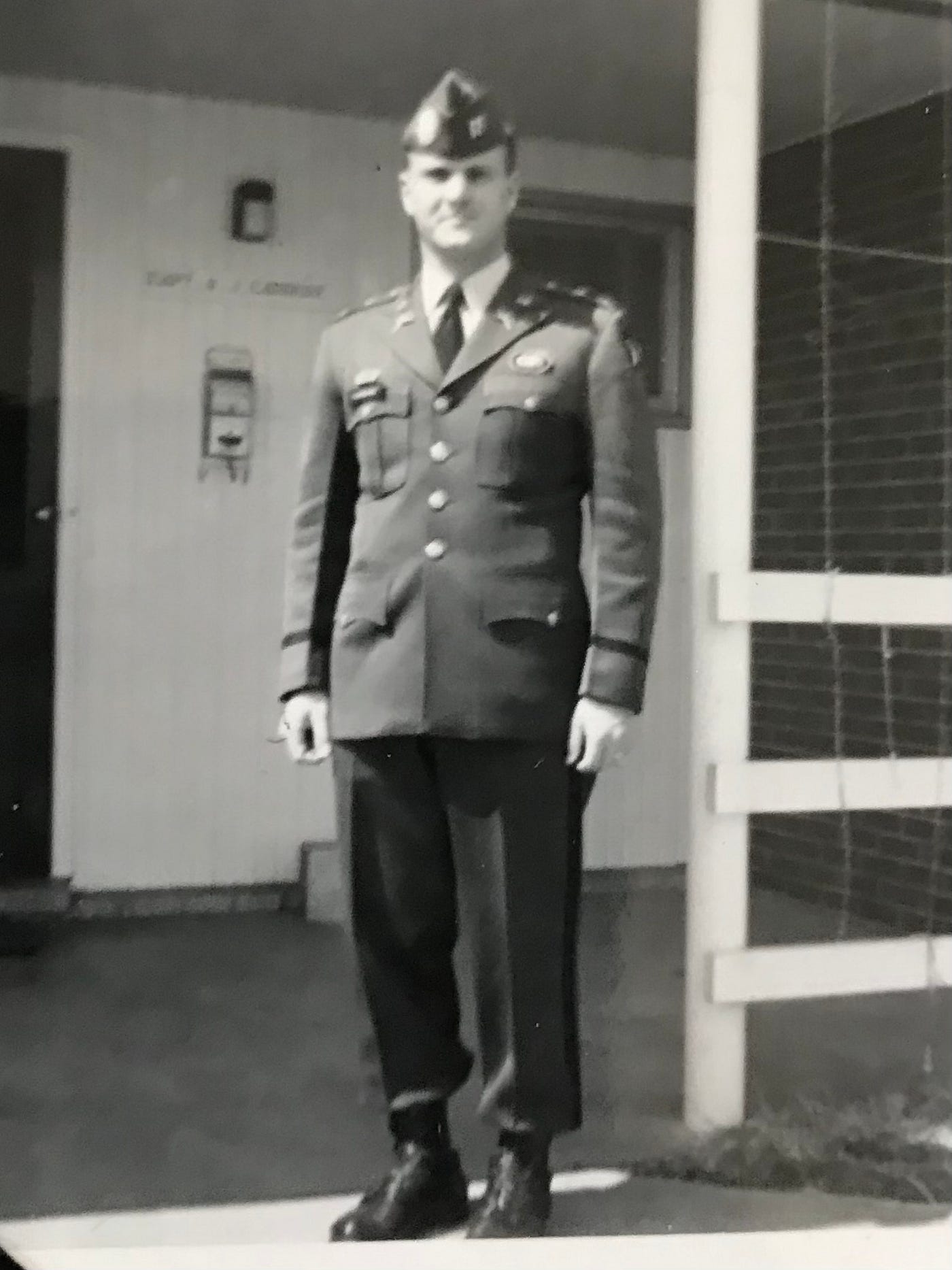
Captain Carbone staning in front of our quarters at Fort Campbell, Kentucky.
Father Gets Orders for Fort Benning, Georgia
In 1963, was father received orders sending him back to the U.S. Army Infantry School and Center at Fort Benning, Georgia to attend the Infantry Officer Advance Course. This was considered an honor and special assignment for an Armor officer.
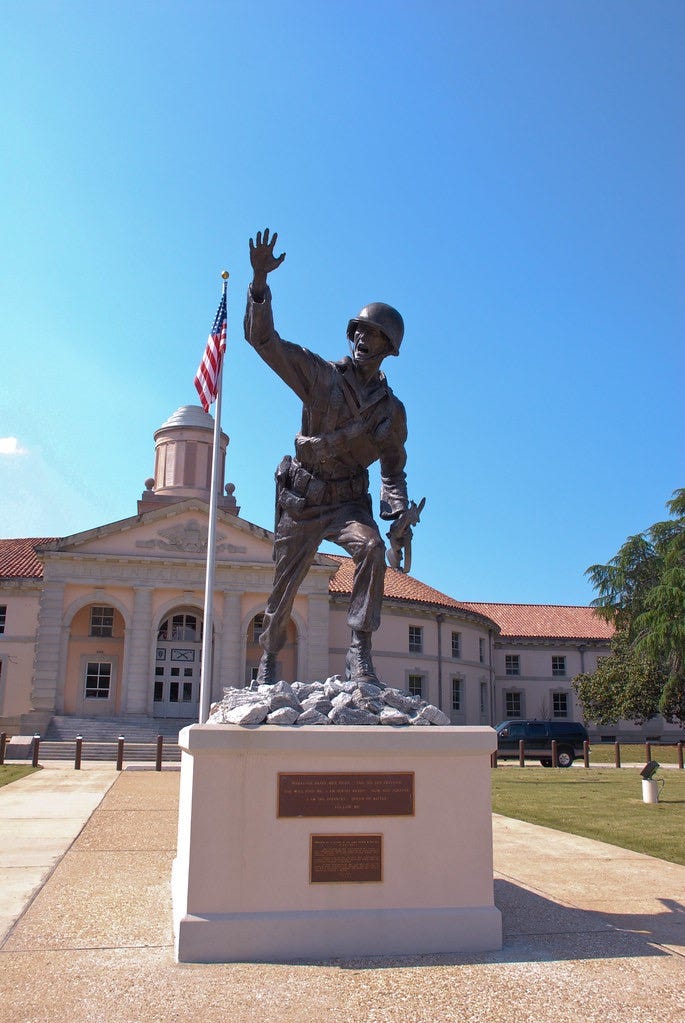
Famous “Follow Me” Statue at the U.S. Army Infantry School & Center at Fort Benning, Georgia.
President & Mrs. Kennedy Travel to Texas and the World Changed
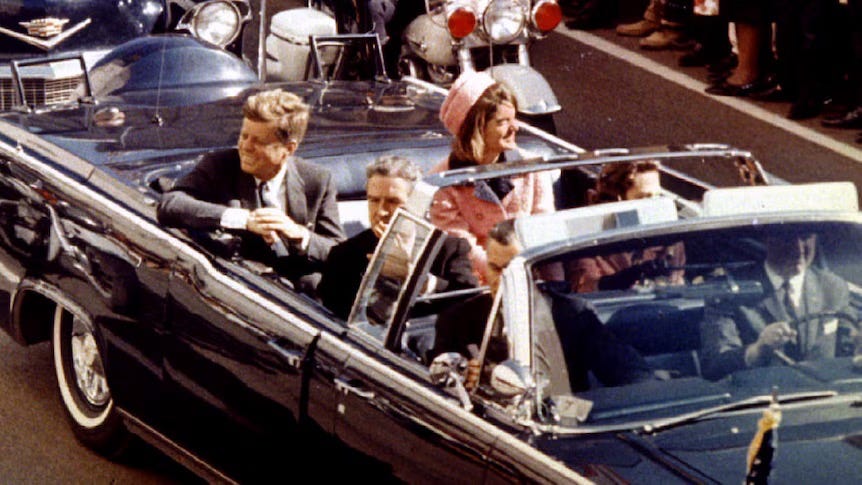
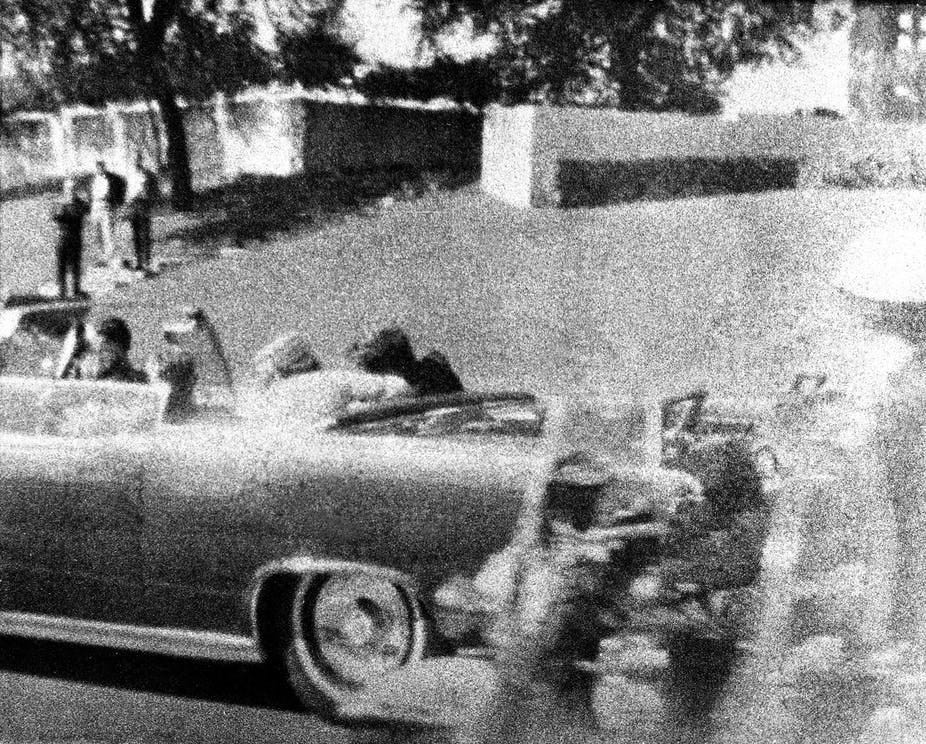
And then came Friday, November 22, 1963. I was not yet four years old, but I remember that day with the kind of clarity that defies age. It was the day President John F. Kennedy was assassinated. The world stopped.
President Kennedy with Jackie in Presidential Limo in Dallas
The Moment of the Assassination of the President in Dealy Plaza
Moment of JFK’s Assasination from the Grassy Knoll in Dealy Plaza Dallas
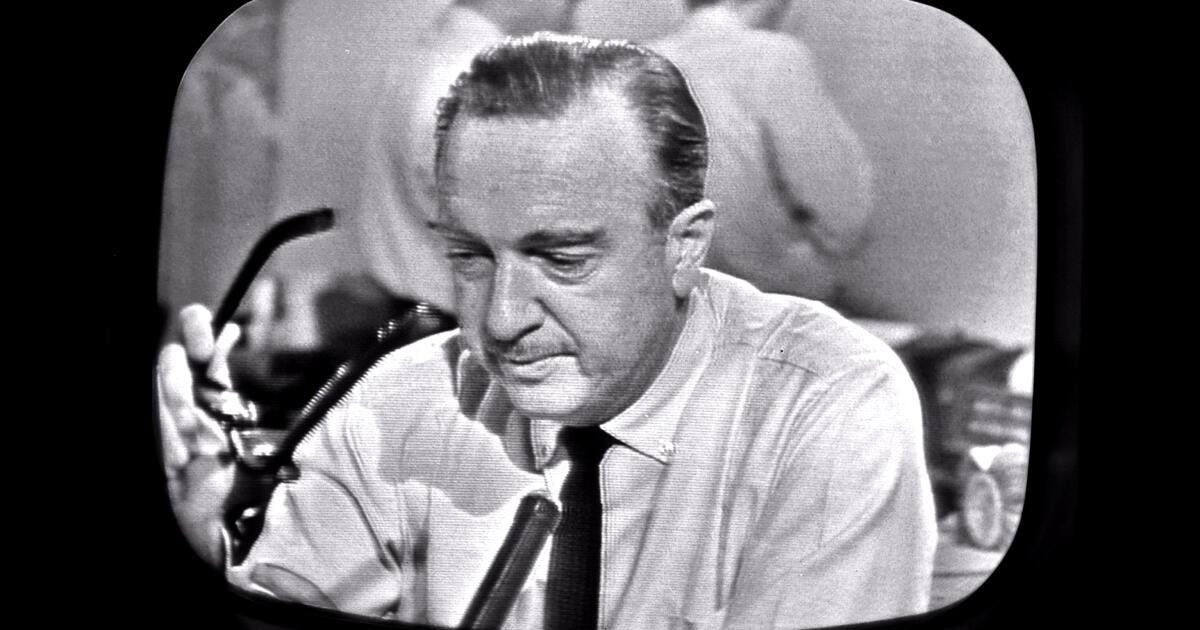
Walter Cronkite Officially Announces the Death of President Kennedy on Live Television
Our home fell into an eerie silence. My parents sat motionless, tears in their eyes, staring at the black-and-white television. I didn’t fully understand what had happened, but I knew it was something terrible. Even as a young boy, I already knew about the Secret Service. I also knew the President was the most powerful man in America. And now, even he could be shot in broad daylight. That single realization shattered something inside me.
Walter Cronkite as he removes his glasses while announcing the death of President John F. Kennedy on CBS News, as seen from a television monitor on Nov. 22, 1963
I suddenly understood the world wasn’t safe and being afraid that my father would now have to go to war. I already knew — instinctively — that war was a bad and dangerous place.
That weekend was unlike any other. We were all home, transfixed by the television as we watched President Johnson get sworn in on Air Force One and saw Kennedy’s casket return to Washington.
Lee Harvey Oswald is Assassinated on Live Television
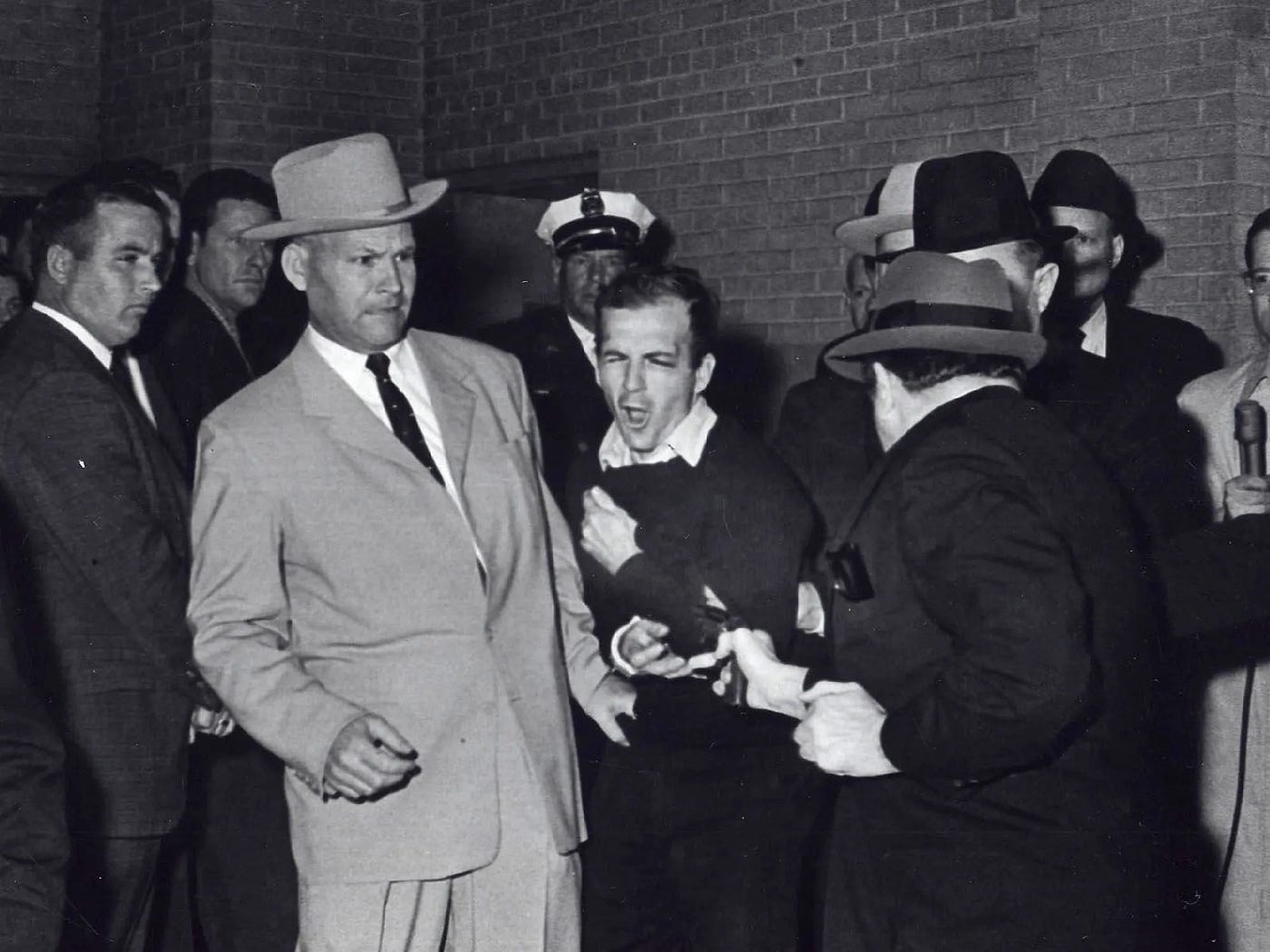
I heard the panicked interviews of Lee Harvey Oswald in Dallas — and then, we watched in disbelief as Oswald was shot and killed by Jack Ruby live on TV just two days later.
Jack Ruby Assasinates Lee Harvey Oswald in Dallas Police Station on live television on November 24, 1963,
The Late President’s Funeral Procession
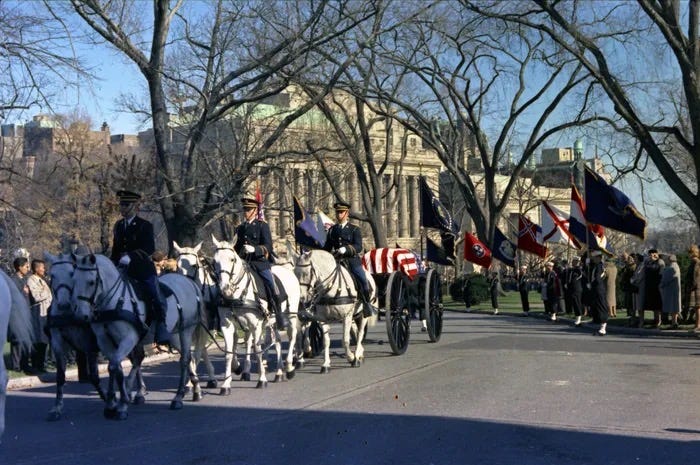
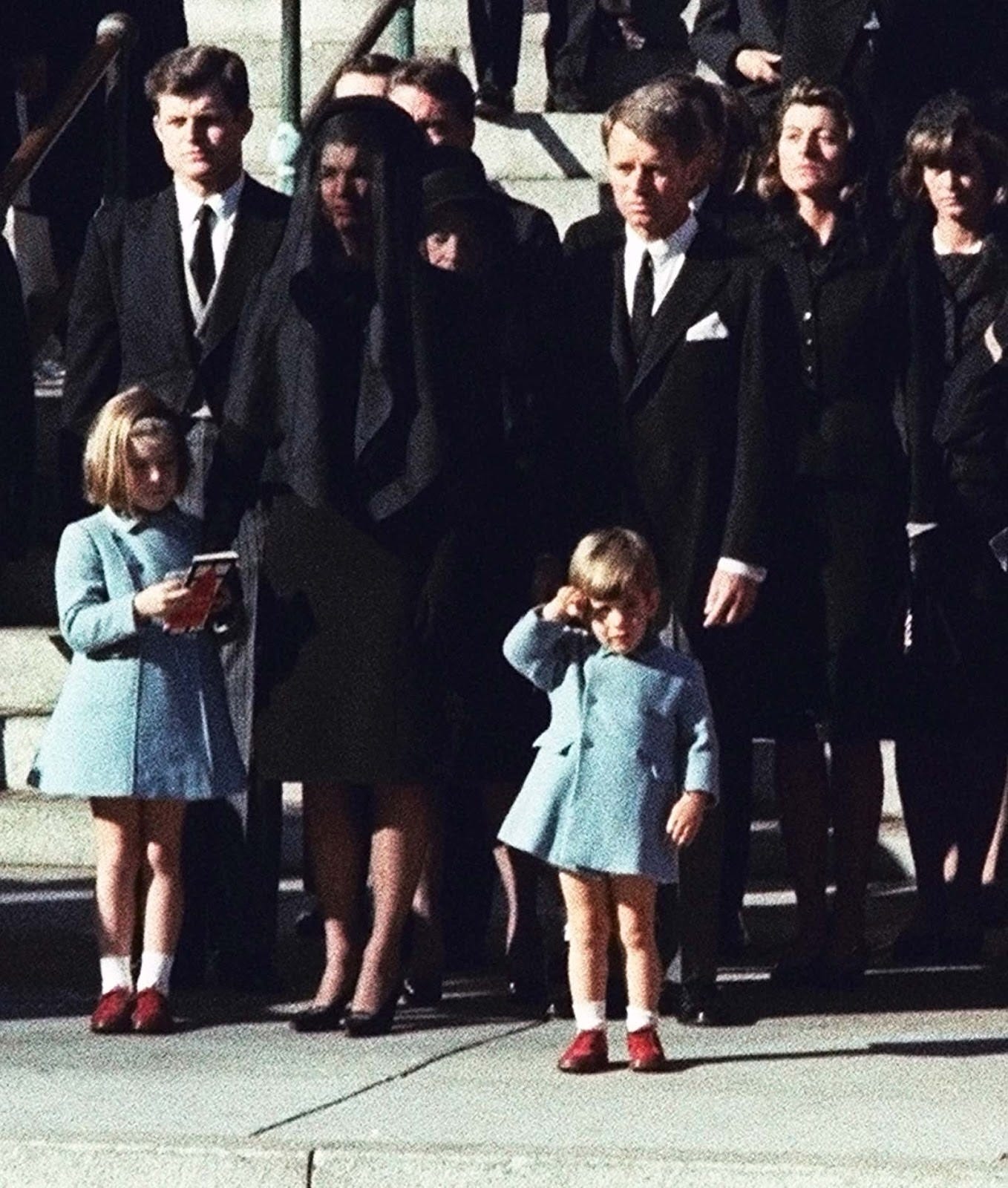
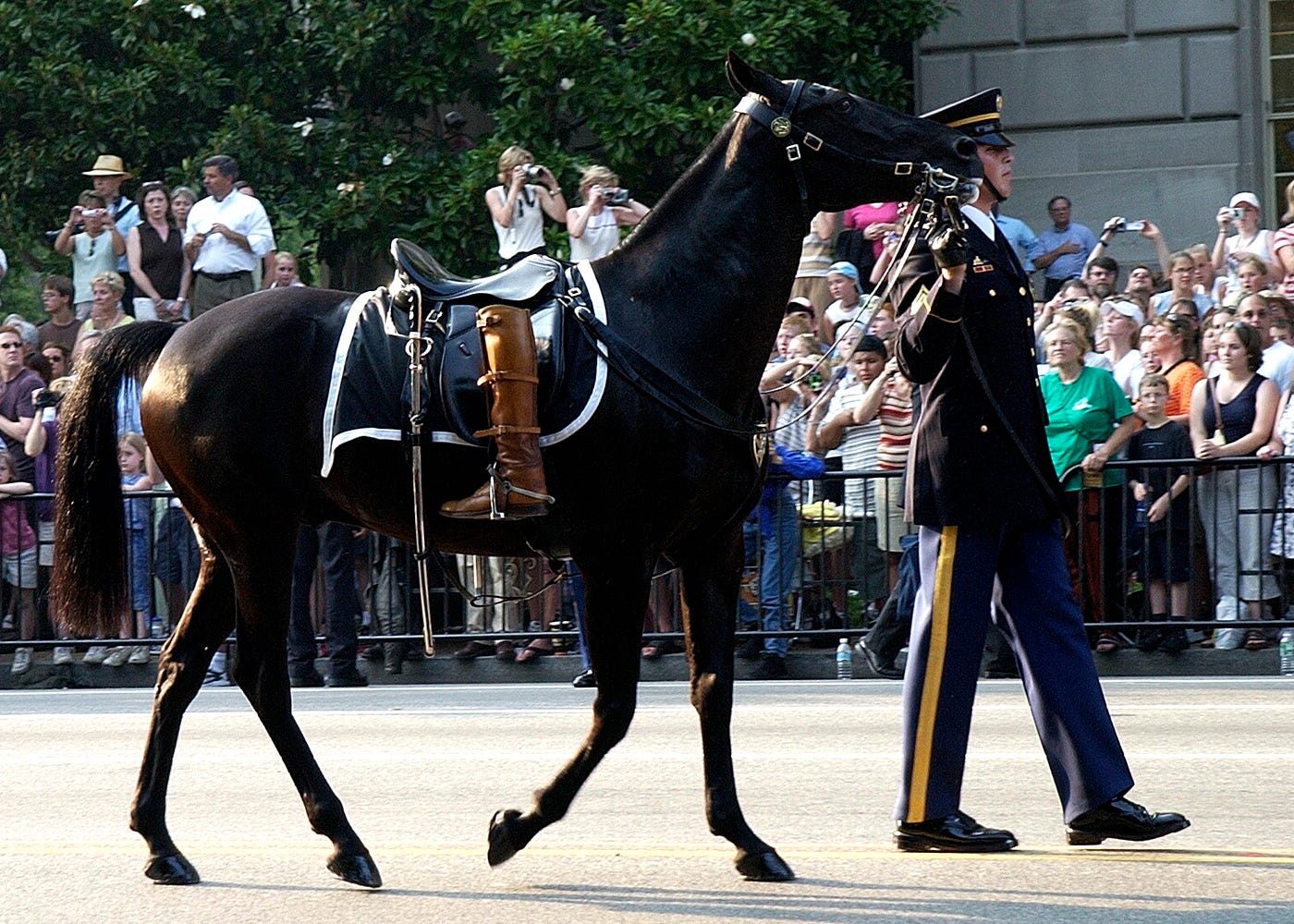
And then came the long, beautiful, sorrow-filled funeral procession. I still see John-John’s heartbreaking salute. The Old Guard soldiers. The late President’s casket on the caisson. Black Jack, the riderless horse. The muffled drums. The silence of millions.
President Kennedy’s Funeral Procession led by members of the 3rd Infantry Division’s “The Old Guard” on November 25, 1963.
John Jr Salutes his father’s casket during funeral
Riderless Horse Black Jack during President Kennedy’s Furneral Procession
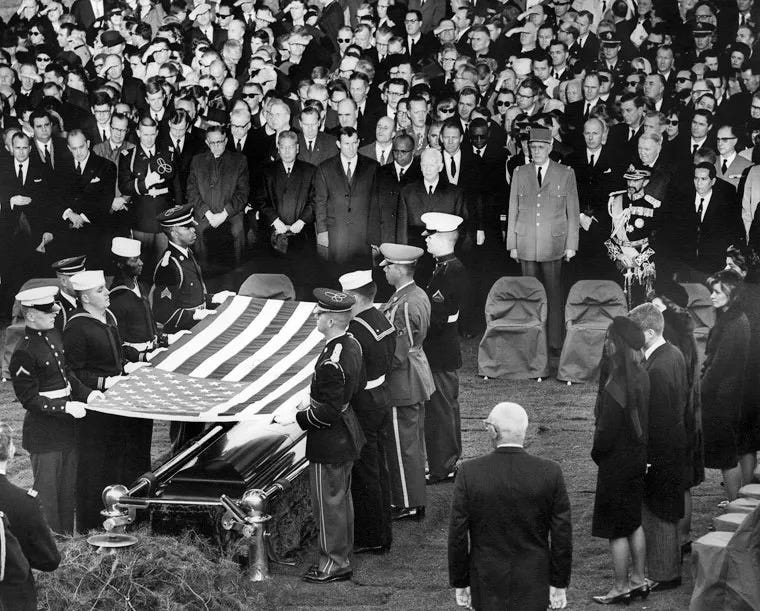
Burial of the Late President John F Kennedy at Arlington National Cemetery
The Infamous Warren Commission Report
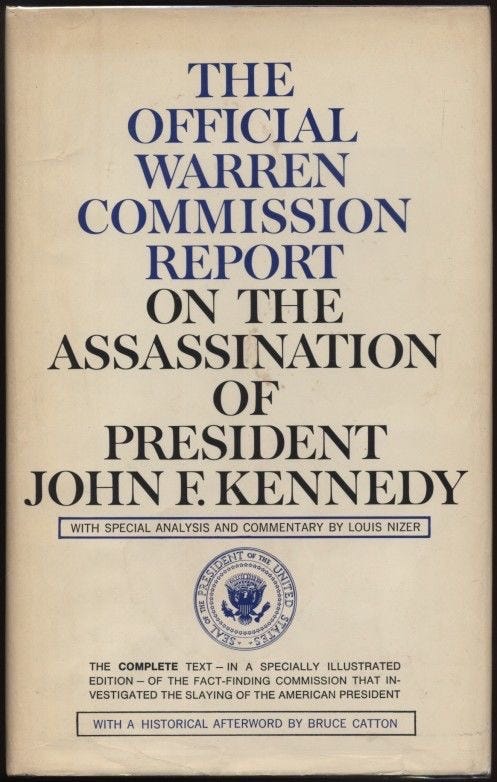
The trauma of that moment stayed with me. It gave me nightmares for years. It also ignited a lifelong obsession with understanding what really happened. The very first nonfiction book I ever read was The President’s Commission on the Assassination of President Kennedy. Even as a child, I could tell it wasn’t right. The Warren Commission’s report was filled with holes — chapters openly admitted that facts and testimony had been disregarded simply because they didn’t fit the predetermined outcome.
The Official Warren Commission Report on the Assassination of President John F Kennedy
I didn’t buy it. I was one of the earliest skeptics I knew. Sixty years later, I’m still studying that moment in history. That day in November didn’t just end the Kennedy era. For me, it ended childhood.
Father Receives Orders for Germany
Shortly afterward, my father received new military orders. In early 1964, we packed up once again and prepared to travel to Germany for our first of three tours to Europe.
But I left a part of my innocence behind in America — along with the memory of a young president whose life, and death, which taught me that truth is not always what it appears or what we’re told.
Believe Nothing You Hear, and Only Half of What You See — A memoir of Service, Shame and the Search for Truth
My Young Father Sent to Bordentown Military Institute
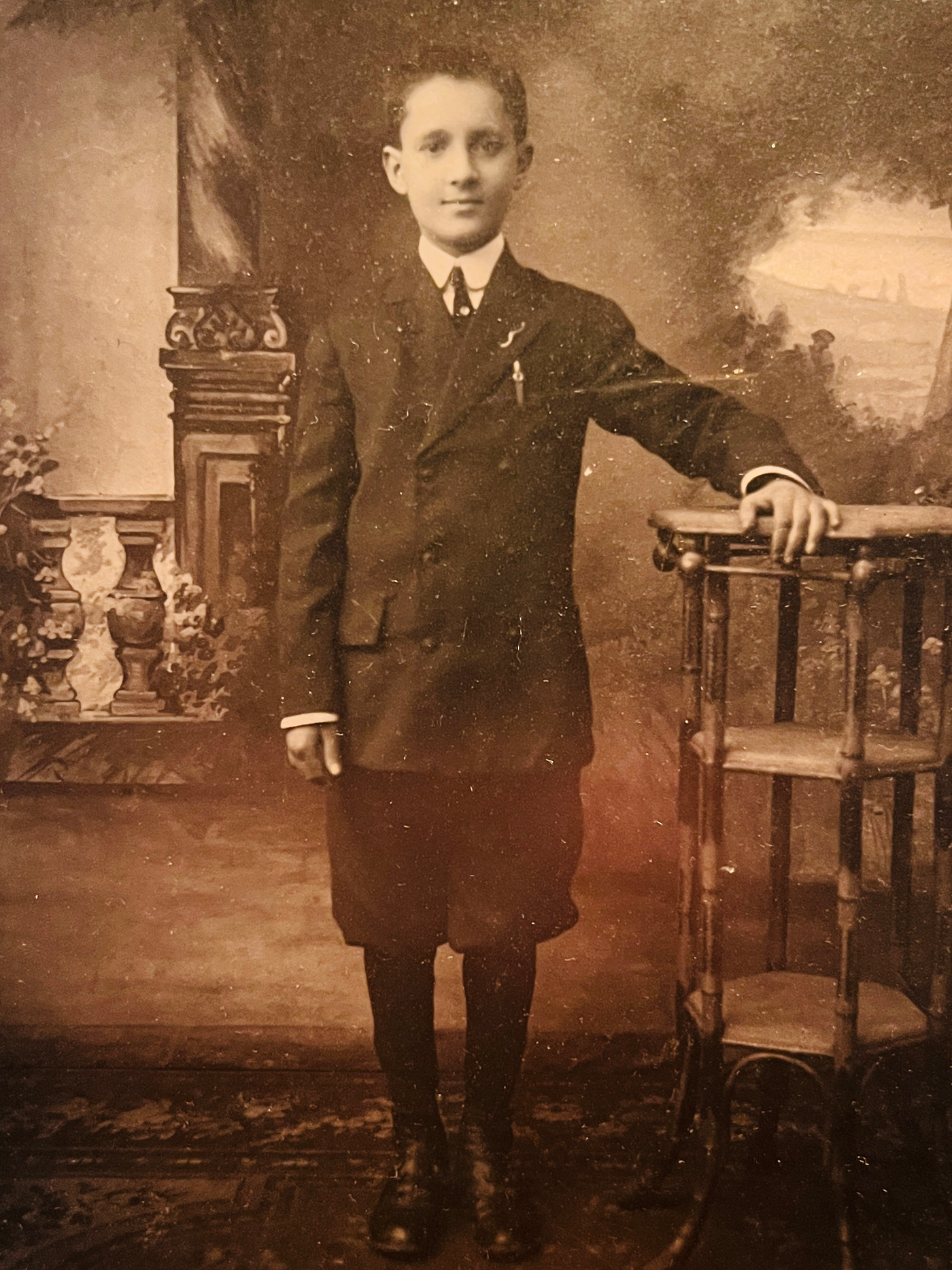
My father was the youngest of four children. His three sisters — Lucille, Theresa, and Rosemarie — absolutely adored their little brother throughout their lives. He was a typical roughhousing boy who loved sports and was constantly in trouble. As a result, my grandparents sent him away to military boarding school — Bordentown Military Institute in New Jersey. Bordentown turned out to be the magic solution, helping straighten out my father into an ideal soldier. It marked the beginning of an honorable 50-year military career.
Bordentown Military Institute, New Jersey
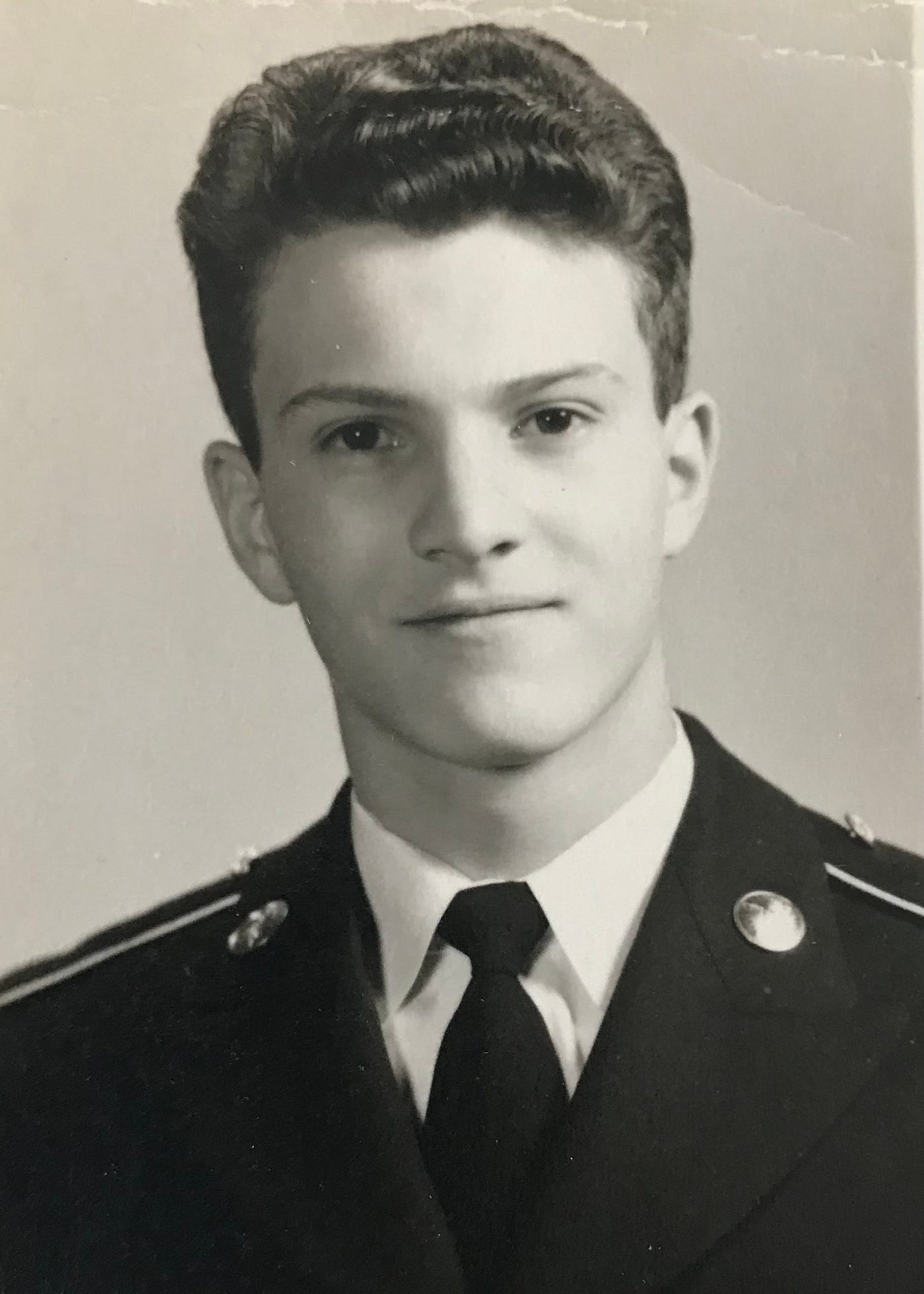
My Father as a Cadet at Bordentown Military Institute
Dad at Bordentown Military Institute
Nana & Papa Carbone visiting my father at Bordentown Military Institute
Carbone Family Moves to Stoneham, Massachusetts
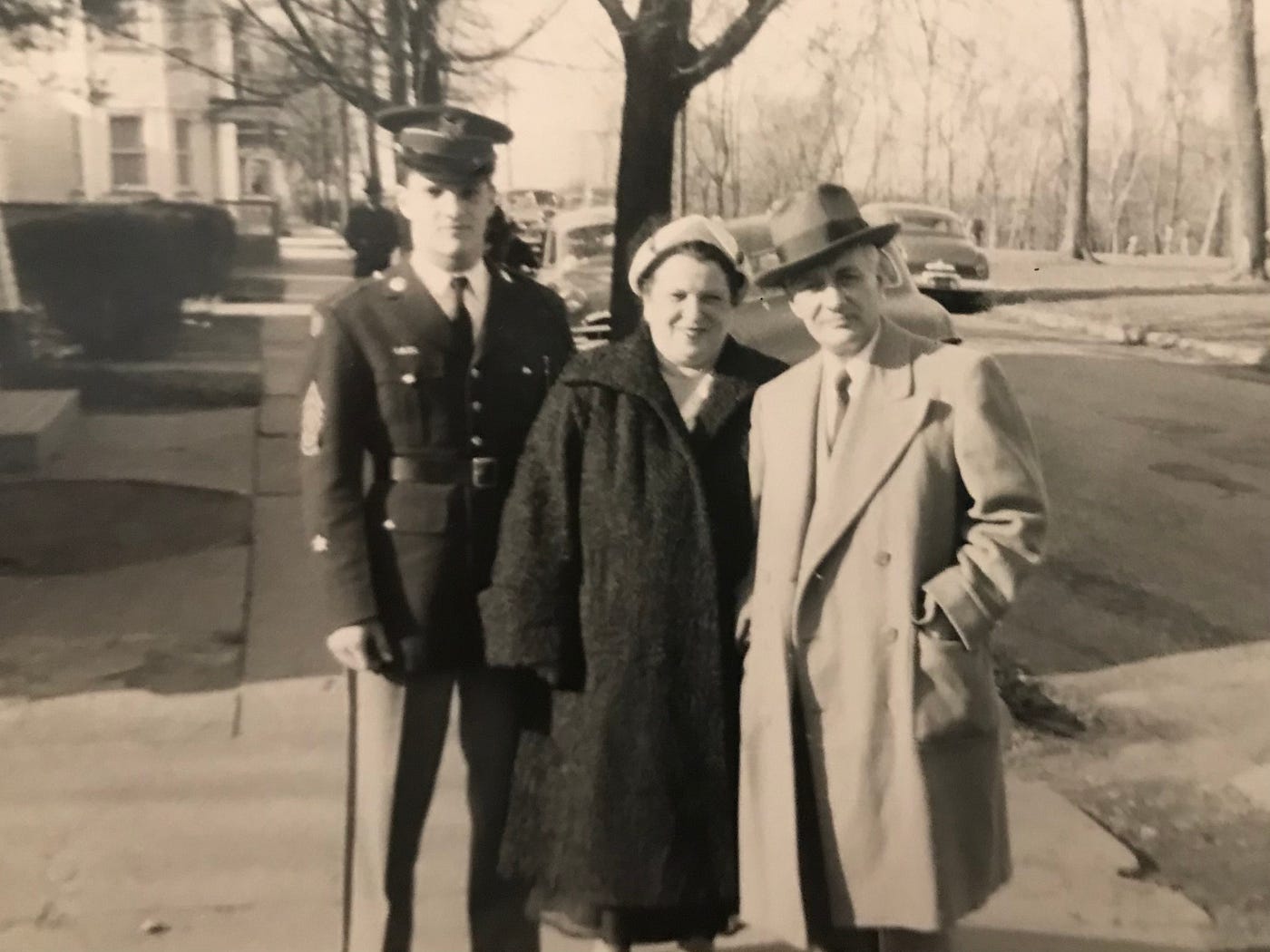
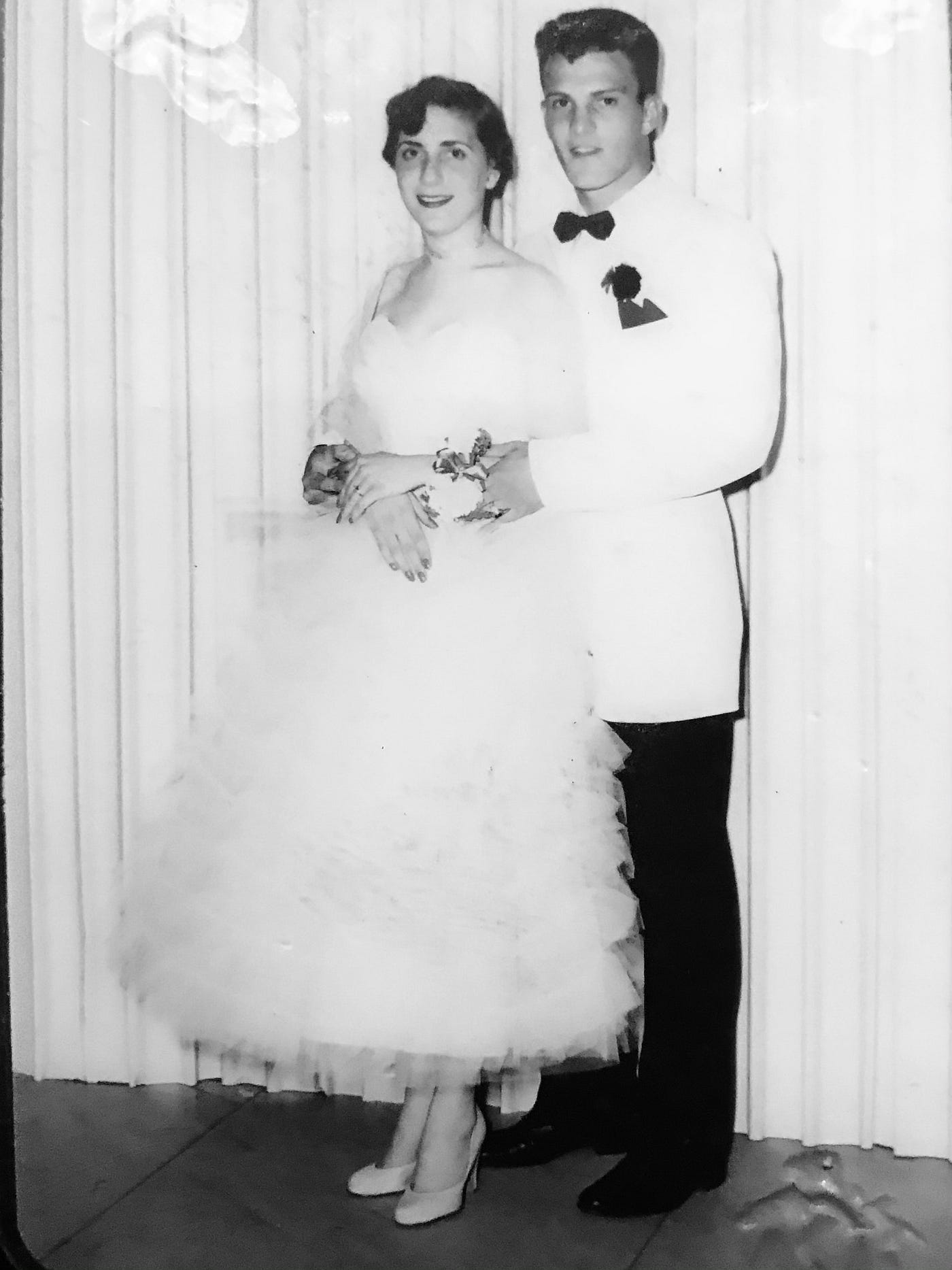
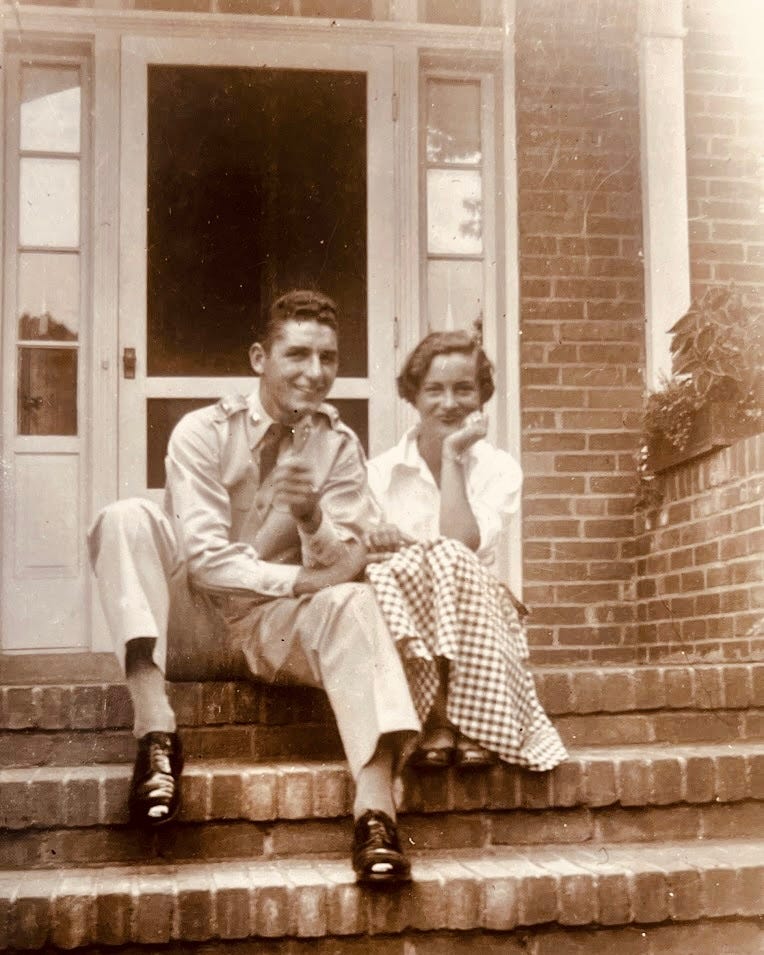
By that time, the Carbone family had moved to Stoneham, Massachusetts, just outside Boston, where my grandfather worked in the garment district. One day while my father was on leave from Bordentown, he attended a high school party in Medford, Massachusetts, where my mother lived. That’s where they met — and from that night forward, my father was in love for the rest of his life. They corresponded while apart. My mother was slower to fall for him, but eventually, he won her heart.
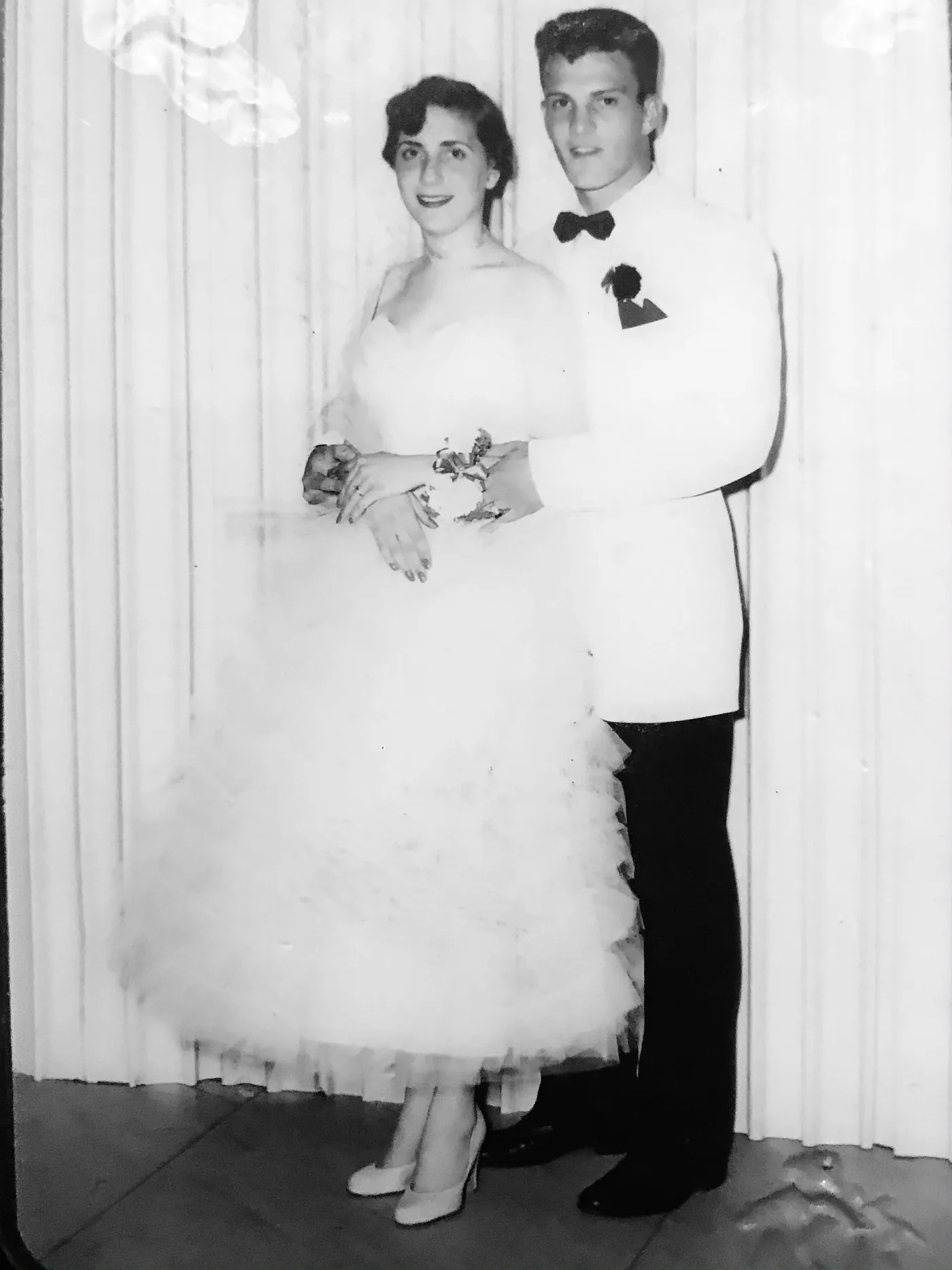
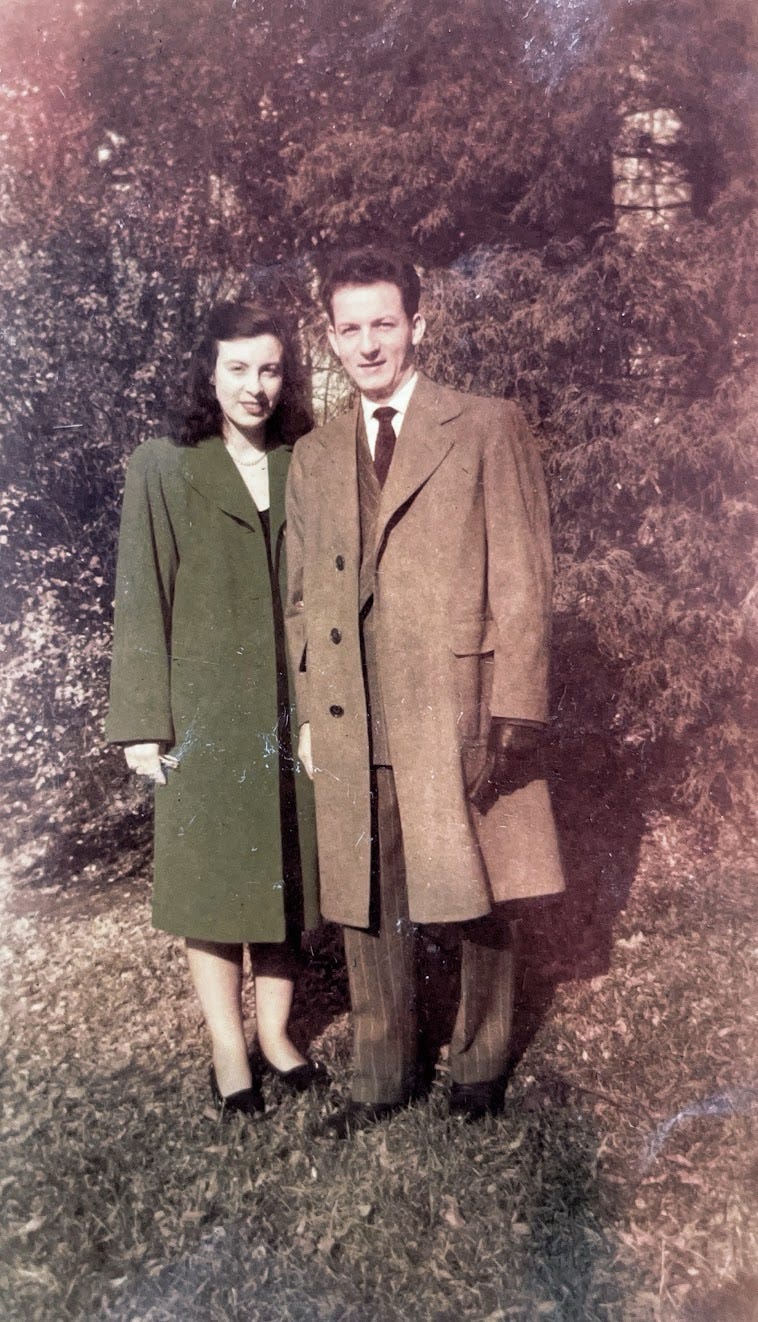
Mom and Dad at my mother’s prom at Medford High School
Father Enters Norwich University
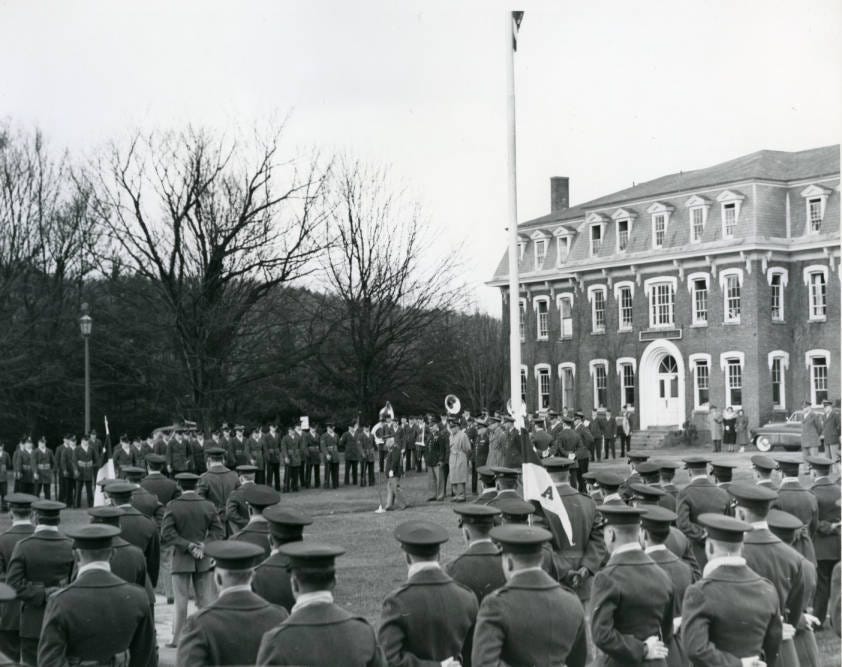
After graduating from Bordentown, my father attended Norwich University, the Military College of Vermont, as an Army cadet. My mother was working as a secretary at Hood Milk in Boston.
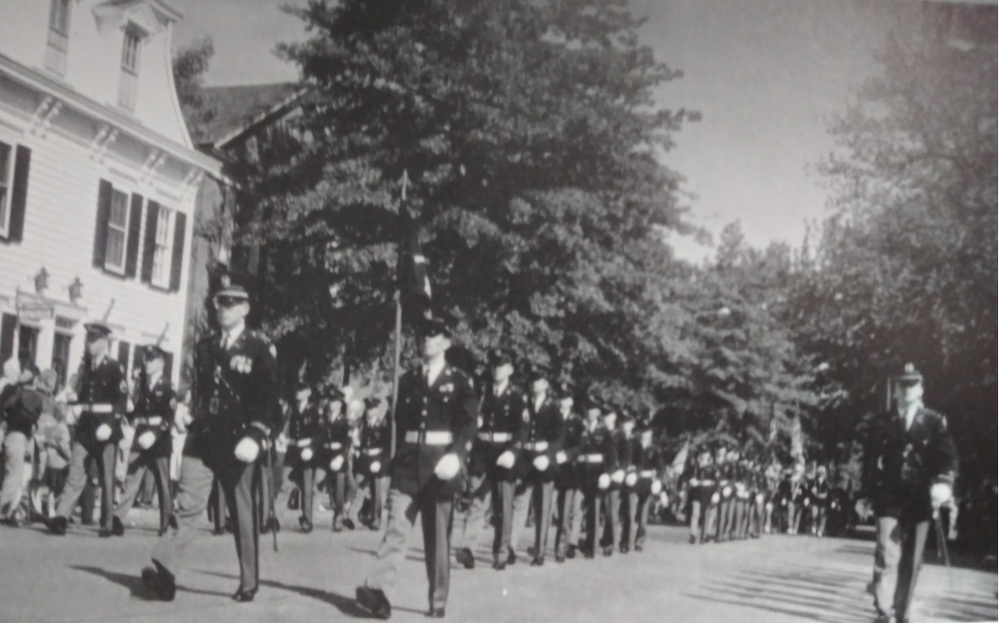
Corps of Cadets at Norwich University
My Parents Marriage
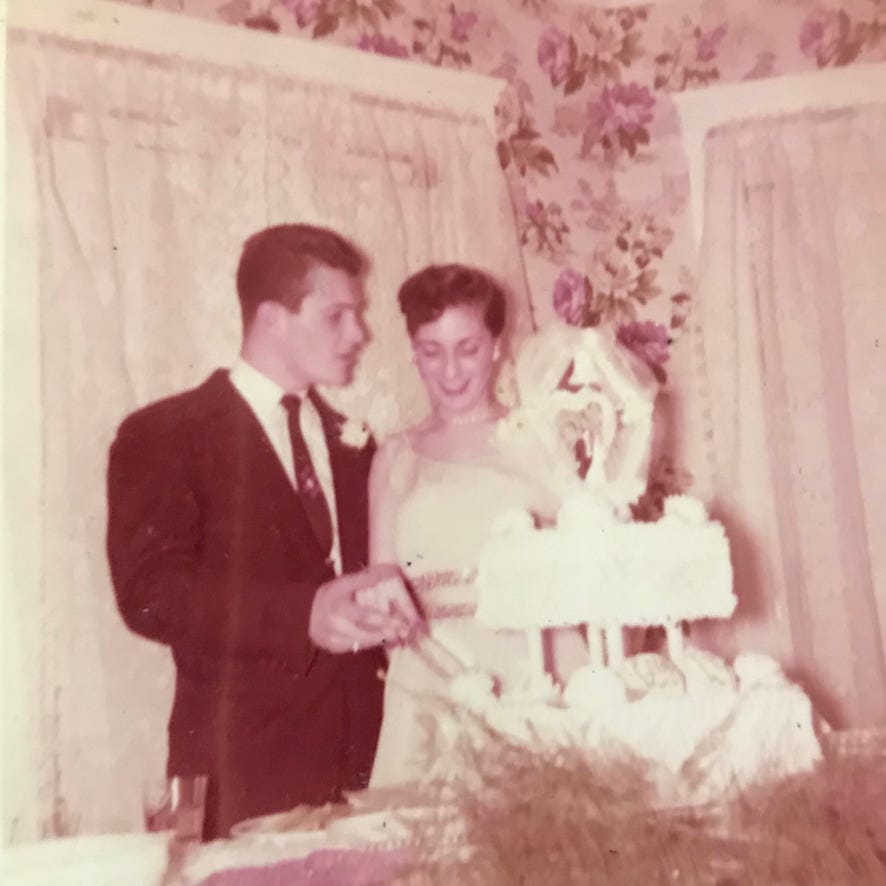
On November 25, 1955, my father convinced my mother to elope. The elopement caused an uproar. His parents insisted they actively marry in a church before living together, which they did on December 22, 1955.
My parents always celebrated both anniversaries.
My parents’ church wedding reception December 22, 1955
Parents Get Settled at Norwich
Norwich University wasn’t happy about the marriage either — cadets were forbidden to wed — so my father was busted in rank. His father cut him off financially, forcing him to work up to three jobs at once to finish school and ROTC training. They were assigned to the “pre-fab” apartments where married cadets lived.
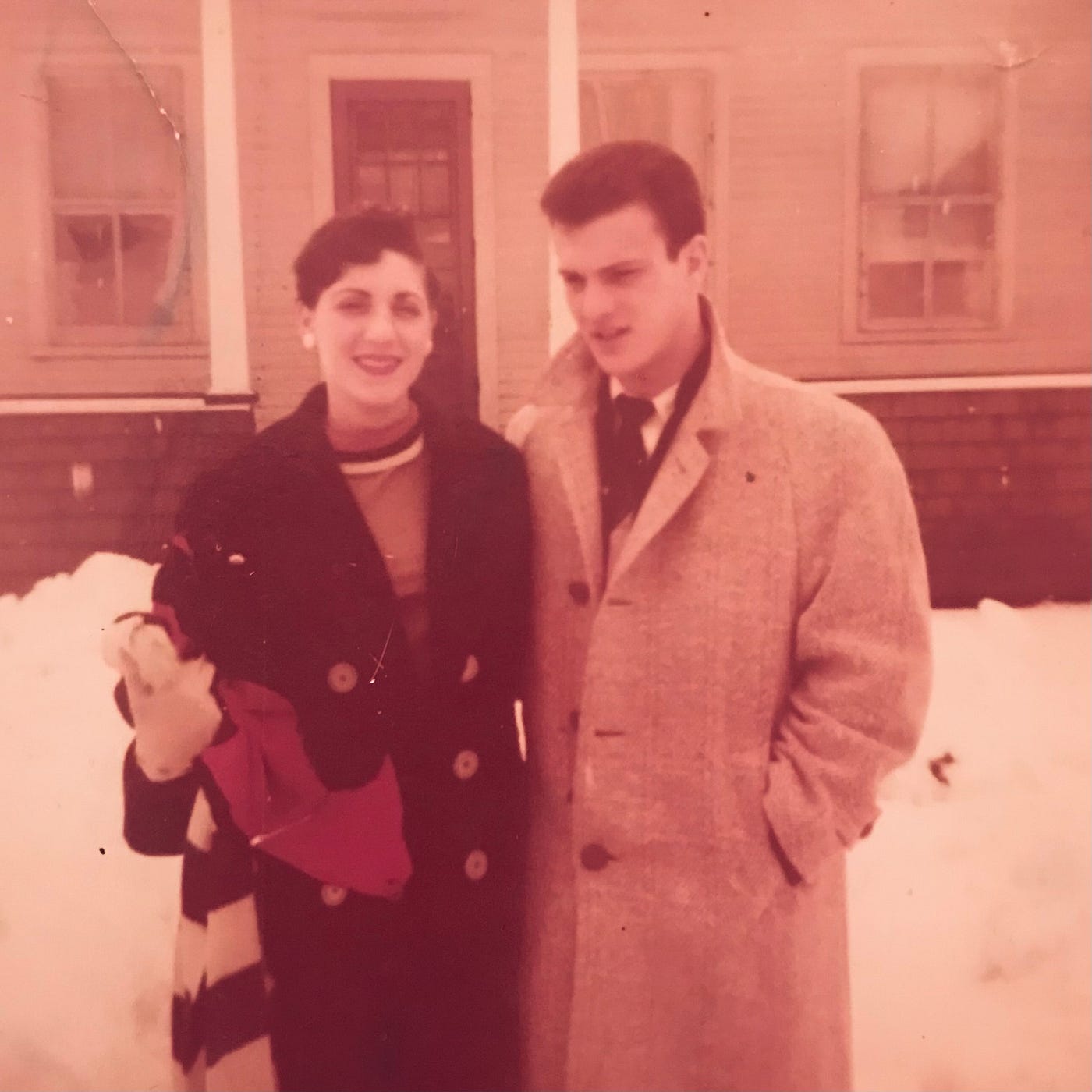
Mom & Dad at Norwich in front of the Prefabs
Birth of My Sister, Lynne
My oldest sister, Lynne, was born in 1957, and my father graduated from Norwich University on December 18, 1958 — the same day my second sister, Diana, was born.
My mother with my oldest sister Lynne Elizabeth.
It wasn’t until after the wedding, when both families finally met, that an incredible coincidence emerged: my maternal grandfather had been working in a factory owned by my paternal grandfather for years — without either of them realizing their future connection. The discovery delighted both families, and the two grandfathers became great friends.
Death of my Father’s Sister Lucille and Brother-in-Law Patrick
Tragedy would strike the Carbone family once again. My father’s eldest sister, Lucille, and her husband Patrick Bonesera of Medford, Massachusetts, were killed by a drunk driver near their home in Lawrence Estates on Valentine’s Day. They left behind two young children, my cousins Margie and Ricky — who were raised by my Uncle John and Auntie Rosemarie Antonelli. The loss was devastating and left a permanent mark on the family’s story. My father kept a news clip with the drunk driver’s name in his wallet for many years to come.
Auntie Lucille & Uncle Pat Bonesara
My Father’s Sister Theresa Marries Uncle Arthur McDonald
My father’s second sister was Theresa B. Carbone was born on July 4, 1926. She married an Irish-American, Arthur F. McDonald, and the two of them had seven children: Dennis, Thomas, Michael, James, Arthur, Jeffrey and Susan.
Uncle Arthur, Auntie Terry, and Cousin Dennis McDonald
Uncle Arthur at Kennedy Space Center
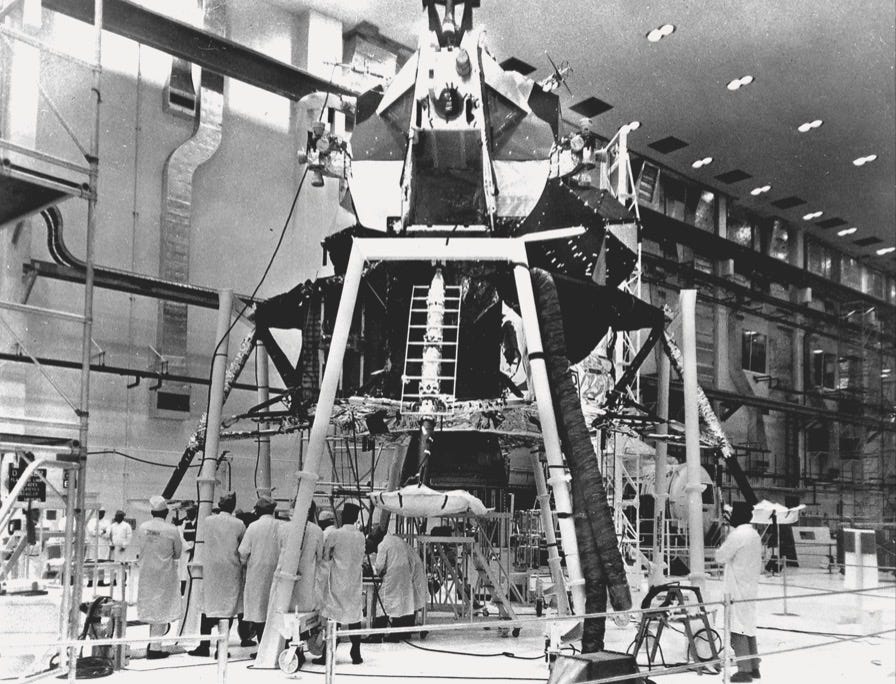
My Uncle Arthur worked for Grumman Aerospace at the Kennedy Space Center in Florida for 30 years in the Apollo Program, and focusing on the Grummun Lunar Module. I remember during the exciting early years of the American space program, Uncle Arthur would send me astronaut patches, photographs, and models of each of the space ships.
Grumman Aerospace Engineers Working on the Apollo’s Lunar Module at Cape Kennedy.
My Father’s Sister Rosemarie Marries Johnny Antonelli
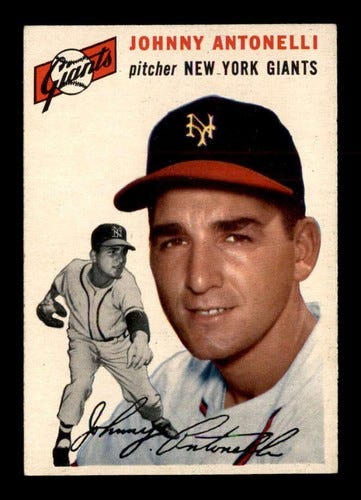
My father’s youngest sister Rosemarie married Johnny Antonelli, a celebrated American professional baseball player. Together, they had four children, Lisa, Donna, John Jr, and Regina and were raised in Rochester, New York.
Uncle John & Auntie Rosemarie Antonelli. He served in the Old Guard (3rd Infantry Regiment) that guards the Tomb of the Unknown Soldier at Arlington National Cemetery.
Uncle Johnny Antonelli the Professional Baseball Pitcher
My uncle was a left-handed starting pitcher, he played for the Boston / Milwaukee Braves, New York / San Francisco Giants, and Cleveland Indians between 1948 and 1961. Noted at the outset of his career as the recipient of the biggest bonus in baseball history when he signed with the Braves for $52,000 in 1948, Antonelli became a six-time National League All-Star, a two-time 20-game winner, and an essential part of the 1954 World Series champion Giants’ pitching staff. His success brought a sense of pride and celebrity into the family at a time when hope was deeply needed.
Uncle Johnny Antonelli pitching for the New York Giants
My Parents Meet and Fall in Love for Life
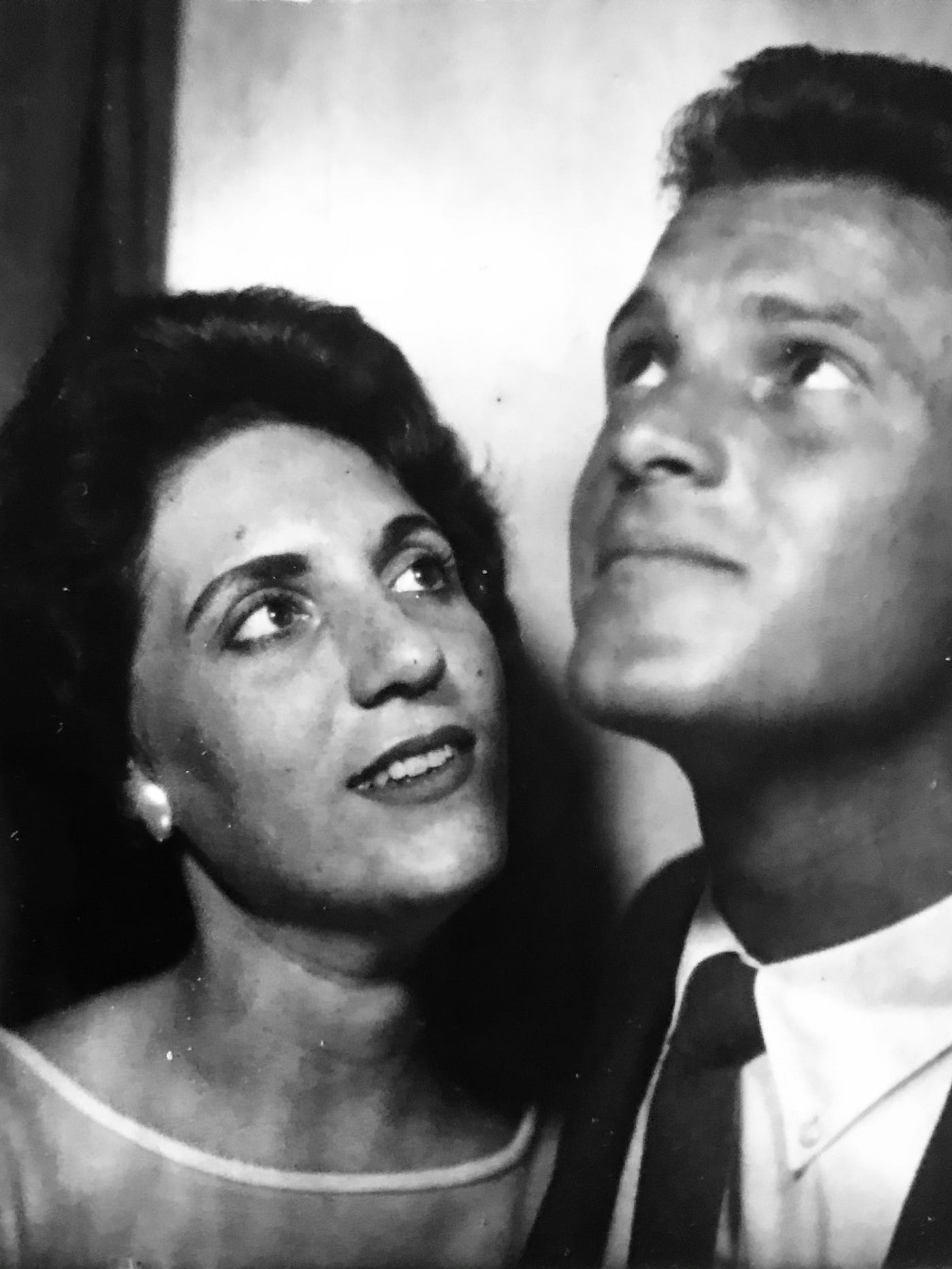
My parents met during their high school years and quickly fell in love — a love that would last for more than fifty years of marriage. Their bond was something rare and beautiful, marked by a constant affection that made them seem more like sweethearts than a long-married couple. My father often called my mother “Ellie Mae” and proudly referred to her as his girlfriend. Even after decades together, whenever they were in the same room, you could still see the spark between them. Their love never faded — it only deepened with time.
Believe Nothing You Hear, and Only Half of What You See—A Memoir of Service, Shame, and the Search for Truth
Both Grandfather’s Emegrated From Italy
Both of my grandfathers came to America at the turn of the 20th century, part of the great wave of Italian immigrants who left their homeland in search of a better life. What they lacked in money, they made up for in skill and determination. Remarkably, they shared the same trade: both were tailors — men who stitched suits with care, who worked with their hands, and who built their lives one hemline at a time.
Paternal Grandfather: Antonio Benjamino Carbone
My paternal grandfather, Antonio Benjamino Carbone, was born near Rome, Italy on January 8, 1899. His father was Giuseppe Carbone and his mother was Lucia Montemurro. He sailed from southern Italy and landed in New York City after passing through Ellis Island. He originally settled in the Jamaica Queens, a borough of New York City overflowing with dreams and the pungent smell of coal smoke and tenement kitchens.
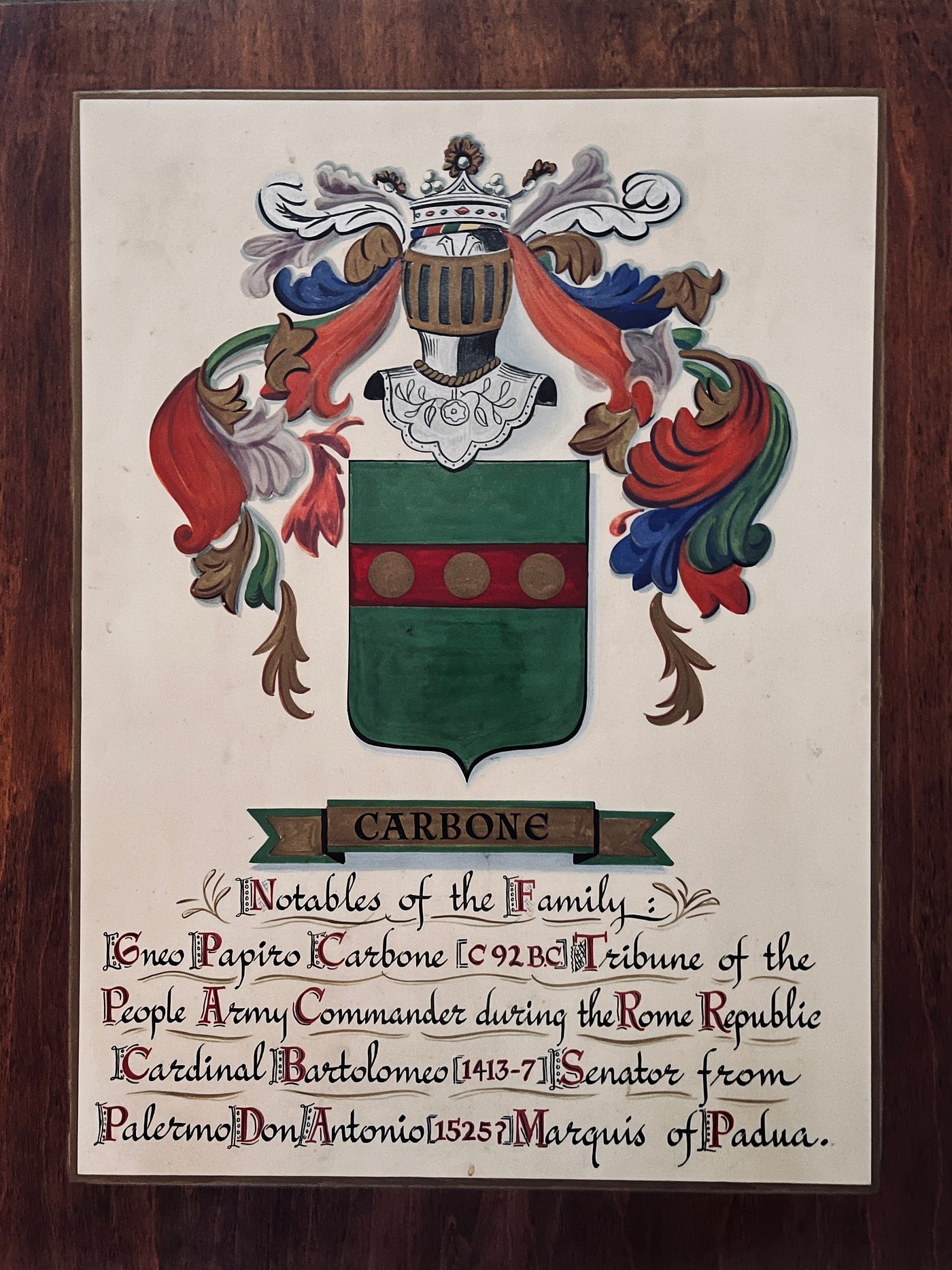
The Carbone Family Coat of Arms & Notables
Carbone Family Coat of Arms displaying notables such as the Marquis of Padua, a Cardinal, a Senator, and a Tribune of the Roman Republic Army.
Carbone Family Genealogy
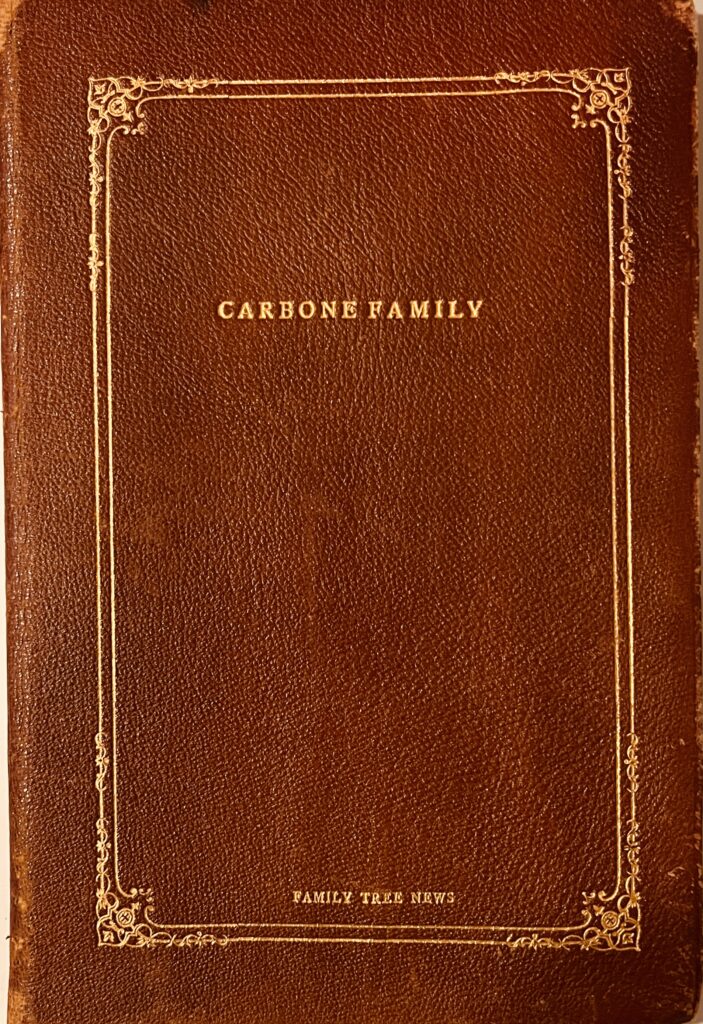
In the 1960s, my grandfather, Papa Carbone, commissioned a genealogist in Italy to trace the Carbone family history. I find this fascinating, because it was decades before the invention of the Internet. This genealogist had to travel from town to town, office to office, archive to archive, piecing together the Carbone lineage. He discovered something extraordinary: the Carbone name traces back to 500 BC.
He recorded his findings in a leather-bound book, hand-typed in both English and Italian.
The genealogist begins the book with the story of Gneo Papirio Carbone, a tribune of the common people in 92 BC. Historical records state that in 87 BC, he actively led one of four army corps in Marius and Cinna’s army.
The book goes on to describe tribunes, legionnaires, consuls, and soldiers; at least three Catholic cardinals; 14 barons; two marquises; multitude of authors; poet laureates; artists; even the baker for King Louis. One Carbone reportedly married Mary of England, King Henry VIII’s daughter. The family erected monuments in the Duomo of Naples, Sorrento, Rome, and other locations where they held noble privileges, including Capua, Reggio Messina, and Genoa.
Maternal Grandfather: Giovanni di Domenico Pietrantoni
My maternal grandfather, Giovanni di Domenico Pietrantoni was born on 13 February 1893, in Goriano Sicoli, L’Aquila, Abruzzo, Italy. His father, Domenico Pietrantonio, was 27 and his mother, Annantonia Ciccone, was 25. He emmigrated to Boston, Massachusetts via Ellis Island in 1921, and eventually settled on Hanover Street in the Italian North End of Boston.
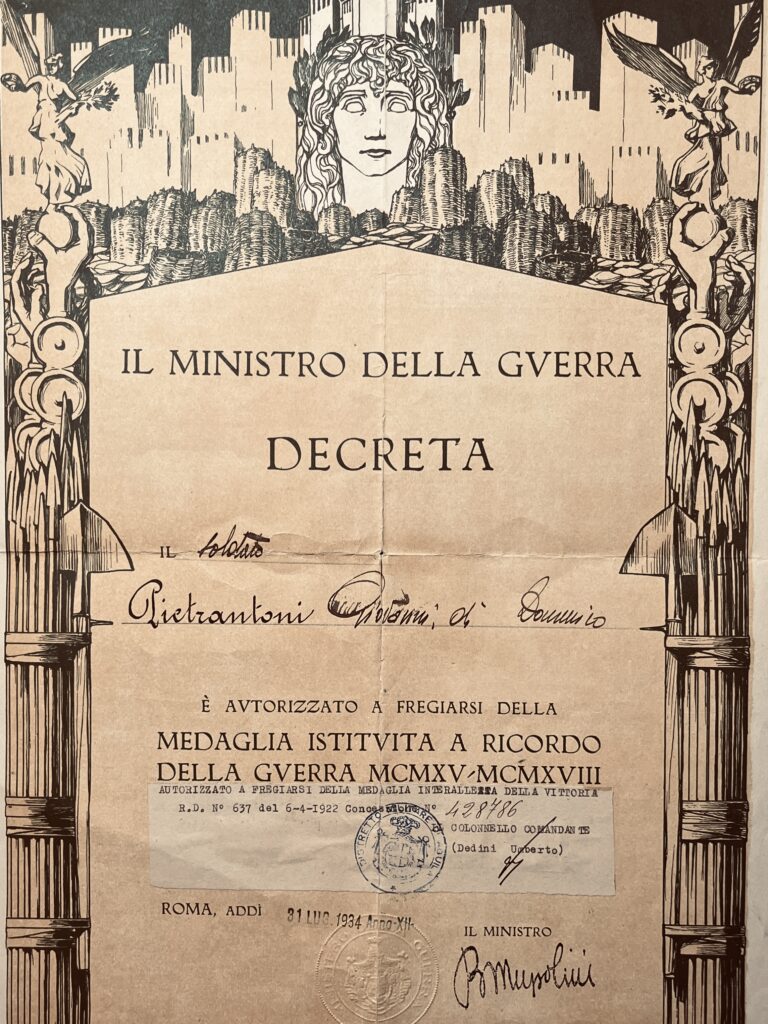
Papa Pietrantoni’s War Medal from Italian Minister of Defense 1934
Both Families Emigrate to America
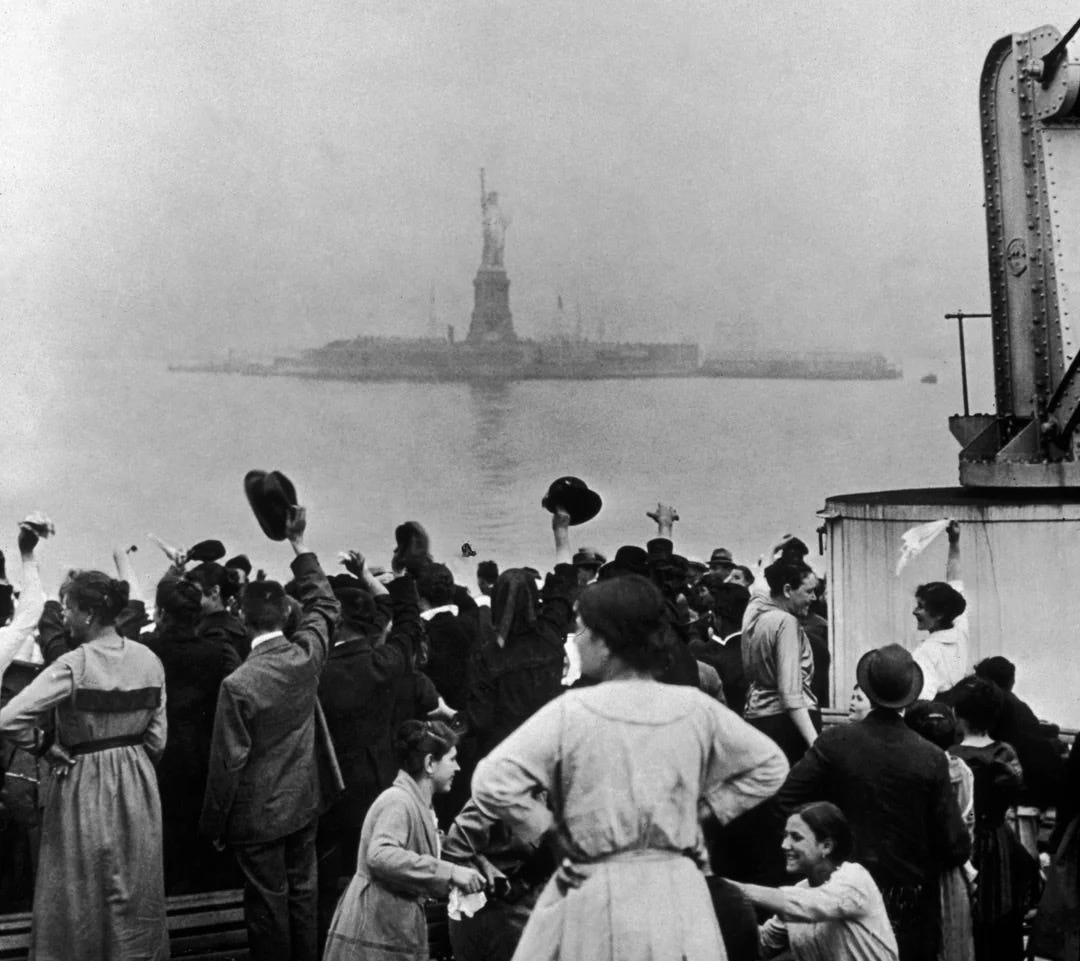
Their journeys were treacherous. They traveled by steerage, crammed into the lower decks of steamships — dark, foul-smelling, and disease-ridden compartments. They told stories of passengers who didn’t survive the voyage, of children lost to fever and old men who never made it above deck again. But for those who did survive, there was the unforgettable sight of Lady Liberty, rising out of the harbor like a promise.
New Immigrants Cheer at the Sight of the Statue of Liberty Upon Arriving to America
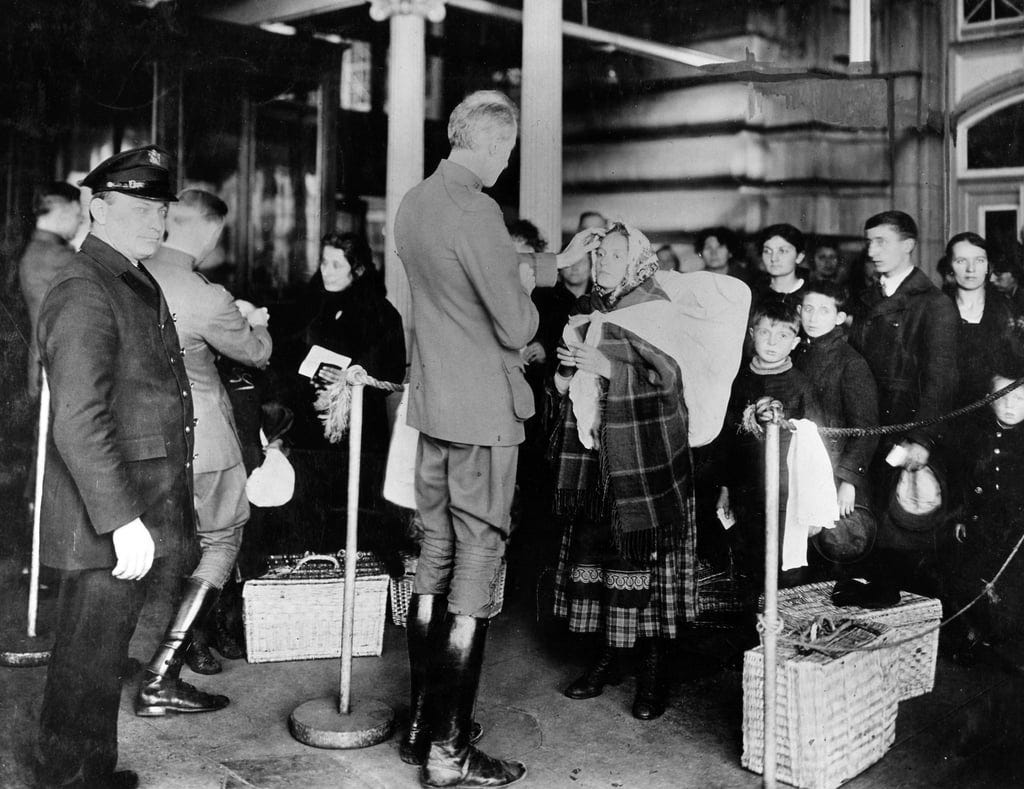
Arrival at Ellis Island & Evaluation by Public Health Officers
At Ellis Island, their fates were further altered — not just by medical inspections and customs agents, but by the careless swipe of a pen. Immigrants were separated — men to one side, women and children to the other — and examined for any sign of disease. Then came the interviews. Names were lost in translation.
Public Health Officers Inspect Newly Arrived Immigrants at Ellis Island
New American Names
My grandfather Antonio Benjamino Carbone became Anthony Benjamin Carbone. Giovanni di Domenico Pietrantoni was simplified to John Pietrantoni. Their rich, lyrical names — each syllable a tribute to family, region, and history — flattened into something more “American.” But they didn’t complain. They were simply grateful to begin again.
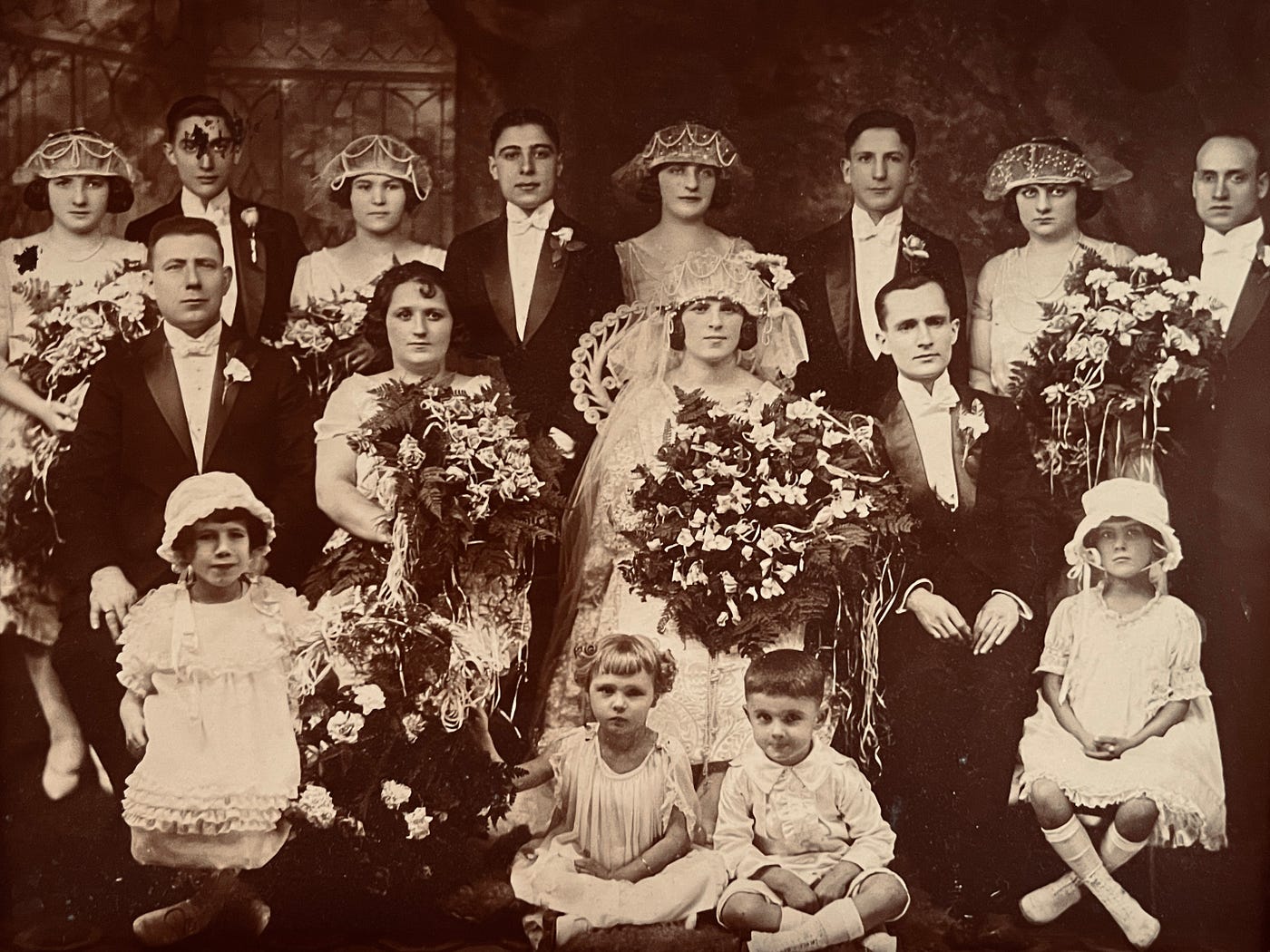
Marriage of Nana & Papa Carbone
In 1922, Papa Carbone married Michelina Annarella, whose name was later changed to Margaret — though everyone called her “Maggie.” Her father was Francesco Annarella and her mother was Theresa Patriarca. Nana Carbone was a second-generation Italian-American born in Kings County, New York. Interestingly, the two Carbone brothers married two Annarella sisters. My Carbone grandparents had 3 daughters and 2 sons.
Nana & Papa Carbone’s Wedding
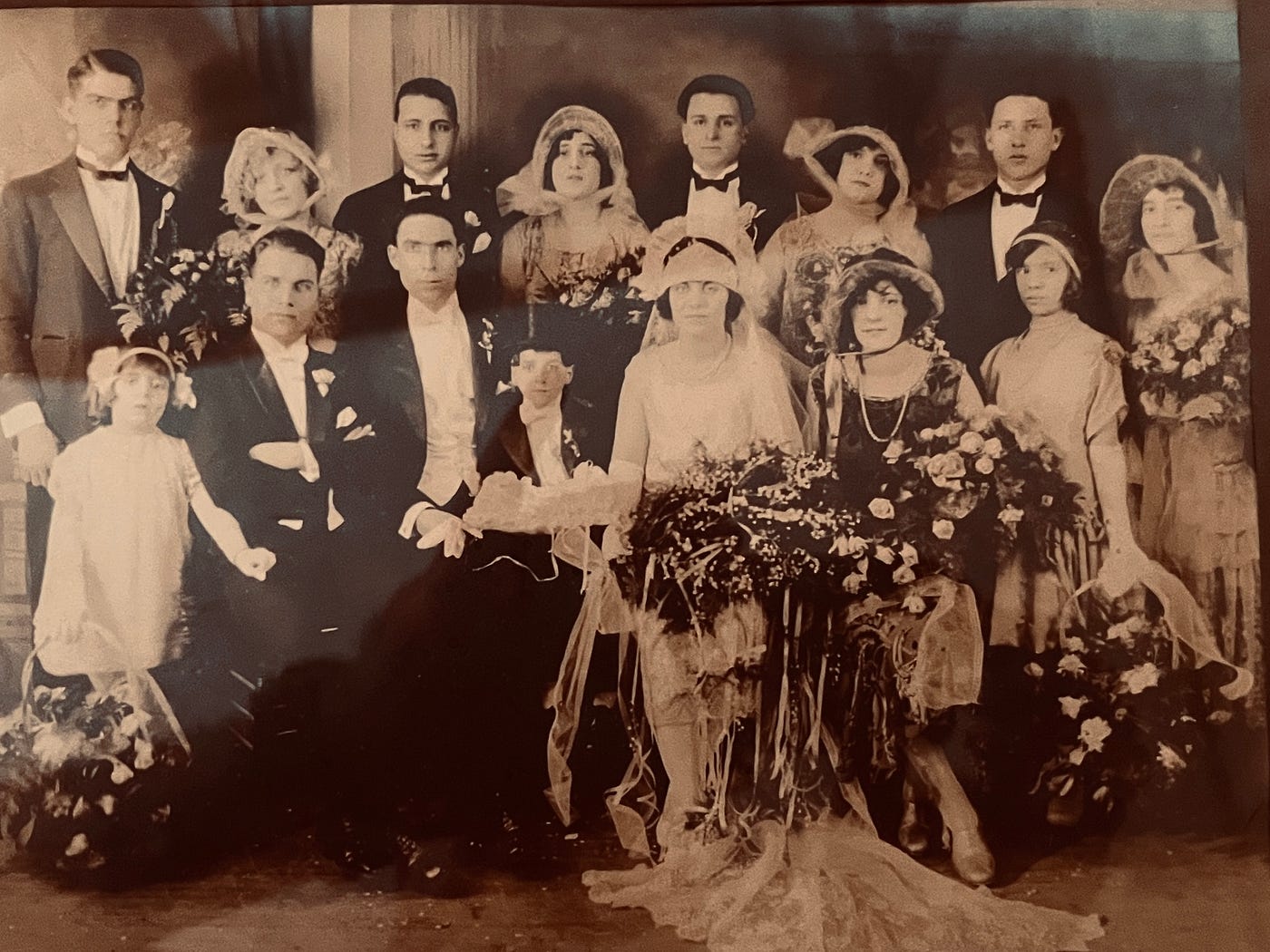
Wedding of Nana & Papa Pietrantoni
Papa Pietrantoni married Giovanna Ranno, who was called “Jenny,” in the North End of Boston on January 16, 1926, in Boston, Suffolk, Massachusetts, United States. They were both first-generation Americans and they were the parents of 4 sons and 5 daughters.
Nana & Papa Pietrantoni’s Wedding
I find it fascinating that although both grandfathers arrived in America with the same skill — tailoring — however, their destinies unfolded in dramatically different ways.
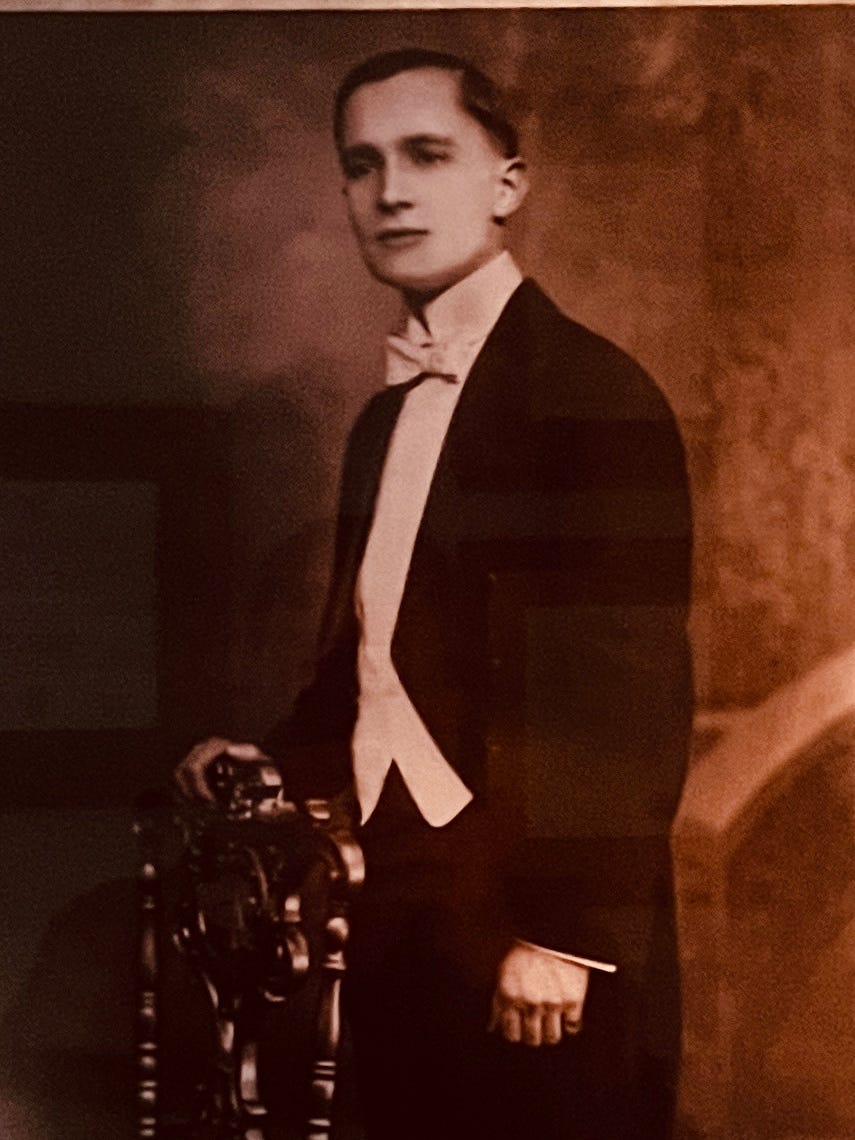
Papa Carbone the Tailor
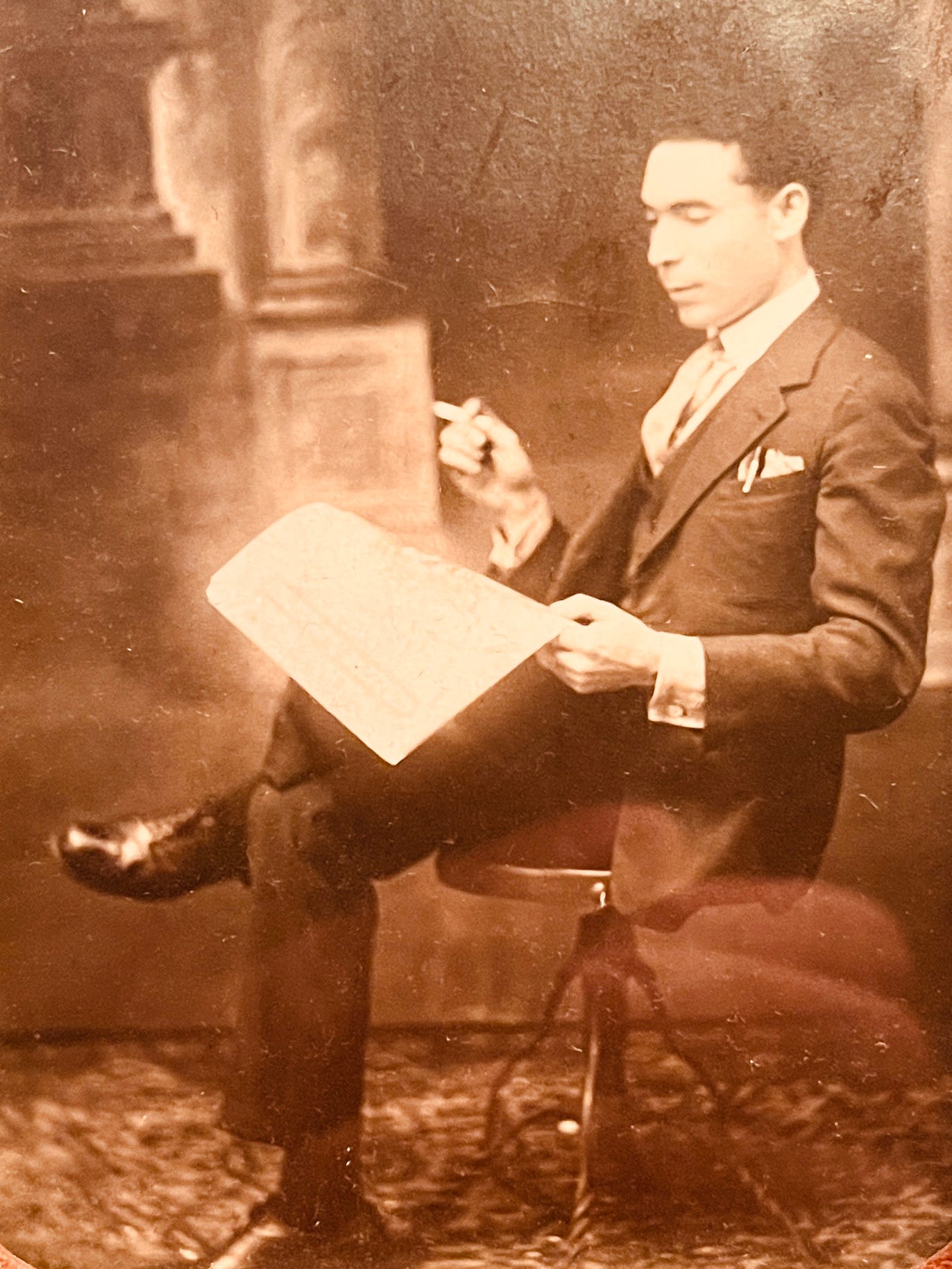
My father’s father rose to great success. He became a sought-after designer, crafting uniforms for the U.S. military and bespoke suits for celebrities like Joe DiMaggio, Frank Sinatra and the Mayor of New York. Their home reflected that prosperity — a large house staffed by servants, a rarity for immigrant families of that era. My grandfather loved driving new Buicks and spending summers at Lake Ronkonkoma on Long Island.
My grandfather, Antonio Benjamino Carbone
Death of the First Carbone Son Followed by Birth of my Father
Tragedy struck when their first son, Anthony Benjamin Carbone Jr., died in early childhood. So when my father was born on May 2, 1935, they named him Anthony Joseph Carbone. To ensure his survival, he was tended to by both a nurse and a wet-nurse, a testament to the lingering fear of loss and the privilege the family could afford by then.
My father, Anthony Joseph Carbone
Papa Pietrantoni the Tailor
In stark contrast, my maternal grandfather, Giovanni Pietrantoni, also a classy gentleman tailor, lived a life of hardship. He raised ten children in a crowded tenement apartment at 4 Battery Street in Boston’s North End, the heartbeat of the city’s Italian-American community. Several of my grandmother’s relativeslived with them — multiple families under one leaky roof, scraping together a life one stitch, one meal, one paycheck at a time.
My maternal grandfather, Giovanni Pietrantoni
The contrast between the two households — one of elegance and status, the other of noise, love, and survival — would shape the family stories I heard growing up, and eventually, shape me.
BELIEVE NOTHING YOU HEAR, AND ONLY HALF OF WHAT YOU SEE — A Memoir of Service, Shame, and the Search for Truth
This prologue introduces the emotional and philosophical foundation of this memoir. While many of the events it alludes to are revealed later, it offers a glimpse of the deeper truths that shaped my life’s journey.
The Prologue
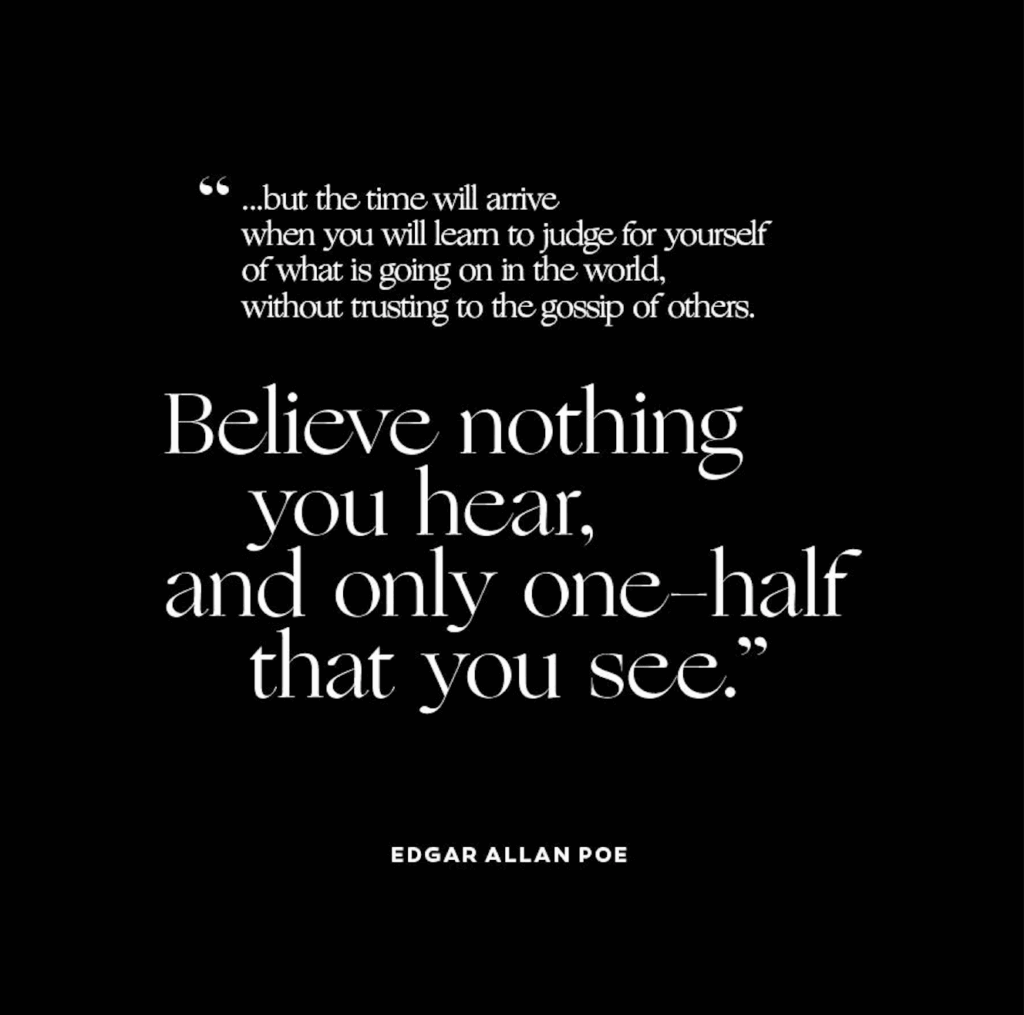
My father gave me that advice when I was a boy still learning to trust the world. “JR,” he said (short for Anthony Jr.), “believe nothing you hear, and only half of what you see.” I didn’t understand it then. I thought truth was obvious and justice inevitable. But as I got older, as life broke me down and built me back in ways I never expected, those words became my anchor.
I grew up in the long, complicated shadow of a Green Beret hero. My father was the kind of man little boys want to become, and grown men feel unworthy to follow. I spent my life trying to live up to his ideals—of duty, honor, country, family, courage—and paid a high price when I couldn’t.
I served my country–I wore the uniform. And later, I was a soldier and a healer. But under the surface, I was unraveling. Crushed by trauma I didn’t yet understand. Haunted by what I saw, by what I didn’t see, and worst of all, by what others chose to believe.
There’s a moment in every man’s life when he realizes the truth doesn’t always win. That moment came for me like a whisper—a rumor. One lie was enough to destroy a reputation I spent decades building. And it wasn’t the first. It wouldn’t be the last.
I’ve been judged for things I didn’t do. Lost friends, careers, my peace of mind. I’ve walked into rooms where the air went still. I’ve watched good people turn away because they heard something. That’s why I live by my father’s words now more than ever.
This memoir is not just about service—it’s about shame. It’s about how the system fails, how silence protects the wrong people, and how strength sometimes means learning to survive in your own skin.
I’m telling this story not to clear my name, but to reclaim my life. To show that even in the aftermath of lies, there is still truth worth telling—and a man still worth knowing.
So read what follows with open eyes. And remember what my father said.